

Trading
Explore a wide range of markets with competitive pricing, deep liquidity, and advanced trading tools.
Learn More 
Platform
Trade seamlessly with TMGM's powerful platform, built for speed, precision, and a superior trading experience.
Learn More Trading Platform
Academy
Learn the fundamentals of trading with beginner-friendly resources, including guides, webinars, and market insights.
Learn More News & Analysis
Get real-time market updates and expert analysis to stay ahead of trading opportunities
Learn More News & Analysis
About
Learn what sets TMGM apart — our global presence, regulatory strength, and commitment to innovation in trading.
Learn More Why Choose TMGM
Sponsorship
US Dollar Index Price Forecast: Could the Rally Extend Towards 104.60?
- Can the US Dollar Index sustain its rally after a mild pullback from a fresh 19-month high near 104.00?
- Further USD Index gains towards 104.60 remain ING’s expectation as hawkish Fed bets lend support.
- An unwinding of the AI trade could leave the US Dollar vulnerable to corrections, Commerzback warns.
A modest pullback in the US Dollar (USD) has interrupted the sharp gains recorded over the past few weeks. At the time of writing, the USD Index stands near 103.81, down 0.1% from the fresh 19-month peak of around 104.00 reached the previous day. The index tracks the Greenback against six major currencies.

How Has the US Dollar Performed This Week?
The US Dollar recorded its strongest performance against the Australian Dollar this week. Its percentage moves against the major currencies listed are set out in the table below.
| USD | EUR | GBP | JPY | CAD | AUD | NZD | CHF | |
|---|---|---|---|---|---|---|---|---|
| USD | 0.47% | 0.82% | -0.35% | 0.47% | 1.65% | 0.60% | 0.39% | |
| EUR | -0.47% | 0.33% | -0.79% | -0.02% | 1.16% | 0.09% | -0.12% | |
| GBP | -0.82% | -0.33% | -1.09% | -0.36% | 0.85% | -0.25% | -0.45% | |
| JPY | 0.35% | 0.79% | 1.09% | 0.68% | 1.94% | 0.82% | 0.72% | |
| CAD | -0.47% | 0.02% | 0.36% | -0.68% | 1.29% | 0.14% | -0.09% | |
| AUD | -1.65% | -1.16% | -0.85% | -1.94% | -1.29% | -1.06% | -1.28% | |
| NZD | -0.60% | -0.09% | 0.25% | -0.82% | -0.14% | 1.06% | -0.21% | |
| CHF | -0.39% | 0.12% | 0.45% | -0.72% | 0.09% | 1.28% | 0.21% |
Percentage movements between the major currencies are displayed in the heat map. Read the base currency from the left-hand column and the quote currency from the top row. For instance, selecting the US Dollar on the left and following its row across to the Japanese Yen gives the percentage change for USD (base)/JPY (quote) in the corresponding cell.
Confidence among traders that the Federal Reserve (Fed) will raise interest rates in the near term continues to underpin a strong US Dollar outlook, with inflationary pressures still building.
Can a firmer FOMC rate path keep the Dollar supported?
Markets are now “quite settled on pricing 25bp hikes in December, January and next summer.” ING strategists place this pricing alongside the latest FOMC minutes, which indicated that only a “couple” of Fed officials favoured a quicker tightening pace at the October meeting.
ING’s assessment of that backdrop is that “there are good reasons for the dollar to be at current levels,” while its directional view remains that “DXY advancing to the 104.60 area remains our bias for now.”
Commerzback takes a more cautious view than ING: as inflows into Artificial Intelligence (AI) stocks slow, it flags the risk of a US Dollar correction.
Could an AI-flow reversal undermine Dollar support?
The capital inflows linked to AI that have recently supported the Dollar also carry risks, according to Commerzbank analysts. They warn that “if growing doubts about the sustainability of the AI boom were to trigger a sharper correction in US equity markets, a reversal of these capital flows could also hit the dollar hard.” However, their assessment is qualified by the view that “we consider an abrupt end to the AI build-out unlikely,” meaning a sudden collapse in the AI narrative is not their base case, even though a sharp reassessment of the theme could leave the currency exposed.
US Dollar Index Technical Analysis: Can the Uptrend Hold?
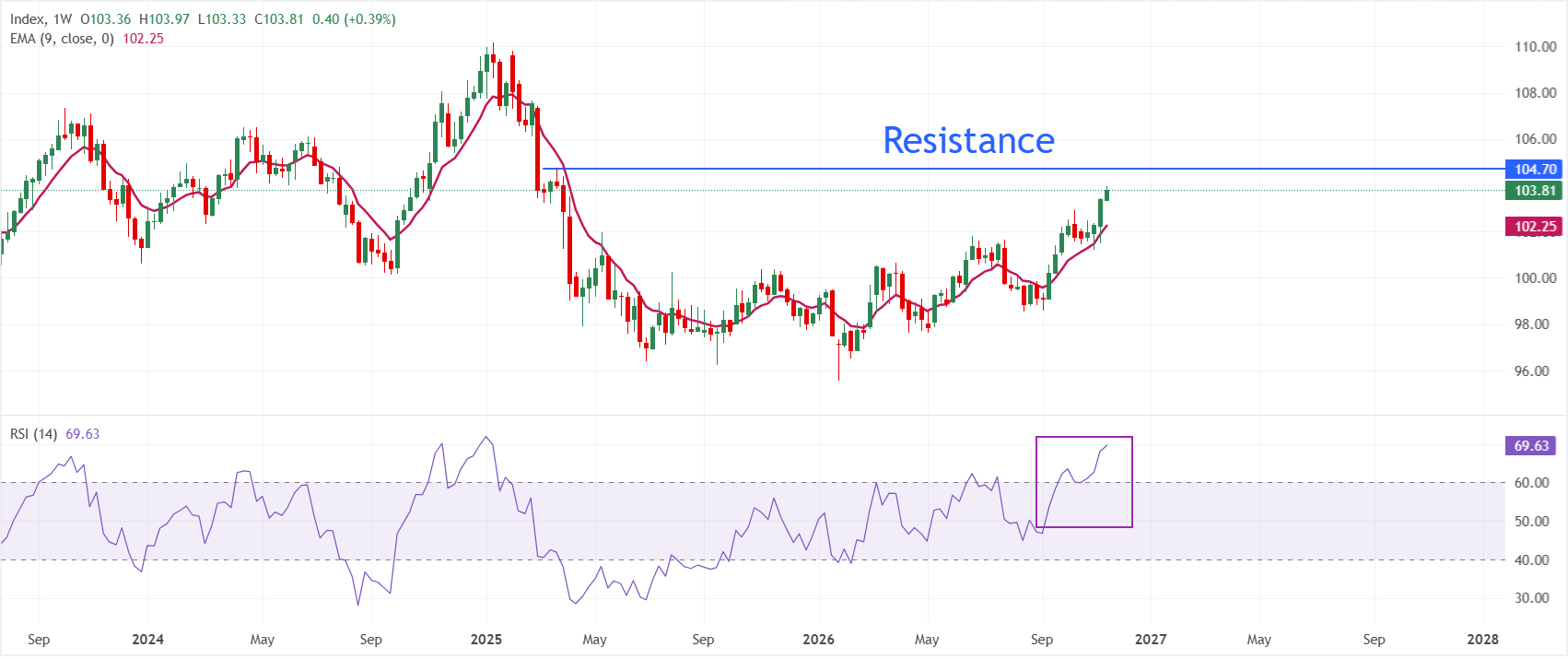
With Dollar Index Spot at 103.81 on the weekly chart, the near-term technical outlook continues to favour the bulls. Trading above the nine-period exponential moving average (EMA) of 102.25 provides firm support for the recent rally. Meanwhile, a Relative Strength Index (RSI) reading of 69.63 is close to overbought territory: upward momentum remains robust, but is looking increasingly stretched.
The nine-week EMA near 102.25 marks the first support on a decline, and a retreat towards it could draw dip-buying interest as long as that level holds. Bullish pressure would show signs of weakening on a weekly close beneath the average. Conversely, continued trading above it would preserve the wider uptrend, even if momentum eases from the current elevated RSI readings.
For further gains, the index faces a key barrier at 104.70, a level close to ING's forecast.
(The technical analysis of this story was written with the help of an AI tool. Know more.)
US Dollar: Common Questions
As the official currency of the United States of America, the US Dollar (USD) also circulates alongside domestic banknotes in a substantial number of other countries, where it serves as the ‘de facto’ currency. No other currency is traded as heavily worldwide. According to 2022 data, it accounts for over 88% of global foreign exchange turnover, equivalent to average daily transactions of $6.6 trillion. The USD replaced the British Pound as the world’s reserve currency after the Second World War. Gold backed the US Dollar for most of its history, until the Gold Standard ended with the Bretton Woods Agreement in 1971.
Monetary policy set by the Federal Reserve (Fed) is the single biggest influence on the US Dollar’s value. Adjustments to interest rates are the Fed’s main means of meeting its two mandates: maintaining price stability by controlling inflation and promoting full employment. If prices climb too rapidly and inflation exceeds the Fed’s 2% target, the central bank will increase rates, supporting the USD. By contrast, inflation below 2% or an excessively high Unemployment Rate may prompt the Fed to cut rates, putting pressure on the Greenback.
When conditions become extreme, quantitative easing (QE) gives the Federal Reserve another option: printing additional Dollars to substantially expand the supply of credit in a stalled financial system. This unconventional policy is deployed when credit dries up as banks refuse to lend to one another for fear of counterparty default. If interest rate cuts alone are unlikely to deliver the required outcome, QE serves as a last resort. During the Great Financial Crisis in 2008, it was the Fed’s preferred response to the credit crunch. Under QE, newly printed Dollars are used by the Fed to purchase US government bonds, mainly from financial institutions. The usual effect is a weaker US Dollar.
The opposite approach, quantitative tightening (QT), generally supports the US Dollar. Under QT, the Federal Reserve halts bond purchases from financial institutions and refrains from reinvesting the principal received when bonds in its portfolio mature into further purchases.
POPULAR ARTICLES
1US Dollar Index Price Forecast: Could the Rally Extend Towards 104.60?2Euro records modest gains within range after German factory inflation runs hot3Indian Rupee: Further gains expected on RBI tightening – Commerzbank4XRP below $1.00: Can legal clarity, payment utility and ETFs make a difference as markets turn risk-off?5Upbeat UK Retail Sales lift British Pound modestly as firmer JPY restrains recovery6Middle East attacks put upward pressure on WTI despite forecasts of record supply7Equities: Global stocks dragged lower by widening tech losses - Danske Bank8Better-than-expected UK sales help British Pound extend recovery from yearly lows9Forex Today: Why is Gold sliding towards $3,500 despite a US Dollar retreat?

Get Started!
Sign up and access the Global Markets in less than 3 minutes

Connect With Us









Contacts
Phone: +61 2 8036 8388
Fax: +61 2 8036 8388
Email: support@tmgm.com



The information provided on this website is of a general nature only and does not constitute personal financial advice. Before acting on any information on this website, you should consider the suitability of the information in relation to your objectives, financial situation and needs. Investing in CFDs and FX Margin Contracts carries significant risks and is not suitable for all investors. You may lose more than your initial deposit. You do not own, or have, any interest in the underlying asset. We recommend that you seek independent advice and ensure you fully understand the risks involved before trading. It is important that you read and consider the disclosure document before you acquire any product listed on the website. The information and advertisements offered on this website are not intended for use by any person in any country or jurisdiction where such use would be contrary to local laws and regulations. The Products and Services offered on this website are not intended for residents of the United States, Malaysia and Thailand.
TMGM is authorized and regulated in various jurisdictions.
Trademax Australia Limited, trading as TMGM, is regulated by the Australian Securities and Investments Commission (ASIC), AFSL no. 436416 and is located at Level 28, One International Tower, 100 Barangaroo Avenue, 2000 Sydney, NSW Australia.
Email: support@tmgm.com.au
Trademax Global Limited, trading as TMGM, is authorized and regulated by the Vanuatu Financial Services Commission (VFSC), registration number 40356 and registered at 1276, Kumul Highway, Port Vila, Vanuatu, Republic of Vanuatu.
Email: support@tmgm.com
Trademax Global Markets (SE) Limited, trading as TMGM, is authorized and regulated by the Financial Services Authority (FSA) of Seychelles, with license number SD224. The company is registered at Office No 13, Providence Estate ABIS Centre, Mahe, Seychelles.
Email: support@tmgm.com
Trademax Global Markets (International) Pty Ltd, trading as TMGM, is authorized and regulated by the Financial Services Commission, Mauritius (FSC) with license no. GB22201012, and registered at 33, Edith Cavell Street C/o IQ EQ Fund Services (Mauritius) Ltd Port Louis, 11324 Mauritius.
Email: support@tmgm.com
Copyright © TMGM. All rights reserved