

Trading
Explore a wide range of markets with competitive pricing, deep liquidity, and advanced trading tools.
Learn More 
Platform
Trade seamlessly with TMGM's powerful platform, built for speed, precision, and a superior trading experience.
Learn More Trading Platform
Academy
Learn the fundamentals of trading with beginner-friendly resources, including guides, webinars, and market insights.
Learn More News & Analysis
Get real-time market updates and expert analysis to stay ahead of trading opportunities
Learn More News & Analysis
About
Learn what sets TMGM apart — our global presence, regulatory strength, and commitment to innovation in trading.
Learn More Why Choose TMGM
Sponsorship
XRP below $1.00: Can legal clarity, payment utility and ETFs make a difference as markets turn risk-off?
Selling pressure continues to weigh on Ripple (XRP), despite a gain of less than 1% on Friday that has taken the token close to $0.97. The price remains within a six-week decline to levels last recorded in November 2024. At roughly 73% below its record high of $3.66, set in July 2025, XRP has suffered a steeper fall than most leading cryptocurrencies. This is despite an impressive mix of strengths: regulatory clarity in the United States (US), rapid expansion of the Ripple Payments network, the institutional-grade stablecoin RLUSD, strategic acquisitions and partnerships, and the November 2025 launch of XRP spot Exchange-Traded Funds (ETFs).
Those who entered at the peak are nursing severe losses. The contrast is difficult to ignore: robust fundamentals, spot ETFs, legal certainty, the Securities and Exchange Commission (SEC) settlement and wider global use through Ripple Payments infrastructure have not arrested the decline. What, then, explains the price collapse?
A straightforward explanation may be difficult to accept: macro liquidity almost always outweighs fundamentals. When money leaves an asset class, regulatory certainty, increased utility and institutional investment products typically carry much less weight.
How are macro headwinds and a hawkish Fed weighing on XRP?
Losses across the wider crypto market provide the backdrop to XRP’s continuing collapse. Several forces are at work, led by a hawkish shift at the Federal Reserve (Fed) that is pulling liquidity out of risk assets at an alarming pace.
Hopes of monetary easing were dented by October’s US inflation figures, even though the Fed kept interest rates steady at 3.75-4.00%. The Consumer Price Index (CPI) advanced 0.4% MoM in October, exceeding the market forecast of 0.3%. Excluding volatile food and energy prices, core CPI increased 0.3%, against an expected 0.2%. Meanwhile, Producer Price Index (PPI) inflation reached 6.5% YoY in October, its highest reading since November 2022.
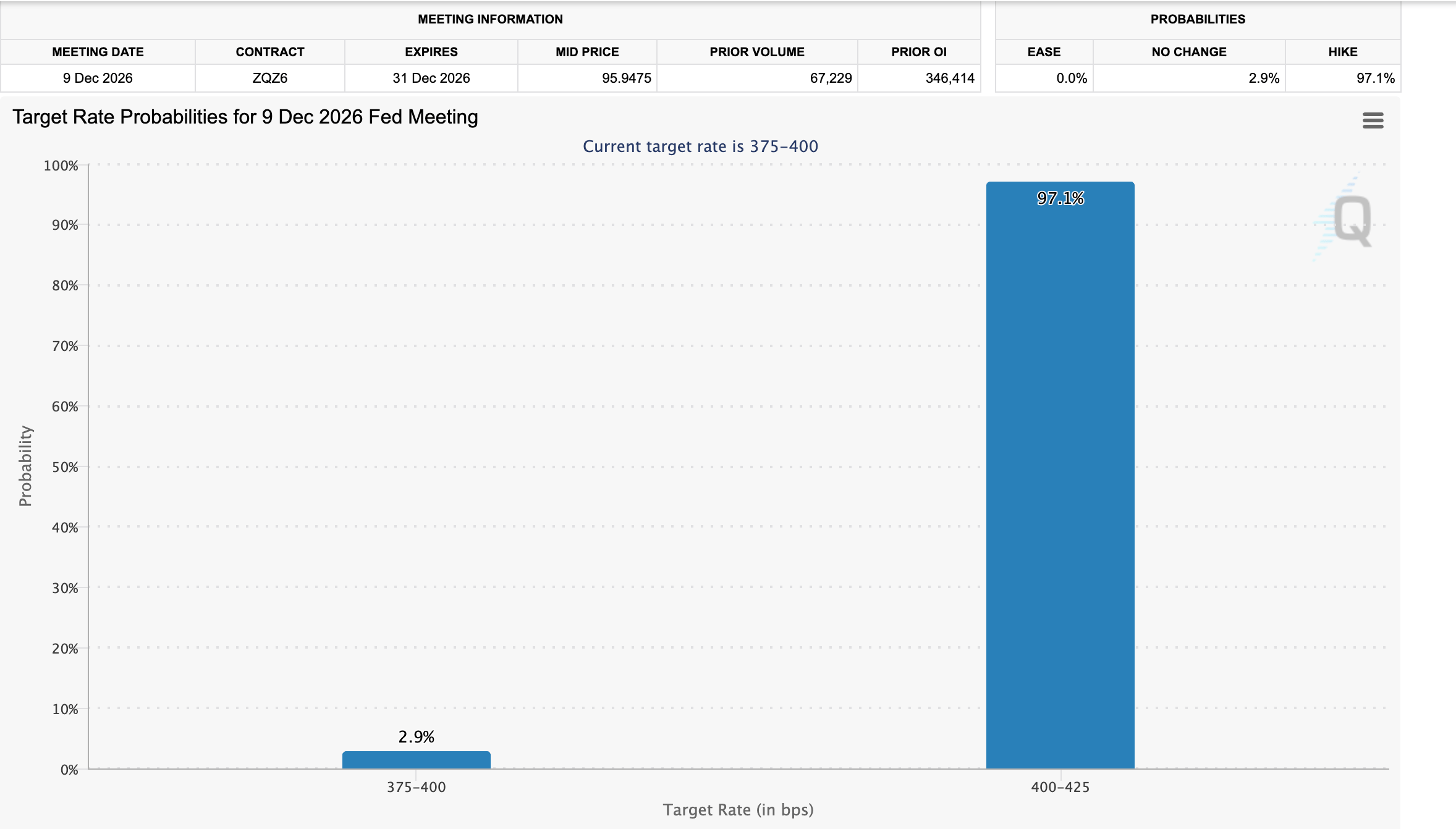
According to the CME FedWatch tool, derivatives markets now price in a roughly 97% probability of a 25 basis point Fed rate increase at the forthcoming December meeting, which would lift the range to 4.00-4.25%.
Persistent risk aversion also reflects the recent Binance hack, which affected assets worth approximately $6.3 billion. To safeguard customers, Binance absorbed the full loss through its own assets and an internal insurance fund programme. Nevertheless, investors have not forgotten the incident, and a return to normality could take time.
Another driver of the risk-off mood is capital flight. The 10-year US Treasury yield, for example, recently rose to 5.14%, a level last seen in 2007, suggesting that traders were adjusting their interest rate expectations. With relatively low-risk Treasury bills offering yields above 5%, investors also have less reason to accept the volatility of crypto assets.
Spot ETF flows offer a clear measure of the retreat. Outflows from Bitcoin (BTC) spot ETFs reached $1.07 billion during the week ending November 13. For November alone, cumulative outflows so far average $2.35 billion. Spot ETFs tracking Ethereum (ETH) lost $399 million over the same week, taking total November withdrawals to $764 million.
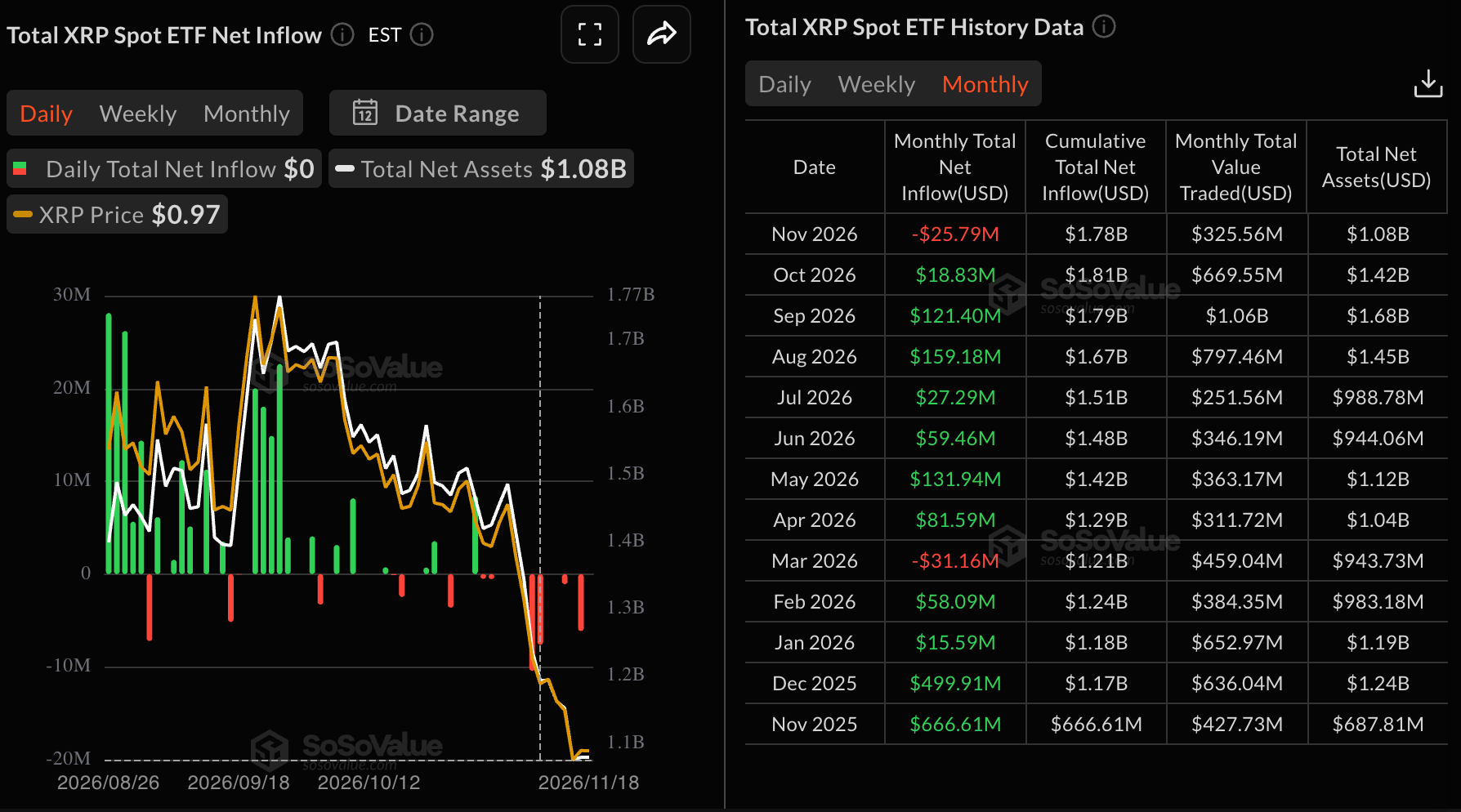
For XRP spot ETFs, outflows averaged $19 million over the week ending November 13. Cumulative withdrawals this week through Wednesday stand at $6 million, while November’s total is $26 million, weakening institutional demand.
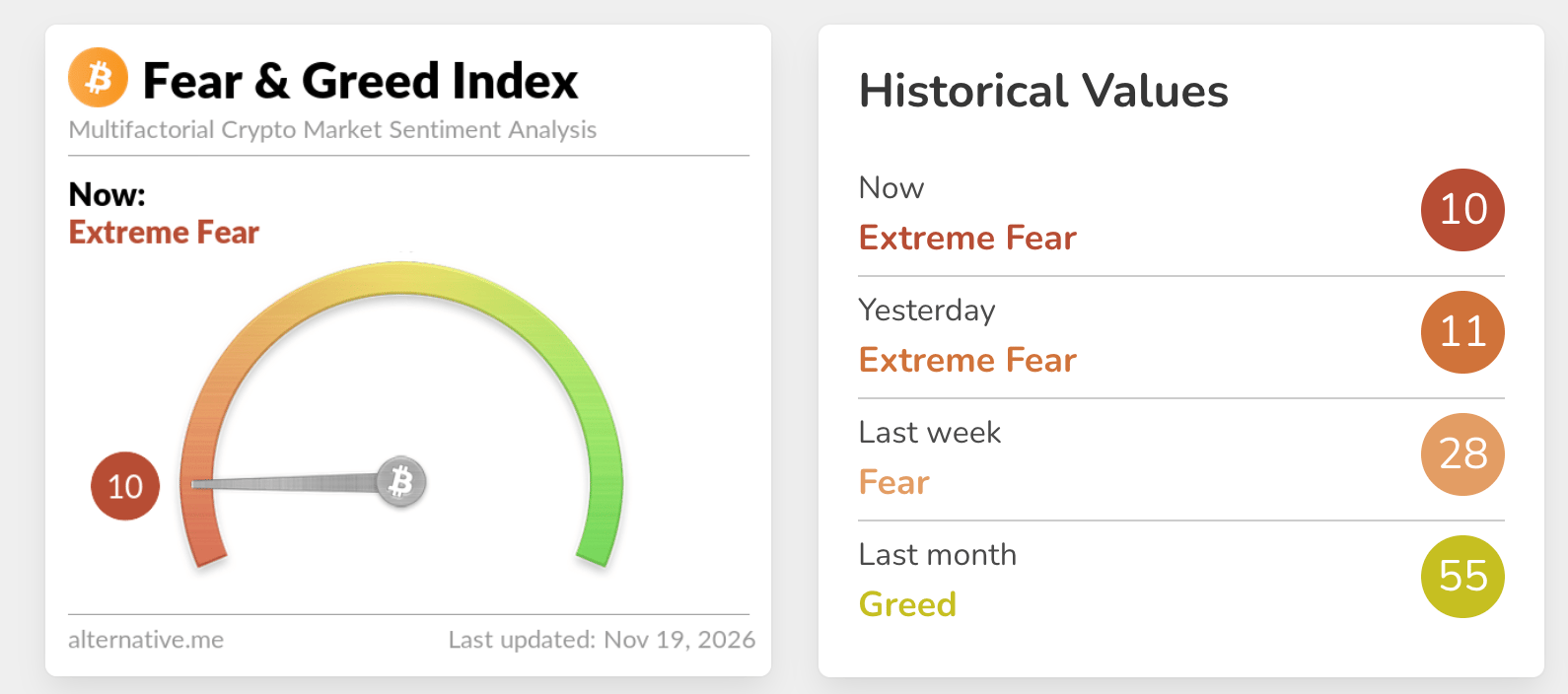
On Thursday, the Fear & Greed Index dropped to 10, within Extreme Fear territory. The reading was only marginally below the previous day’s 11, pointing to weak appetite across crypto assets.
Against this macroeconomic backdrop, XRP has nevertheless fallen much more sharply than its peers.
November’s sell-off swept through the entire cryptocurrency market, but XRP ranks among the worst performers. A weekend fall to $0.89, its weakest level since November 2024, extended the monthly loss to around 29%. A modest rebound subsequently carried the token towards $1.00 before it eased back to $0.97.
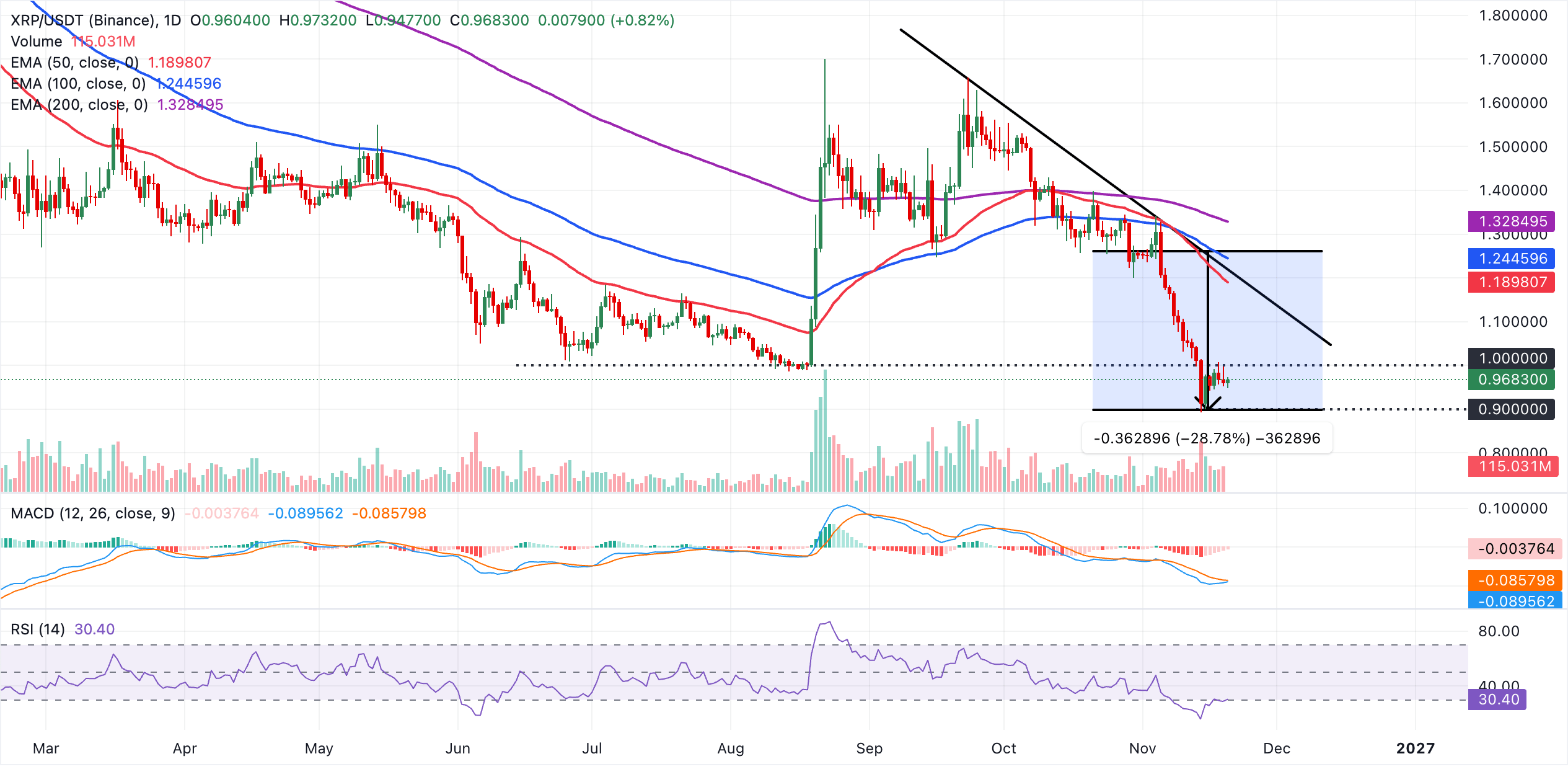
From its July 2026 peak of $3.66, XRP has lost around 73%. An analysis published by CoinDesk on October 16 observes that “XRP has failed to make holders rich like Bitcoin and Ether.”
Why is XRP lagging behind its ecosystem’s growth?
Despite the strongest fundamentals in its ecosystem’s history, XRP continues to face relentless corrections. Ripple spent years contesting the US Securities and Exchange Commission (SEC) lawsuit brought in 2020. It secured a partial victory when XRP sales through third-party platforms, including exchanges, were found not to constitute securities. An August 2025 settlement then brought the case to a close, with Ripple paying a $125 million penalty over direct sales to institutional clients.
Much-needed regulatory certainty followed in March 2026, when the SEC and the Commodity Futures Trading Commission (CFTC) moved to publish a joint interpretation identifying XRP as a “digital commodity,” rather than a security.
A further affirmation of XRP’s commodity status came in September 2026, as regulators cleared a rule change allowing Nasdaq Texas to list XRP commodity trust shares. Yet the token lost approximately 60% between January and November, despite gaining the regulatory standing Ripple had fought fiercely to secure through years of litigation.
The implication is that removing regulatory obstacles to investment may still fail to generate sustained demand. Institutional participation and exposure are required, but they are not enough, particularly when markets turn risk-averse. In such conditions, investors are either looking for stability in Treasuries or raising their exposure to the booming Artificial Intelligence (AI) market.
For the US-based blockchain company, Ripple USD (RLUSD) has been a notable success. The regulated stablecoin, aimed at institutions and officially launched in December 2024, ranked seventh among stablecoins in November, with a market capitalisation of $2.8 billion. While the broader sector contracts, the token has continued to expand, adding around $102 million over the past week. Strategic partnerships have supported RLUSD adoption. An October agreement with Cross River Bank opened access to thousands of financial institutions, while the same month’s tie-up with DriveWealth enables RLUSD to support settlement for more than 100 brokerages. Institutional custody for RLUSD is available through Standard Chartered in Dubai. Robinhood RLUSD, meanwhile, launched in October on the Robinhood chain and Bitstamp. A strategic investment by Ripple in Flutterwave in June also positioned the network for payment corridors in Africa.
For now, however, RLUSD’s achievements neither strengthen nor affect XRP’s prospects. Their direct link is instead to Ripple Lab’s revenue, leaving XRP holders alienated. More enterprises are holding RLUSD without any need for XRP. Stablecoin transactions earn fees for the company but do not generate XRP demand. For Ripple, this represents a strategic investment rather than an XRP catalyst.
Strategic acquisitions totalling a substantial $2.7 billion are also turning Ripple into a conglomerate in its own right. Its ambitions indicate a shift towards building a financial services empire.
The acquisition of Hidden Road, since renamed Ripple Prime, was completed for $1.25 billion in October 2025. According to a CoinDesk report, Ripple bought GTreasury for $1 billion in December. The corporate treasury platform serves more than 1,000 clients and handles at least $13 trillion in annual transaction volume. These purchases follow the August 2025 acquisition of stablecoin platform Rail for $200 million.
As with RLUSD, revenue from these acquisitions accrues to Ripple. The profits remain within the company, benefiting Ripple Labs and its shareholders.
Does payment liquidity translate into XRP demand?
Designed as a bridge currency for cross-border payments, XRP continues to function within the architecture Ripple created for it. The network has steadily broadened its payment liquidity presence across jurisdictions worldwide. Strategic tie-ups with financial institutions and payment processors have also sought to demonstrate that the technology delivers.
At its core, though, XRP serves mainly as a monetary bridge rather than a store of value. Consider a bank using RippleNet to send a payment from the US Dollar (USD) to the Euro (EUR): it is likely to hold XRP for just three to four seconds while the transaction takes place. Instead of building XRP reserves, the bank converts the funds straight into fiat, avoiding the volatility associated with holding crypto. From the perspective of institutional users, at least, this utility model does little to generate demand or encourage accumulation.
Supply dynamics present another challenge. According to CoinGecko, XRP’s circulating supply has risen from roughly 38.7 billion tokens in the 2017-2018 bull market to approximately 63.5 billion today. That 64% expansion in less than eight years dilutes the tokens’ notional value.
A greater concern is that Ripple Labs continues to hold approximately 31.1 billion XRP locked in ledger escrow accounts. Ripple releases tokens periodically and sometimes makes substantially less available than the approved monthly batch. Even so, the potential supply creates psychological resistance, as investors know that additional tokens could swell the amount currently in circulation.
Compared with its peers, XRP has a less compelling utility proposition. Bitcoin has achieved institutional adoption as a store of value and digital gold. Ethereum’s (ETH) liquidity, by contrast, draws on its extensive smart contract platform, Decentralized Finance (DeFi) ecosystem and non-fungible token (NFT) marketplaces.
Conclusion: Does holding XRP still make sense?
For XRP holders facing the continuing sell-off, I suspect few questions are more pressing: is it better to stay invested or cut their losses?
There is no universal answer, but I will set out a balanced framework for investors prepared to work through that decision.
The macroeconomic pressures have not eased. With US inflation proving sticky, the Fed is widely expected to raise rates in December and maintain elevated borrowing costs in the near term. That leaves fewer catalysts for a shift towards risk-taking in crypto and other digital assets.
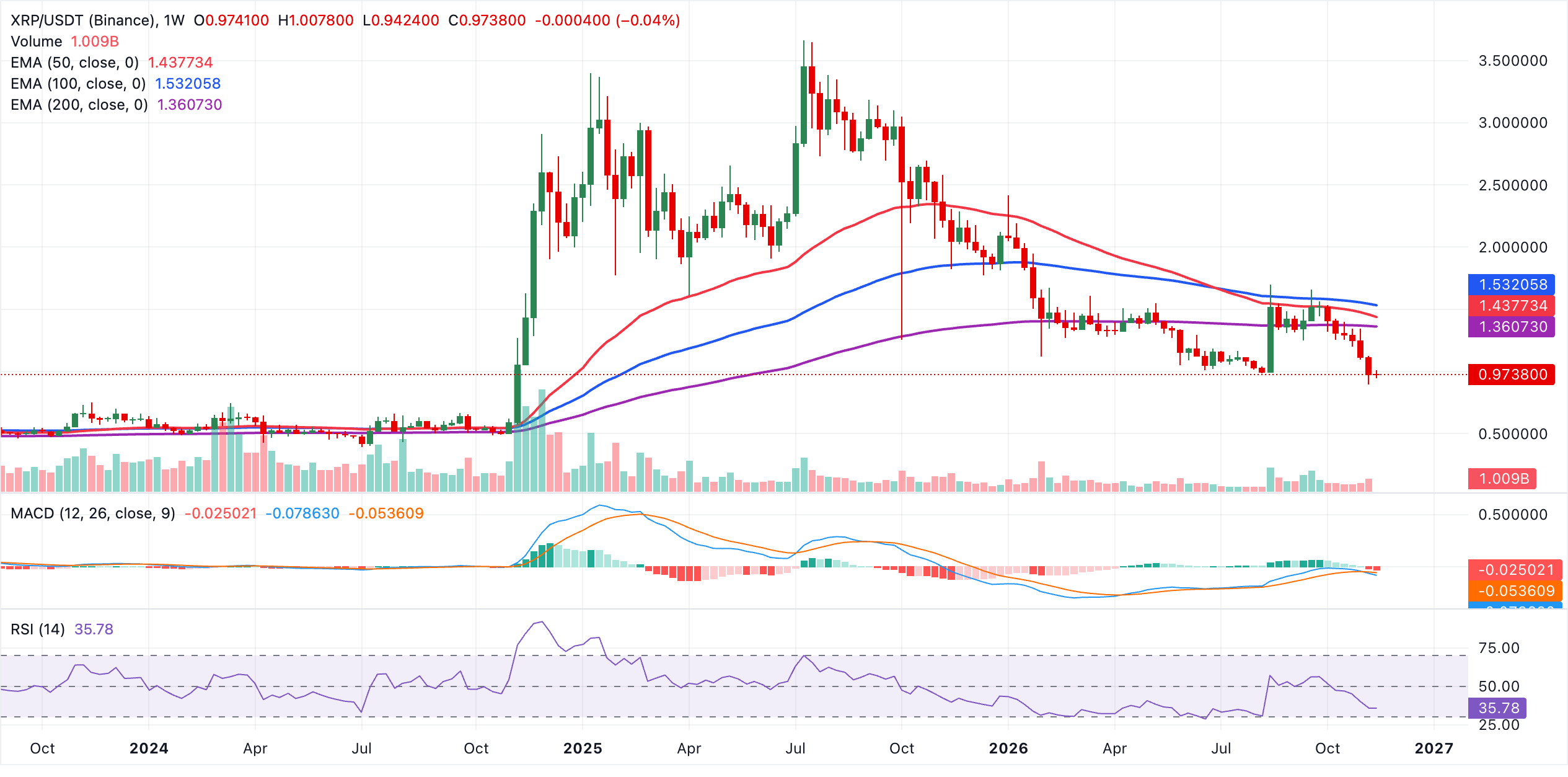
From a technical standpoint, XRP’s structure is weak and, in some respects, broken. Trading is below the important 50-week, 100-week and 200-week Exponential Moving Averages (EMAs). After the token touched $0.89 in November, there is no indication of immediate technical support.
A year after launch, subscriptions to XRP spot ETFs remain substantially below those of Bitcoin and Ethereum ETFs. Cumulative inflows are close to $1.8 billion, against net assets under management of $1.1 billion. November’s monthly outflows so far average $26 million, marking the first withdrawal since March 2026.
The bullish argument, on the other hand, remains valid. It rests on XRP’s legal certainty, RLUSD’s growth, the expansion of Ripple’s enterprise infrastructure and ETF inflows that are still positive at $1.8 billion. Deeply oversold conditions and a reduction in overleveraged long orders also leave room for a potential recovery. Longer-term investors, moreover, are likely to retain their holdings, limiting the supply available for sale on the open market.
At the heart of XRP’s crisis lies a contradiction. Through partnerships, acquisitions and strategic expansion, Ripple is constructing global financial services infrastructure. XRP, however, is missing the utility, demand and potential revenue-sharing models that token holders need.
Ultimately, whether to retain or sell the token depends on each investor’s tolerance for risk and confidence in XRP and its ecosystem.
Common questions about Ripple
Specialising in cross-border remittances, payments company Ripple uses blockchain technology to move funds. Ripple Labs Inc. created RippleNet as a payment transfer network accessible to financial institutions around the world. The company also makes use of the XRP token.
The decentralised XRPLedger blockchain has XRP as its native token. Ripple Labs uses XRP to enable transactions on the XRPLedger, allowing financial institutions to transfer value across borders. By supporting instant, trustless payments on the XRPLedger chain, XRP helps financial firms reduce the cost of transactions worldwide.
Built on distributed ledger technology and blockchain, XRPLedger uses XRP to power transactions. Unlike other blockchains, the ledger incorporates an inflammatory protocol designed to counter spam and distributed denial-of-service (DDOS) attacks. A peer-to-peer network called the global XRP Ledger community maintains XRPL.
The interledger standard used by XRP is a blockchain protocol that enables payments between different networks. XRP’s blockchain, for example, can link the ledgers of two or more banks, effectively eliminating intermediaries and the need for a centralised system. Jed McCaleb, Arthur Britto and David Schwartz engineered the XRPLedger blockchain, whose native token is XRP.
POPULAR ARTICLES
1Yemen’s Hodeidah port comes under attack from Saudi-led coalition2Australian Dollar regains 0.6600: What will the crucial RBA inflation test bring?3Gold Retreats Towards $3,550 as Markets Await US PCE Inflation Data4New Zealand Dollar meets US inflation data near its 2026 low5Yen stays below 160.00 as markets await Tokyo CPI on a US holiday6Softer core inflation and Fed hike threat send Mexican Peso sharply lower7Euro recovers from a 19-month low as ECB minutes and US inflation data approach8What will US inflation data bring for the Pound after its return above 1.31?9Could BTC fall to $53,200 as Bitcoin realised losses reach FTX-era levels?


Get Started!
Sign up and access the Global Markets in less than 3 minutes

Connect With Us









Contacts
Phone: +61 2 8036 8388
Fax: +61 2 8036 8388
Email: support@tmgm.com



The information provided on this website is of a general nature only and does not constitute personal financial advice. Before acting on any information on this website, you should consider the suitability of the information in relation to your objectives, financial situation and needs. Investing in CFDs and FX Margin Contracts carries significant risks and is not suitable for all investors. You may lose more than your initial deposit. You do not own, or have, any interest in the underlying asset. We recommend that you seek independent advice and ensure you fully understand the risks involved before trading. It is important that you read and consider the disclosure document before you acquire any product listed on the website. The information and advertisements offered on this website are not intended for use by any person in any country or jurisdiction where such use would be contrary to local laws and regulations. The Products and Services offered on this website are not intended for residents of the United States, Malaysia and Thailand.
TMGM is authorized and regulated in various jurisdictions.
Trademax Australia Limited, trading as TMGM, is regulated by the Australian Securities and Investments Commission (ASIC), AFSL no. 436416 and is located at Level 28, One International Tower, 100 Barangaroo Avenue, 2000 Sydney, NSW Australia.
Email: support@tmgm.com.au
Trademax Global Limited, trading as TMGM, is authorized and regulated by the Vanuatu Financial Services Commission (VFSC), registration number 40356 and registered at 1276, Kumul Highway, Port Vila, Vanuatu, Republic of Vanuatu.
Email: support@tmgm.com
Trademax Global Markets (SE) Limited, trading as TMGM, is authorized and regulated by the Financial Services Authority (FSA) of Seychelles, with license number SD224. The company is registered at Office No 13, Providence Estate ABIS Centre, Mahe, Seychelles.
Email: support@tmgm.com
Trademax Global Markets (International) Pty Ltd, trading as TMGM, is authorized and regulated by the Financial Services Commission, Mauritius (FSC) with license no. GB22201012, and registered at 33, Edith Cavell Street C/o IQ EQ Fund Services (Mauritius) Ltd Port Louis, 11324 Mauritius.
Email: support@tmgm.com
Copyright © TMGM. All rights reserved