

Trading
Explore a wide range of markets with competitive pricing, deep liquidity, and advanced trading tools.
Learn More 
Platform
Trade seamlessly with TMGM's powerful platform, built for speed, precision, and a superior trading experience.
Learn More Trading Platform
Academy
Learn the fundamentals of trading with beginner-friendly resources, including guides, webinars, and market insights.
Learn More News & Analysis
Get real-time market updates and expert analysis to stay ahead of trading opportunities
Learn More News & Analysis
About
Learn what sets TMGM apart — our global presence, regulatory strength, and commitment to innovation in trading.
Learn More Why Choose TMGM
Sponsorship
Euro recovers from a 19-month low as ECB minutes and US inflation data approach
- Can EUR/USD sustain its recovery from below 1.0900, its weakest level since April 2025?
- Renewed concerns over AI stocks see the Dollar Index surrender Monday's advance.
- Wednesday's US PCE release precedes Thursday's account of the ECB's October meeting.
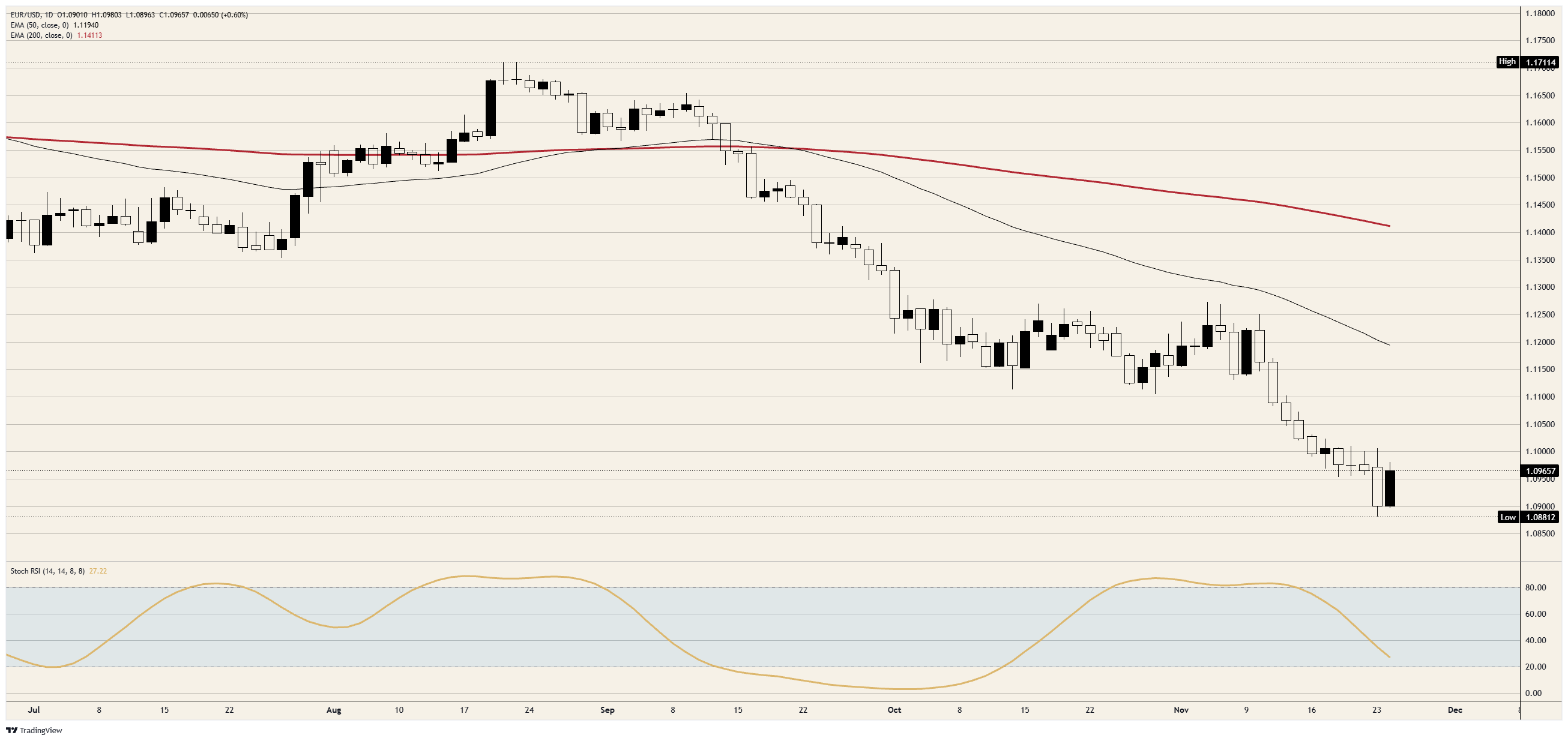
The Euro has recovered from a 19-month trough as the Dollar Index unwinds almost all of Monday's advance to its highest level since April 2025. Having slipped just below 1.0900, EUR/USD reversed course. The pair is now changing hands just above 1.0950, with its recovery having stalled below 1.1000.

Monday's gains in US equities and the Dollar followed Nvidia (NVDA) bringing back Chief Executive Huang. The boost proved short-lived: fresh declines in Nvidia and other artificial intelligence (AI) stocks weighed on the Dollar and supported the Euro. Nevertheless, the interest-rate differential behind the Euro's slide to its low remains intact, with markets still pricing in more than a 95% chance of the Fed's December 9 hike.
Expectations of further European Central Bank (ECB) tightening have offered little support to the Euro, as US interest rates remain higher and markets anticipate the Fed moving first. Two more quarter-point ECB hikes are priced in by March 2027, following two this year. Against this backdrop, November business activity across the euro area was largely flat. France's downturn intensified amid continuing political and budget disagreements, while Germany's private sector expanded at its quickest pace since 2022. That German improvement came in November, the same month in which the Euro touched a 19-month low.
Which releases could shape rate expectations?
Pricing for the Fed's December and January meetings will take cues first from US data. Scheduled for 13:30 GMT on Wednesday are October's Personal Consumption Expenditures Price Index (PCE) and the revised third-quarter Gross Domestic Product (GDP) estimate. The releases arrive a day before US markets close for Thanksgiving.
For the ECB's December 17 decision, markets will draw on the account of its October 29 meeting, due at 12:30 GMT on Thursday, and Friday's flash November inflation readings from France and Spain. Speaking on November 7, ECB President Lagarde said she could not promise a hike on December 17.
What does the Euro's chart show?
Having lost about 9% from its January peak just below 1.2100, the Euro sits roughly 200 pips beneath 1.1100. That level provided support for six weeks through November 11. Meanwhile, the 50-day Exponential Moving Average (EMA), just below 1.1200, remains under the 200-day average, which stands just above 1.1400. The shorter-term average has traded below its longer-term counterpart since mid-September.
EUR/USD: daily price chart
Euro: key questions answered
Second only to the US Dollar in global trading activity, the Euro is used by the 20 European Union countries within the Eurozone. Its share of all foreign exchange transactions stood at 31% in 2022, when average daily turnover exceeded $2.2 trillion. Among currency pairs, EUR/USD leads global trading with an estimated 30% of all transactions. Next come EUR/JPY at 4%, EUR/GBP at 3% and EUR/AUD at 2%.
Based in Frankfurt, Germany, the European Central Bank (ECB) serves as the Eurozone's reserve bank, setting interest rates and overseeing monetary policy. Maintaining price stability is its core mandate, pursued by containing inflation or supporting growth. Changes to interest rates are its main policy instrument. The Euro generally benefits when rates are relatively high, or are expected to rise; the reverse also holds. Monetary policy is decided by the ECB Governing Council at eight meetings each year. The decision-makers comprise the heads of the Eurozone's national banks and six permanent members, among them ECB President Christine Lagarde.
For the Euro, a key economic measure is Eurozone inflation, tracked through the Harmonized Index of Consumer Prices (HICP). An inflation reading above expectations, particularly one exceeding the ECB's 2% target, requires the central bank to increase interest rates to regain control over prices. By making the region a more attractive destination for global investors' funds, interest rates that are relatively high compared with those elsewhere generally support the Euro.
The Euro can respond to economic releases because they provide a measure of the economy's health. GDP, Manufacturing and Services PMIs, employment figures and consumer sentiment surveys are among the indicators that can steer the single currency. Economic strength supports the Euro by drawing in more foreign investment. It may also prompt the ECB to raise interest rates, directly strengthening the currency. Weak economic readings, by contrast, are likely to weigh on the Euro. Particular weight is attached to figures from Germany, France, Italy and Spain. These four largest euro-area economies together represent 75% of the Eurozone's economy.
The Trade Balance is another release that matters for the Euro. Over a specified period, it records the gap between a country's export earnings and its spending on imports. Strong foreign demand for a country's exports generates additional demand for its currency as overseas buyers seek to purchase those goods, lifting the currency's value. A positive net Trade Balance therefore supports a currency, while a negative balance has the opposite effect.
POPULAR ARTICLES
1Euro recovers from a 19-month low as ECB minutes and US inflation data approach2What will US inflation data bring for the Pound after its return above 1.31?3Could BTC fall to $53,200 as Bitcoin realised losses reach FTX-era levels?4Dow Jones Industrial Average returns to 50,000 amid Nvidia-led tech decline5Ethereum Price Forecast: Tariff concerns pressure crypto as ETH drops below $1,7006Is Australia’s CPI likely to complicate the RBA’s task?7Chinese Yuan: Is upside against the US Dollar capped? – UOB8Forex Today: Australian inflation in focus ahead of a packed pre-Thanksgiving US calendar9Silver Price Forecast: Can $40 support hold as XAG/USD slides?


Get Started!
Sign up and access the Global Markets in less than 3 minutes

Connect With Us









Contacts
Phone: +61 2 8036 8388
Fax: +61 2 8036 8388
Email: support@tmgm.com



The information provided on this website is of a general nature only and does not constitute personal financial advice. Before acting on any information on this website, you should consider the suitability of the information in relation to your objectives, financial situation and needs. Investing in CFDs and FX Margin Contracts carries significant risks and is not suitable for all investors. You may lose more than your initial deposit. You do not own, or have, any interest in the underlying asset. We recommend that you seek independent advice and ensure you fully understand the risks involved before trading. It is important that you read and consider the disclosure document before you acquire any product listed on the website. The information and advertisements offered on this website are not intended for use by any person in any country or jurisdiction where such use would be contrary to local laws and regulations. The Products and Services offered on this website are not intended for residents of the United States, Malaysia and Thailand.
TMGM is authorized and regulated in various jurisdictions.
Trademax Australia Limited, trading as TMGM, is regulated by the Australian Securities and Investments Commission (ASIC), AFSL no. 436416 and is located at Level 28, One International Tower, 100 Barangaroo Avenue, 2000 Sydney, NSW Australia.
Email: support@tmgm.com.au
Trademax Global Limited, trading as TMGM, is authorized and regulated by the Vanuatu Financial Services Commission (VFSC), registration number 40356 and registered at 1276, Kumul Highway, Port Vila, Vanuatu, Republic of Vanuatu.
Email: support@tmgm.com
Trademax Global Markets (SE) Limited, trading as TMGM, is authorized and regulated by the Financial Services Authority (FSA) of Seychelles, with license number SD224. The company is registered at Office No 13, Providence Estate ABIS Centre, Mahe, Seychelles.
Email: support@tmgm.com
Trademax Global Markets (International) Pty Ltd, trading as TMGM, is authorized and regulated by the Financial Services Commission, Mauritius (FSC) with license no. GB22201012, and registered at 33, Edith Cavell Street C/o IQ EQ Fund Services (Mauritius) Ltd Port Louis, 11324 Mauritius.
Email: support@tmgm.com
Copyright © TMGM. All rights reserved