

Trading
Explore a wide range of markets with competitive pricing, deep liquidity, and advanced trading tools.
Learn More 
Platform
Trade seamlessly with TMGM's powerful platform, built for speed, precision, and a superior trading experience.
Learn More Trading Platform
Academy
Learn the fundamentals of trading with beginner-friendly resources, including guides, webinars, and market insights.
Learn More News & Analysis
Get real-time market updates and expert analysis to stay ahead of trading opportunities
Learn More News & Analysis
About
Learn what sets TMGM apart — our global presence, regulatory strength, and commitment to innovation in trading.
Learn More Why Choose TMGM
Sponsorship
Is Australia’s CPI likely to complicate the RBA’s task?
- October’s Australian Consumer Price Index is forecast to show annual inflation accelerating to its fastest pace in three years.
- The Reserve Bank of Australia is likely to face a difficult policy backdrop as persistent inflation coincides with mounting evidence of an economic slowdown.
- November is shaping up to deliver the Australian Dollar’s steepest monthly fall in years.
Expectations of a sharp rise in Australian inflation are in focus ahead of Wednesday’s October Consumer Price Index (CPI) release from the Australian Bureau of Statistics (ABS) at 00:30 GMT. Consensus forecasts put annual consumer price growth at 4.8%, the fastest rate since the 4.9% recorded in October 2023.

Heavy selling in the Australian Dollar (AUD) against the US Dollar (USD) forms the backdrop to the release. With investors increasingly positioning for a steeper monetary tightening cycle from the US Federal Reserve (Fed), AUD/USD has lost nearly 6% in November. By contrast, the Reserve Bank of Australia (RBA) is viewed as having finished raising rates and is expected to deliver at least one cut in 2027.
Will Australia’s inflation data deepen the RBA’s policy dilemma?
For RBA policymakers, Wednesday’s CPI release could complicate an already difficult backdrop. Maintaining inflation within the 2% to 3% band is the central bank’s primary objective. A reading of 4.8%, as forecast, would intensify pressure to raise borrowing costs further, even as the economic effects of the five rate increases implemented in 2026 begin to emerge.
Evidence of rapid labour market deterioration has come from economic releases over recent weeks: October’s Unemployment Rate climbed to 4.9%, while net employment declined by nearly 80K across the past two months.
Further signs of weakness emerged in preliminary S&P Global Purchasing Managers' Index (PMI) figures published earlier this week. Both services and manufacturing activity shrank in November at their fastest rates in years, together signalling weak Gross Domestic Product (GDP) growth in the year’s final quarter.
In the view of Rabobank strategists, the risks of waiting too long to address inflation are illustrated by Australia, which offers a “salient case study”. The RBA’s policy rate is “now 50bps above its peak during the Covid-19 inflation wave,” they point out. This, they suggest, may support Fed Governor Lisa Cook’s warning that “failure to do enough to tackle inflation in the short term may necessitate a harsher response in the future.”
Yet Rabobank’s experts also caution that the unemployment rate is “now above the RBA’s estimate of the non-accelerating inflation rate of unemployment (NAIRU) and perilously close to triggering the Sahm Rule recession indicator,” highlighting growing fears that monetary policy may be moving beyond restrictive settings into excessive tightening.
In its latest monetary policy statement, the RBA projected that inflation risks would remain tilted upwards over the coming months, while “tighter monetary policy is expected to keep GDP growth below potential”. A strong inflation print would therefore heighten worries over stagflation, a combination of elevated consumer prices, slowing growth and rising unemployment, and could add to pressure on the Aussie.
Could Australia’s Consumer Price Index release offer AUD/USD any relief?
A softer-than-forecast CPI print could offer some relief to RBA policymakers and modest support to the Aussie, whereas high inflation would present the serious policy challenge outlined above. Any support is likely to remain limited, however, since domestic factors alone do not explain the Australian Dollar’s steep losses.
Expectations of Fed tightening have driven broad-based US Dollar gains in recent weeks. A reversal in that trend appears unlikely while US economic releases continue to reinforce the narrative of US economic exceptionalism.
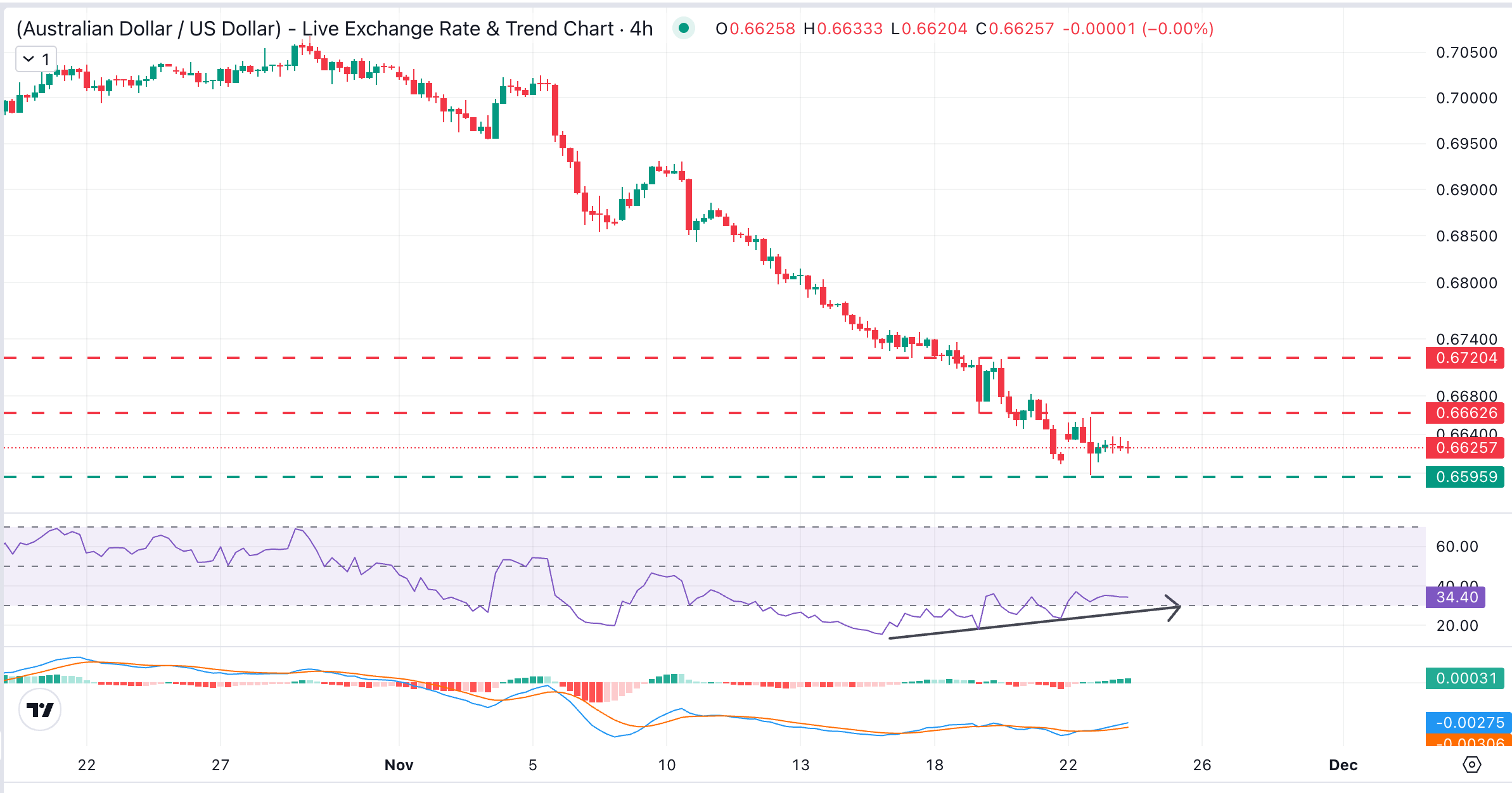
Guillermo Alcalá, Forex analyst at FXStreet, describes the technical picture for AUD/USD as strongly bearish. As Alcalá puts it: “The pair has lost nearly 6% in November and 8.5% from September’s highs and is not showing any sign of an immediate trend reversal, except for the bullish divergence in the 4-hour Relative Strength Index (RSI)”.
The momentum signals offer a mixed picture. Although the RSI sits just above oversold territory, the Moving Average Convergence Divergence (MACD) histogram has moved above zero. Nevertheless, Alcalá says bulls “need solid reasons to gain the necessary confidence to break resistances at Monday’s high near 0.6560 and the November 19 high at 0.6720 before raising expectations of any significant recovery.”
For now, sellers are being held back by the area below 0.6600. Should that support give way, Alcalá identifies the psychological 0.6500 mark, followed by the November 2025 lows around 0.6420, as the next downside targets.
Inflation: frequently asked questions
A rise in the cost of a representative basket of goods and services is measured as inflation. The headline measure is generally reported as a percentage change both month-on-month (MoM) and year-on-year (YoY). By excluding more volatile components, including food and fuel, core inflation removes items whose prices can shift with geopolitical developments and seasonal factors. Economists concentrate on this core measure, which is also targeted by central banks under their mandate to maintain manageable inflation, usually around 2%.
Changes over time in the cost of a basket of goods and services are tracked by the Consumer Price Index (CPI). Readings are generally presented as percentage changes month-on-month (MoM) and year-on-year (YoY). Central banks target Core CPI, which strips out volatile food and fuel components. A rise in Core CPI above 2% typically leads to higher interest rates; a drop below 2% usually has the reverse effect. As higher rates support a currency, rising inflation generally strengthens it, while falling inflation tends to have the opposite impact.
Higher inflation generally lifts a country’s currency, while lower inflation has the reverse effect, even if that relationship appears counter-intuitive. The reason lies in the central bank’s usual response: raising interest rates to tackle stronger price pressures. Those higher rates draw additional global capital from investors seeking attractive returns on their money.
Historically, investors sought Gold during periods of high inflation because it retained its value. Gold still attracts safe-haven buying during severe market turmoil, but that historical relationship does not hold most of the time. High inflation typically prompts central banks to increase interest rates to bring price pressures under control. For Gold, rising rates are unfavourable: they raise the opportunity cost of holding the metal rather than an interest-bearing asset or a cash deposit. Conversely, easing inflation tends to benefit Gold by lowering interest rates and making the precious metal a more attractive investment alternative.
Economic Data Indicator
Consumer Price Index: Annual Change (YoY)
Published monthly by the Australian Bureau of Statistics, the Consumer Price Index (CPI) tracks price movements across a broad basket of goods and services purchased by households. Following a methodological change from quarterly to monthly readings, applicable to data from April 2024 onwards, it serves as the main gauge of headline inflation. Its YoY figure compares prices in the reporting month with those in the corresponding month a year earlier. Higher readings are regarded as bullish for the Australian Dollar (AUD); lower readings are viewed as bearish.
Read further.Upcoming release: Wed 25 Nov 2026 00:30
Release frequency: Every month
Market consensus: 4.8%
Previous reading: 4.3%
Data source: Australian Bureau of Statistics
POPULAR ARTICLES
1Is Australia’s CPI likely to complicate the RBA’s task?2Chinese Yuan: Is upside against the US Dollar capped? – UOB3Forex Today: Australian inflation in focus ahead of a packed pre-Thanksgiving US calendar4Silver Price Forecast: Can $40 support hold as XAG/USD slides?5Can the Canadian Dollar Extend Gains as BoC Governor Highlights Persistent Inflation Risks?6Could the Oil shock prompt a rate hike? BoC’s Macklem flags risk as inflation rises7Fed hike bets drive gold lower despite a softer US Dollar8Pound Sterling Price News and Forecast: How are BoE hike bets supporting a GBP/USD rebound despite USD strength?9Dogecoin Price Forecast: Is $0.05 next for DOGE after November’s 27% decline?


Get Started!
Sign up and access the Global Markets in less than 3 minutes

Connect With Us









Contacts
Phone: +61 2 8036 8388
Fax: +61 2 8036 8388
Email: support@tmgm.com



The information provided on this website is of a general nature only and does not constitute personal financial advice. Before acting on any information on this website, you should consider the suitability of the information in relation to your objectives, financial situation and needs. Investing in CFDs and FX Margin Contracts carries significant risks and is not suitable for all investors. You may lose more than your initial deposit. You do not own, or have, any interest in the underlying asset. We recommend that you seek independent advice and ensure you fully understand the risks involved before trading. It is important that you read and consider the disclosure document before you acquire any product listed on the website. The information and advertisements offered on this website are not intended for use by any person in any country or jurisdiction where such use would be contrary to local laws and regulations. The Products and Services offered on this website are not intended for residents of the United States, Malaysia and Thailand.
TMGM is authorized and regulated in various jurisdictions.
Trademax Australia Limited, trading as TMGM, is regulated by the Australian Securities and Investments Commission (ASIC), AFSL no. 436416 and is located at Level 28, One International Tower, 100 Barangaroo Avenue, 2000 Sydney, NSW Australia.
Email: support@tmgm.com.au
Trademax Global Limited, trading as TMGM, is authorized and regulated by the Vanuatu Financial Services Commission (VFSC), registration number 40356 and registered at 1276, Kumul Highway, Port Vila, Vanuatu, Republic of Vanuatu.
Email: support@tmgm.com
Trademax Global Markets (SE) Limited, trading as TMGM, is authorized and regulated by the Financial Services Authority (FSA) of Seychelles, with license number SD224. The company is registered at Office No 13, Providence Estate ABIS Centre, Mahe, Seychelles.
Email: support@tmgm.com
Trademax Global Markets (International) Pty Ltd, trading as TMGM, is authorized and regulated by the Financial Services Commission, Mauritius (FSC) with license no. GB22201012, and registered at 33, Edith Cavell Street C/o IQ EQ Fund Services (Mauritius) Ltd Port Louis, 11324 Mauritius.
Email: support@tmgm.com
Copyright © TMGM. All rights reserved