

Trading
Explore a wide range of markets with competitive pricing, deep liquidity, and advanced trading tools.
Learn More 
Platform
Trade seamlessly with TMGM's powerful platform, built for speed, precision, and a superior trading experience.
Learn More Trading Platform
Academy
Learn the fundamentals of trading with beginner-friendly resources, including guides, webinars, and market insights.
Learn More News & Analysis
Get real-time market updates and expert analysis to stay ahead of trading opportunities
Learn More News & Analysis
About
Learn what sets TMGM apart — our global presence, regulatory strength, and commitment to innovation in trading.
Learn More Why Choose TMGM
Sponsorship
Ripple Price Forecast: Even as leveraged traders cut risk exposure, XRP builds upside momentum
- Bulls appear to be returning to XRP, which trades above $1.35 on Wednesday after gaining 5% over two days.
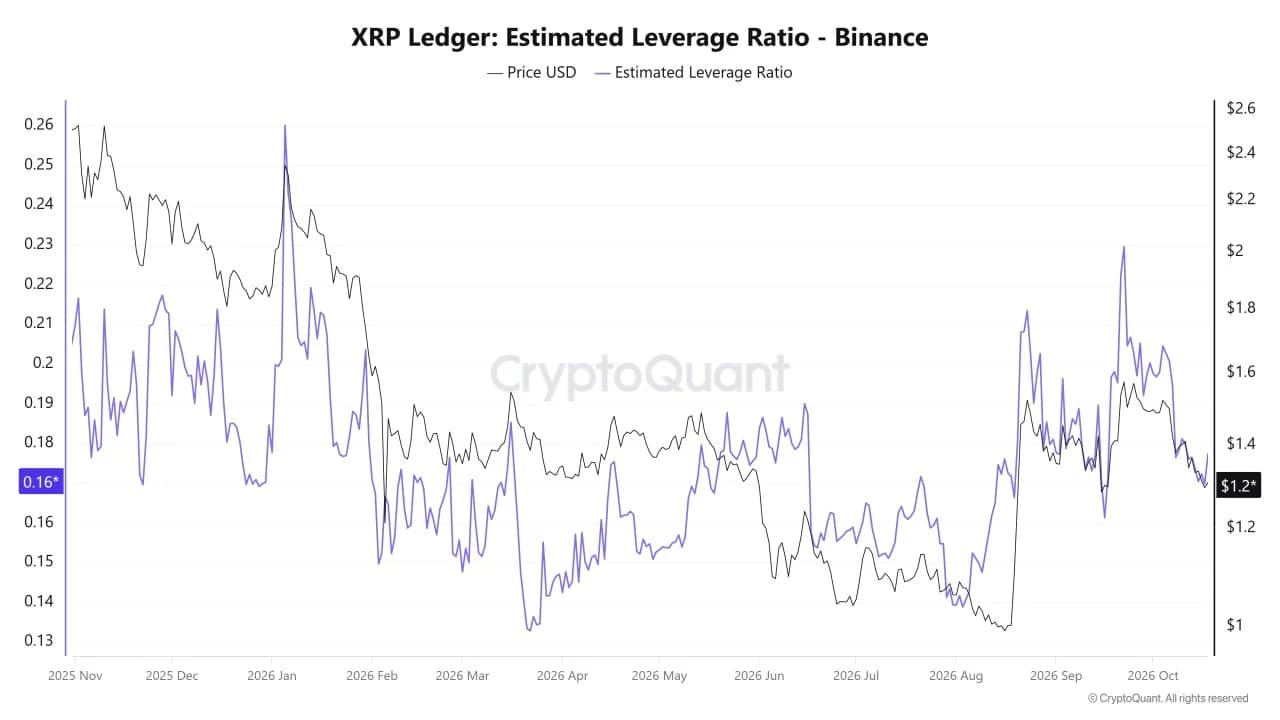
- Reduced risk-taking by traders sees Binance’s Estimated Leverage Ratio fall 26% in less than a month.
- The 100-day EMA provides support for XRP, while the 50-day and 200-day EMAs form resistance above it.
Tentative signs of a recovery are emerging for Ripple (XRP) on Wednesday, with the price inching above $1.36. Gains have continued for a second straight day, offering early indications of a potential reversal after the recent sell-off below $1.30.

The scope for XRP’s recovery nevertheless remains structurally constrained by short- and long-term moving averages. Medium-term support around $1.34 offers some protection against downside pressures, increasing the chances of a rebound towards $1.40. A decisive break below that support zone, however, could prompt a broader sell-off and leave XRP facing lower demand zones at $1.12 and $1.00, respectively.
Is interest in XRP derivatives weakening?
A marked decline in traders’ relative exposure to leveraged positions is evident in XRP’s Estimated Leveraged Ratio on Binance. From 0.229 in September, the ratio has dropped 26.2% to around 0.169.
The fall points to substantially subdued demand for leveraged XRP positions, as traders scale back risk by exiting open positions or using less leverage. A lower ratio is also likely to make the token less sensitive to volatility linked to leveraged positions. The extent of that effect, however, hinges on wider crypto market conditions and the size of positions still open.
Writing in the CryptoQuant Insights section, Arab Chain highlighted: “However, a decline in this metric does not necessarily mean that traders are shifting toward selling, nor does it independently signal a bearish or bullish market trend,” adding, “The decline may reflect a reduction in leveraged positioning, potentially mitigating the risks associated with liquidations.”
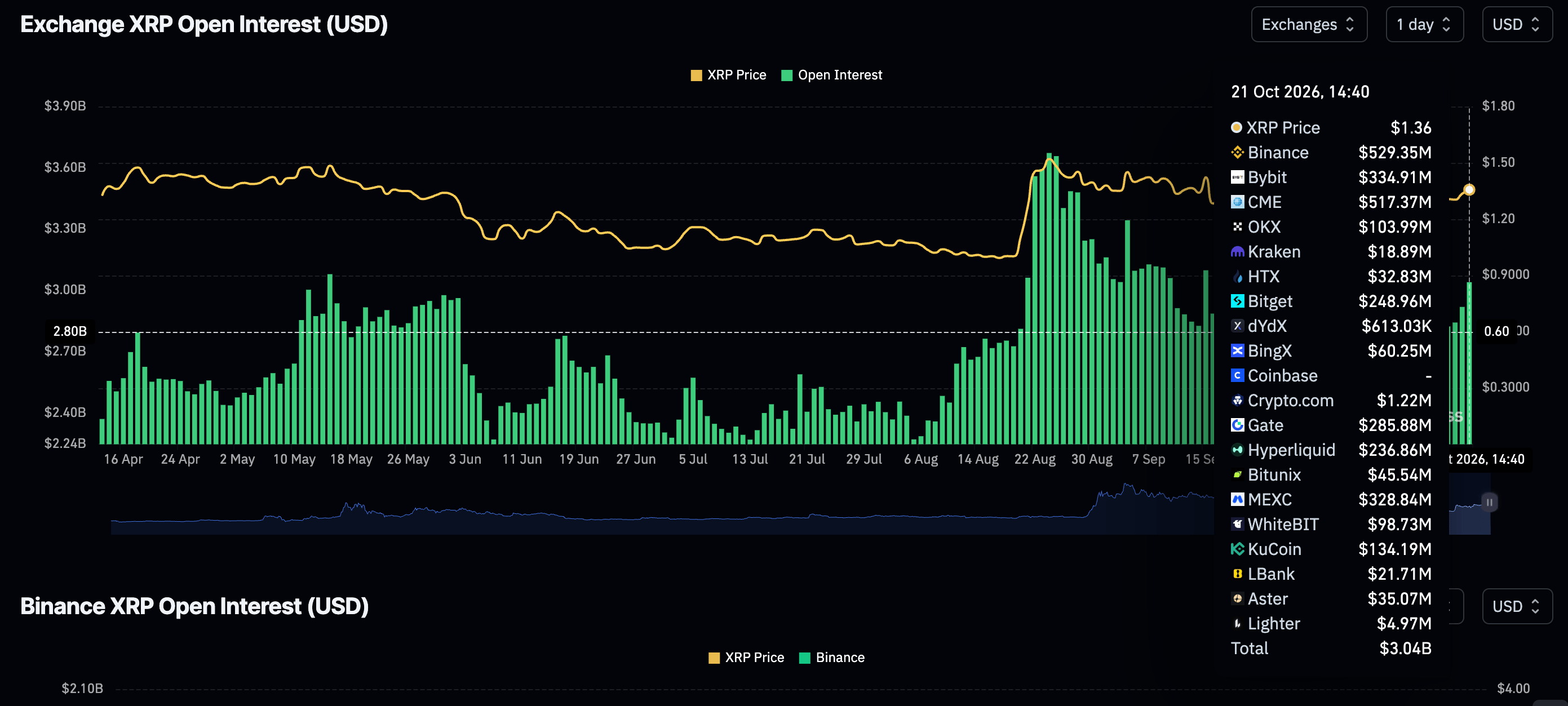
Demand from leveraged traders in the derivatives market is picking up, though gradually, according to perpetual futures Open Interest (OI). On Wednesday, OI averaged 3.04 billion XRP, compared with 2.84 billion XRP a day earlier. Even so, it remains substantially below the August and September highs of 3.78 billion and 3.67 billion XRP. Taken alongside Binance’s Estimated Leveraged Ratio, these readings suggest a recovery could prove difficult unless traders substantially raise their risk exposure.
Technical analysis: Can XRP recover within a broader bearish structure?
Bulls are attempting to regain control of XRP’s trend, lifting the token above $1.36 after its correction below $1.30 earlier this week. However, the remittance token remains beneath the 50-day and 200-day Exponential Moving Averages (EMAs), at $1.38 and $1.37. This leaves the near-term outlook bearish, with overhead supply continuing to restrict rallies.
Further reinforcing the cap on gains is the SuperTrend line at $1.47. Meanwhile, the Moving Average Convergence Divergence (MACD) remains just below zero, and the Relative Strength Index (RSI) is close to 47. Together, these indicators suggest subdued momentum without a clear direction, rather than a convincing recovery.
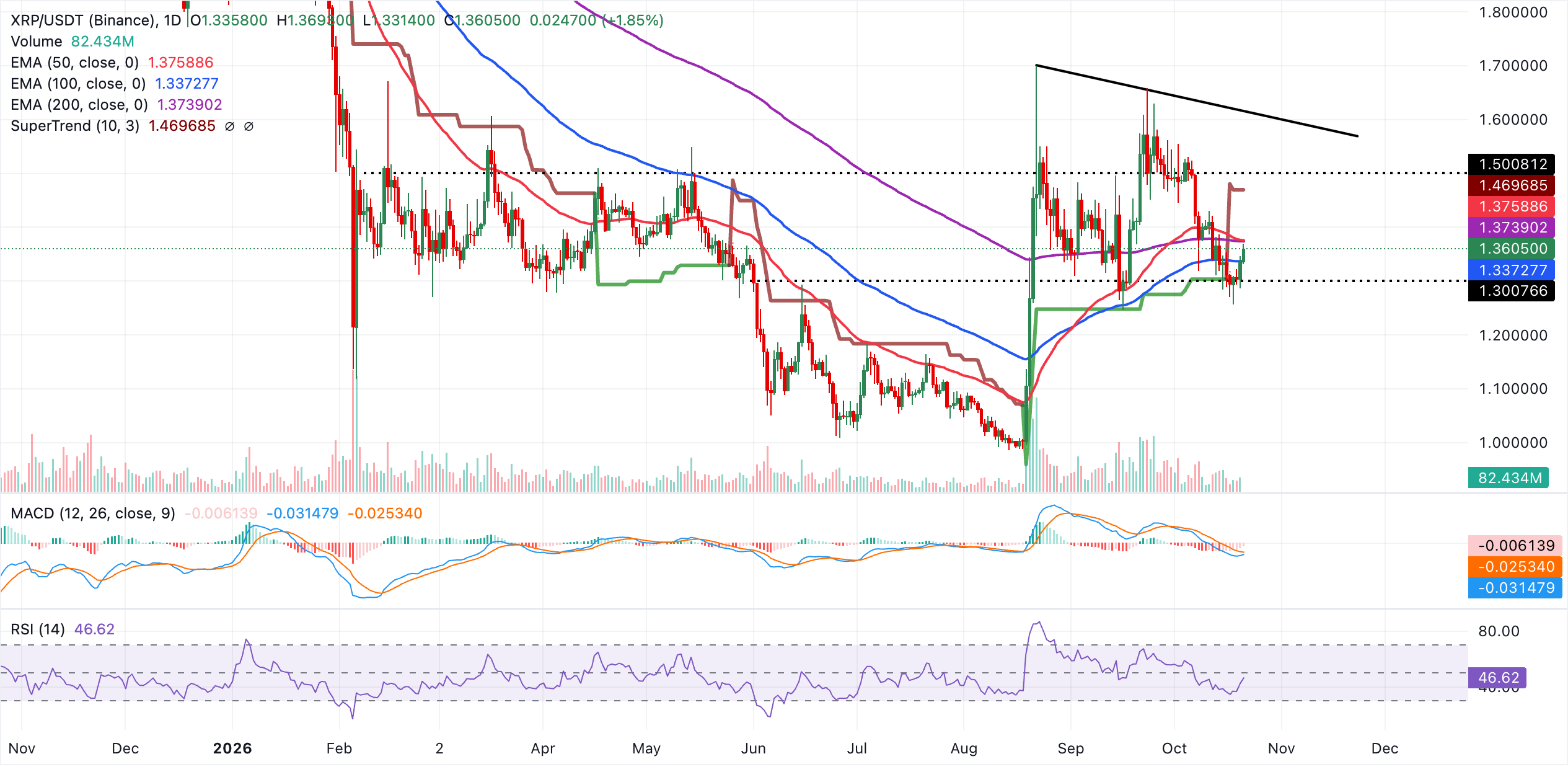
Before XRP can approach the SuperTrend level of $1.47 and the wider downtrend structure marked by $1.62 and $1.70, it faces a narrow resistance band. The first hurdle is the 200-day EMA at $1.38, with the 50-day EMA close behind. Immediate downside support lies at the 100-day EMA at $1.34; a clear breach would likely pave the way for a deeper decline over the coming sessions.
(The technical analysis of this story was written with the help of an AI tool. Know more.)
Common questions about Ripple
Specialising in cross-border remittances, payments company Ripple uses blockchain technology to carry out transfers. Ripple Labs Inc. created RippleNet, a payment transfer network available to financial institutions across the world. The company also uses the XRP token.
The decentralised XRPLedger blockchain has XRP as its native token. Ripple Labs uses XRP to enable transactions on XRPLedger, allowing financial institutions to transfer value across borders. By supporting instant, trustless payments on the XRPLedger chain, XRP helps financial firms reduce the cost of transactions worldwide.
Built on distributed ledger technology and blockchain, XRPLedger uses XRP to facilitate transactions. Unlike other blockchains, the ledger incorporates an inflammatory protocol designed to counter spam and distributed denial-of-service (DDOS) attacks. A peer-to-peer network called the global XRP Ledger community maintains XRPL.
The interledger standard used by XRP is a blockchain protocol that enables payments between different networks. XRP’s blockchain can, for example, link the ledgers of two or more banks, effectively eliminating intermediaries and the need for centralisation within the system. Developed by Jed McCaleb, Arthur Britto and David Schwartz, the XRPLedger blockchain uses XRP as its native token.
POPULAR ARTICLES
1Brazilian Real: What Do Election Flows and Fiscal Reform Prospects Signal? – Societe Generale2British Pound: Can the overbought rally extend further against the US Dollar? – UOB3US Dollar: Rate expectations shift as the tone softens – MUFG4Hungarian Forint: Can domestic improvement offset global headwinds? – ING5Romanian Leu: Why is budget credibility crucial for stability? - Societe Generale6Bitcoin Price Forecast: Can Renewed Institutional Demand Drive BTC Above $85,000?7Ripple Price Forecast: Even as leveraged traders cut risk exposure, XRP builds upside momentum8How is the RBA’s hawkish shift supporting the Australian Dollar? – MUFG9Japanese Yen: Rangebound Against the US Dollar – UOB
LIVE QUOTES


ALL ABOUT TECHNICAL
What Is a Judas Swing? ICT Trading Strategy Explained With Examples
The Real Interest Rate: Are Your Savings Actually Earning Anything?
Butterfly Pattern Trading: How to Identify and Trade the Butterfly Harmonic Pattern
What Is a Rising Wedge Pattern and How Do You Trade It?
What Is a Descending Triangle Pattern and How Do You Trade It?
Accumulation, Manipulation and Distribution (AMD): ICT Power of 3 Trading Guide
How to Read the CPI Report Before You Trade It: A Trader's Guide to Headline and Core
Slippage, Spread and Gaps: Why Your Fill Differs From the Price You Saw
Backtesting in Trading: What It Is and How to Backtest a Strategy
Get Started!
Sign up and access the Global Markets in less than 3 minutes

Connect With Us









Contacts
Phone: +61 2 8036 8388
Fax: +61 2 8036 8388
Email: support@tmgm.com



The information provided on this website is of a general nature only and does not constitute personal financial advice. Before acting on any information on this website, you should consider the suitability of the information in relation to your objectives, financial situation and needs. Investing in CFDs and FX Margin Contracts carries significant risks and is not suitable for all investors. You may lose more than your initial deposit. You do not own, or have, any interest in the underlying asset. We recommend that you seek independent advice and ensure you fully understand the risks involved before trading. It is important that you read and consider the disclosure document before you acquire any product listed on the website. The information and advertisements offered on this website are not intended for use by any person in any country or jurisdiction where such use would be contrary to local laws and regulations. The Products and Services offered on this website are not intended for residents of the United States, Malaysia and Thailand.
TMGM is authorized and regulated in various jurisdictions.
Trademax Australia Limited, trading as TMGM, is regulated by the Australian Securities and Investments Commission (ASIC), AFSL no. 436416 and is located at Level 28, One International Tower, 100 Barangaroo Avenue, 2000 Sydney, NSW Australia.
Email: support@tmgm.com.au
Trademax Global Limited, trading as TMGM, is authorized and regulated by the Vanuatu Financial Services Commission (VFSC), registration number 40356 and registered at 1276, Kumul Highway, Port Vila, Vanuatu, Republic of Vanuatu.
Email: support@tmgm.com
Trademax Global Markets (SE) Limited, trading as TMGM, is authorized and regulated by the Financial Services Authority (FSA) of Seychelles, with license number SD224. The company is registered at Office No 13, Providence Estate ABIS Centre, Mahe, Seychelles.
Email: support@tmgm.com
Trademax Global Markets (International) Pty Ltd, trading as TMGM, is authorized and regulated by the Financial Services Commission, Mauritius (FSC) with license no. GB22201012, and registered at 33, Edith Cavell Street C/o IQ EQ Fund Services (Mauritius) Ltd Port Louis, 11324 Mauritius.
Email: support@tmgm.com
Copyright © TMGM. All rights reserved