

Trading
Explore a wide range of markets with competitive pricing, deep liquidity, and advanced trading tools.
Learn More 
Platform
Trade seamlessly with TMGM's powerful platform, built for speed, precision, and a superior trading experience.
Learn More Trading Platform
Academy
Learn the fundamentals of trading with beginner-friendly resources, including guides, webinars, and market insights.
Learn More News & Analysis
Get real-time market updates and expert analysis to stay ahead of trading opportunities
Learn More News & Analysis
About
Learn what sets TMGM apart — our global presence, regulatory strength, and commitment to innovation in trading.
Learn More Why Choose TMGM
Sponsorship
Gold sinks to new YTD low after breaching $3,886 support as Fed hawks keep up pressure
- Gold slides more than 3.3% to $3,880, marking a new low for the year.
- A breach of $3,886 reinforces bearish pressure and leaves prices vulnerable to further declines.
- The probability of a December rate hike drops to 70% even as Fed officials advocate further tightening.
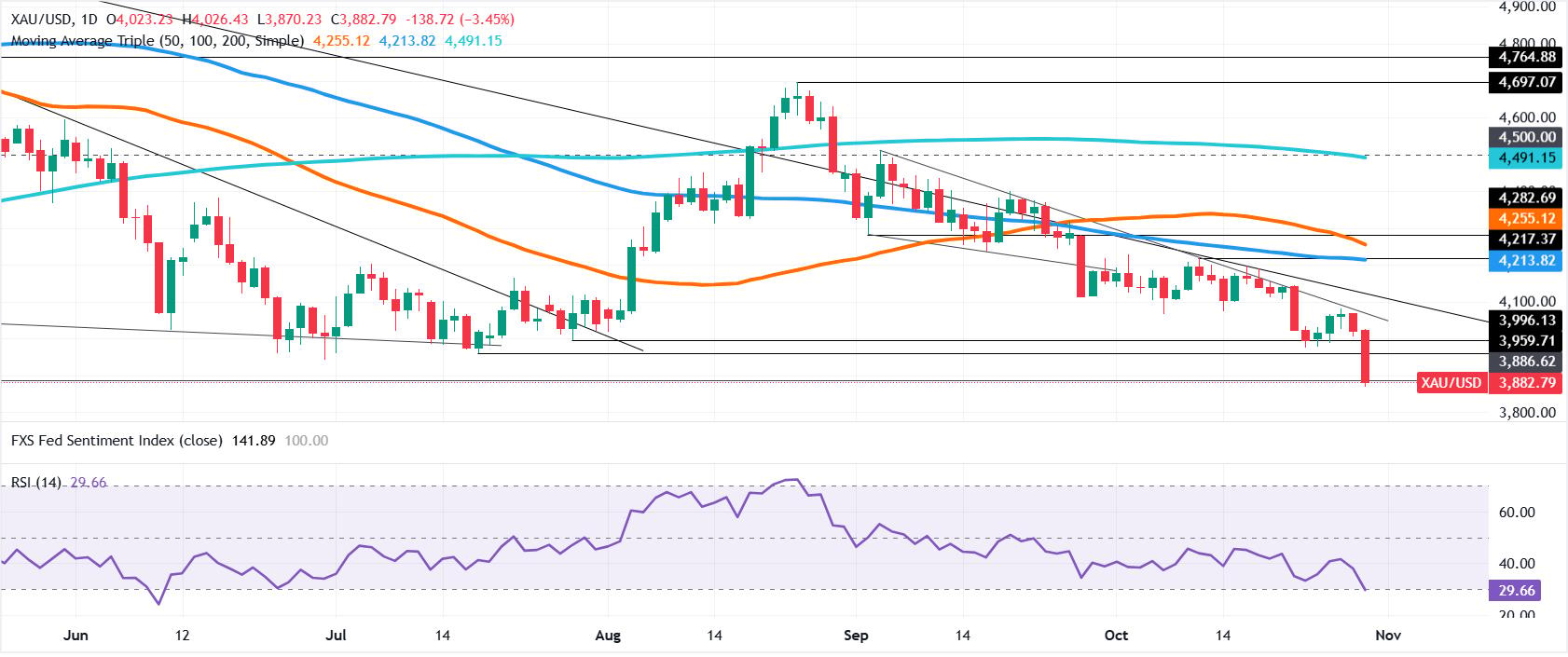
Selling pressure intensified in Gold (XAU/USD) on Friday as risk appetite weakened, the Greenback and US Treasury yields edged up, and hawkish Fed commentary weighed on the metal. Prices slipped below $3,900 for the first time since October last year, reaching a fresh year-to-date (YTD) low of $3,880. XAU/USD is trading at $3,884, a decline of more than 3.3%.

Can XAU/USD stem its bearish slide amid hawkish Fed signals and high Oil prices?
Further losses in Bullion appear possible after prices broke through the key $3,886 support level recorded on 28 October 2025. Of the three Federal Reserve (Fed) officials, two advocated further tightening, although all three favour a gradual approach.
Two additional rate increases were urged by Dallas Fed President Lorie Logan. Meanwhile, St. Louis Fed President Alberto Musalem argued that another hike was needed soon, saying monetary policy remained too loose.
A gradual approach was also favoured by Richmond Fed President Thomas Barkin, who nevertheless acknowledged that inflationary pressures were spreading.
Against this backdrop, the US Dollar was unable to gain ground, while US Treasury yields slipped slightly.
Investors have pared back the probability of a Fed rate hike despite robust US growth and elevated inflation. The economy expanded by a healthy 3.4% YoY in Q3, comfortably surpassing forecasts, while core PCE inflation stood at 3.1% YoY. The inflation reading was higher than September’s but matched estimates. Although these figures could strengthen the case for a hike, the CME FedWatch Tool shows that the odds have fallen to 70% from around 84% on Wednesday after the Fed’s decision.
Higher energy prices are adding to the pressure on Bullion, even as US-Iran talks continue, according to Axios. The US Oil benchmark, West Texas Intermediate (WTI), has gained 0.5% and is trading near $102 per barrel.
A busy US economic calendar awaits markets next week, with October’s ISM Manufacturing and Services PMIs due alongside a series of employment releases. The labour-market line-up comprises JOLTS, ADP Employment Change and Initial Jobless Claims, culminating in the week’s key release, Nonfarm Payrolls.
XAU/USD technical outlook: How far could Gold fall below $3,900?
Gold’s break below $3,900 leaves the broader trend pointing lower and brings a 12-month low into view. The Relative Strength Index (RSI) indicates bearish momentum that is close to entering oversold territory, signalling a strengthening downtrend.
A daily close for XAU/USD below $3,886, the low recorded on 28 October 2025, would put $3,800 in focus. A break beneath that level would shift attention to $3,500, where the swing high of 22 April 2025 has turned into support.
Buyers would need to reclaim both $3,900 and $4,000 to secure a bullish reversal. That would clear the way for a test of $4,100, followed by the 100-day Simple Moving Average (SMA) at $4,213.
Gold: Frequently asked questions
Widely used as both a store of value and a medium of exchange, Gold has occupied an important place throughout human history. Beyond its lustre and use in jewellery, the precious metal is now commonly regarded as a safe-haven asset, or a suitable investment during periods of turmoil. Its independence from any particular issuer or government also underpins its widespread appeal as a hedge against inflation and currency depreciation.
The largest holders of Gold are central banks. To support their currencies during turbulent periods, they typically diversify their reserves and purchase Gold, reinforcing perceptions of economic and currency strength. Substantial Gold reserves can bolster confidence in a country’s solvency. World Gold Council data show that central banks increased their reserves by 1,136 tonnes in 2022, with those purchases worth around $70 billion. No higher annual purchase has been recorded since records began. Emerging-economy central banks, including those in China, India and Turkey, are rapidly expanding their Gold reserves.
Both major reserve and safe-haven assets, the US Dollar and US Treasuries generally move inversely to Gold. A decline in the Dollar tends to lift Gold, helping investors and central banks diversify their holdings during turbulent periods. An inverse relationship also exists between Gold and risk assets: rising stock markets typically weigh on the metal, whereas selling in riskier markets tends to support it.
A broad set of influences can move Gold prices. Its safe-haven appeal means geopolitical instability or concern over a deep recession can send prices sharply higher. Since Gold pays no yield, lower interest rates generally support it, while a higher cost of money usually weighs on the metal. Most price movements, however, hinge on the US Dollar (USD), as Gold is denominated in dollars (XAU/USD). Dollar strength tends to restrain Gold prices, while a weaker Dollar is likely to lift them.
POPULAR ARTICLES
1Ethereum Price Forecast: Following Binance hack, ETH slides towards $2,2002Gold sinks to new YTD low after breaching $3,886 support as Fed hawks keep up pressure3Vietnam: How does strong growth complicate the inflation fight? – DBS4Chinese Yuan: 6.6450 in sight as uptrend against US Dollar continues – UOB5Japanese Yen stays resilient following BoJ’s hawkish hold6Singapore Dollar: OCBC Sees Relatively Limited Scope for a Rebound Against US Dollar7Fed’s Logan backs two further rate hikes, says pause will not change course8Thai Baht: Downside persists as BoT remains cautious about normalisation – Commerzbank9Week-ahead outlook: How will US Midterm Elections, Payrolls and the BoE shape markets?


Get Started!
Sign up and access the Global Markets in less than 3 minutes

Connect With Us









Contacts
Phone: +61 2 8036 8388
Fax: +61 2 8036 8388
Email: support@tmgm.com



The information provided on this website is of a general nature only and does not constitute personal financial advice. Before acting on any information on this website, you should consider the suitability of the information in relation to your objectives, financial situation and needs. Investing in CFDs and FX Margin Contracts carries significant risks and is not suitable for all investors. You may lose more than your initial deposit. You do not own, or have, any interest in the underlying asset. We recommend that you seek independent advice and ensure you fully understand the risks involved before trading. It is important that you read and consider the disclosure document before you acquire any product listed on the website. The information and advertisements offered on this website are not intended for use by any person in any country or jurisdiction where such use would be contrary to local laws and regulations. The Products and Services offered on this website are not intended for residents of the United States, Malaysia and Thailand.
TMGM is authorized and regulated in various jurisdictions.
Trademax Australia Limited, trading as TMGM, is regulated by the Australian Securities and Investments Commission (ASIC), AFSL no. 436416 and is located at Level 28, One International Tower, 100 Barangaroo Avenue, 2000 Sydney, NSW Australia.
Email: support@tmgm.com.au
Trademax Global Limited, trading as TMGM, is authorized and regulated by the Vanuatu Financial Services Commission (VFSC), registration number 40356 and registered at 1276, Kumul Highway, Port Vila, Vanuatu, Republic of Vanuatu.
Email: support@tmgm.com
Trademax Global Markets (SE) Limited, trading as TMGM, is authorized and regulated by the Financial Services Authority (FSA) of Seychelles, with license number SD224. The company is registered at Office No 13, Providence Estate ABIS Centre, Mahe, Seychelles.
Email: support@tmgm.com
Trademax Global Markets (International) Pty Ltd, trading as TMGM, is authorized and regulated by the Financial Services Commission, Mauritius (FSC) with license no. GB22201012, and registered at 33, Edith Cavell Street C/o IQ EQ Fund Services (Mauritius) Ltd Port Louis, 11324 Mauritius.
Email: support@tmgm.com
Copyright © TMGM. All rights reserved