

Trading
Explore a wide range of markets with competitive pricing, deep liquidity, and advanced trading tools.
Learn More 
Platform
Trade seamlessly with TMGM's powerful platform, built for speed, precision, and a superior trading experience.
Learn More Trading Platform
Academy
Learn the fundamentals of trading with beginner-friendly resources, including guides, webinars, and market insights.
Learn More News & Analysis
Get real-time market updates and expert analysis to stay ahead of trading opportunities
Learn More News & Analysis
About
Learn what sets TMGM apart — our global presence, regulatory strength, and commitment to innovation in trading.
Learn More Why Choose TMGM
Sponsorship
Gold drops below $4,000 as hawkish Fed expectations overshadow risk-off sentiment
- Can Gold find support at its lowest since July as hawkish Fed expectations sustain selling pressure?
Selling pressure persists in Gold (XAU/USD) on Friday despite risk aversion across financial markets, with the metal touching $3,965 in Asian trade, its weakest level since July. Expectations of additional interest rate increases by the Federal Reserve (Fed) remain the dominant influence on prices, putting Gold on course for a monthly loss. XAU/USD is trading near $3,979 at the time of writing, a decline of nearly 1% for the day.

Risk appetite has weakened after disappointing technology earnings revived doubts over substantial AI spending and the adequacy of returns from those investments. A shift towards government bonds has lowered US Treasury yields, pulling the US Dollar down alongside them.
Losses in the US Dollar Index (DXY) have now extended into a third straight day, with the index trading near 101.65. The gauge measures the Greenback against a basket of six major currencies.
For the Dollar, positioning could matter more than fundamentals in the near term, according to analysts at ING. They warn that “the main risk for the dollar today is some precautionary unwinding of net-long positions ahead of Tuesday’s US midterm elections.” Pointing out that “a Democratic sweep is trading around 68% in prediction markets,” they describe that outcome as “slightly negative for the US dollar from a few angles, from higher risk of government shutdown and gridlock on debt ceiling negotiations to potential damage to already shaky AI-related sentiment.”
ING consequently warns that “resurgent AI-related jitters and the upcoming US midterms are increasing downside risks for the dollar,” while acknowledging that “a still-hawkish Fed argues against major corrections.”
Investor unease has also deepened following reports of a major security breach at cryptocurrency exchange Binance, which have put digital assets under pressure. Yet the defensive market mood has offered no support to Gold so far. Traders remain focused on the rise in Oil prices linked to Middle East tensions and the implications for inflation and interest rates.
Fears that the US may restart military strikes against Iran after next week’s US midterm elections have driven Oil to its highest levels since May. With West Texas Intermediate (WTI) trading above $103 a barrel, inflation risks stemming from energy remain a key concern.
The risk from rising energy costs is that inflation could remain above the Fed’s 2% target for an extended period. Thursday’s data showed September headline Personal Consumption Expenditures (PCE) inflation increasing 0.5% MoM and 3.6% YoY. The core reading, meanwhile, rose 0.3% MoM and 3.1% YoY.
Following the Fed’s decision to hold rates steady in October, traders are assigning roughly a 75% probability to a December rate increase, according to the CME FedWatch Tool. Since Gold pays no interest, an increase in borrowing costs typically puts the metal under pressure.
Technical analysis: Could XAU/USD extend its decline below $4000?
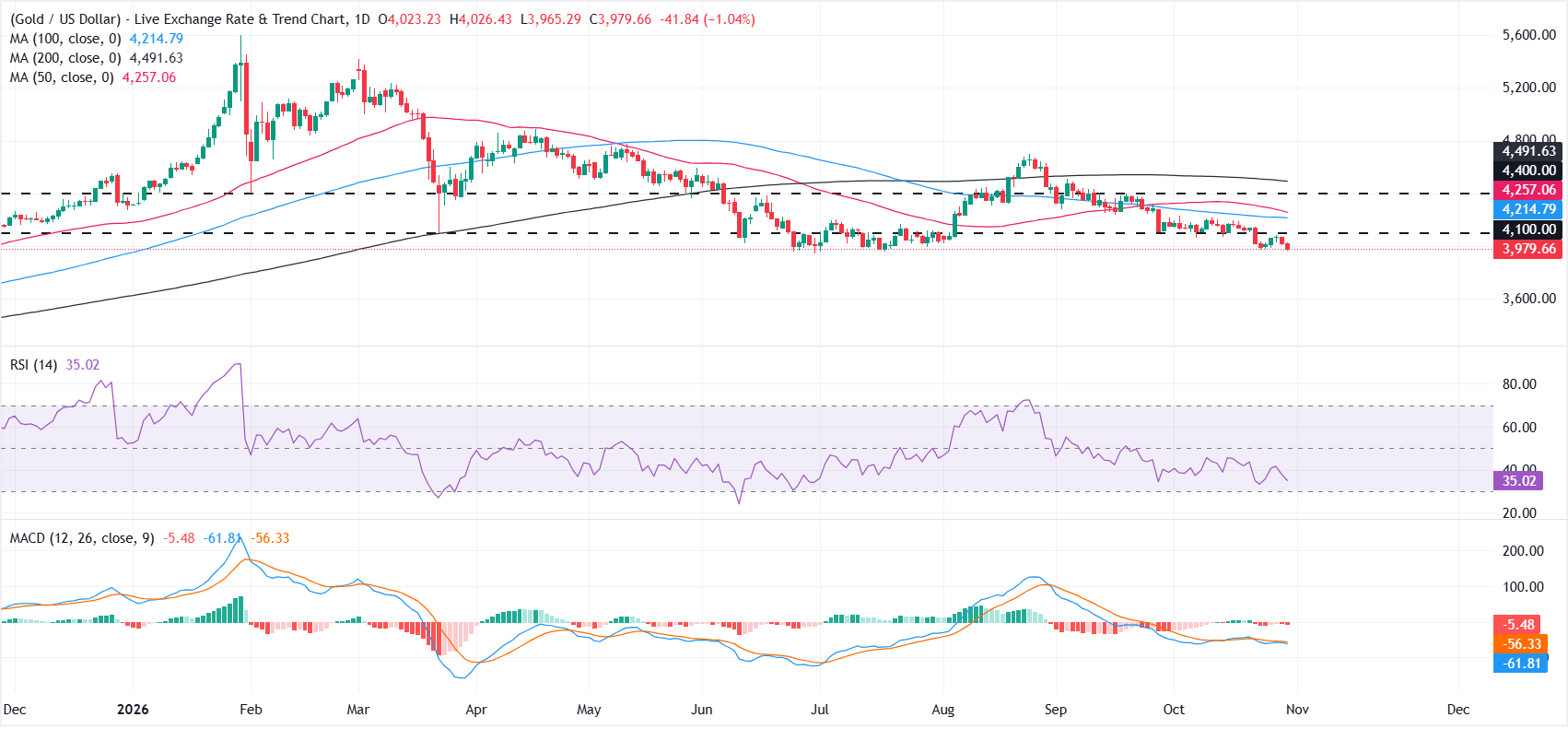
Sellers retain the upper hand on the daily XAU/USD chart, where a sequence of lower highs and lower lows has developed since the late-August peak near $4,700. Gold remains beneath its 50-day, 100-day and 200-day Simple Moving Averages (SMAs). Buying interest appears muted, with the Relative Strength Index (RSI) around 34, while a negative Moving Average Convergence Divergence (MACD) reading points to continuing downward pressure.
On the upside, Gold faces its first resistance at $4,000 and then $4,100. Further hurdles are the 100-day SMA near $4,218 and the adjacent 50-day SMA at $4,257. If the recovery gathers strength, attention could turn to horizontal resistance at $4,400, ahead of the 200-day SMA around $4,491.
Below the $4,000 level, where Gold is already trading, the nearest support is $3,950, with the July low near $3,941 next in line. A clear break beneath this zone would leave room for additional declines.
(The technical analysis of this story was written with the help of an AI tool. Know more.)
Gold: Frequently asked questions
During periods of uncertainty, Gold is widely regarded as a safe-haven asset and, therefore, a sound investment in turbulent conditions. Its importance in human history stems from its extensive use as both a store of value and a means of exchange. Today, its appeal extends beyond its lustre and use in jewellery. Because Gold does not depend on a particular issuer or government, it is also commonly viewed as protection against inflation and currency depreciation.
The largest holdings of Gold sit with central banks. To support their currencies during unsettled periods, they often spread their reserves across assets and purchase Gold, strengthening perceptions of their economies and currencies. Substantial Gold reserves can reinforce confidence in a country’s solvency. According to World Gold Council data, central banks expanded their reserves by 1,136 tonnes of Gold, valued at around $70 billion, in 2022. No other year since records began has seen purchases on that scale. Emerging-economy central banks, including those in China, India and Turkey, are rapidly building their Gold reserves.
Both the US Dollar and US Treasuries are major reserve and safe-haven assets, and Gold has an inverse relationship with them. A fall in the Dollar typically supports Gold, allowing investors and central banks to diversify their holdings during uncertain periods. The metal also tends to move in the opposite direction to risk assets: stock-market gains generally put pressure on Gold prices, whereas selling in riskier markets usually benefits the precious metal.
Several influences can drive Gold prices. Demand for its safe-haven qualities can send prices sharply higher when geopolitical instability rises or fears of a severe recession emerge. Lower interest rates generally support Gold because it generates no yield, while higher borrowing costs usually weigh on the metal. Nevertheless, the direction of the US Dollar (USD) determines most price movements, as Gold is quoted in dollars (XAU/USD). Dollar strength tends to restrain Gold prices; a weaker Dollar, by contrast, is likely to lift them.
POPULAR ARTICLES
1European Central Bank: A December hike, but could a pause follow? – Rabobank2Swiss Franc: Sharp selloff gives way to further gains against US Dollar – UOB3Australian Dollar: Is support from an RBA hike likely to be limited? – TD Securities4Why has the Euro fallen to 19-month lows of 0.8336 against the British Pound despite upbeat Eurozone GDP?5Bitcoin Weekly Forecast: Why are a Binance security breach and hawkish Fed driving BTC lower?6Can the range-bound Japanese Yen offer an upside hedge against the US Dollar? – BBH7Gold drops below $4,000 as hawkish Fed expectations overshadow risk-off sentiment8Crypto Today: Selling pressure on Bitcoin, Ethereum and XRP eases following Binance security breach9ECB’s Nagel: If needed, central bank will act decisively to lower inflation


Get Started!
Sign up and access the Global Markets in less than 3 minutes

Connect With Us









Contacts
Phone: +61 2 8036 8388
Fax: +61 2 8036 8388
Email: support@tmgm.com



The information provided on this website is of a general nature only and does not constitute personal financial advice. Before acting on any information on this website, you should consider the suitability of the information in relation to your objectives, financial situation and needs. Investing in CFDs and FX Margin Contracts carries significant risks and is not suitable for all investors. You may lose more than your initial deposit. You do not own, or have, any interest in the underlying asset. We recommend that you seek independent advice and ensure you fully understand the risks involved before trading. It is important that you read and consider the disclosure document before you acquire any product listed on the website. The information and advertisements offered on this website are not intended for use by any person in any country or jurisdiction where such use would be contrary to local laws and regulations. The Products and Services offered on this website are not intended for residents of the United States, Malaysia and Thailand.
TMGM is authorized and regulated in various jurisdictions.
Trademax Australia Limited, trading as TMGM, is regulated by the Australian Securities and Investments Commission (ASIC), AFSL no. 436416 and is located at Level 28, One International Tower, 100 Barangaroo Avenue, 2000 Sydney, NSW Australia.
Email: support@tmgm.com.au
Trademax Global Limited, trading as TMGM, is authorized and regulated by the Vanuatu Financial Services Commission (VFSC), registration number 40356 and registered at 1276, Kumul Highway, Port Vila, Vanuatu, Republic of Vanuatu.
Email: support@tmgm.com
Trademax Global Markets (SE) Limited, trading as TMGM, is authorized and regulated by the Financial Services Authority (FSA) of Seychelles, with license number SD224. The company is registered at Office No 13, Providence Estate ABIS Centre, Mahe, Seychelles.
Email: support@tmgm.com
Trademax Global Markets (International) Pty Ltd, trading as TMGM, is authorized and regulated by the Financial Services Commission, Mauritius (FSC) with license no. GB22201012, and registered at 33, Edith Cavell Street C/o IQ EQ Fund Services (Mauritius) Ltd Port Louis, 11324 Mauritius.
Email: support@tmgm.com
Copyright © TMGM. All rights reserved