
News & AnalysisCareer

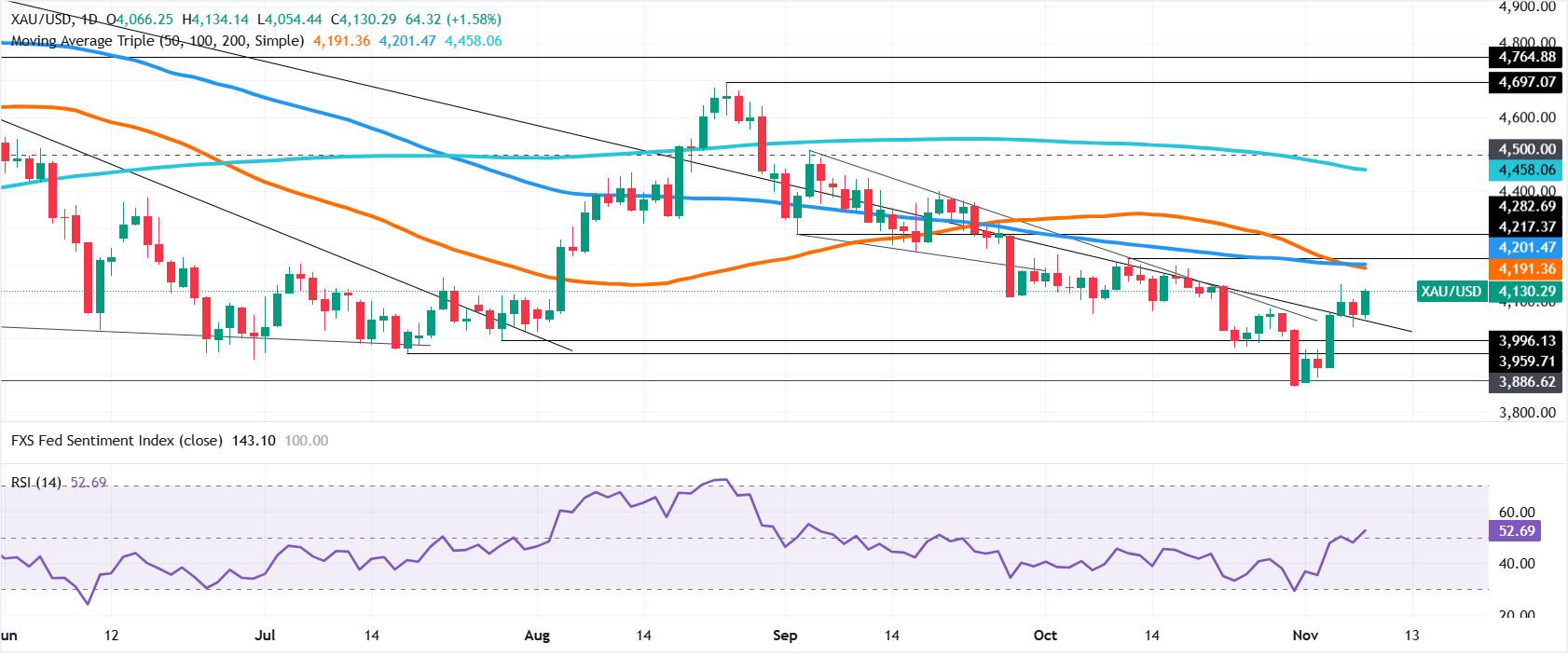
Last Friday’s strong US jobs figures prompted a modest hawkish reassessment, increasing market bets on a December interest rate rise by the Federal Reserve (Fed). Despite that shift, a weaker US Dollar lifts Gold (XAU/USD) by over 1.50% on Monday, taking the price above $4,130.

A recovery in US equities points to renewed risk appetite, partly after US President Donald Trump described further strikes on Iran as “highly unlikely”. In response, US Oil benchmark West Texas Intermediate (WTI) fell nearly 6% to $85.00. Its positive correlation with the US Dollar meant the decline also pulled the currency lower.
Reports of renewed US-Iran nuclear negotiations were emerging at the time of writing. Citing sources, Al-Arabiya said a Qatar-Pakistani proposal would permit Iran to enrich uranium to 3.67%. Washington had reportedly agreed to the terms, while Tehran had accepted the proposal.
Further tightening began to be priced in following last Friday’s employment report, lifting the US 10-year Treasury yield two basis points to 4.889%. By contrast, the US Dollar Index (DXY), which measures the currency against its peers, has fallen 0.46% to 101.81.A much stronger-than-expected Nonfarm Payrolls reading brought the Unemployment Rate down to 4.1% from 4.2%. According to the CME FedWatch Tool, the probability of a December rate rise now stands at 84%, compared with 76% last Friday.
Although higher interest rates typically weigh on non-yielding Gold, central bank purchases continue to underpin the metal. The World Gold Council reports that the People’s Bank of China (PBoC) increased its reserves by nearly 25.8 metric tons in October, its biggest monthly purchase in three years.
Comments from Federal Reserve (Fed) officials also drew attention. Thomas Barkin, President of the Richmond Fed, said there was no base case for December interest rates, adding that risks were concentrated on the inflation side of the mandate.
Chicago Fed President Austan Goolsbee had struck a hawkish tone earlier. He said services inflation was starting to “pick up,” had become a “big problem,” and that the Fed needed to acknowledge its failure on inflation.
Tuesday’s US Consumer Price Index (CPI) release is now in focus. Annual headline inflation is expected to increase to 3.9% in October from 3.7%, while the forecast for core CPI is a rise to 2.8% YoY from 2.6%.
Despite opening the week higher, Gold has yet to regain last Thursday’s $4,146 peak. The modest advance in price is accompanied by momentum pointing to further consolidation, as the Relative Strength Index (RSI) approaches the neutral 50 level.
A sustained bullish move requires XAU/USD to overcome the confluence of its 100- and 50-day Simple Moving Averages (SMAs), which stand at $4,191 and $4,201 respectively. Beyond those levels, attention would turn to the psychological $4,300 mark.
For sellers, a break below $4,100 would bring $4,000 into view. A further decline would put the November 4 daily low of $3,919 in focus, ahead of the October 30 year-to-date low of $3,879.
As both a means of exchange and a store of value, Gold has occupied an important place throughout human history. Today, its appeal extends beyond its lustre and use in jewellery: the metal is widely regarded as a safe-haven asset, or an investment considered attractive during periods of turbulence. Because it does not depend on a particular issuer or government, Gold is also commonly viewed as protection against inflation and currency depreciation.
The largest holders of Gold are central banks. To underpin their currencies during unsettled periods, they often diversify reserves by purchasing the metal, seeking to strengthen perceptions of both their economies and their currencies. Substantial Gold holdings can bolster confidence in a country’s solvency. World Gold Council data show that central banks increased their reserves by 1,136 tonnes in 2022, worth around $70 billion, marking the largest annual purchase on record. Emerging-economy central banks, including those in China, India and Turkey, are rapidly expanding their Gold holdings.
Both the US Dollar and US Treasuries are major reserve and safe-haven assets, and Gold is inversely correlated with them. A weaker Dollar generally supports Gold, allowing investors and central banks to diversify their holdings during turbulent periods. The metal also tends to move in the opposite direction to risk assets: rising equity markets usually put pressure on Gold, whereas selling in riskier markets typically supports it.
Many factors can influence Gold prices. Its safe-haven appeal means geopolitical instability or concern over a deep recession can trigger a rapid rise. Lower interest rates generally support the non-yielding metal, while a higher cost of borrowing usually weighs on it. Nevertheless, because Gold is quoted in dollars (XAU/USD), most price movements hinge on the performance of the US Dollar (USD). Dollar strength tends to restrain Gold prices, while a weaker currency is likely to lift them.







Phone: +61 2 8036 8388
Fax: +61 2 8036 8388
Email: support@tmgm.com



The information provided on this website is of a general nature only and does not constitute personal financial advice. Before acting on any information on this website, you should consider the suitability of the information in relation to your objectives, financial situation and needs. Investing in CFDs and FX Margin Contracts carries significant risks and is not suitable for all investors. You may lose more than your initial deposit. You do not own, or have, any interest in the underlying asset. We recommend that you seek independent advice and ensure you fully understand the risks involved before trading. It is important that you read and consider the disclosure document before you acquire any product listed on the website. The information and advertisements offered on this website are not intended for use by any person in any country or jurisdiction where such use would be contrary to local laws and regulations. The Products and Services offered on this website are not intended for residents of the United States, Malaysia and Thailand.
TMGM is authorized and regulated in various jurisdictions.
Trademax Australia Limited, trading as TMGM, is regulated by the Australian Securities and Investments Commission (ASIC), AFSL no. 436416 and is located at Level 28, One International Tower, 100 Barangaroo Avenue, 2000 Sydney, NSW Australia.
Email: support@tmgm.com.au
Trademax Global Limited, trading as TMGM, is authorized and regulated by the Vanuatu Financial Services Commission (VFSC), registration number 40356 and registered at 1276, Kumul Highway, Port Vila, Vanuatu, Republic of Vanuatu.
Email: support@tmgm.com
Trademax Global Markets (SE) Limited, trading as TMGM, is authorized and regulated by the Financial Services Authority (FSA) of Seychelles, with license number SD224. The company is registered at Office No 13, Providence Estate ABIS Centre, Mahe, Seychelles.
Email: support@tmgm.com
Trademax Global Markets (International) Pty Ltd, trading as TMGM, is authorized and regulated by the Financial Services Commission, Mauritius (FSC) with license no. GB22201012, and registered at 33, Edith Cavell Street C/o IQ EQ Fund Services (Mauritius) Ltd Port Louis, 11324 Mauritius.
Email: support@tmgm.com
Copyright © TMGM. All rights reserved

