


Gold stalls below $4,150 as rising US yields offset Fed relief
- Gold slips below $4,150 as US yields hit 5.34%.
- October Fed hold odds reach 77%, but December hike odds stay elevated.
- Dollar strength and upbeat sentiment erode bullion’s safe-haven appeal.
Gold (XAU/USD) prices drift lower on Monday as a strong US Dollar and high US Treasury yields undermine the precious metal, which has failed to rally as investors expect a less hawkish Federal Reserve (Fed) and have priced out a rate hike this month. At the time of writing, XAU/USD trades at $4,132, down 0.27%.

Bullion struggles as Dollar strength and rising yields overwhelm dovish repricing
Market mood is upbeat, hurting bullion’s safe-haven appeal, which is also weighed down by the rise of the US 10-year Treasury note yield, which is up six basis points at 5.341%. Consequently, the US Dollar Index (DXY), which measures the buck’s performance against six currencies, is up 0.25% at 102.17.
US services sector activity declined marginally as the ISM Services PMI in September decreased from 55.4 to 54.9, slightly below the expected 55. Input costs kept climbing, surpassing forecasts, with prices paid rising from 72.6 to 74, higher than the predicted 73.3. Meanwhile, new orders slowed, but the employment component grew.
Last week, the Federal Reserve’s (Fed) favorite inflation gauge, the Core PCE, was mostly unchanged from the previous print, which triggered a reaction by investors, who trimmed Fed hawkish bets, boosting Gold prices.
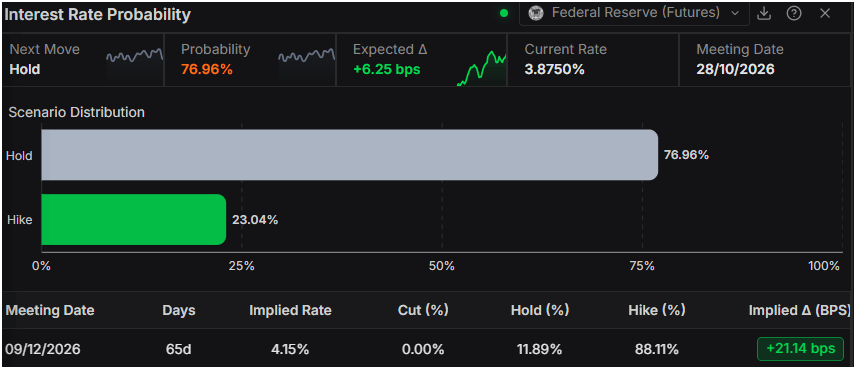
Money markets price in a nearly 77% chance that the Fed will stand pat at the October meeting, but the odds of a rate hike in December are at 88%, according to Prime Terminal data.
Friday’s September Nonfarm Payrollscame in lower than expected and sent XAU/USD to a weekly peak of $4,227 before sellers stepped in and sent spot prices below the $4,150 psychological figure.
The jump in US Treasury yields undermines Gold's non-yielding status, even though it can also serve as a hedge against inflation.
Tensions in the Middle East escalate as Yemeni forces clashed with Houthis over Bab al-Mandab. Yemeni forces, with air support, announced they captured Al-Makah after exchanging fire with Houthi militias.
Investors brace for the ADP Employment Change 4-week average data ahead of the September Federal Open Market Committee (FOMC) meeting minutes on Wednesday, which will lay the path for the future of interest rates in the US.
XAU/USD technical analysis: Gold price pressured on the downside, as RSI stays bearish
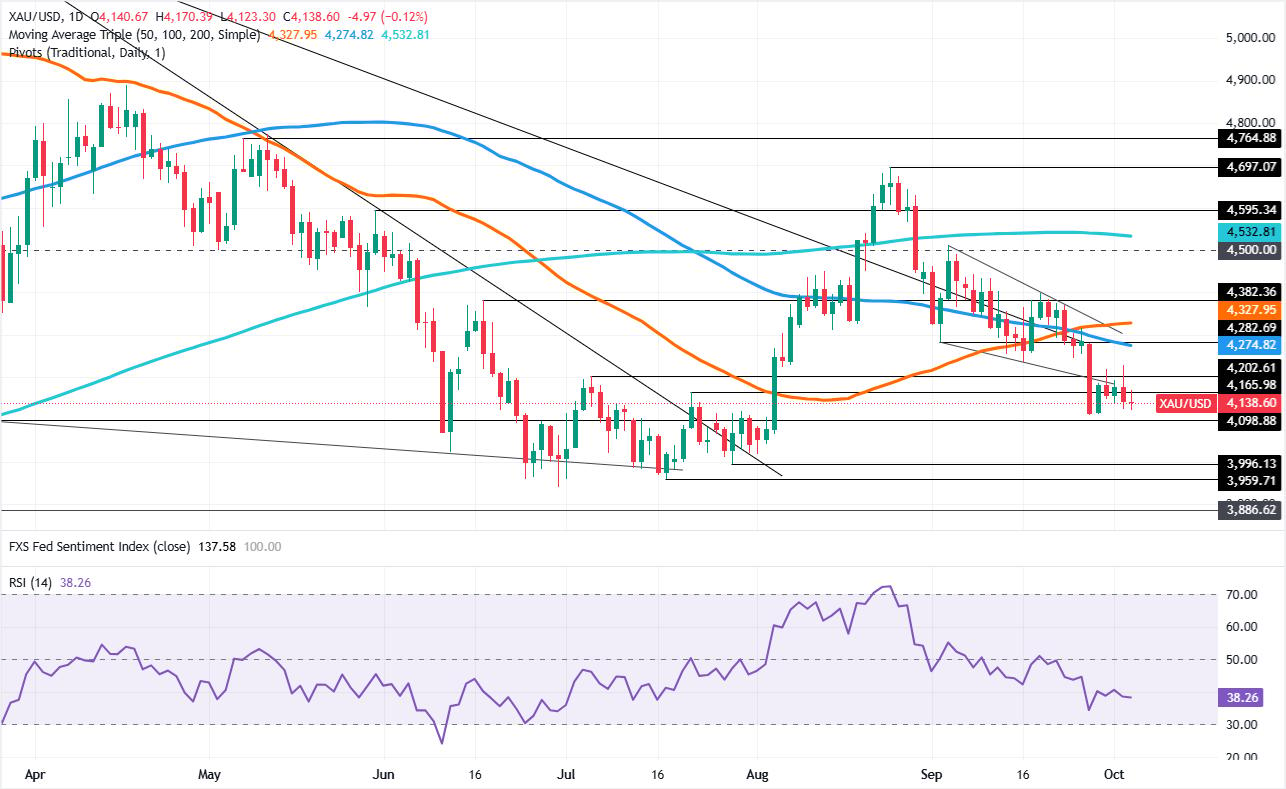
Price action shows Gold is poised to consolidate further below $4,150, with eyes set on challenging the first support at $4,100. Momentum suggests further downside is expected, as the Relative Strength Index (RSI) is trending lower, nearing oversold conditions.
If XAU/USD falls beneath $4,100, it paves the way for a move to the $4,000 figure, slightly above the July 29 swing low of $3,996. Once those two levels are taken out, the year-to-date (YTD) low of $3,941 would be next.
For a bullish reversal, bullion buyers must push prices above $4,200 and clear the 100- and 50-day Simple Moving Averages (SMAs), at $4,274 and $4,327, respectively. Once hurdled, up next is $4,500.
Gold FAQs
Gold has played a key role in human’s history as it has been widely used as a store of value and medium of exchange. Currently, apart from its shine and usage for jewelry, the precious metal is widely seen as a safe-haven asset, meaning that it is considered a good investment during turbulent times. Gold is also widely seen as a hedge against inflation and against depreciating currencies as it doesn’t rely on any specific issuer or government.
Central banks are the biggest Gold holders. In their aim to support their currencies in turbulent times, central banks tend to diversify their reserves and buy Gold to improve the perceived strength of the economy and the currency. High Gold reserves can be a source of trust for a country’s solvency. Central banks added 1,136 tonnes of Gold worth around $70 billion to their reserves in 2022, according to data from the World Gold Council. This is the highest yearly purchase since records began. Central banks from emerging economies such as China, India and Turkey are quickly increasing their Gold reserves.
Gold has an inverse correlation with the US Dollar and US Treasuries, which are both major reserve and safe-haven assets. When the Dollar depreciates, Gold tends to rise, enabling investors and central banks to diversify their assets in turbulent times. Gold is also inversely correlated with risk assets. A rally in the stock market tends to weaken Gold price, while sell-offs in riskier markets tend to favor the precious metal.
The price can move due to a wide range of factors. Geopolitical instability or fears of a deep recession can quickly make Gold price escalate due to its safe-haven status. As a yield-less asset, Gold tends to rise with lower interest rates, while higher cost of money usually weighs down on the yellow metal. Still, most moves depend on how the US Dollar (USD) behaves as the asset is priced in dollars (XAU/USD). A strong Dollar tends to keep the price of Gold controlled, whereas a weaker Dollar is likely to push Gold prices up.
인기 기사
1Singapore Dollar: MAS seen very slightly tightening – Standard Chartered2Silver Price Forecast: XAG/USD builds base above $60, eyes $643Chinese Yuan: Sideways with firmer bias against US Dollar - UOB4Gold stalls below $4,150 as rising US yields offset Fed relief5Markets just priced out rate hikes on financial stress. This chart shows why 2022-23 says they’ll be wrong6Japanese Yen weakens as wide yield gap supports US Dollar7Forex Today: PMIs in Europe and Fedspeak will do the rounds8United States: Domestic rare earth production push – ING9Cryptocurrencies price prediction: XRP, Bitcoin & Cryptos – American Wrap 05 October
실시간 시세


GOLD & PRECIOUS METALS에 대한 모든 것

소셜 미디어












이 웹사이트에 제공된 정보는 일반적인 성격의 정보일 뿐이며 개인 맞춤형 금융 자문을 구성하지 않습니다. 이 웹사이트의 정보를 바탕으로 행동하기 전에, 귀하의 목표, 재정 상황 및 필요에 비추어 해당 정보의 적합성을 고려해야 합니다. CFD 및 FX 마진 계약에 대한 투자는 상당한 위험을 수반하며 모든 투자자에게 적합하지 않을 수 있습니다. 귀하는 최초 예치금보다 더 큰 손실을 입을 수 있습니다. 귀하는 기초자산에 대한 소유권이나 어떠한 이해관계도 보유하지 않습니다. 거래를 시작하기 전에 독립적인 자문을 구하고 관련 위험을 충분히 이해하시기를 권장합니다. 웹사이트에 기재된 상품을 취득하기 전에 공시 문서를 읽고 검토하는 것이 중요합니다. 이 웹사이트에서 제공되는 정보 및 광고는 그러한 사용이 현지 법률 및 규정에 위배되는 국가 또는 관할권의 개인이 사용하도록 의도된 것이 아닙니다. 이 웹사이트에서 제공되는 상품 및 서비스는 미국, 말레이시아 및 태국 거주자를 대상으로 하지 않습니다.
TMGM은 다양한 관할권에서 승인 및 규제를 받고 있습니다.
TMGM으로 거래하는 Trademax Australia Limited는 호주 증권투자위원회(ASIC)의 규제를 받으며, AFSL 번호 436416이고 Level 28, One International Tower, 100 Barangaroo Avenue, 2000 Sydney, NSW Australia에 위치하고 있습니다.
이메일: support@tmgm.com.au
TMGM으로 거래하는 Trademax Global Limited는 바누아투 금융서비스위원회(VFSC)의 승인 및 규제를 받으며, 등록 번호 40356이고 1276, Kumul Highway, Port Vila, Vanuatu, Republic of Vanuatu에 등록되어 있습니다.
이메일: support@tmgm.com
Trademax Global Markets (SE) Limited(이하 TMGM)는 세이셸 금융청(FSA)의 인가 및 규제를 받으며, 허가 번호는 SD224입니다. 회사는 세이셸 마헤, 프로비던스 에스테이트 ABIS 센터, 사무실 번호 13에 등록되어 있습니다.
이메일: support@tmgm.com
TMGM으로 거래하는 Trademax Global Markets (International) Pty Ltd는 모리셔스 금융서비스위원회(FSC)의 승인 및 규제를 받으며 라이선스 번호 GB22201012이고, 33, Edith Cavell Street C/o IQ EQ Fund Services (Mauritius) Ltd Port Louis, 11324 Mauritius에 등록되어 있습니다.
이메일: support@tmgm.com
Copyright © TMGM. All rights reserved