


Dow Jones Industrial Average tests fresh lows as long bond yields climb
- DJIA slides to 51,100, its lowest since June, as 30-year yields reach a 2004 high.
- Philadelphia Fed President Paulson backs more hikes with rates at 3.75-4.00%.
- 30-year mortgage rates near 7%, a full point higher than before the Iran war.
The 30-year Treasury yield rose to its highest since 2004 on Thursday while the two-year yield barely moved, and the Dow Jones Industrial Average is falling with the long one. The index dropped as far as 51,100, its lowest since June, and is on track for a third losing session in a row.

Two-year yields follow what traders expect the Fed to do over the next couple of years. The 30-year follows what investors want paid for lending to Washington for three decades, and that price is the one still going up. Two Fed officials spent Thursday talking about the rate the Fed sets, and the market repriced the one it doesn't.
The end of forward guidance, announced with forward guidance
New York Fed President Williams told a London conference on Thursday that the era of explicit forward guidance is over, the same line Fed Chair Warsh has taken. In the same remarks he said market bets on another hike before year-end looked reasonable to him.
Philadelphia Fed President Paulson, a voter this year who had favoured holding rates before the September meeting, said a little more tightening may be needed after the September 16 hike to 3.75-4.00%. She put the new inflation pressure down to the Middle East conflict and the artificial intelligence build-out, with tariff pressure easing.
The two-year yield is close to its 2023 high and didn't react to either speech, so for the Dow the next quarter-point is already in the price. Futures price an October hike as more likely than not, and 16 of 18 policymakers projected at least one more this year. President Paulson's warmest words on underlying inflation were that it hasn't gotten worse this year, which is the case for another hike delivered as praise.
The mortgage market has already done four hikes' worth of tightening
Investors want more to lend for 30 years because the Iran war has kept energy expensive, growth has held up and governments keep borrowing. Brent traded near $105 a barrel on Thursday. Japan's 10-year yield reached its highest since 1996 as Tokyo reopened after a three-day holiday, and Germany's finance agency expects record federal borrowing of €525.5 billion in 2026.
Bank of America analysts put US federal interest costs at a record 3.3% of Gross Domestic Product (GDP) in the second quarter, up from 1.7% the last time the 10-year yield was near 5% in 2007. Chair Warsh can raise the overnight rate at any meeting, but the 30-year yield is set by people who have to hold the bond until 2056.
The 30-year mortgage rate is near 7%, a full point above where it was before the war. The first Dow members exposed are Home Depot (HD) and Sherwin-Williams (SHW), which sell hardware and paint into a housing market where fewer people move at 7%. JPMorgan Chase (JPM) is the member that could come out ahead, because a bank borrows short and lends long, and a wider gap between two-year and 30-year yields could lift what it earns on new loans.
Levels that change the reading
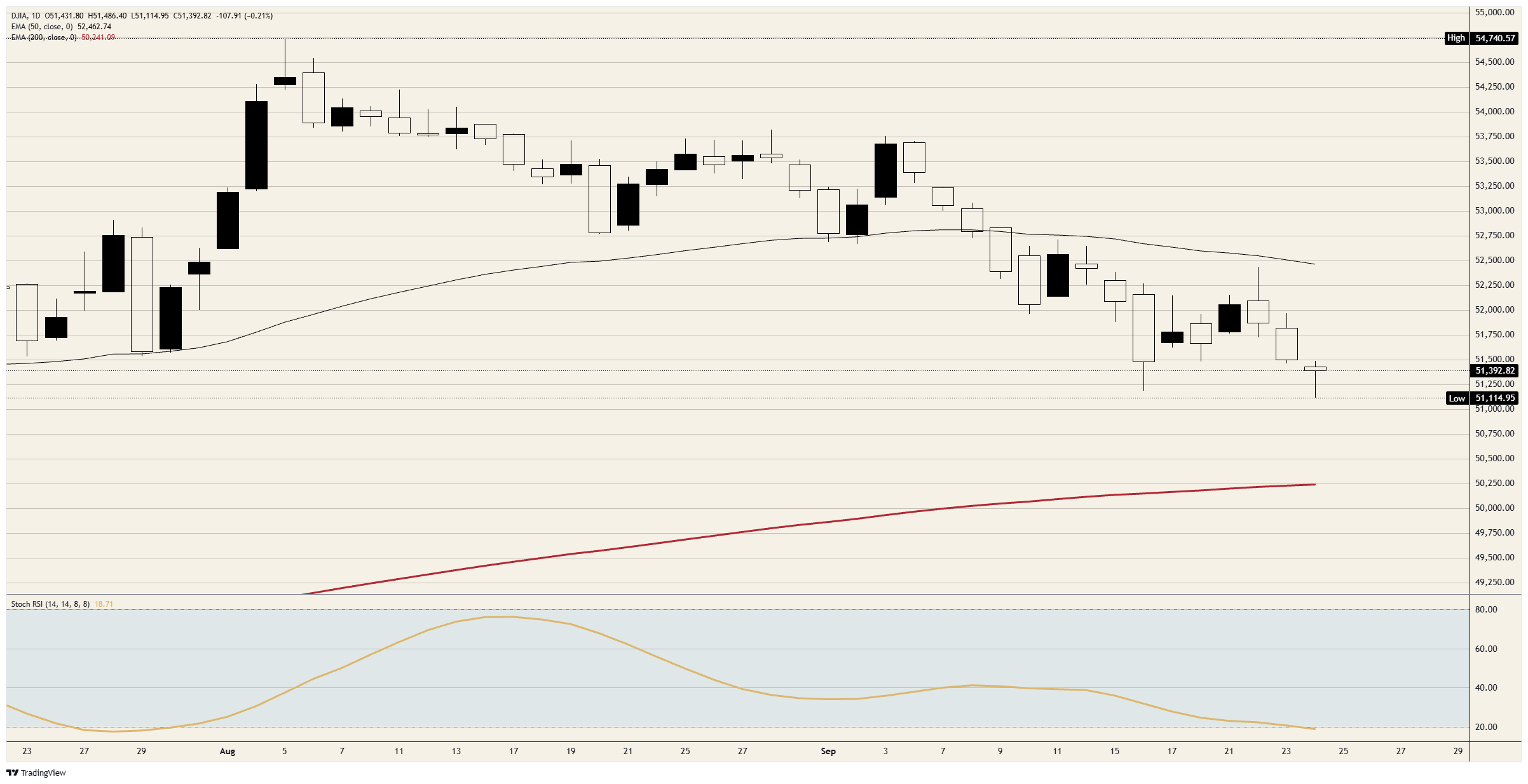
Resistance: 51,500 is Wednesday's close, and Thursday opened beneath it and hasn't traded back above it since. Above that, 52,000 is the level the index gave up on Tuesday and hasn't regained, and each session since has made a lower high.
Support: Thursday's low near 51,100 took out the September 16 low and is the lowest since June, though buyers took back most of the drop off that low. 51,000 is the next round number beneath it.
Bias: The lean is short below 52,000, with 51,000 as the first objective and the 200-day Exponential Moving Average (EMA) near 50,250 as the second. The daily Stochastic Relative Strength Index (Stoch RSI) is near 19, its first reading under 20 since late July, so a bounce toward 51,500 could come first without changing the call. A daily close above 52,000 ends the short case.
Dow Jones daily chart
Dow Jones FAQs
The Dow Jones Industrial Average, one of the oldest stock market indices in the world, is compiled of the 30 most traded stocks in the US. The index is price-weighted rather than weighted by capitalization. It is calculated by summing the prices of the constituent stocks and dividing them by a factor, currently 0.152. The index was founded by Charles Dow, who also founded the Wall Street Journal. In later years it has been criticized for not being broadly representative enough because it only tracks 30 conglomerates, unlike broader indices such as the S&P 500.
Many different factors drive the Dow Jones Industrial Average (DJIA). The aggregate performance of the component companies revealed in quarterly company earnings reports is the main one. US and global macroeconomic data also contributes as it impacts on investor sentiment. The level of interest rates, set by the Federal Reserve (Fed), also influences the DJIA as it affects the cost of credit, on which many corporations are heavily reliant. Therefore, inflation can be a major driver as well as other metrics which impact the Fed decisions.
Dow Theory is a method for identifying the primary trend of the stock market developed by Charles Dow. A key step is to compare the direction of the Dow Jones Industrial Average (DJIA) and the Dow Jones Transportation Average (DJTA) and only follow trends where both are moving in the same direction. Volume is a confirmatory criteria. The theory uses elements of peak and trough analysis. Dow’s theory posits three trend phases: accumulation, when smart money starts buying or selling; public participation, when the wider public joins in; and distribution, when the smart money exits.
There are a number of ways to trade the DJIA. One is to use ETFs which allow investors to trade the DJIA as a single security, rather than having to buy shares in all 30 constituent companies. A leading example is the SPDR Dow Jones Industrial Average ETF (DIA). DJIA futures contracts enable traders to speculate on the future value of the index and Options provide the right, but not the obligation, to buy or sell the index at a predetermined price in the future. Mutual funds enable investors to buy a share of a diversified portfolio of DJIA stocks thus providing exposure to the overall index.
인기 기사
1US-Iran talks eye phased Hormuz deal, but leverage stalls progress2British Pound four-day slide deepens as US yields fuel US Dollar rally3Dow Jones Industrial Average tests fresh lows as long bond yields climb4New Zealand Dollar remains under pressure, RBNZ rate hike bets cushion losses5Europe: Rightward risks build – Standard Chartered6Canadian Dollar falls to two-month low as higher US yields outweigh Oil support7Germany: Resilient but modest recovery – Commerzbank8Xi pitches cooperation, friendship, and fairness amid overhanging trade war truce9United States: Bifurcated revival with advanced sectors – ING



소셜 미디어












이 웹사이트에 제공된 정보는 일반적인 성격의 정보일 뿐이며 개인 맞춤형 금융 자문을 구성하지 않습니다. 이 웹사이트의 정보를 바탕으로 행동하기 전에, 귀하의 목표, 재정 상황 및 필요에 비추어 해당 정보의 적합성을 고려해야 합니다. CFD 및 FX 마진 계약에 대한 투자는 상당한 위험을 수반하며 모든 투자자에게 적합하지 않을 수 있습니다. 귀하는 최초 예치금보다 더 큰 손실을 입을 수 있습니다. 귀하는 기초자산에 대한 소유권이나 어떠한 이해관계도 보유하지 않습니다. 거래를 시작하기 전에 독립적인 자문을 구하고 관련 위험을 충분히 이해하시기를 권장합니다. 웹사이트에 기재된 상품을 취득하기 전에 공시 문서를 읽고 검토하는 것이 중요합니다. 이 웹사이트에서 제공되는 정보 및 광고는 그러한 사용이 현지 법률 및 규정에 위배되는 국가 또는 관할권의 개인이 사용하도록 의도된 것이 아닙니다. 이 웹사이트에서 제공되는 상품 및 서비스는 미국, 말레이시아 및 태국 거주자를 대상으로 하지 않습니다.
TMGM은 다양한 관할권에서 승인 및 규제를 받고 있습니다.
TMGM으로 거래하는 Trademax Australia Limited는 호주 증권투자위원회(ASIC)의 규제를 받으며, AFSL 번호 436416이고 Level 28, One International Tower, 100 Barangaroo Avenue, 2000 Sydney, NSW Australia에 위치하고 있습니다.
이메일: support@tmgm.com.au
TMGM으로 거래하는 Trademax Global Limited는 바누아투 금융서비스위원회(VFSC)의 승인 및 규제를 받으며, 등록 번호 40356이고 1276, Kumul Highway, Port Vila, Vanuatu, Republic of Vanuatu에 등록되어 있습니다.
이메일: support@tmgm.com
Trademax Global Markets (SE) Limited(이하 TMGM)는 세이셸 금융청(FSA)의 인가 및 규제를 받으며, 허가 번호는 SD224입니다. 회사는 세이셸 마헤, 프로비던스 에스테이트 ABIS 센터, 사무실 번호 13에 등록되어 있습니다.
이메일: support@tmgm.com
TMGM으로 거래하는 Trademax Global Markets (International) Pty Ltd는 모리셔스 금융서비스위원회(FSC)의 승인 및 규제를 받으며 라이선스 번호 GB22201012이고, 33, Edith Cavell Street C/o IQ EQ Fund Services (Mauritius) Ltd Port Louis, 11324 Mauritius에 등록되어 있습니다.
이메일: support@tmgm.com
Copyright © TMGM. All rights reserved