


Bitcoin Price Forecast: BTC consolidates below $85,000 amid rising US Treasury yields, derivatives deleveraging
- Bitcoin consolidates near $83,000 on Wednesday after bulls failed to close above the key $85,000 level earlier this week.
- Rising US Treasury yields and key macroeconomic data releases this week are keeping BTC investors cautious.
- A K33 report highlights that BTC absorbed a major derivatives deleveraging event without a sharp decline, keeping its technical structure relatively healthy.
Bitcoin (BTC) consolidates near $83,000 at the time of writing on Wednesday after bulls failed to close above the key $85,000 level earlier this week. The Crypto King's investors remain cautious amid rising US Treasury yields and several key macroeconomic data releases due this week. Meanwhile, a K33 Research report suggests that BTC's market structure remains relatively healthy, as the market absorbed a major derivatives deleveraging event without a sharp price decline.

Soaring US yields weigh on BTC
Bitcoin bulls are losing momentum, with BTC failing to recover above the $85,000 resistance level at the start of the week and consolidating below this zone so far.
Crypto markets are being held back by the same force weighing on broader risk assets: soaring US Treasury yields. The 5-year yield has risen above 5%, while the 10-year yield is above 5.2%, with both at 19-year highs. Surging yields are pushing investors away from risk assets, which pauses the Crypto King's upside momentum.
In addition, bulls remain reluctant to add bullish positions ahead of key macroeconomic data releases this week. The US Personal Consumption Expenditures (PCE) Price Index – the Federal Reserve's (Fed) preferred inflation gauge – will be published on Wednesday, along with the final US Gross Domestic Product (GDP) Q2 reading.
Traders will also watch the US ISM Manufacturing PMI due on Thursday and the important Nonfarm Payrolls (NFP) report release on Friday. Apart from this, speeches from influential Federal Open Market Committee (FOMC) members will be looked upon for more cues about the US central bank's future policy path. These developments could influence the US Dollar (USD) and, in turn, provide fresh impetus to risky assets such as BTC.
BTC's structure remains relatively healthy
A K33 Research report published on Tuesday highlighted that BTC has absorbed a major derivatives deleveraging event without a sharp price decline, keeping its technical structure relatively healthy.
The report explained that BTC's derivatives markets have undergone an orderly reset, with Chicago Mercantile Exchange (CME) and perpetual Open Interest (OI) falling by 49,028 BTC over the past seven days, the largest weekly decline since October 2025.
The reset appears to have been driven by profit-taking, while spot trading volumes remained below yearly averages despite higher prices, suggesting limited sell-side pressure.
"With little leverage left to trigger forced liquidations and holders reluctant to sell 33% below all-time high (ATH), we see considerable upside asymmetry," the analyst said.
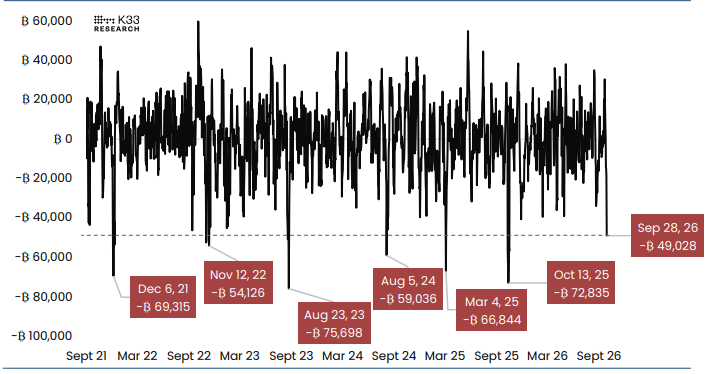
In addition, past orderly unwinds offer few directional signals, but they have tended to precede periods of low forward volatility as traders remain on the sidelines. Structurally, however, the market remains sound, the report noted.
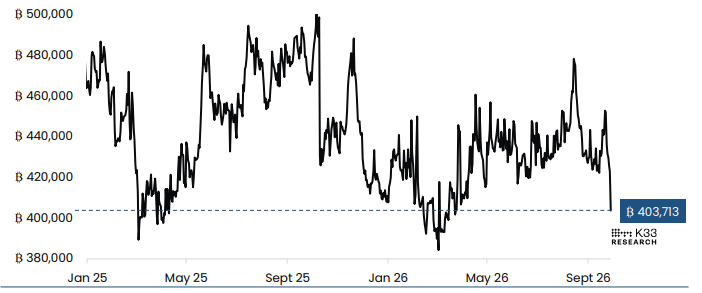
Aggregate OI is approaching 400K BTC, a level visited only twice in the past two years: between March 9 and April 10, 2025, and between February 15 and March 15, 2026, as shown in the chart below.
Both periods marked consolidation phases that were followed by solid BTC appreciation as traders returned to the market.
"With leverage this low, the risk of an imminent long squeeze is limited, a welcome backdrop for a BTC trend that remains solid above its major moving averages," the report stated.
Bitcoin technical outlook: Momentum indicators show fading upside pressure
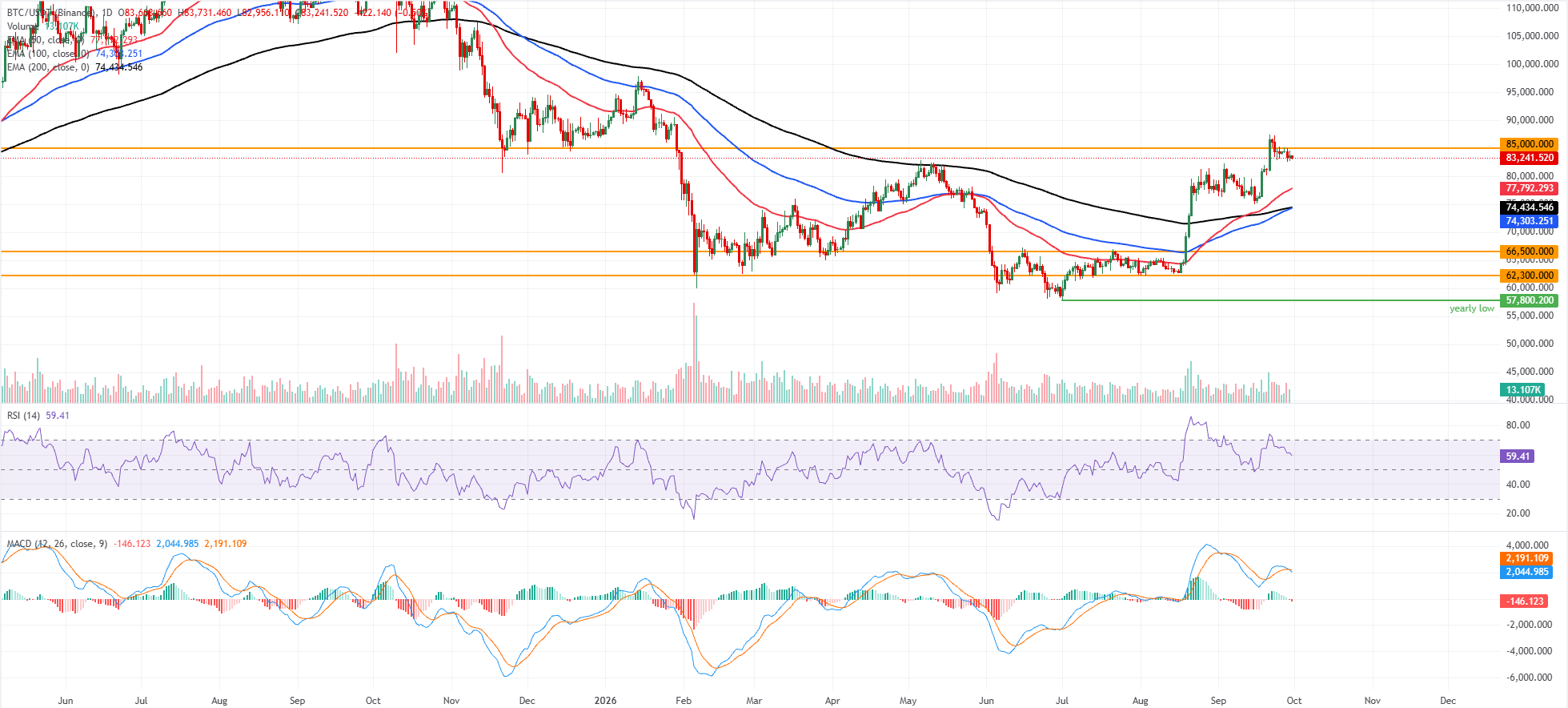
Bitcoin price trades at $83,241 on Wednesday after failing to close above key resistance near $85,000 earlier this week. Despite this pullback, BTC holds above the 50-day, 100-day and 200-day Exponential Moving Averages (EMAs), which collectively reinforce a bullish near-term bias.
The Relative Strength Index (RSI) at 59 stays in neutral-to-positive territory, hinting at constructive but not overextended momentum, while the Moving Average Convergence Divergence (MACD) histogram slips slightly negative, suggesting waning upside pressure rather than a decisive trend shift.
On the downside, initial support is seen at the 50-day EMA near $77,792, followed by the longer-term 200-day EMA at $74,434 and the 100-day EMA at $74,303, before deeper structural floors emerge at the previously referenced horizontal levels of $66,500 and $62,300.
On the topside, a decisive push higher would face the next notable resistance around the horizontal barrier at $85,000, where fresh selling interest could emerge if momentum fails to re-accelerate.
(The technical analysis of this story was written with the help of an AI tool. Know more.)
Bitcoin, altcoins, stablecoins FAQs
Bitcoin is the largest cryptocurrency by market capitalization, a virtual currency designed to serve as money. This form of payment cannot be controlled by any one person, group, or entity, which eliminates the need for third-party participation during financial transactions.
Altcoins are any cryptocurrency apart from Bitcoin, but some also regard Ethereum as a non-altcoin because it is from these two cryptocurrencies that forking happens. If this is true, then Litecoin is the first altcoin, forked from the Bitcoin protocol and, therefore, an “improved” version of it.
Stablecoins are cryptocurrencies designed to have a stable price, with their value backed by a reserve of the asset it represents. To achieve this, the value of any one stablecoin is pegged to a commodity or financial instrument, such as the US Dollar (USD), with its supply regulated by an algorithm or demand. The main goal of stablecoins is to provide an on/off-ramp for investors willing to trade and invest in cryptocurrencies. Stablecoins also allow investors to store value since cryptocurrencies, in general, are subject to volatility.
Bitcoin dominance is the ratio of Bitcoin's market capitalization to the total market capitalization of all cryptocurrencies combined. It provides a clear picture of Bitcoin’s interest among investors. A high BTC dominance typically happens before and during a bull run, in which investors resort to investing in relatively stable and high market capitalization cryptocurrency like Bitcoin. A drop in BTC dominance usually means that investors are moving their capital and/or profits to altcoins in a quest for higher returns, which usually triggers an explosion of altcoin rallies.
인기 기사
1EUR/USD: Dollar correction faces resistance – Societe Generale2Brent Oil: Prices reverse on supply headlines – Deutsche Bank3US Dollar: Coin flip for October rate hike – DBS4USD/JPY: Offered tone with key 155–158.20 range – Societe Generale5Pound: Stronger UK growth and reverse-Brexit risk – MUFG6US Treasuries: Curve steepens with long yields at cycle highs – Deutsche Bank7Mexican Peso: Carry trade unwind risks into Q4 – Societe Generale8EUR/USD: Range view holds as Dollar doubts grow – Deutsche Bank9Silver price today: Silver falls, according to FXStreet data
실시간 시세



소셜 미디어












이 웹사이트에 제공된 정보는 일반적인 성격의 정보일 뿐이며 개인 맞춤형 금융 자문을 구성하지 않습니다. 이 웹사이트의 정보를 바탕으로 행동하기 전에, 귀하의 목표, 재정 상황 및 필요에 비추어 해당 정보의 적합성을 고려해야 합니다. CFD 및 FX 마진 계약에 대한 투자는 상당한 위험을 수반하며 모든 투자자에게 적합하지 않을 수 있습니다. 귀하는 최초 예치금보다 더 큰 손실을 입을 수 있습니다. 귀하는 기초자산에 대한 소유권이나 어떠한 이해관계도 보유하지 않습니다. 거래를 시작하기 전에 독립적인 자문을 구하고 관련 위험을 충분히 이해하시기를 권장합니다. 웹사이트에 기재된 상품을 취득하기 전에 공시 문서를 읽고 검토하는 것이 중요합니다. 이 웹사이트에서 제공되는 정보 및 광고는 그러한 사용이 현지 법률 및 규정에 위배되는 국가 또는 관할권의 개인이 사용하도록 의도된 것이 아닙니다. 이 웹사이트에서 제공되는 상품 및 서비스는 미국, 말레이시아 및 태국 거주자를 대상으로 하지 않습니다.
TMGM은 다양한 관할권에서 승인 및 규제를 받고 있습니다.
TMGM으로 거래하는 Trademax Australia Limited는 호주 증권투자위원회(ASIC)의 규제를 받으며, AFSL 번호 436416이고 Level 28, One International Tower, 100 Barangaroo Avenue, 2000 Sydney, NSW Australia에 위치하고 있습니다.
이메일: support@tmgm.com.au
TMGM으로 거래하는 Trademax Global Limited는 바누아투 금융서비스위원회(VFSC)의 승인 및 규제를 받으며, 등록 번호 40356이고 1276, Kumul Highway, Port Vila, Vanuatu, Republic of Vanuatu에 등록되어 있습니다.
이메일: support@tmgm.com
Trademax Global Markets (SE) Limited(이하 TMGM)는 세이셸 금융청(FSA)의 인가 및 규제를 받으며, 허가 번호는 SD224입니다. 회사는 세이셸 마헤, 프로비던스 에스테이트 ABIS 센터, 사무실 번호 13에 등록되어 있습니다.
이메일: support@tmgm.com
TMGM으로 거래하는 Trademax Global Markets (International) Pty Ltd는 모리셔스 금융서비스위원회(FSC)의 승인 및 규제를 받으며 라이선스 번호 GB22201012이고, 33, Edith Cavell Street C/o IQ EQ Fund Services (Mauritius) Ltd Port Louis, 11324 Mauritius에 등록되어 있습니다.
이메일: support@tmgm.com
Copyright © TMGM. All rights reserved