

Trading
Explora una amplia gama de mercados con precios competitivos, liquidez profunda y herramientas de trading avanzadas.
Más información 
Plataforma
Opera sin interrupciones con la potente plataforma de TMGM, diseñada para ofrecer velocidad, precisión y una experiencia de trading superior.
Más información Plataforma de trading
Herramientas de trading
Academia
Aprende los fundamentos del trading con recursos ideales para principiantes, incluidas guías, seminarios web y análisis del mercado.
Más información Academia TMGM
Noticias y análisis
Obtén actualizaciones del mercado en tiempo real y análisis de expertos para adelantarte a las oportunidades de trading
Más información Noticias y análisis
Acerca de
Descubre qué distingue a TMGM: nuestra presencia global, solidez regulatoria y compromiso con la innovación en el trading.
Más información Por qué elegir TMGM
Japanese Yen keeps sliding as Tokyo repeats its warning and holds fire
- USD/JPY rises for a fifth straight session to the edge of 159.00 as Tokyo holds fire.
- BoJ policy rate at 1.25%, its highest in 31 years, against 3.75%-4.00% at the Fed.
- Japan's Tankan survey lands on September 30, Tokyo CPI on October 1.
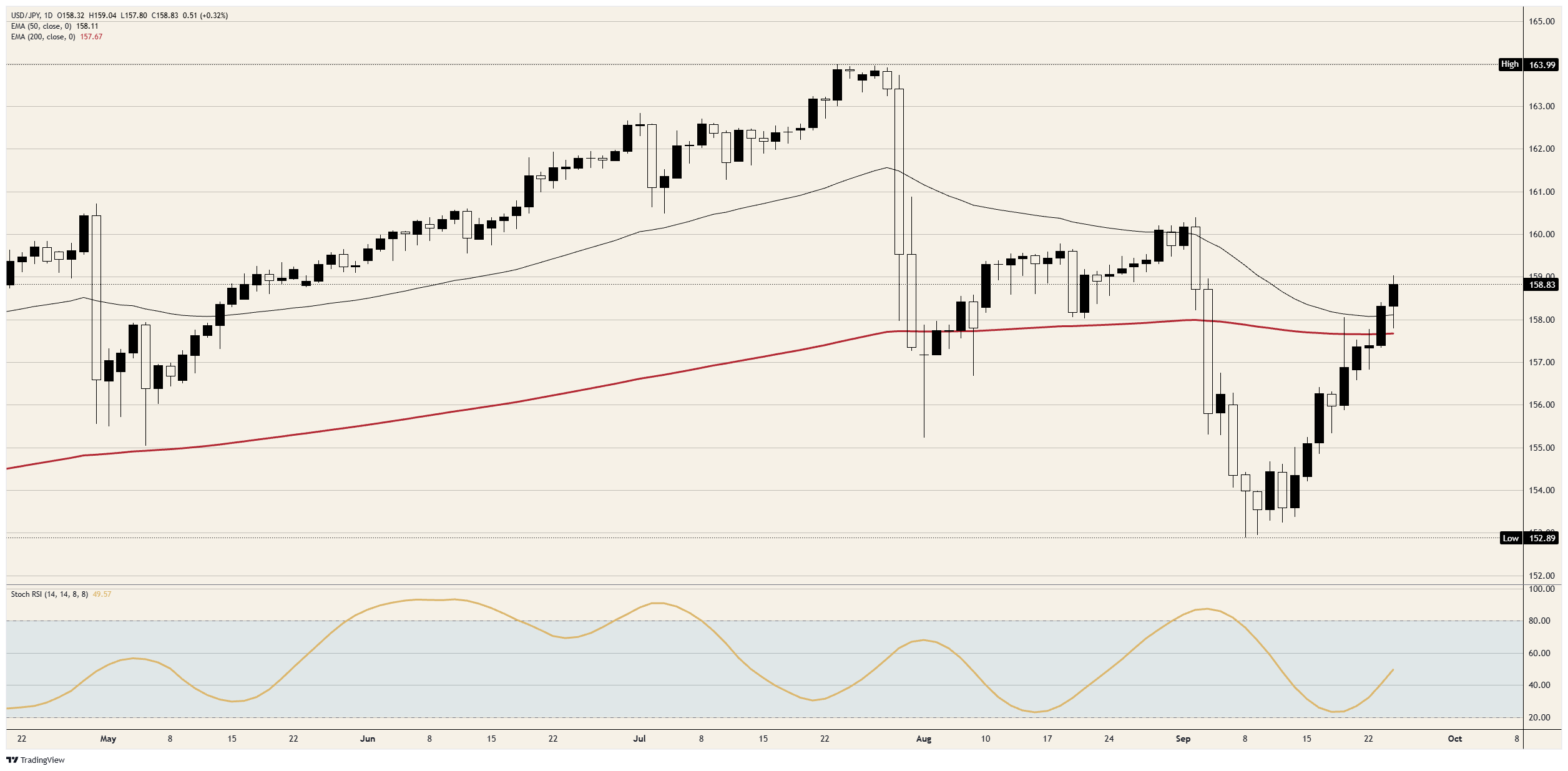
Finance Minister Katayama said on Thursday that the principles behind the joint US-Japan intervention of July 31 are still alive, and USD/JPY went on to touch 159.00, its highest since early September. The pair is trading just under 159.00, on track for a fifth straight gain. In a single week the Bank of Japan (BoJ) has raised its policy rate, Japanese authorities have checked rates with dealers and Katayama has repeated her warning, and USD/JPY is higher than it was before any of them.

Katayama declined to comment on levels. Japanese authorities checked rates with dealers in overseas markets on Friday, September 18, according to people familiar with the matter, a step that often comes before intervention. Tokyo was shut from Monday to Wednesday for national holidays, so Thursday was the first Japanese session since the September 18 rate check. Japan last bought Yen on July 31, jointly with the US, after USD/JPY went through 163.00, and is reported to have done so on April 30 after a move just above 160.50.
A 1.25% BoJ rate is still 2.5 points below the Fed's floor
The BoJ raised its policy rate to 1.25% on September 18, the highest since 1995, and the Yen fell on the day. BoJ Governor Ueda said financial conditions would stay accommodative, and two board members voted against the increase, which suggested the next one isn't close.
The Fed raised its range to 3.75%-4.00% two days earlier without a single dissent, and futures lean toward another quarter-point on October 28. Japan's highest rate in three decades left the gap to US rates exactly where it was.
Tokyo inflation is running below the BoJ's 2% target
The BoJ publishes minutes of its July 30-31 meeting on Sunday at 23:50 GMT, and they record board member Takata as the only vote for the 1.25% rate the board adopted seven weeks later. August retail sales follow on Tuesday at 23:50 GMT. The quarterly Tankan survey of large manufacturers lands on Wednesday, September 30 at 23:50 GMT, previously at 22 with an outlook of 17, alongside a summary of opinions from the September meeting.
Tokyo's Consumer Price Index (CPI) for September comes out on Thursday, October 1 at 23:30 GMT, after 1.9% YoY in August and 1.8% excluding fresh food. A soft reading would make another BoJ hike this year harder to argue for. On the US side, August inflation on the Personal Consumption Expenditures (PCE) measure comes out on September 30, and the Nonfarm Payrolls (NFP) report on October 2 carries average hourly earnings, which grew 3.1% YoY in August.
Levels and bias
Resistance: Thursday's high came in just above 159.00, the top of a five-session run. Above that, 160.00 is the next round number and the area where Japan's warnings have turned into action this year.
Support: The 50-day Exponential Moving Average (EMA), just above 158.00, is the first floor, and USD/JPY got back above it on Wednesday for the first time since early September. Below that, Thursday's low just above 157.50 is the next floor, with 157.00 under it.
Bias: Long above 158.00, looking for 159.50 and then 160.00, where intervention risk makes it the last objective rather than a waypoint. The daily Stochastic Relative Strength Index (Stoch RSI) is near 50 and rising from under 25 in mid-September. A daily close under 157.50 ends the long.
USD/JPY daily chart
Japanese Yen FAQs
The Japanese Yen (JPY) is one of the world’s most traded currencies. Its value is broadly determined by the performance of the Japanese economy, but more specifically by the Bank of Japan’s policy, the differential between Japanese and US bond yields, or risk sentiment among traders, among other factors.
One of the Bank of Japan’s mandates is currency control, so its moves are key for the Yen. The BoJ has directly intervened in currency markets sometimes, generally to lower the value of the Yen, although it refrains from doing it often due to political concerns of its main trading partners. The BoJ ultra-loose monetary policy between 2013 and 2024 caused the Yen to depreciate against its main currency peers due to an increasing policy divergence between the Bank of Japan and other main central banks. More recently, the gradually unwinding of this ultra-loose policy has given some support to the Yen.
Over the last decade, the BoJ’s stance of sticking to ultra-loose monetary policy has led to a widening policy divergence with other central banks, particularly with the US Federal Reserve. This supported a widening of the differential between the 10-year US and Japanese bonds, which favored the US Dollar against the Japanese Yen. The BoJ decision in 2024 to gradually abandon the ultra-loose policy, coupled with interest-rate cuts in other major central banks, is narrowing this differential.
The Japanese Yen is often seen as a safe-haven investment. This means that in times of market stress, investors are more likely to put their money in the Japanese currency due to its supposed reliability and stability. Turbulent times are likely to strengthen the Yen’s value against other currencies seen as more risky to invest in.
Artículos destacados
1Federal Reserve seeks public input on two stablecoin proposals under GENIUS Act2Japanese Yen keeps sliding as Tokyo repeats its warning and holds fire3Australian Dollar tests 200-day SMA amid soaring US yields4Mexican Peso : Range view with downside risks against US Dollar – Rabobank5New Zealand Dollar grinds lower as US bond yields climb to new highs6Dow Jones Industrial Average falls a third day as bond yields climb7Pound Sterling slides again as Fed speakers line up behind another hike8Indonesian Rupiah: BI prioritizes IDR stability – Commerzbank9Ethereum Price Forecast: Whales resume accumulation as ETF flows remain strong
COTIZACIONES EN VIVO


¡Comience ahora!
Regístrese y acceda a los mercados globales en menos de 3 minutos

Conéctese con nosotros









Contactos
Teléfono: +61 2 8036 8388
Fax: +61 2 8036 8388
Correo electrónico: support@tmgm.com



La información proporcionada en este sitio web es únicamente de carácter general y no constituye asesoramiento financiero personal. Antes de actuar sobre cualquier información de este sitio web, debe considerar la idoneidad de la información en relación con sus objetivos, situación financiera y necesidades. Invertir en CFD y contratos de margen de FX conlleva riesgos significativos y no es adecuado para todos los inversores. Puede perder más que su depósito inicial. Usted no posee ni tiene ningún interés en el activo subyacente. Le recomendamos que busque asesoramiento independiente y se asegure de comprender plenamente los riesgos involucrados antes de operar. Es importante que lea y considere el documento de divulgación antes de adquirir cualquier producto listado en el sitio web. La información y los anuncios ofrecidos en este sitio web no están destinados al uso por parte de ninguna persona en ningún país o jurisdicción donde dicho uso sea contrario a las leyes y regulaciones locales. Los productos y servicios ofrecidos en este sitio web no están destinados a residentes de Estados Unidos, Malasia y Tailandia.
TMGM está autorizado y regulado en varias jurisdicciones.
Trademax Australia Limited, que opera como TMGM, está regulada por la Comisión Australiana de Valores e Inversiones (ASIC), AFSL n.º 436416, y está ubicada en Level 28, One International Tower, 100 Barangaroo Avenue, 2000 Sydney, NSW Australia.
Correo electrónico: support@tmgm.com.au
Trademax Global Limited, que opera como TMGM, está autorizada y regulada por la Comisión de Servicios Financieros de Vanuatu (VFSC), número de registro 40356, y está registrada en 1276, Kumul Highway, Port Vila, Vanuatu, República de Vanuatu.
Correo electrónico: support@tmgm.com
Trademax Global Markets (SE) Limited, que opera como TMGM, está autorizada y regulada por la Autoridad de Servicios Financieros (FSA) de Seychelles, con número de licencia SD224. La empresa está registrada en Office No 13, Providence Estate ABIS Centre, Mahe, Seychelles.
Correo electrónico: support@tmgm.com
Trademax Global Markets (International) Pty Ltd, que opera como TMGM, está autorizada y regulada por la Comisión de Servicios Financieros de Mauricio (FSC) con licencia n.º GB22201012, y está registrada en 33, Edith Cavell Street C/o IQ EQ Fund Services (Mauritius) Ltd Port Louis, 11324 Mauricio.
Correo electrónico: support@tmgm.com
Copyright © TMGM. Todos los derechos reservados