

Trading
Explora una amplia gama de mercados con precios competitivos, liquidez profunda y herramientas de trading avanzadas.
Más información 
Plataforma
Opera sin interrupciones con la potente plataforma de TMGM, diseñada para ofrecer velocidad, precisión y una experiencia de trading superior.
Más información Plataforma de trading
Herramientas de trading
Academia
Aprende los fundamentos del trading con recursos ideales para principiantes, incluidas guías, seminarios web y análisis del mercado.
Más información Academia TMGM
Noticias y análisis
Obtén actualizaciones del mercado en tiempo real y análisis de expertos para adelantarte a las oportunidades de trading
Más información Noticias y análisis
Acerca de
Descubre qué distingue a TMGM: nuestra presencia global, solidez regulatoria y compromiso con la innovación en el trading.
Más información Por qué elegir TMGM
Dow Jones Industrial Average falls a third day as bond yields climb
- DJIA closes at its lowest since mid-June, its third straight losing session.
- The 30-year US Treasury yield hit 5.50%, its highest since June 2004.
The 30-year Treasury yield touched 5.50% on Thursday, and two Fed officials gave bond buyers no reason to expect relief. New York Fed President Williams said another rate increase this year looks reasonable, and Philadelphia Fed President Paulson said rates may need to rise a little more. Sherwin-Williams (SHW), which sells paint into a housing market priced off long-term rates, was among the Dow's three biggest losers with Walmart (WMT) and International Business Machines (IBM).

Stocks came off their lows after Reuters reported that US and Iranian negotiators are discussing a phased deal to reopen the Strait of Hormuz. Brent still finished above $106 a barrel, up on the day, on a report that tankers may soon be able to use the strait again.
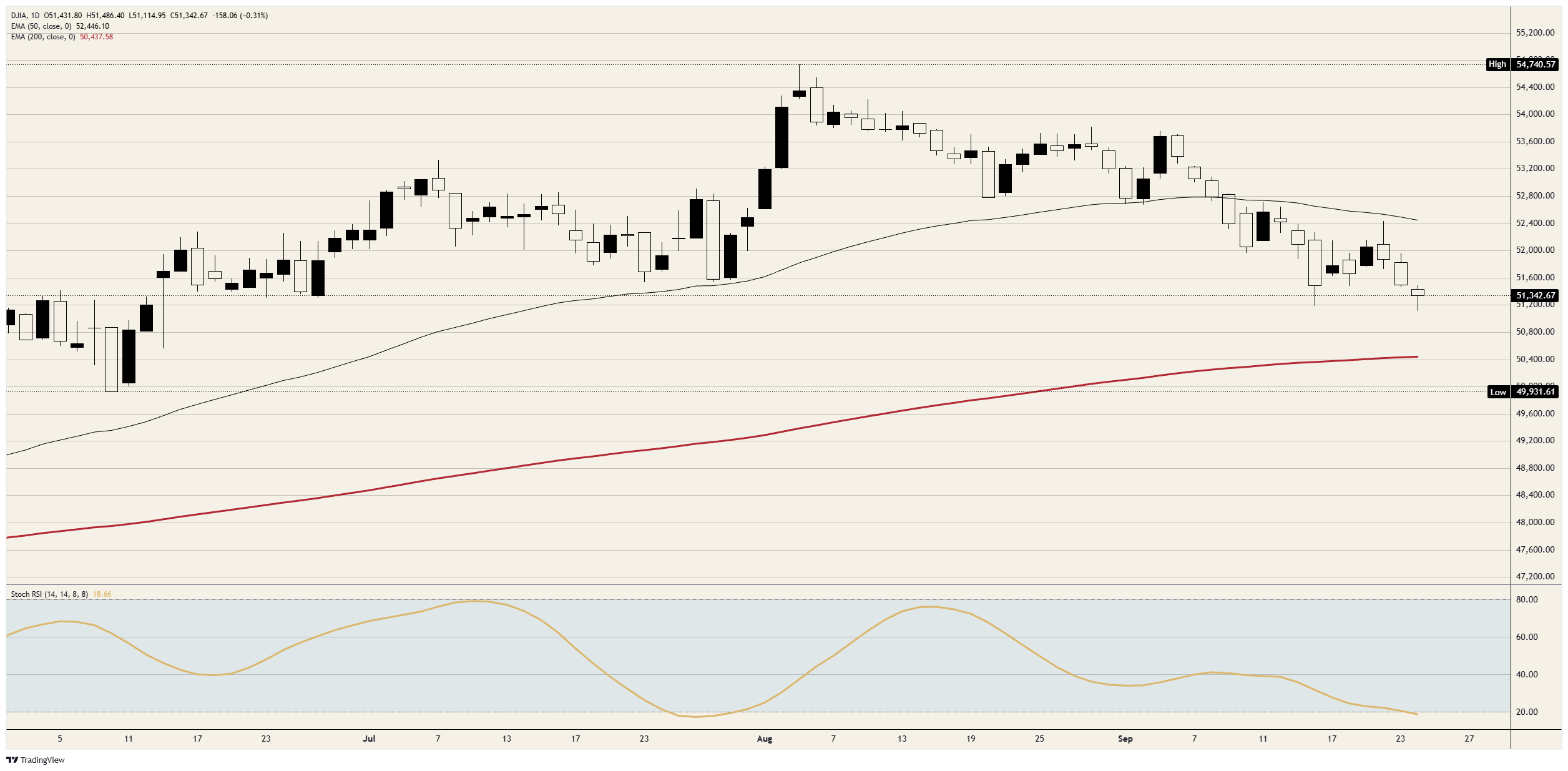
The index closed at its lowest since mid-June after dipping to the 51,100 area, beneath the September 16 low near 51,200. It has now given back about 70% of the June-to-August rally that peaked near 54,750. The S&P 500 finished flat and the Nasdaq Composite edged higher, so the Dow was the only one of the three to fall. It ended the day well below its 50-day moving average, a smoothed line of recent closes near 52,500 that has stayed above the index since the second week of September. The daily Stochastic Relative Strength Index (Stoch RSI), a momentum gauge, fell under 20 for the first time since late July.
Dow Jones daily chart
Dow Jones FAQs
The Dow Jones Industrial Average, one of the oldest stock market indices in the world, is compiled of the 30 most traded stocks in the US. The index is price-weighted rather than weighted by capitalization. It is calculated by summing the prices of the constituent stocks and dividing them by a factor, currently 0.152. The index was founded by Charles Dow, who also founded the Wall Street Journal. In later years it has been criticized for not being broadly representative enough because it only tracks 30 conglomerates, unlike broader indices such as the S&P 500.
Many different factors drive the Dow Jones Industrial Average (DJIA). The aggregate performance of the component companies revealed in quarterly company earnings reports is the main one. US and global macroeconomic data also contributes as it impacts on investor sentiment. The level of interest rates, set by the Federal Reserve (Fed), also influences the DJIA as it affects the cost of credit, on which many corporations are heavily reliant. Therefore, inflation can be a major driver as well as other metrics which impact the Fed decisions.
Dow Theory is a method for identifying the primary trend of the stock market developed by Charles Dow. A key step is to compare the direction of the Dow Jones Industrial Average (DJIA) and the Dow Jones Transportation Average (DJTA) and only follow trends where both are moving in the same direction. Volume is a confirmatory criteria. The theory uses elements of peak and trough analysis. Dow’s theory posits three trend phases: accumulation, when smart money starts buying or selling; public participation, when the wider public joins in; and distribution, when the smart money exits.
There are a number of ways to trade the DJIA. One is to use ETFs which allow investors to trade the DJIA as a single security, rather than having to buy shares in all 30 constituent companies. A leading example is the SPDR Dow Jones Industrial Average ETF (DIA). DJIA futures contracts enable traders to speculate on the future value of the index and Options provide the right, but not the obligation, to buy or sell the index at a predetermined price in the future. Mutual funds enable investors to buy a share of a diversified portfolio of DJIA stocks thus providing exposure to the overall index.
Artículos destacados
1New Zealand Dollar grinds lower as US bond yields climb to new highs2Dow Jones Industrial Average falls a third day as bond yields climb3Pound Sterling slides again as Fed speakers line up behind another hike4Indonesian Rupiah: BI prioritizes IDR stability – Commerzbank5Ethereum Price Forecast: Whales resume accumulation as ETF flows remain strong6Banxico: Flexible stance with upside risks – Rabobank7Norwegian Krone: Norges Bank hike supports currency – BBH8Mexican Peso slides to April lows as Banxico shrugs off Fed gap9SEC’s Peirce urges shift from KYC/AML data collection to zero-knowledge proofs
COTIZACIONES EN VIVO


TODO SOBRE INDICATORS
Zero Lag Exponential Moving Average (ZLEMA): Formula, Calculation and How to Use It
What Is a Triple Exponential Moving Average: How It Works & How to Trade It
Death Cross: Understand the Signal and Its Track Record
Double Exponential Moving Average: How It Works & How to Use It
What Is a Golden Cross? Formation and Trading Guide
EMA vs SMA: What's the Difference and Which Is Better?
Exponential Moving Average (EMA): Formula, Settings & Strategies
5 Best Support and Resistance Indicators
What is RSI, the Relative Strength Index
¡Comience ahora!
Regístrese y acceda a los mercados globales en menos de 3 minutos

Conéctese con nosotros









Contactos
Teléfono: +61 2 8036 8388
Fax: +61 2 8036 8388
Correo electrónico: support@tmgm.com



La información proporcionada en este sitio web es únicamente de carácter general y no constituye asesoramiento financiero personal. Antes de actuar sobre cualquier información de este sitio web, debe considerar la idoneidad de la información en relación con sus objetivos, situación financiera y necesidades. Invertir en CFD y contratos de margen de FX conlleva riesgos significativos y no es adecuado para todos los inversores. Puede perder más que su depósito inicial. Usted no posee ni tiene ningún interés en el activo subyacente. Le recomendamos que busque asesoramiento independiente y se asegure de comprender plenamente los riesgos involucrados antes de operar. Es importante que lea y considere el documento de divulgación antes de adquirir cualquier producto listado en el sitio web. La información y los anuncios ofrecidos en este sitio web no están destinados al uso por parte de ninguna persona en ningún país o jurisdicción donde dicho uso sea contrario a las leyes y regulaciones locales. Los productos y servicios ofrecidos en este sitio web no están destinados a residentes de Estados Unidos, Malasia y Tailandia.
TMGM está autorizado y regulado en varias jurisdicciones.
Trademax Australia Limited, que opera como TMGM, está regulada por la Comisión Australiana de Valores e Inversiones (ASIC), AFSL n.º 436416, y está ubicada en Level 28, One International Tower, 100 Barangaroo Avenue, 2000 Sydney, NSW Australia.
Correo electrónico: support@tmgm.com.au
Trademax Global Limited, que opera como TMGM, está autorizada y regulada por la Comisión de Servicios Financieros de Vanuatu (VFSC), número de registro 40356, y está registrada en 1276, Kumul Highway, Port Vila, Vanuatu, República de Vanuatu.
Correo electrónico: support@tmgm.com
Trademax Global Markets (SE) Limited, que opera como TMGM, está autorizada y regulada por la Autoridad de Servicios Financieros (FSA) de Seychelles, con número de licencia SD224. La empresa está registrada en Office No 13, Providence Estate ABIS Centre, Mahe, Seychelles.
Correo electrónico: support@tmgm.com
Trademax Global Markets (International) Pty Ltd, que opera como TMGM, está autorizada y regulada por la Comisión de Servicios Financieros de Mauricio (FSC) con licencia n.º GB22201012, y está registrada en 33, Edith Cavell Street C/o IQ EQ Fund Services (Mauritius) Ltd Port Louis, 11324 Mauricio.
Correo electrónico: support@tmgm.com
Copyright © TMGM. Todos los derechos reservados