

Trading
Explore a wide range of markets with competitive pricing, deep liquidity, and advanced trading tools.
Learn More 
Platform
Trade seamlessly with TMGM's powerful platform, built for speed, precision, and a superior trading experience.
Learn More Trading Platform
Academy
Learn the fundamentals of trading with beginner-friendly resources, including guides, webinars, and market insights.
Learn More News & Analysis
Get real-time market updates and expert analysis to stay ahead of trading opportunities
Learn More News & Analysis
About
Learn what sets TMGM apart — our global presence, regulatory strength, and commitment to innovation in trading.
Learn More Why Choose TMGM
Sponsorship
BoC recap: Rates raised, with another increase in prospect?
2.5% is the Bank of Canada’s (BoC) new overnight rate. The 25 basis points increase came with a warning that persistently high energy prices and greater pass-through of costs could prolong elevated inflation. A further increase may be necessary, Governor Tiff Macklem said, but the Governing Council remains cautious, with no predetermined policy path.
Preventing sustained energy costs from feeding more widely into goods and services prices prompted the BoC’s decision. Although businesses have absorbed most of the increase in input costs to date, the Bank’s surveys indicate that more will be passed on over the coming year. Inflation appears less likely to stay well contained, according to Macklem, though longer-term expectations are still anchored.

Evidence of excess supply, alongside a softer housing market, made the decision more difficult. Even following the increase, Macklem said, the policy rate remained too low to restrain growth. Rogers, however, acknowledged that borrowing costs were already putting pressure on housing. Substantial uncertainty surrounding trade relations with the US and the broader economic outlook adds to the Bank’s challenges.
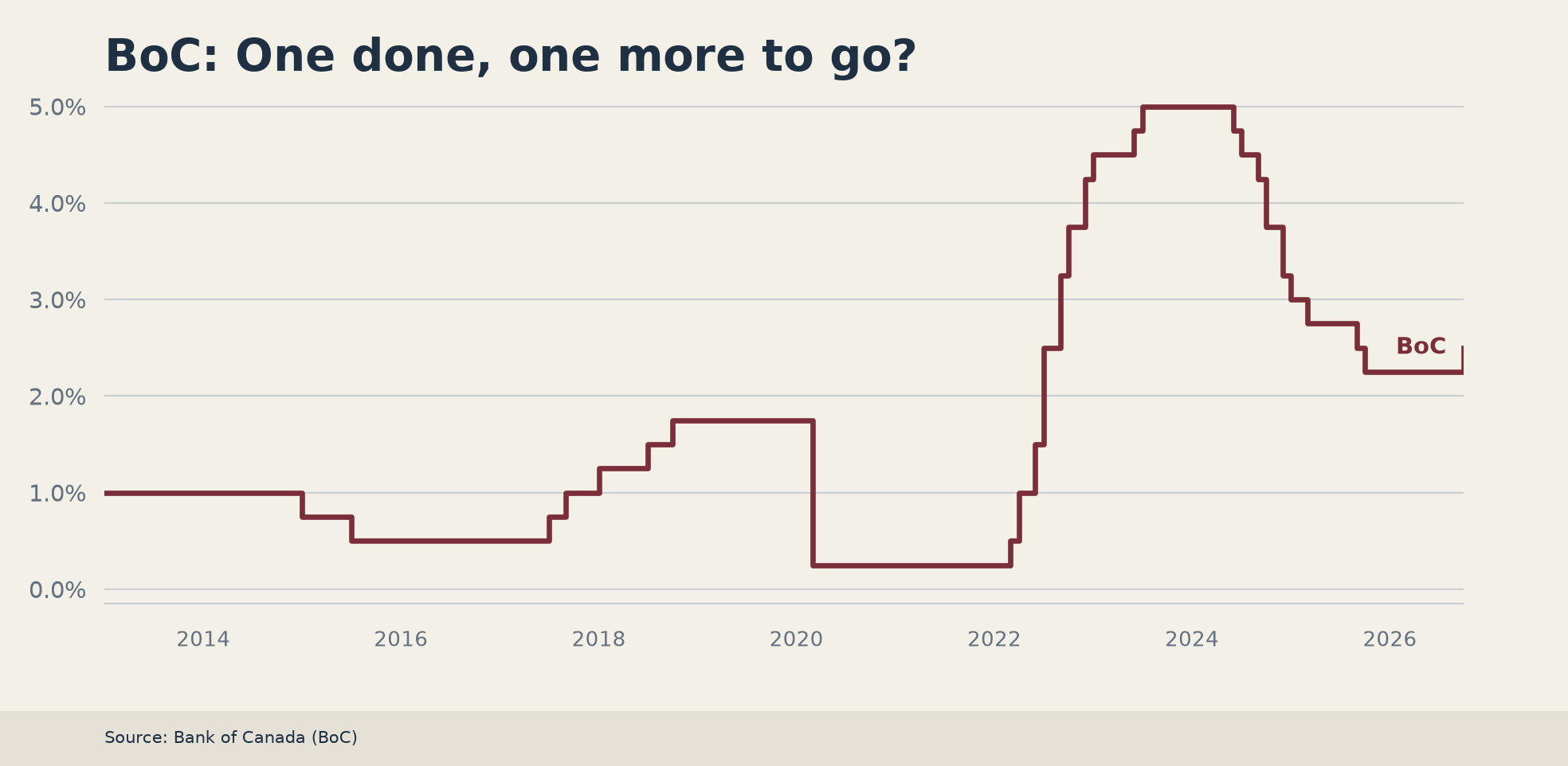
Taken together, the signals were hawkish yet restrained. Additional tightening is still a possibility should energy-led inflation spread or prove more persistent. Macklem nevertheless emphasised that rates are not on a preset course: the inflation outlook and incoming data will guide each decision.
Bank of Canada: Key Questions
From its base in Ottawa, the Bank of Canada (BoC) sets Canada’s interest rates and directs monetary policy. Decisions are taken at eight scheduled meetings each year, supplemented by emergency meetings when needed. Price stability is its primary mandate, defined as keeping inflation within 1-3%. Interest rate increases and cuts are the principal means of meeting that objective. Higher relative interest rates typically strengthen the Canadian Dollar (CAD), while lower rates tend to have the opposite effect. The BoC also uses quantitative easing and quantitative tightening.
When conditions become extreme, the Bank of Canada may turn to Quantitative Easing (QE). Under this policy, the BoC prints Canadian Dollars to purchase assets from financial institutions, typically government or corporate bonds. The CAD usually weakens as a result. Reserved as a last resort, QE is used when interest rate cuts alone are unlikely to deliver price stability. During the Great Financial Crisis of 2009-11, the Bank of Canada deployed the measure after banks’ loss of confidence in one another’s ability to repay debts caused credit to freeze.
Once an economic recovery is under way and inflation begins to rise, quantitative tightening (QT) reverses the earlier use of QE. Under QE, purchases of government and corporate bonds by the Bank of Canada supply financial institutions with liquidity. QT instead ends further asset purchases and the reinvestment of principal as bonds already held by the BoC mature. This is generally supportive of, or bullish for, the Canadian Dollar.
POPULAR ARTICLES
1RBNZ rates unchanged: New Zealand Dollar falls sharply ahead of Fed decision2Federal Reserve: Rabobank on guidance and yield curve pricing3BoC recap: Rates raised, with another increase in prospect?4Inflation surprise gives Australian Dollar fresh impetus ahead of Fed decision5Swiss Franc under pressure with traders awaiting Fed interest rate decision6$80K holds for BTC bulls: Bitcoin and Gold forecast as XAU defends $4,000 ahead of Fed71.3300: British Pound holds on with UK budget in focus before Fed decision80.7060 Cap in Sight: Australian Dollar Has Room to Gain Against US Dollar – UOB9BoC rate hike offers little traction for Canadian Dollar
LIVE QUOTES

Get Started!
Sign up and access the Global Markets in less than 3 minutes

Connect With Us









Contacts
Phone: +61 2 8036 8388
Fax: +61 2 8036 8388
Email: support@tmgm.com



The information provided on this website is of a general nature only and does not constitute personal financial advice. Before acting on any information on this website, you should consider the suitability of the information in relation to your objectives, financial situation and needs. Investing in CFDs and FX Margin Contracts carries significant risks and is not suitable for all investors. You may lose more than your initial deposit. You do not own, or have, any interest in the underlying asset. We recommend that you seek independent advice and ensure you fully understand the risks involved before trading. It is important that you read and consider the disclosure document before you acquire any product listed on the website. The information and advertisements offered on this website are not intended for use by any person in any country or jurisdiction where such use would be contrary to local laws and regulations. The Products and Services offered on this website are not intended for residents of the United States, Malaysia and Thailand.
TMGM is authorized and regulated in various jurisdictions.
Trademax Australia Limited, trading as TMGM, is regulated by the Australian Securities and Investments Commission (ASIC), AFSL no. 436416 and is located at Level 28, One International Tower, 100 Barangaroo Avenue, 2000 Sydney, NSW Australia.
Email: support@tmgm.com.au
Trademax Global Limited, trading as TMGM, is authorized and regulated by the Vanuatu Financial Services Commission (VFSC), registration number 40356 and registered at 1276, Kumul Highway, Port Vila, Vanuatu, Republic of Vanuatu.
Email: support@tmgm.com
Trademax Global Markets (SE) Limited, trading as TMGM, is authorized and regulated by the Financial Services Authority (FSA) of Seychelles, with license number SD224. The company is registered at Office No 13, Providence Estate ABIS Centre, Mahe, Seychelles.
Email: support@tmgm.com
Trademax Global Markets (International) Pty Ltd, trading as TMGM, is authorized and regulated by the Financial Services Commission, Mauritius (FSC) with license no. GB22201012, and registered at 33, Edith Cavell Street C/o IQ EQ Fund Services (Mauritius) Ltd Port Louis, 11324 Mauritius.
Email: support@tmgm.com
Copyright © TMGM. All rights reserved