

Trading
Explore a wide range of markets with competitive pricing, deep liquidity, and advanced trading tools.
Learn More 
Platform
Trade seamlessly with TMGM's powerful platform, built for speed, precision, and a superior trading experience.
Learn More Trading Platform
Academy
Learn the fundamentals of trading with beginner-friendly resources, including guides, webinars, and market insights.
Learn More News & Analysis
Get real-time market updates and expert analysis to stay ahead of trading opportunities
Learn More News & Analysis
About
Learn what sets TMGM apart — our global presence, regulatory strength, and commitment to innovation in trading.
Learn More Why Choose TMGM
Sponsorship
Half its gain erased: Yen retreats ahead of expected BoJ hold on Friday
- 157.50 reclaimed at the close. USD/JPY recovers roughly half its two-session decline.
- An October BoJ rate increase is forecast by none of the economists surveyed by Bloomberg.
- Wednesday's Fed statement precedes both Tokyo CPI and the BoJ policy decision.
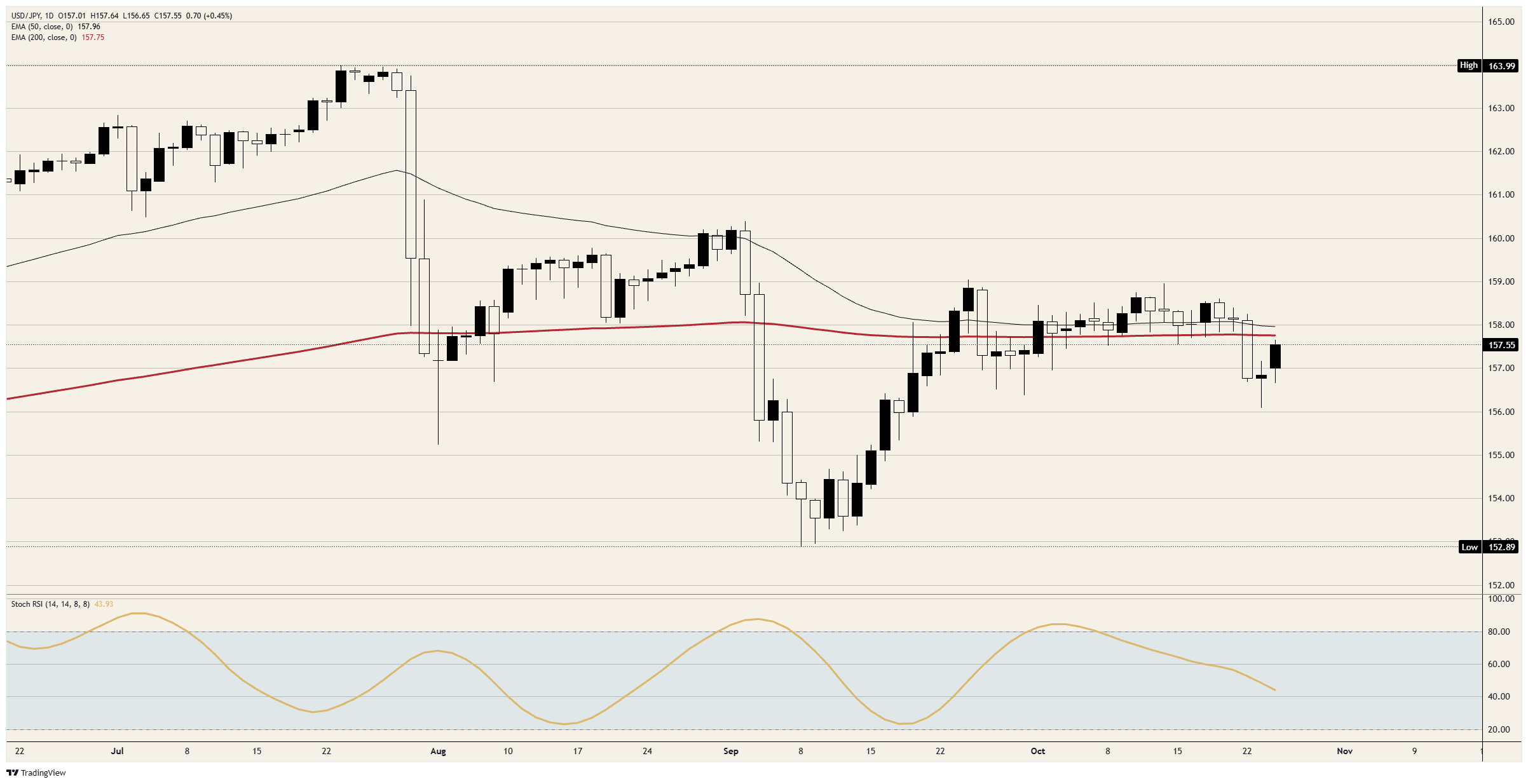
USD/JPY closed just above 157.50 on Monday. The advance from just above 156.50 reversed roughly half the losses recorded on 22 and 23 October, leaving the pair near its session high two days ahead of the Fed decision. Earlier Yen buying in Tokyo had pushed the pair below 157.00 to its weakest level since 18 September.

After lifting its rate from 1% to 1.25% in September, the Bank of Japan (BoJ) is not expected to deliver another increase for Yen traders on Friday. BoJ Governor Ueda has said consecutive hikes are unnecessary, and a Friday increase would follow directly after September's move. No economist in Bloomberg's survey forecasts an October hike; most anticipate one in December.
A 7-2 vote approved September's increase, with both dissenters opposing the hike. For Friday, previews identify BoJ board members Takata and Tamura as potential dissenters in favour of raising rates. Such a vote could bring forward the December increase that Yen traders are awaiting.
Key data and policy dates
Thursday at 23:30 GMT brings Tokyo's October Consumer Price Index (CPI) and Japan's September unemployment rate. These are the final data releases ahead of Friday's BoJ decision. At 06:30 GMT on Friday, BoJ Governor Ueda holds his subsequent press conference. His December guidance remains the Tokyo input left for USD/JPY to price in.
A hold at 3.75%-4.00% is expected from the Fed, whose statement is due at 18:00 GMT Wednesday. Attention then turns to third-quarter US growth and September's Personal Consumption Expenditures Price Index (PCE), both scheduled for 12:30 GMT Thursday. Each will help shape the case for a December Fed rate increase.
158.00 moving-average area in focus
Just below 158.00 sit the 200-day Exponential Moving Average (EMA) and the 50-day EMA; Monday's peak failed to reach either. The decline on 22 October produced the first daily close below 157.00 since 18 September. Across the chart's six-month range, the low on 8 September lies just below 153.00, while July's high stands just below 164.00.
USD/JPY daily price chart
Japanese Yen: key questions
Among the world's most actively traded currencies, the Japanese Yen (JPY) draws its broad direction from Japan's economic performance. More specific influences include Bank of Japan policy, the gap between Japanese and US bond yields, and traders' appetite for risk, alongside other factors.
Currency control forms part of the Bank of Japan's mandate, making its actions an important influence on the Yen. Direct intervention in currency markets has occurred on occasion, usually with the aim of weakening the currency. Political concerns among Japan's main trading partners, however, discourage frequent intervention. From 2013 to 2024, the BoJ's ultra-loose monetary stance increasingly diverged from those of other major central banks, driving the Yen lower against its principal currency peers. More recently, a gradual withdrawal of that ultra-loose policy has offered the Yen some support.
The BoJ's commitment to ultra-loose monetary settings over the past decade widened its policy divergence with other central banks, notably the US Federal Reserve. As a result, the yield gap between 10-year US and Japanese bonds widened, supporting the US Dollar against the Japanese Yen. That differential is now narrowing as the BoJ's 2024 decision to withdraw gradually from ultra-loose policy combines with interest-rate reductions by other major central banks.
Often regarded as a safe-haven investment, the Japanese Yen tends to attract capital when markets are under stress. Investors are more inclined to hold the currency because of its perceived reliability and stability. During periods of turbulence, the Yen is therefore likely to appreciate against currencies regarded as riskier investments.
POPULAR ARTICLES
1Canada’s Carney says position in US trade talks will remain unchanged2Above $4,000: gold rebounds on hopes of easing US‑Iran tensions3Half its gain erased: Yen retreats ahead of expected BoJ hold on Friday40.70 rally falters for Aussie Dollar ahead of Fed, RBA inflation tests5Third straight RBNZ hike priced in by New Zealand Dollar traders6Below 1.12: Euro faces Fed and ECB decisions a day apart7Pound retreats from its high ahead of UK Budget and Fed decision8Anthropic's filing boosts tech while Dow Jones Industrial Average trails9211.10 in bulls’ sights: GBP/JPY Price Forecast as bearish trend continues
LIVE QUOTES


Get Started!
Sign up and access the Global Markets in less than 3 minutes

Connect With Us









Contacts
Phone: +61 2 8036 8388
Fax: +61 2 8036 8388
Email: support@tmgm.com



The information provided on this website is of a general nature only and does not constitute personal financial advice. Before acting on any information on this website, you should consider the suitability of the information in relation to your objectives, financial situation and needs. Investing in CFDs and FX Margin Contracts carries significant risks and is not suitable for all investors. You may lose more than your initial deposit. You do not own, or have, any interest in the underlying asset. We recommend that you seek independent advice and ensure you fully understand the risks involved before trading. It is important that you read and consider the disclosure document before you acquire any product listed on the website. The information and advertisements offered on this website are not intended for use by any person in any country or jurisdiction where such use would be contrary to local laws and regulations. The Products and Services offered on this website are not intended for residents of the United States, Malaysia and Thailand.
TMGM is authorized and regulated in various jurisdictions.
Trademax Australia Limited, trading as TMGM, is regulated by the Australian Securities and Investments Commission (ASIC), AFSL no. 436416 and is located at Level 28, One International Tower, 100 Barangaroo Avenue, 2000 Sydney, NSW Australia.
Email: support@tmgm.com.au
Trademax Global Limited, trading as TMGM, is authorized and regulated by the Vanuatu Financial Services Commission (VFSC), registration number 40356 and registered at 1276, Kumul Highway, Port Vila, Vanuatu, Republic of Vanuatu.
Email: support@tmgm.com
Trademax Global Markets (SE) Limited, trading as TMGM, is authorized and regulated by the Financial Services Authority (FSA) of Seychelles, with license number SD224. The company is registered at Office No 13, Providence Estate ABIS Centre, Mahe, Seychelles.
Email: support@tmgm.com
Trademax Global Markets (International) Pty Ltd, trading as TMGM, is authorized and regulated by the Financial Services Commission, Mauritius (FSC) with license no. GB22201012, and registered at 33, Edith Cavell Street C/o IQ EQ Fund Services (Mauritius) Ltd Port Louis, 11324 Mauritius.
Email: support@tmgm.com
Copyright © TMGM. All rights reserved