

Trading
Explore a wide range of markets with competitive pricing, deep liquidity, and advanced trading tools.
Learn More 
Platform
Trade seamlessly with TMGM's powerful platform, built for speed, precision, and a superior trading experience.
Learn More Trading Platform
Academy
Learn the fundamentals of trading with beginner-friendly resources, including guides, webinars, and market insights.
Learn More News & Analysis
Get real-time market updates and expert analysis to stay ahead of trading opportunities
Learn More News & Analysis
About
Learn what sets TMGM apart — our global presence, regulatory strength, and commitment to innovation in trading.
Learn More Why Choose TMGM
Sponsorship
USD/IDR: BI Support and MSCI News Lift Rupiah to Rp18,190 Ahead of US PMI and PCE
- The Rupiah recovered from an all-time low of Rp18,290 to close Monday at Rp18,190 per US Dollar, gaining 70 points, or 0.38%.
- Foreign capital inflows through SRBI and progress in the Indonesian government's discussions with MSCI lent support to the Rupiah's recovery.
- Markets are turning their attention to this week's US PMI and PCE inflation releases, while Indonesian money supply data showed an acceleration in growth.
Sentiment towards the Indonesian Rupiah (IDR) improved on Monday (23 November), supported by Bank Indonesia's (BI) stabilisation measures and positive developments concerning Indonesia's equity market status in MSCI indices. The currency ended the session at Rp18,190 per US Dollar (USD), up 70 points, or 0.38%, from Friday's close of Rp18,260. According to Reuters data, the Rupiah reversed its early losses after hitting an all-time low of Rp18,290. A pullback in the US Dollar Index (DXY) also aided the recovery, with the index trading around 103.65 after reaching a high near 103.95 last week.

How Are Foreign Inflows and MSCI Developments Supporting the Rupiah?
Foreign inflows of more than US$1 billion through last week's Bank Indonesia Rupiah Securities (SRBI) auction helped lift the Rupiah, BI said. The central bank continues to reinforce exchange-rate stability through hedging incentives and intervention in the foreign exchange market. Domestic sentiment also benefited from a Bloomberg report on communication between President Prabowo Subianto and MSCI CEO Henry Fernandez, which raised the possibility of an alternative to a two-tier downgrade of Indonesia's equity market classification. Reuters, however, said the information could not be independently verified and did not constitute an official MSCI decision.
In their earlier report dated 20 November, OCBC strategists Sim Moh Siong and Christopher Wong assessed that a 25-basis-point increase in the BI-Rate to 6.00%, enhanced hedging incentives and foreign exchange intervention had helped ease pressure on the Rupiah. Foreign equity outflows and elevated US bond yields nevertheless remained challenges. OCBC recorded foreign equity outflows of about US$0.9 billion in the fourth quarter up to 16 November, although overall portfolio flows remained positive at US$4.8 billion. "Further policy tightening remains possible if pressure on the currency intensifies," the two analysts wrote, stressing that a more sustained Rupiah recovery would require external headwinds to ease.
On domestic fundamentals, BI put broad money supply (M2) at Rp10,698.0 trillion in October 2026. Annual growth accelerated to 9.3% from September's 8.5%, supported by increases of 9.5% in narrow money (M1) and 8.3% in quasi-money. Credit growth, by contrast, eased slightly to 12.7% year-on-year from 12.8% in the preceding month.
What Do US PMI and PCE Inflation Releases Hold for Markets?
US data released on Friday (20 November) showed the University of Michigan's final November consumer sentiment index at 51.5 and its consumer expectations index at 52.9. One-year inflation expectations declined to 3.7% from 4.7% in October, while five-year expectations eased to 3.3% from 3.5%. Separately, Federal Reserve Governor Lisa Cook warned on Friday that delaying further interest rate increases risked leaving the central bank behind in its efforts to contain inflation. This week's US calendar includes November's S&P Global Manufacturing and Services Purchasing Managers' Indices (PMIs) on Monday (23 November), followed by the consumer confidence index on Tuesday (24 November). October Personal Consumption Expenditures (PCE) inflation and the second estimate of third-quarter Gross Domestic Product (GDP) are due on Wednesday (25 November).
Can USD/IDR Clear Rp18,300 Resistance as Consolidation Continues?
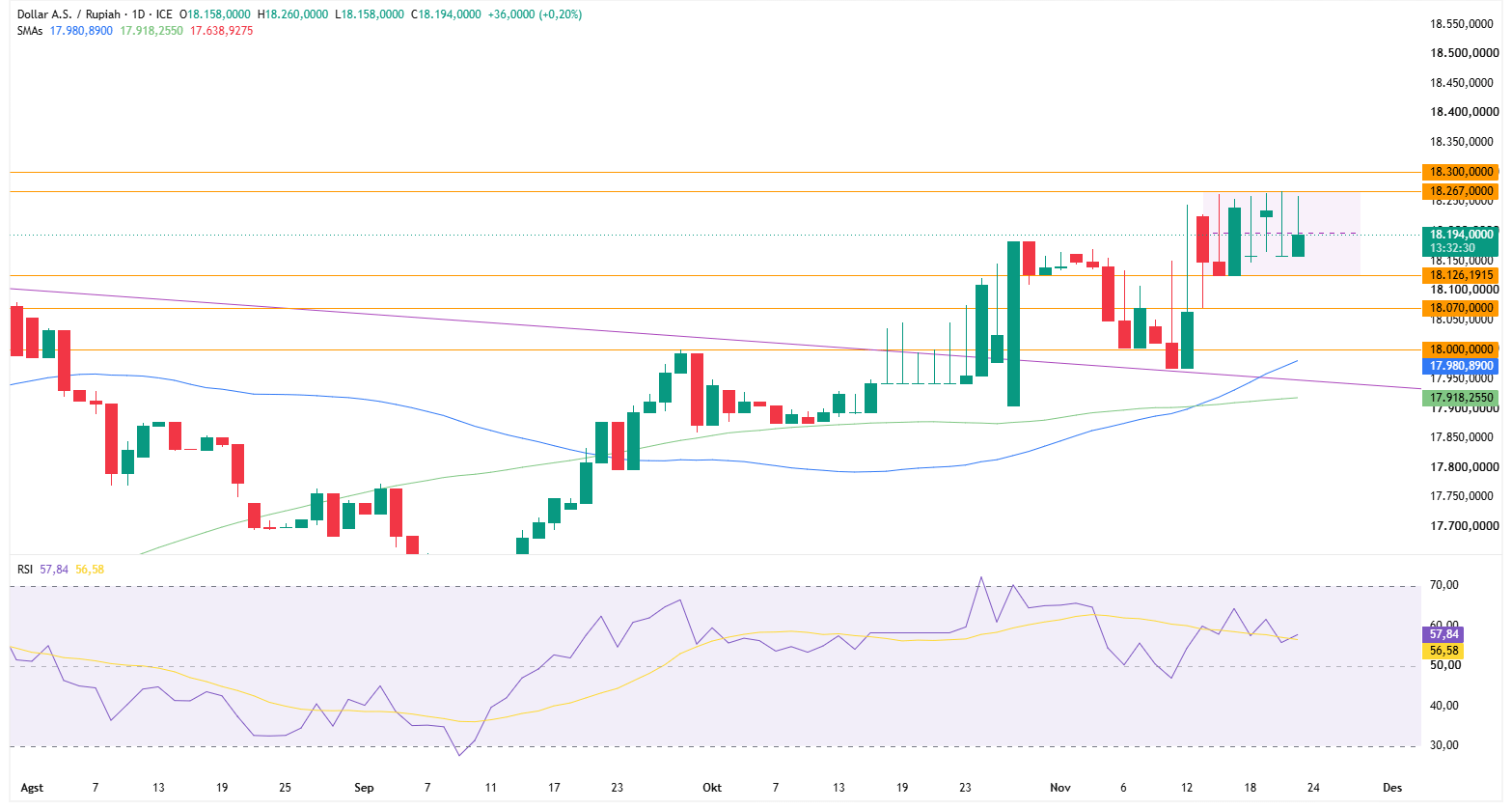
ICE's daily chart shows USD/IDR consolidating between Rp18,126 and Rp18,267 following repeated unsuccessful attempts to break through the resistance zone at Rp18,267–Rp18,300. The upward trend remains intact, with the pair trading above its 50-day Simple Moving Average (SMA) at Rp17,980.89, 100-day SMA at Rp17,918.26 and 200-day SMA at Rp17,638.93. At 57.84, the 14-day Relative Strength Index (RSI) remains above the neutral 50 mark, suggesting that bullish momentum persists but is not yet strong enough to deliver a break above resistance.
A move above the resistance zone at Rp18,267–Rp18,300 could pave the way for USD/IDR to extend its advance towards Rp18,400. If selling pressure persists instead, the nearest support level is Rp18,126, the low recorded on 16 and 17 November. Below that lie Rp18,070, the 13 November low, and the psychological Rp18,000 mark.
Economic Data in Focus
What Does the S&P Global Manufacturing PMI Signal?
Published monthly, the S&P Global Manufacturing Purchasing Managers Index (PMI) provides an early gauge of business activity across US manufacturing. It draws on surveys of senior executives at private-sector manufacturing companies, with responses indicating whether conditions have changed from the preceding month. The findings can foreshadow shifts in official series covering Gross Domestic Product (GDP), industrial production, employment and inflation. Readings above 50 point to a broadly expanding manufacturing economy and are considered positive for the US Dollar (USD). Conversely, a figure below 50 indicates a general contraction in manufacturing activity and is viewed as negative for USD.
Learn more.Upcoming release: Mon 23 Nov 2026 14:45 (Prel)
Release frequency: Every month
Consensus estimate: 54.6
Prior reading: 54.9
Data source: S&P Global
POPULAR ARTICLES
1USD/IDR: BI Support and MSCI News Lift Rupiah to Rp18,190 Ahead of US PMI and PCE2Euro: Danske Bank sees gradual weakness against US Dollar over 6–12M3Pi Network Price Forecast: PI builds on V-shaped recovery from an all-time low4Germany’s flash Manufacturing PMI reaches 55.0 in November as expansion unexpectedly accelerates5CEE FX: Regional currencies remain under bearish pressure – ING6Business activity data take centre stage as Euro retains gains against British Pound7British Pound: Could it fall to 1.3010 against US Dollar? - UOB8WTI Price Forecast: Does Crude Remain Vulnerable Below $83.00 Despite Middle East Jitters?9Forex Today: Can Gold Sustain Its Rebound Above $3,600 as the US Dollar Eases Ahead of PMI Data?


Get Started!
Sign up and access the Global Markets in less than 3 minutes

Connect With Us









Contacts
Phone: +61 2 8036 8388
Fax: +61 2 8036 8388
Email: support@tmgm.com



The information provided on this website is of a general nature only and does not constitute personal financial advice. Before acting on any information on this website, you should consider the suitability of the information in relation to your objectives, financial situation and needs. Investing in CFDs and FX Margin Contracts carries significant risks and is not suitable for all investors. You may lose more than your initial deposit. You do not own, or have, any interest in the underlying asset. We recommend that you seek independent advice and ensure you fully understand the risks involved before trading. It is important that you read and consider the disclosure document before you acquire any product listed on the website. The information and advertisements offered on this website are not intended for use by any person in any country or jurisdiction where such use would be contrary to local laws and regulations. The Products and Services offered on this website are not intended for residents of the United States, Malaysia and Thailand.
TMGM is authorized and regulated in various jurisdictions.
Trademax Australia Limited, trading as TMGM, is regulated by the Australian Securities and Investments Commission (ASIC), AFSL no. 436416 and is located at Level 28, One International Tower, 100 Barangaroo Avenue, 2000 Sydney, NSW Australia.
Email: support@tmgm.com.au
Trademax Global Limited, trading as TMGM, is authorized and regulated by the Vanuatu Financial Services Commission (VFSC), registration number 40356 and registered at 1276, Kumul Highway, Port Vila, Vanuatu, Republic of Vanuatu.
Email: support@tmgm.com
Trademax Global Markets (SE) Limited, trading as TMGM, is authorized and regulated by the Financial Services Authority (FSA) of Seychelles, with license number SD224. The company is registered at Office No 13, Providence Estate ABIS Centre, Mahe, Seychelles.
Email: support@tmgm.com
Trademax Global Markets (International) Pty Ltd, trading as TMGM, is authorized and regulated by the Financial Services Commission, Mauritius (FSC) with license no. GB22201012, and registered at 33, Edith Cavell Street C/o IQ EQ Fund Services (Mauritius) Ltd Port Louis, 11324 Mauritius.
Email: support@tmgm.com
Copyright © TMGM. All rights reserved