

Trading
Explore a wide range of markets with competitive pricing, deep liquidity, and advanced trading tools.
Learn More 
Platform
Trade seamlessly with TMGM's powerful platform, built for speed, precision, and a superior trading experience.
Learn More Trading Platform
Academy
Learn the fundamentals of trading with beginner-friendly resources, including guides, webinars, and market insights.
Learn More News & Analysis
Get real-time market updates and expert analysis to stay ahead of trading opportunities
Learn More News & Analysis
About
Learn what sets TMGM apart — our global presence, regulatory strength, and commitment to innovation in trading.
Learn More Why Choose TMGM
Sponsorship
USD/CHF Price Forecast: Does a spinning top cast doubt on the bullish outlook at 0.8400?
- Indecision grows in USD/CHF as a spinning top takes shape near 0.8400.
- Buying conviction shows signs of fading, though the broader upward trend holds.
- A move beyond 0.8444 opens the way to 0.8476; a fall below 0.8376 puts 0.8300 at risk.
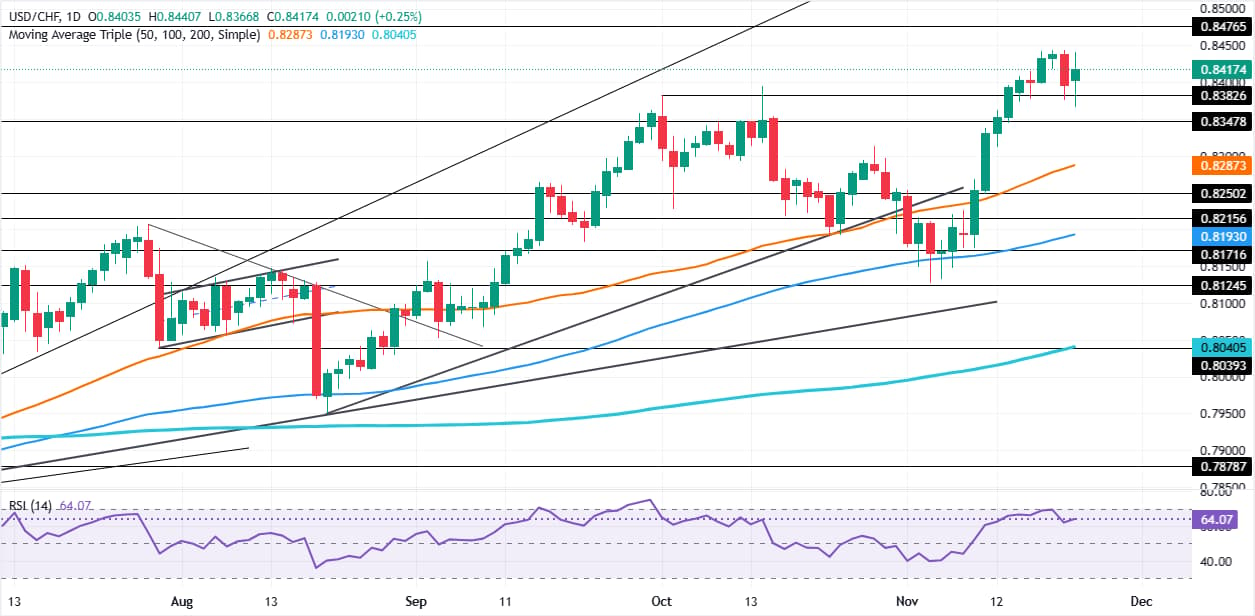
Indecision is tempering the USD/CHF uptrend, even as the pair posts a modest gain of over 0.20% on Monday. A ‘spinning top’ taking shape around 0.8400 signals that neither buyers nor sellers have the upper hand. The pair may therefore be set for consolidation while traders await crucial US inflation figures.

USD/CHF Price Forecast: Can the uptrend extend?
News surrounding NVIDIA lifted the Greenback, helping USD/CHF recover part of its earlier losses. The move invalidated the ‘bearish engulfing’ chart pattern formed during last Friday’s trading.
Although price movements suggest the upward trend remains intact, further gains require buyers to take USD/CHF above its year-to-date (YTD) peak of 0.8444. A break would bring the 12 May high of 0.8476 into focus, with 0.8500 next.
A drop through last Friday’s low of 0.8376, however, would open the way for a test of 0.8300. Below that level, attention would turn to the 50-day Simple Moving Average (SMA) at 0.8282 and then to 0.8200.
USD/CHF Daily Price Chart
Swiss Franc: Frequently Asked Questions
Among the world’s ten most actively traded currencies, the Swiss Franc (CHF) is the official currency of Switzerland, with trading volumes far exceeding the size of the country’s economy. Broad market sentiment, domestic economic conditions and Swiss National Bank (SNB) action are among the influences on its value. From 2011 to 2015, the Swiss Franc maintained a peg to the Euro (EUR). Its abrupt removal sent the Franc’s value up by more than 20%, triggering market turmoil. Although the peg no longer applies, CHF movements tend to remain closely linked to those of the Euro, reflecting Switzerland’s heavy economic reliance on the neighbouring Eurozone.
During periods of market stress, investors tend to seek out the Swiss Franc (CHF), giving it a reputation as a safe-haven asset. That appeal reflects Switzerland’s perceived standing globally: economic stability, a robust export sector, substantial central bank reserves and a longstanding policy of neutrality in international conflicts make its currency attractive to investors seeking to avoid risk. In turbulent conditions, CHF is likely to appreciate against currencies regarded as riskier investments.
Monetary policy decisions at the Swiss National Bank (SNB) are taken four times a year, once each quarter, making its meetings less frequent than those of other major central banks. Its objective is annual inflation below 2%. If inflation exceeds that target, or is forecast to do so in the foreseeable future, the bank will seek to restrain price increases by lifting its policy rate. By raising yields and making Switzerland more appealing to investors, higher interest rates generally support the Swiss Franc (CHF). Lower rates, by contrast, tend to weigh on CHF.
Assessing Switzerland’s economic health depends heavily on macroeconomic releases, which can also influence the Swiss Franc’s (CHF) valuation. Despite the economy’s broad stability, abrupt shifts in growth, inflation, the current account or the central bank’s foreign currency reserves can prompt CHF movements. Strong growth, low unemployment and elevated confidence generally support the currency. Data signalling a loss of economic momentum, on the other hand, are likely to lead to CHF depreciation.
Switzerland’s small, open economy relies heavily on the economic health of its Eurozone neighbours. With the broader European Union serving as its principal economic partner and an important political ally, stability in Eurozone macroeconomic conditions and monetary policy is essential for Switzerland and, in turn, the Swiss Franc (CHF). Reflecting this dependence, some models put the correlation between movements in the Euro (EUR) and CHF at more than 90%, close to a perfect correlation.
POPULAR ARTICLES
1USD/CHF Price Forecast: Does a spinning top cast doubt on the bullish outlook at 0.8400?2How is Nvidia news fuelling gold’s rally back above $3,650 ahead of US PCE?3Silver Price Forecast: Can bullish harami clear the $43.95 breakout hurdle?4Why is the Japanese Yen weakening as a Nvidia-led equity rally lifts risk appetite?5Singapore Dollar: Is consolidation within a tight band against US Dollar likely? – UOB6Forex Today: Focus Turns to Upcoming US Consumer Confidence and German IFO7Bitcoin Price Outlook: Can BTC’s recovery hold after Nvidia reinstates Jensen Huang?8Chinese Yuan: Is controlled appreciation the path into 2028? – Commerzbank9Why is the British Pound weakening as NVIDIA’s return drives a USD rally?

Get Started!
Sign up and access the Global Markets in less than 3 minutes

Connect With Us









Contacts
Phone: +61 2 8036 8388
Fax: +61 2 8036 8388
Email: support@tmgm.com



The information provided on this website is of a general nature only and does not constitute personal financial advice. Before acting on any information on this website, you should consider the suitability of the information in relation to your objectives, financial situation and needs. Investing in CFDs and FX Margin Contracts carries significant risks and is not suitable for all investors. You may lose more than your initial deposit. You do not own, or have, any interest in the underlying asset. We recommend that you seek independent advice and ensure you fully understand the risks involved before trading. It is important that you read and consider the disclosure document before you acquire any product listed on the website. The information and advertisements offered on this website are not intended for use by any person in any country or jurisdiction where such use would be contrary to local laws and regulations. The Products and Services offered on this website are not intended for residents of the United States, Malaysia and Thailand.
TMGM is authorized and regulated in various jurisdictions.
Trademax Australia Limited, trading as TMGM, is regulated by the Australian Securities and Investments Commission (ASIC), AFSL no. 436416 and is located at Level 28, One International Tower, 100 Barangaroo Avenue, 2000 Sydney, NSW Australia.
Email: support@tmgm.com.au
Trademax Global Limited, trading as TMGM, is authorized and regulated by the Vanuatu Financial Services Commission (VFSC), registration number 40356 and registered at 1276, Kumul Highway, Port Vila, Vanuatu, Republic of Vanuatu.
Email: support@tmgm.com
Trademax Global Markets (SE) Limited, trading as TMGM, is authorized and regulated by the Financial Services Authority (FSA) of Seychelles, with license number SD224. The company is registered at Office No 13, Providence Estate ABIS Centre, Mahe, Seychelles.
Email: support@tmgm.com
Trademax Global Markets (International) Pty Ltd, trading as TMGM, is authorized and regulated by the Financial Services Commission, Mauritius (FSC) with license no. GB22201012, and registered at 33, Edith Cavell Street C/o IQ EQ Fund Services (Mauritius) Ltd Port Louis, 11324 Mauritius.
Email: support@tmgm.com
Copyright © TMGM. All rights reserved