

Trading
Explore a wide range of markets with competitive pricing, deep liquidity, and advanced trading tools.
Learn More 
Platform
Trade seamlessly with TMGM's powerful platform, built for speed, precision, and a superior trading experience.
Learn More Trading Platform
Academy
Learn the fundamentals of trading with beginner-friendly resources, including guides, webinars, and market insights.
Learn More News & Analysis
Get real-time market updates and expert analysis to stay ahead of trading opportunities
Learn More News & Analysis
About
Learn what sets TMGM apart — our global presence, regulatory strength, and commitment to innovation in trading.
Learn More Why Choose TMGM
Sponsorship
New Zealand Dollar recovers from 2009 low as confidence data looms
- NZD/USD extends its rebound into a second session, following ten consecutive declines to a 17-year low.
- At 2.75%, the RBNZ's policy rate remains at least a full percentage point below the Fed's, with the latter set to rise.
- Thursday brings ANZ-Roy Morgan consumer confidence data while US markets remain closed for a holiday.
NZD/USD has clawed back about a quarter of its ten-session slide over the past two sessions, after touching its lowest level since March 2009 on Monday. On Wednesday, the pair slipped towards 0.5450 but held above Monday's trough, and now trades just below 0.5500. An interest-rate differential underpinned the losing streak, and Wednesday's US data offered no prospect of that gap narrowing.

A December Fed rate increase is priced at close to 94%, which would widen the current 1.00-1.25 percentage-point differential by another quarter-point. The Fed's rate stands at 3.75%-4.00%, compared with the Reserve Bank of New Zealand's (RBNZ) 2.75%. On 28 October, the RBNZ voted 4-3 to leave its rate unchanged despite an almost fully priced-in hike. With US third-quarter growth coming in at 4.3% against expectations of 3.4%, traders had little reason to question the prospect of a Fed increase.
Selling in artificial intelligence (AI) shares spread from Asia to New York on Wednesday, weighing on NZD/USD. South Korea's Kospi shed 6.2%, while Japan's Nikkei 225 lost 2.8%. Separately, the US proposed fresh tariffs on China, New Zealand's largest export market, and 13 other economies. A recovery in US equities subsequently helped NZD/USD rebound, as the Dow Jones Industrial Average wiped out a decline of more than 2%.
What is next on the calendar?
With US markets closed for Thanksgiving, attention on Thursday turns to November's ANZ-Roy Morgan consumer confidence reading at 21:00 GMT, following October's 96.2. Fed speeches cease from Saturday. Both central banks next announce their decisions on 9 December, putting the RBNZ and the Fed's contributions to the NZD/USD interest-rate differential in focus on the same day.
What do the charts indicate?
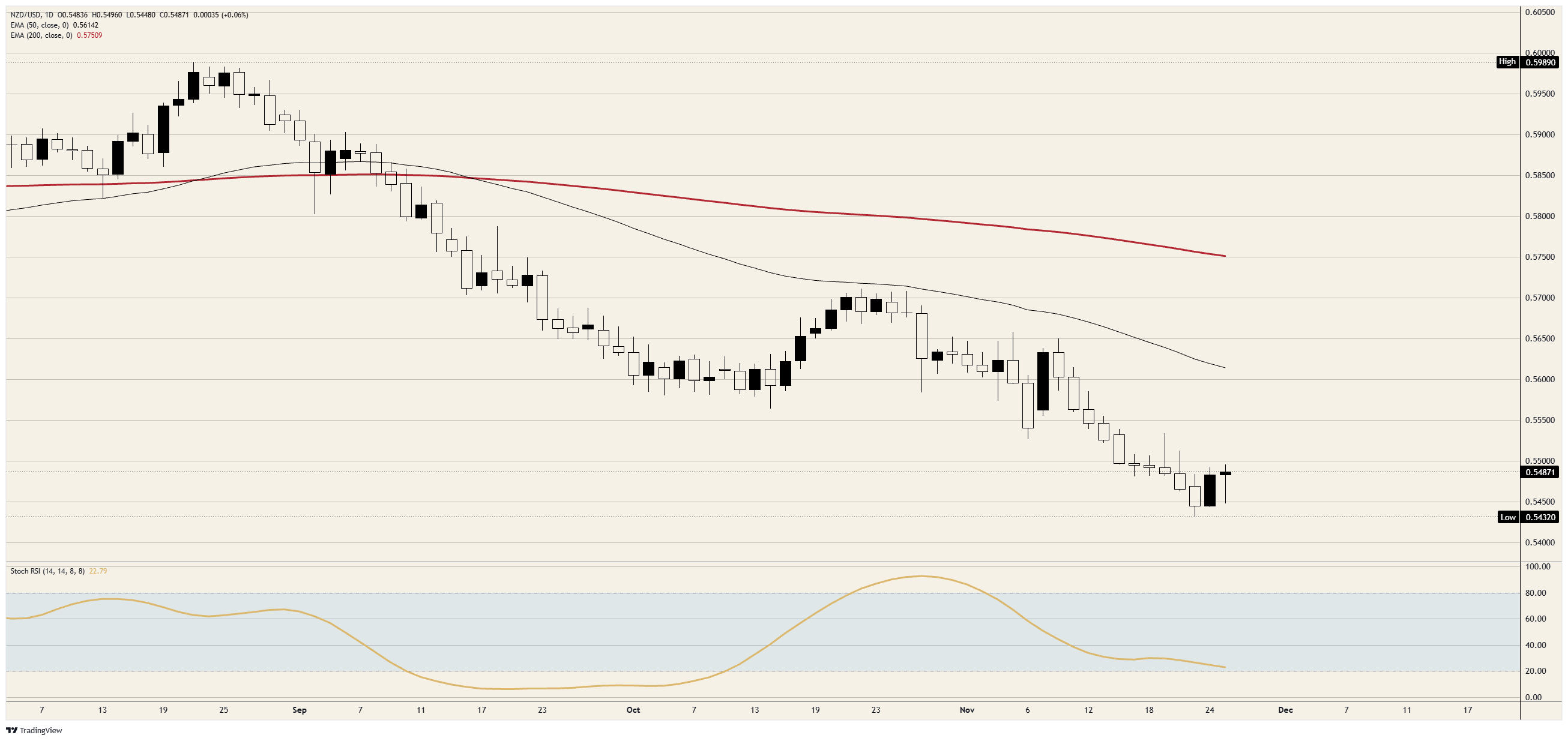
NZD/USD remained below its 50-day Exponential Moving Average (EMA) throughout the decline from the 10 November high near 0.5650 to Monday's trough. That average now sits just above 0.5600. The pair has not traded above the 200-day EMA since early September; the average currently lies near 0.5750. Having weakened since late October, daily momentum is approaching oversold territory.
Daily chart for NZD/USD
New Zealand Dollar: Frequently Asked Questions
Movements in the New Zealand Dollar (NZD), commonly called the Kiwi and widely traded by investors, largely reflect the strength of New Zealand's economy and its central bank's policy. However, several more specific influences also affect the currency. As China is New Zealand's largest trading partner, developments in the Chinese economy tend to influence the Kiwi. Adverse Chinese economic news is likely to imply weaker demand for New Zealand's exports, weighing on its economy and, in turn, its currency. Dairy prices are another important driver, given the industry's position as New Zealand's leading export sector. Higher dairy prices lift export earnings, supporting both the economy and the NZD.
Keeping inflation within a 1% to 3% range over the medium term, with an emphasis on the 2% midpoint, is the Reserve Bank of New Zealand's (RBNZ) objective. The bank adjusts interest rates to a suitable level to pursue that goal. If inflation becomes too high, the RBNZ raises rates to slow the economy. Higher rates also lift bond yields, making investment in the country more attractive and thereby supporting the NZD. Rate reductions, by contrast, generally put pressure on the currency. Another significant influence on NZD/USD is the interest-rate differential: the difference between actual or expected New Zealand rates and those set by the US Federal Reserve.
The New Zealand Dollar's (NZD) valuation can respond to domestic macroeconomic releases because these provide an important gauge of the economy's condition. Robust growth, low unemployment and strong confidence indicate an economy that is supportive of the NZD. Strong economic growth draws foreign investment and, when accompanied by elevated inflation, may prompt the Reserve Bank of New Zealand to raise interest rates. Weak economic readings, on the other hand, are likely to lead to NZD depreciation.
Risk-on conditions generally support the New Zealand Dollar (NZD). In these periods, investors see broader market risks as limited and take an optimistic view of growth, usually improving the outlook for commodities and so-called ‘commodity currencies’ such as the Kiwi. During market disruption or economic uncertainty, the opposite tends to occur: investors sell riskier assets in favour of more stable safe havens, and the NZD typically weakens.
POPULAR ARTICLES
1New Zealand Dollar recovers from 2009 low as confidence data looms2Pound holds steady ahead of BoE stability report following rate hearing3Euro above 19-month low: What next as ECB meeting accounts loom?4Dow Jones Industrial Average recovers lost ground even as AI stocks retreat5FX Today: Why is the US Dollar weakening despite strong US data? ECB minutes in focus6Why is gold tumbling despite lower US yields as core PCE reaches 3.3%?7Chinese Yuan: Is Its Role in Global Portfolios Growing? – DBS8Australian Dollar recovers even as risk appetite stays weak and Fed outlook remains hawkish9LatAm FX: Regional currencies weaken as carry trades unwind – ING


Get Started!
Sign up and access the Global Markets in less than 3 minutes

Connect With Us









Contacts
Phone: +61 2 8036 8388
Fax: +61 2 8036 8388
Email: support@tmgm.com



The information provided on this website is of a general nature only and does not constitute personal financial advice. Before acting on any information on this website, you should consider the suitability of the information in relation to your objectives, financial situation and needs. Investing in CFDs and FX Margin Contracts carries significant risks and is not suitable for all investors. You may lose more than your initial deposit. You do not own, or have, any interest in the underlying asset. We recommend that you seek independent advice and ensure you fully understand the risks involved before trading. It is important that you read and consider the disclosure document before you acquire any product listed on the website. The information and advertisements offered on this website are not intended for use by any person in any country or jurisdiction where such use would be contrary to local laws and regulations. The Products and Services offered on this website are not intended for residents of the United States, Malaysia and Thailand.
TMGM is authorized and regulated in various jurisdictions.
Trademax Australia Limited, trading as TMGM, is regulated by the Australian Securities and Investments Commission (ASIC), AFSL no. 436416 and is located at Level 28, One International Tower, 100 Barangaroo Avenue, 2000 Sydney, NSW Australia.
Email: support@tmgm.com.au
Trademax Global Limited, trading as TMGM, is authorized and regulated by the Vanuatu Financial Services Commission (VFSC), registration number 40356 and registered at 1276, Kumul Highway, Port Vila, Vanuatu, Republic of Vanuatu.
Email: support@tmgm.com
Trademax Global Markets (SE) Limited, trading as TMGM, is authorized and regulated by the Financial Services Authority (FSA) of Seychelles, with license number SD224. The company is registered at Office No 13, Providence Estate ABIS Centre, Mahe, Seychelles.
Email: support@tmgm.com
Trademax Global Markets (International) Pty Ltd, trading as TMGM, is authorized and regulated by the Financial Services Commission, Mauritius (FSC) with license no. GB22201012, and registered at 33, Edith Cavell Street C/o IQ EQ Fund Services (Mauritius) Ltd Port Louis, 11324 Mauritius.
Email: support@tmgm.com
Copyright © TMGM. All rights reserved