

Trading
Explore a wide range of markets with competitive pricing, deep liquidity, and advanced trading tools.
Learn More 
Platform
Trade seamlessly with TMGM's powerful platform, built for speed, precision, and a superior trading experience.
Learn More Trading Platform
Academy
Learn the fundamentals of trading with beginner-friendly resources, including guides, webinars, and market insights.
Learn More News & Analysis
Get real-time market updates and expert analysis to stay ahead of trading opportunities
Learn More News & Analysis
About
Learn what sets TMGM apart — our global presence, regulatory strength, and commitment to innovation in trading.
Learn More Why Choose TMGM
Sponsorship
New Zealand Dollar advances as pressure builds on US Dollar ahead of US Midterm elections
- NZD/USD surges towards 0.5627 against the US Dollar as attention turns to US midterm elections.
- Further monetary tightening remains the expected course for the RBNZ.
- NZ Q3 labour market figures are also on investors’ radar.
Broad gains mark Tuesday’s trading in the New Zealand Dollar (NZD), with the Canadian Dollar (CAD) the sole exception among its peers. NZD/USD has advanced 0.22% to around 0.5627 against the US Dollar (USD).
Support around 0.5600 has held firm for the Kiwi dollar since last week’s monetary policy announcement by the Reserve Bank of New Zealand (RBNZ), which unexpectedly kept interest rates on hold.

Could the RBNZ pause limit Kiwi downside, as Commerzbank suggests?
Rather than signalling a softer policy stance, the latest Reserve Bank of New Zealand decision represents “more of a pause than a dovish pivot.” That is the assessment of Commerzbank strategists, who see the policy outlook still leaning towards additional tightening. They “continue to expect two further hikes, in December and 1Q27, which should limit further NZD downside.”
Wednesday’s release of New Zealand (NZ) Q3 employment figures will be the next focus for investors.
Forecasts put the Labour Cost Index at 0.5%, down from 0.7% in this year’s second quarter. Meanwhile, the Unemployment Rate is expected to ease from the previous 5.6% to 5.5%.
For the US Dollar, the United States (US) midterm elections are in focus as investors prepare for the vote. At the time of writing, the US Dollar Index (DXY), a measure of the Greenback against six major currencies,
How are markets pricing a Democratic sweep in the US midterms?
With “the US midterm elections will be held on Tuesday,” strategists at Brown Brothers Harriman say “Democrats widely expected to win the House of Representatives.” Their assessment is that “Senate control is much closer, but the tide favors the Democratic party,” noting that “Democrats need a net gain of four seats to secure a majority in the Senate”. They consider that target “within reach as Republicans are defending six of the seven toss-up seats.”
A Democratic sweep is the outcome betting markets “favor a Democratic sweep,” according to BBH, with Polymarket and Kalshi “putting the odds around 70%.” The strategists say this “points to a relatively muted initial market reaction if Democrats win both chambers,” while cautioning that “a Republican Senate hold would be the bigger surprise and could spark more market volatility.”
NZD/USD Technical Analysis: Can the Pair Reclaim Its Short-Term EMA?
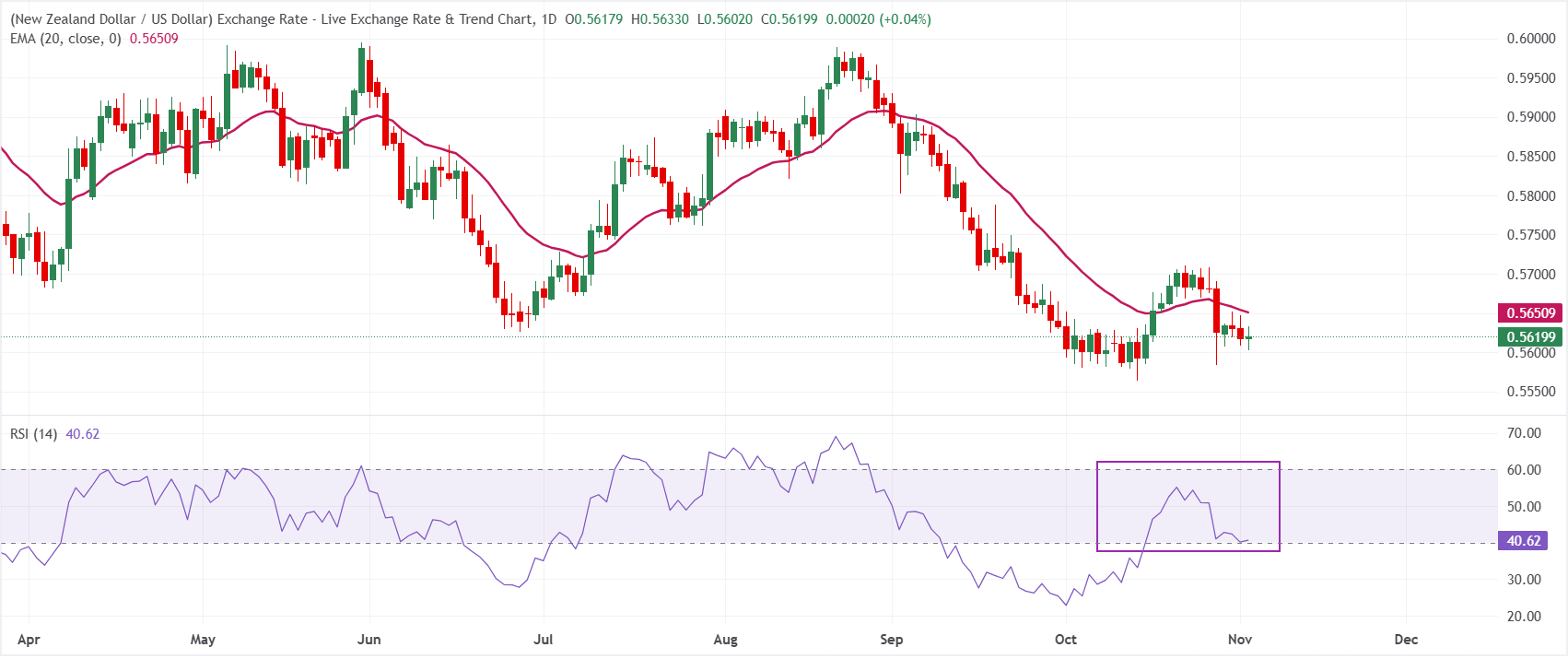
A near-term bearish bias persists on the daily chart, where NZD/USD stands at 0.5619, below the 20-period Exponential Moving Average (EMA) of 0.5651. Failure to regain this short-term EMA indicates that upside moves remain constrained. At around 40, the Relative Strength Index (RSI) points to improving yet subdued momentum, suggesting consolidation rather than a clear reversal.
To reduce the prevailing downward pressure, the pair would need a sustained move above immediate resistance at the 20-period EMA of 0.5651. As the supplied dataset offers no nearby technical support levels, traders may turn to earlier swing lows on the wider chart to identify potential demand zones. Until then, trading below the EMA leaves the directional bias on the downside.
(The technical analysis of this story was written with the help of an AI tool. Know more.)
Economic Data Indicator
What does the RBNZ Interest Rate Decision signal?
After each of its seven scheduled policy meetings every year, the Reserve Bank of New Zealand (RBNZ) publishes its interest rate decision. A hawkish RBNZ that judges inflationary pressures to be increasing raises the Official Cash Rate (OCR) to curb inflation. Higher rates draw greater capital inflows, supporting the New Zealand Dollar (NZD). Conversely, when the central bank considers inflation too low, it cuts the OCR, a move that generally weakens the NZD.
Explore further.Latest release: Wed 28 Oct 2026 01:00
Release frequency: Non-periodic
Actual figure: 2.75%
Consensus estimate: 3%
Prior reading: 2.75%
Data source: Reserve Bank of New Zealand
The valuation of the NZD is particularly sensitive to signals from the Reserve Bank of New Zealand (RBNZ) on the economic outlook and the direction of monetary policy. At its seven monetary policy meetings each year, the central bank announces its interest rate decision and sets out the economic assessments behind it. Favourable economic developments and an optimistic outlook could prompt the RBNZ to raise interest rates to tighten monetary policy, a move that generally supports the NZD. A press conference by interim Governor Christian Hawkesby usually follows these policy announcements.
POPULAR ARTICLES
1Australian Dollar: Why is a dovish hike putting pressure on the aussie? – Commerzbank2Swiss Franc: Is May high in sight after gains against Euro? - Societe Generale3AUD/USD Price Forecast: Why is RBA’s dovish hike weighing on the Australian Dollar?4Bitcoin Price Forecast: Could BTC face deeper losses as pressure builds on the 200-day EMA?5Silver price today: FXStreet data show silver moving lower6Japanese Yen: Trade against US Dollar remains range-bound – UOB7Can the euro withstand pressure on EUR/CAD from rising oil prices?8Euro: How is a hawkish ECB limiting losses against the US Dollar? - ING9Polish Zloty: Why is the constitutional crisis weighing on the currency? – Commerzbank


Get Started!
Sign up and access the Global Markets in less than 3 minutes

Connect With Us









Contacts
Phone: +61 2 8036 8388
Fax: +61 2 8036 8388
Email: support@tmgm.com



The information provided on this website is of a general nature only and does not constitute personal financial advice. Before acting on any information on this website, you should consider the suitability of the information in relation to your objectives, financial situation and needs. Investing in CFDs and FX Margin Contracts carries significant risks and is not suitable for all investors. You may lose more than your initial deposit. You do not own, or have, any interest in the underlying asset. We recommend that you seek independent advice and ensure you fully understand the risks involved before trading. It is important that you read and consider the disclosure document before you acquire any product listed on the website. The information and advertisements offered on this website are not intended for use by any person in any country or jurisdiction where such use would be contrary to local laws and regulations. The Products and Services offered on this website are not intended for residents of the United States, Malaysia and Thailand.
TMGM is authorized and regulated in various jurisdictions.
Trademax Australia Limited, trading as TMGM, is regulated by the Australian Securities and Investments Commission (ASIC), AFSL no. 436416 and is located at Level 28, One International Tower, 100 Barangaroo Avenue, 2000 Sydney, NSW Australia.
Email: support@tmgm.com.au
Trademax Global Limited, trading as TMGM, is authorized and regulated by the Vanuatu Financial Services Commission (VFSC), registration number 40356 and registered at 1276, Kumul Highway, Port Vila, Vanuatu, Republic of Vanuatu.
Email: support@tmgm.com
Trademax Global Markets (SE) Limited, trading as TMGM, is authorized and regulated by the Financial Services Authority (FSA) of Seychelles, with license number SD224. The company is registered at Office No 13, Providence Estate ABIS Centre, Mahe, Seychelles.
Email: support@tmgm.com
Trademax Global Markets (International) Pty Ltd, trading as TMGM, is authorized and regulated by the Financial Services Commission, Mauritius (FSC) with license no. GB22201012, and registered at 33, Edith Cavell Street C/o IQ EQ Fund Services (Mauritius) Ltd Port Louis, 11324 Mauritius.
Email: support@tmgm.com
Copyright © TMGM. All rights reserved