

Trading
Explore a wide range of markets with competitive pricing, deep liquidity, and advanced trading tools.
Learn More 
Platform
Trade seamlessly with TMGM's powerful platform, built for speed, precision, and a superior trading experience.
Learn More Trading Platform
Academy
Learn the fundamentals of trading with beginner-friendly resources, including guides, webinars, and market insights.
Learn More News & Analysis
Get real-time market updates and expert analysis to stay ahead of trading opportunities
Learn More News & Analysis
About
Learn what sets TMGM apart — our global presence, regulatory strength, and commitment to innovation in trading.
Learn More Why Choose TMGM
Sponsorship
Why is gold falling as US Treasuries attract safe-haven demand despite lower yields?
- Gold slides more than 2% even as Treasury yields decline.
- Safe-haven buying drives US 10-year yields 15 basis points lower to 4.963%.
- Inflation worries intensify as Middle East tensions push WTI towards $100.
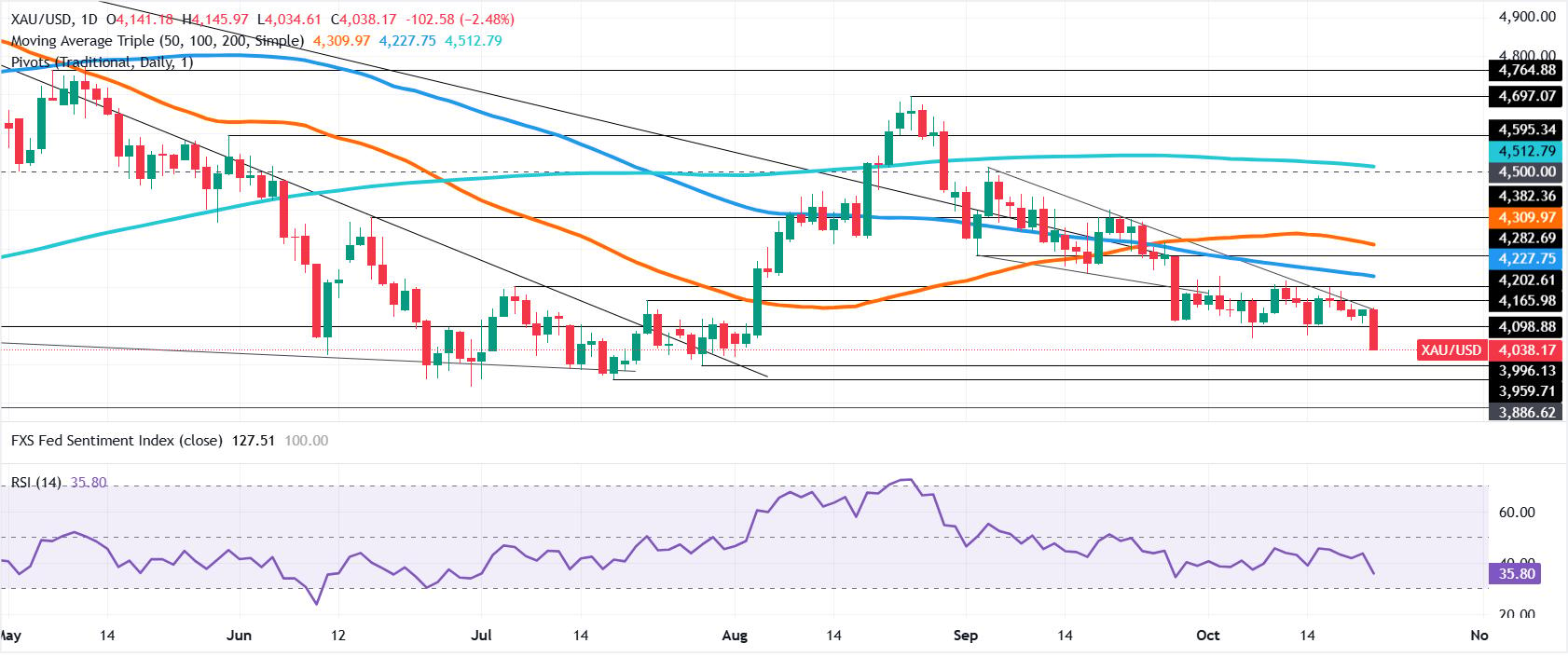
A rush into the safety of US Treasuries leaves Gold (XAU/USD) more than 2% lower on Thursday, as both yields and US equities retreat. Investors are increasingly concerned about credit risks at technology companies and want evidence that substantial AI investments will generate returns. Having touched a ten-week low of $4,034, XAU/USD is trading at $4,047 at the time of writing.

Why is XAU/USD sliding as AI credit concerns and geopolitical tensions draw investors to US Treasuries?
A bleak mood has taken hold in markets as exchanges of attacks between the Houthis and Saudi Arabia heighten Middle East tensions. Energy prices are climbing against this backdrop, alongside a US order to evacuate its embassy in Saudi Arabia and newswire reports that Washington and Jerusalem are preparing for an attack on Iran.
Safe-haven demand has sent Treasury yields sharply lower, taking the US 10-year yield down 15 basis points to 4.963%. That is its lowest reading since 23 September.
Bullion is receiving no support from the sharp decline in US yields, despite typically benefiting from a lower-yield environment. Instead, elevated energy prices are prompting investors to seek both safety and yield in US Treasuries, rather than hold the non-yielding metal.
At $99.50 per barrel, US crude benchmark West Texas Intermediate (WTI) is up more than 1.80%. Meanwhile, the US Dollar Index (DXY) stands at 101.62, down just some 0.02%. The index tracks the American currency against six other currencies.
A better-than-expected US Initial Jobless Claims reading pointed to limited layoffs in the week ending 17 October. Claims dropped to 194K, a near 57-year low, coming in below both forecasts and the previous figure of 200K. The four-week average also eased, reaching 197.75K.
Traders have so far priced out an October rate increase, despite last week's stronger-than-expected US inflation figures. Most Federal Reserve (Fed) officials favour another increase, but want to assess the data before raising rates again.
With the probability at 8%, an October Federal Reserve rate rise is considered off the table. For December, however, the likelihood is nearly 80%, according to Prime Terminal.
The University of Michigan Consumer Sentiment release is next on the US economic calendar. Attention next week will turn to the Fed's meeting and, subsequently, the Core Personal Consumption Expenditures (PCE) Price Index.
XAU/USD technical analysis: Can Gold sellers reach $4,000 after breaking $4,100?
Sellers have finally driven Gold through the lower boundary of its $4,100-$4,200 trading range, pushing prices decisively below $4,050. Further losses are suggested by the Relative Strength Index (RSI), which indicates that bearish momentum is strengthening.
If the decline continues, initial support comes at the $4,000 mark, just above the 29 July cycle low of $3,996. Further down, support lies at the 17 July low of $3,959, followed by the year-to-date (YTD) trough of $3,941.
A bullish reversal would first encounter resistance at $4,100, with a break opening the path to $4,200. Beyond that lie the 100-day Simple Moving Average (SMA) at $4,222, the 50-day SMA at $4,309 and then $4,500.
Gold: common questions
Throughout human history, Gold has held an important place as both a store of value and a medium of exchange. Beyond its lustre and use in jewellery, the precious metal is now widely regarded as a safe-haven asset, making it a favoured investment during unsettled periods. Because it is not dependent on a particular issuer or government, Gold is also commonly viewed as a hedge against inflation and currency depreciation.
The largest holders of Gold are central banks. To support their currencies during periods of turbulence, they typically diversify reserves and purchase Gold, reinforcing perceptions of economic and currency strength. Substantial Gold reserves can bolster confidence in a country's solvency. According to World Gold Council data, central banks increased their reserves by 1,136 tonnes of Gold valued at around $70 billion in 2022. That marked the largest annual purchase since records began. Emerging-economy central banks, including those of China, India and Turkey, are expanding their Gold holdings rapidly.
Both the US Dollar and US Treasuries are leading reserve and safe-haven assets, and Gold is inversely correlated with them. Dollar weakness generally supports Gold, allowing investors and central banks to diversify their holdings during turbulent periods. The metal also tends to move in the opposite direction to risk assets: stock-market gains usually weigh on Gold prices, whereas selling in riskier markets tends to benefit the precious metal.
A broad set of influences can drive Gold prices. Its safe-haven appeal means geopolitical turmoil or concerns about a severe recession can trigger a rapid increase. Since Gold pays no yield, lower interest rates tend to support it, while a higher cost of borrowing usually puts pressure on the metal. Most price movements, however, hinge on the US Dollar (USD), as Gold is quoted in dollars (XAU/USD). Dollar strength generally restrains Gold prices, while a weaker Dollar is likely to lift them.
POPULAR ARTICLES
1Silver Price Forecast: Can bears push XAG/USD towards $50 after breaking $55?2Why is gold falling as US Treasuries attract safe-haven demand despite lower yields?3South Korean Won: Gains Against US Dollar Find Support in Hawkish BoK Hold – Societe Generale4European Central Bank: Why gradual tightening signals a December rate hike – Rabobank5Forex Today: What Will PMIs Day Bring?6Easing third-quarter inflation weighs on New Zealand Dollar7Indonesian Rupiah: Currency Finds Support in Policy Mix Despite Lingering Challenges – Commerzbank8Who bears the gap between producer and consumer prices? This chart shows, as producer prices rise 6.3% while consumer prices increase by only 3.7%.9Singapore Dollar: Narrow Range Against US Dollar With an Upside Bias – UOB
LIVE QUOTES


ALL ABOUT GOLD & PRECIOUS METALS
Gold ETF Taxation: What Is the Tax on Gold ETF in India?
How Much Gold Is Allowed From Dubai to India?
How much is the Tax on Gold in India?
Gold Market Open Time: XAUUSD Trading Hours & Best Time to Trade
How to Trade Gold
Top 10 Most Traded Commodities in India & The Best Commodity to Trade
Gold Price Chart India 10 Years: An Overview
Why Invest in Gold: The Advantages of Trading Gold CFDs
4 Strategies for Investing in Gold for Beginners in 2025
Get Started!
Sign up and access the Global Markets in less than 3 minutes

Connect With Us









Contacts
Phone: +61 2 8036 8388
Fax: +61 2 8036 8388
Email: support@tmgm.com



The information provided on this website is of a general nature only and does not constitute personal financial advice. Before acting on any information on this website, you should consider the suitability of the information in relation to your objectives, financial situation and needs. Investing in CFDs and FX Margin Contracts carries significant risks and is not suitable for all investors. You may lose more than your initial deposit. You do not own, or have, any interest in the underlying asset. We recommend that you seek independent advice and ensure you fully understand the risks involved before trading. It is important that you read and consider the disclosure document before you acquire any product listed on the website. The information and advertisements offered on this website are not intended for use by any person in any country or jurisdiction where such use would be contrary to local laws and regulations. The Products and Services offered on this website are not intended for residents of the United States, Malaysia and Thailand.
TMGM is authorized and regulated in various jurisdictions.
Trademax Australia Limited, trading as TMGM, is regulated by the Australian Securities and Investments Commission (ASIC), AFSL no. 436416 and is located at Level 28, One International Tower, 100 Barangaroo Avenue, 2000 Sydney, NSW Australia.
Email: support@tmgm.com.au
Trademax Global Limited, trading as TMGM, is authorized and regulated by the Vanuatu Financial Services Commission (VFSC), registration number 40356 and registered at 1276, Kumul Highway, Port Vila, Vanuatu, Republic of Vanuatu.
Email: support@tmgm.com
Trademax Global Markets (SE) Limited, trading as TMGM, is authorized and regulated by the Financial Services Authority (FSA) of Seychelles, with license number SD224. The company is registered at Office No 13, Providence Estate ABIS Centre, Mahe, Seychelles.
Email: support@tmgm.com
Trademax Global Markets (International) Pty Ltd, trading as TMGM, is authorized and regulated by the Financial Services Commission, Mauritius (FSC) with license no. GB22201012, and registered at 33, Edith Cavell Street C/o IQ EQ Fund Services (Mauritius) Ltd Port Louis, 11324 Mauritius.
Email: support@tmgm.com
Copyright © TMGM. All rights reserved