

Trading
Explore a wide range of markets with competitive pricing, deep liquidity, and advanced trading tools.
Learn More 
Platform
Trade seamlessly with TMGM's powerful platform, built for speed, precision, and a superior trading experience.
Learn More Trading Platform
Academy
Learn the fundamentals of trading with beginner-friendly resources, including guides, webinars, and market insights.
Learn More News & Analysis
Get real-time market updates and expert analysis to stay ahead of trading opportunities
Learn More News & Analysis
About
Learn what sets TMGM apart — our global presence, regulatory strength, and commitment to innovation in trading.
Learn More Why Choose TMGM
Sponsorship
Why is Apple's margin forecast weighing on the Dow Jones Industrial Average?
- DJIA slides to its weakest level since October 14, erasing Monday's entire advance.
- A semiconductor rally supports the Nasdaq and S&P 500 following three consecutive session declines.
- Ahead of Wednesday's session, midterm vote counting takes centre stage; October payrolls follow on Friday.
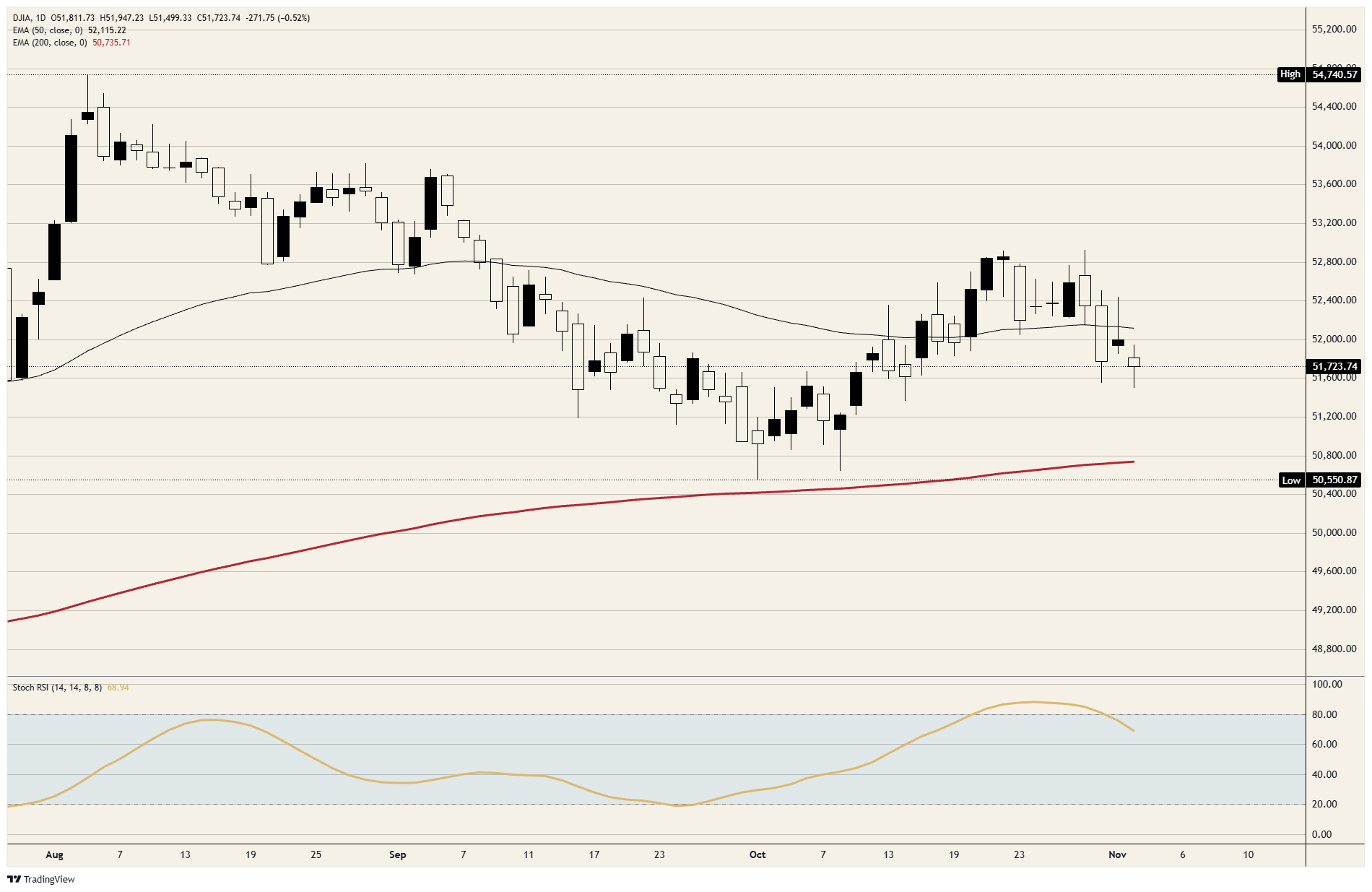
US equities are diverging on Tuesday: semiconductor-led gains are supporting the Nasdaq Composite and S&P 500 following three consecutive losing sessions, but the Dow Jones Industrial Average is retreating. Trading around 51,700, marginally below Friday's close, the Dow has erased Monday's entire advance. An intraday trough around 51,500 marks its weakest level since October 14.

Pressure on the Dow is coming from Apple (AAPL), whose Monday results fell short of analysts' expectations. Both its gross margin guidance and fiscal fourth-quarter iPad sales missed estimates. Following the release, HSBC lowered its share price forecast for Apple by $6 to $360.
Ahead of its third-quarter earnings release, Advanced Micro Devices (AMD) is gaining, alongside Broadcom (AVGO), Micron (MU) and Nvidia (NVDA). This reverses Monday's pattern, when the Dow advanced while the Nasdaq Composite lost more than 1%. Measured against its recent high, the NASDAQ 100 remains roughly 10% lower; the Dow's decline from its August peak is less than 6%.
What Is Next on the Economic Calendar?
Once Tuesday's polls close, counting begins for the US midterm elections. Wednesday offers the first trading session in which markets can respond to the results determining control of the House and Senate from January. With prediction markets assigning Democrats a near 75% chance of winning the Senate, investors and analysts said equities have not yet priced in a Democratic sweep of both chambers.
Wednesday's releases begin with the Automatic Data Processing (ADP) employment count for October at 13:15 GMT, with a forecast of 69K compared with the previous 90K. At 15:00 GMT, the Institute for Supply Management (ISM) services index is expected at 54.8. Friday brings October Nonfarm Payrolls (NFP) at 13:30 GMT, forecast at 65K against the previous 29K. Both employment counts will inform the Fed's December interest rate decision.
What Do the Charts Indicate?
Around half of the advance that began just above 50,500 on October 1 has been erased by the retreat from the late-October peak near 52,900. For a third session, the index is trading beneath its 50-day Exponential Moving Average (EMA), around 52,100, while the 200-day EMA stands near 50,750. After spending most of October's second half in overbought territory, daily momentum has now eased out of that zone.
Daily Chart of the Dow Jones
Dow Jones: Frequently Asked Questions
Comprising the 30 most actively traded US stocks, the Dow Jones Industrial Average ranks among the world's oldest stock market indices. Rather than using market capitalisation, it assigns weights according to share prices. Its value is calculated by adding the constituent share prices and dividing the total by a factor, currently 0.152. Charles Dow, who also established the Wall Street Journal, founded the index. In subsequent years, critics have questioned how broadly it represents the market: unlike wider benchmarks such as the S&P 500, it follows only 30 conglomerates.
The combined performance of its constituent companies, as shown in their quarterly earnings reports, is the principal driver of the Dow Jones Industrial Average (DJIA). Other influences include US and global macroeconomic releases, which shape investor sentiment. By determining interest rates, the Federal Reserve (Fed) also affects the index through borrowing costs, given many companies' heavy reliance on credit. Inflation and other indicators that influence Fed decisions can therefore play a significant role in the DJIA's movements.
Developed by Charles Dow, Dow Theory provides a framework for recognising the stock market's primary trend. It involves comparing the direction of the Dow Jones Industrial Average (DJIA) with that of the Dow Jones Transportation Average (DJTA), following a trend only when both indices move in the same direction. Trading volume serves as confirmation, while analysis of peaks and troughs forms another part of the approach. Dow's framework describes three phases: accumulation, as smart money begins buying or selling; public participation, as the broader public enters; and distribution, as smart money exits.
Investors can access the DJIA through several instruments. ETFs offer a way to trade the index as one security without purchasing shares in each of its 30 constituent companies; a prominent example is the SPDR Dow Jones Industrial Average ETF (DIA). Futures contracts on the DJIA allow traders to speculate on its future value. Options, by contrast, grant the right, without imposing an obligation, to buy or sell the index at a pre-agreed price in the future. Through mutual funds, investors can purchase a share of a diversified portfolio of DJIA stocks, gaining exposure to the index as a whole.
POPULAR ARTICLES
1Banxico survey puts Peso near 18.40, projects rates at 6.50% through 20272Indonesian Rupiah: Do currency risks persist despite softer inflation? – MUFG3Why is the Mexican Peso tumbling amid US midterm jitters and a factory slowdown?4Why is Apple's margin forecast weighing on the Dow Jones Industrial Average?5Singapore Dollar: Is Range-Bound Trading Against the US Dollar Likely? – UOB6Copper: Why are supply risks mounting despite strong US imports? – Commerzbank7Chinese Yuan: PBoC Acts to Curb Yuan Appreciation - Societe Generale8Why Is Resistance Capping the British Pound’s Recovery Against the US Dollar? – Scotiabank9Is the South Korean Won on the verge of a breakout against the US Dollar? – Societe Generale


Get Started!
Sign up and access the Global Markets in less than 3 minutes

Connect With Us









Contacts
Phone: +61 2 8036 8388
Fax: +61 2 8036 8388
Email: support@tmgm.com



The information provided on this website is of a general nature only and does not constitute personal financial advice. Before acting on any information on this website, you should consider the suitability of the information in relation to your objectives, financial situation and needs. Investing in CFDs and FX Margin Contracts carries significant risks and is not suitable for all investors. You may lose more than your initial deposit. You do not own, or have, any interest in the underlying asset. We recommend that you seek independent advice and ensure you fully understand the risks involved before trading. It is important that you read and consider the disclosure document before you acquire any product listed on the website. The information and advertisements offered on this website are not intended for use by any person in any country or jurisdiction where such use would be contrary to local laws and regulations. The Products and Services offered on this website are not intended for residents of the United States, Malaysia and Thailand.
TMGM is authorized and regulated in various jurisdictions.
Trademax Australia Limited, trading as TMGM, is regulated by the Australian Securities and Investments Commission (ASIC), AFSL no. 436416 and is located at Level 28, One International Tower, 100 Barangaroo Avenue, 2000 Sydney, NSW Australia.
Email: support@tmgm.com.au
Trademax Global Limited, trading as TMGM, is authorized and regulated by the Vanuatu Financial Services Commission (VFSC), registration number 40356 and registered at 1276, Kumul Highway, Port Vila, Vanuatu, Republic of Vanuatu.
Email: support@tmgm.com
Trademax Global Markets (SE) Limited, trading as TMGM, is authorized and regulated by the Financial Services Authority (FSA) of Seychelles, with license number SD224. The company is registered at Office No 13, Providence Estate ABIS Centre, Mahe, Seychelles.
Email: support@tmgm.com
Trademax Global Markets (International) Pty Ltd, trading as TMGM, is authorized and regulated by the Financial Services Commission, Mauritius (FSC) with license no. GB22201012, and registered at 33, Edith Cavell Street C/o IQ EQ Fund Services (Mauritius) Ltd Port Louis, 11324 Mauritius.
Email: support@tmgm.com
Copyright © TMGM. All rights reserved