

Trading
Explore a wide range of markets with competitive pricing, deep liquidity, and advanced trading tools.
Learn More 
Platform
Trade seamlessly with TMGM's powerful platform, built for speed, precision, and a superior trading experience.
Learn More Trading Platform
Academy
Learn the fundamentals of trading with beginner-friendly resources, including guides, webinars, and market insights.
Learn More News & Analysis
Get real-time market updates and expert analysis to stay ahead of trading opportunities
Learn More News & Analysis
About
Learn what sets TMGM apart — our global presence, regulatory strength, and commitment to innovation in trading.
Learn More Why Choose TMGM
Sponsorship
Dogecoin Price Forecast: Is a potential bottom in sight for DOGE bulls as retail interest holds steady?
- A subdued broader crypto market outlook keeps Dogecoin confined to a tight consolidation range of $0.0750 to $0.0800.
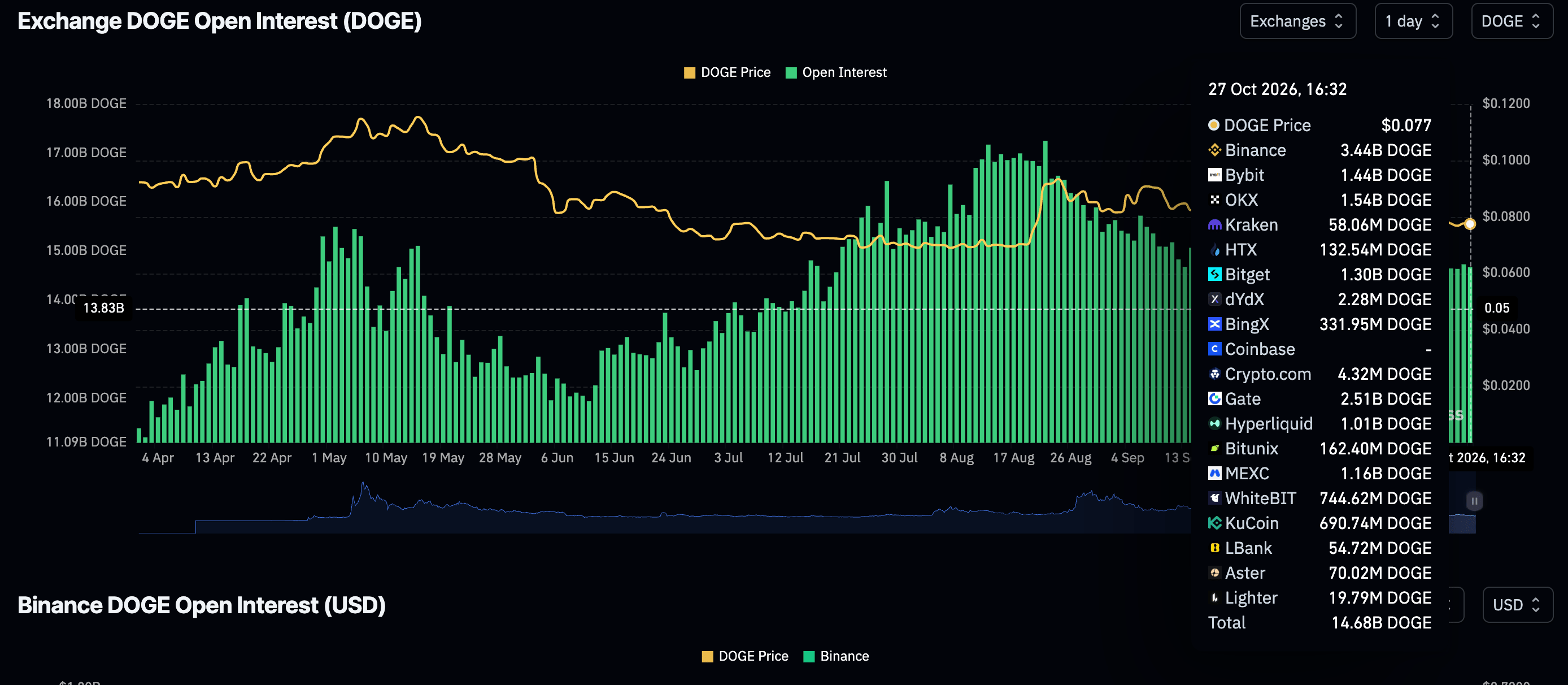
- With perpetual futures open interest at 14.7 billion, Dogecoin’s derivatives market shows signs of stabilisation.
- Holding range support could allow Dogecoin to recover, although its technical momentum indicators remain weak.
Neutral-to-bearish sentiment continues to weigh on Dogecoin (DOGE), keeping the meme coin range-bound on Tuesday between support at $0.0750 and supply at $0.0800. Macroeconomic concerns ahead of Wednesday’s Federal Reserve (Fed) interest rate decision reinforce this cautious outlook.

While rates are widely expected to stay within the 3.75-4.00% range, traders will also scrutinise Fed Chair Kevin Warsh’s post-meeting press conference. They will look for signals on the policy outlook as inflation persists and wider geopolitical tensions affect oil and energy prices.
In an analysis report sent by email, Crypto Finance said, “Wednesday's Fed meeting is the key macro event,” and added, “We expect rates to remain unchanged.”
Economists expect a rate increase in December after a likely hold in October. September saw the Fed raise rates for the first time in three years, highlighting its efforts to lower inflation to the 2% target.
Crypto Finance also noted, “Markets currently price a 90% probability of a skip, followed by a December hike and two further hikes by year-end 2027, taking the target range to 4.50-4.75%,”
Can stabilising retail activity support Dogecoin?
Relative stability persists in the derivatives market: futures Open Interest (OI) stood at 14.68 billion DOGE on Tuesday, only slightly below the previous day’s 14.73 billion DOGE. Since October 21, OI has broadly stayed below the 15 billion DOGE mark, with the lowest reading at 18.64 billion. Retail participation will remain in focus, as a sustained rise in OI could underpin a short- to medium-term rebound. A decline in retail activity, however, could leave the downside as the path of least resistance, prompting traders to look towards lower support levels at $0.0750 and $0.0700, respectively.
Technical analysis: Can Dogecoin consolidate as selling pressure subsides?
Trading at $0.0777, Doge maintains a bearish bias below every key Exponential Moving Average (EMA) and the active SuperTrend line. Overhead resistance from the 50-day EMA at $0.0841 and the 100-day EMA at $0.0845 suggests limited upside, while the 200-day EMA at $0.0908 adds to the broader bearish structure.
Resistance remains in place at the SuperTrend level of $0.0876. At around 36, the Relative Strength Index (RSI) points to muted momentum rather than clearly oversold conditions, suggesting scope for additional losses should sellers retain control.
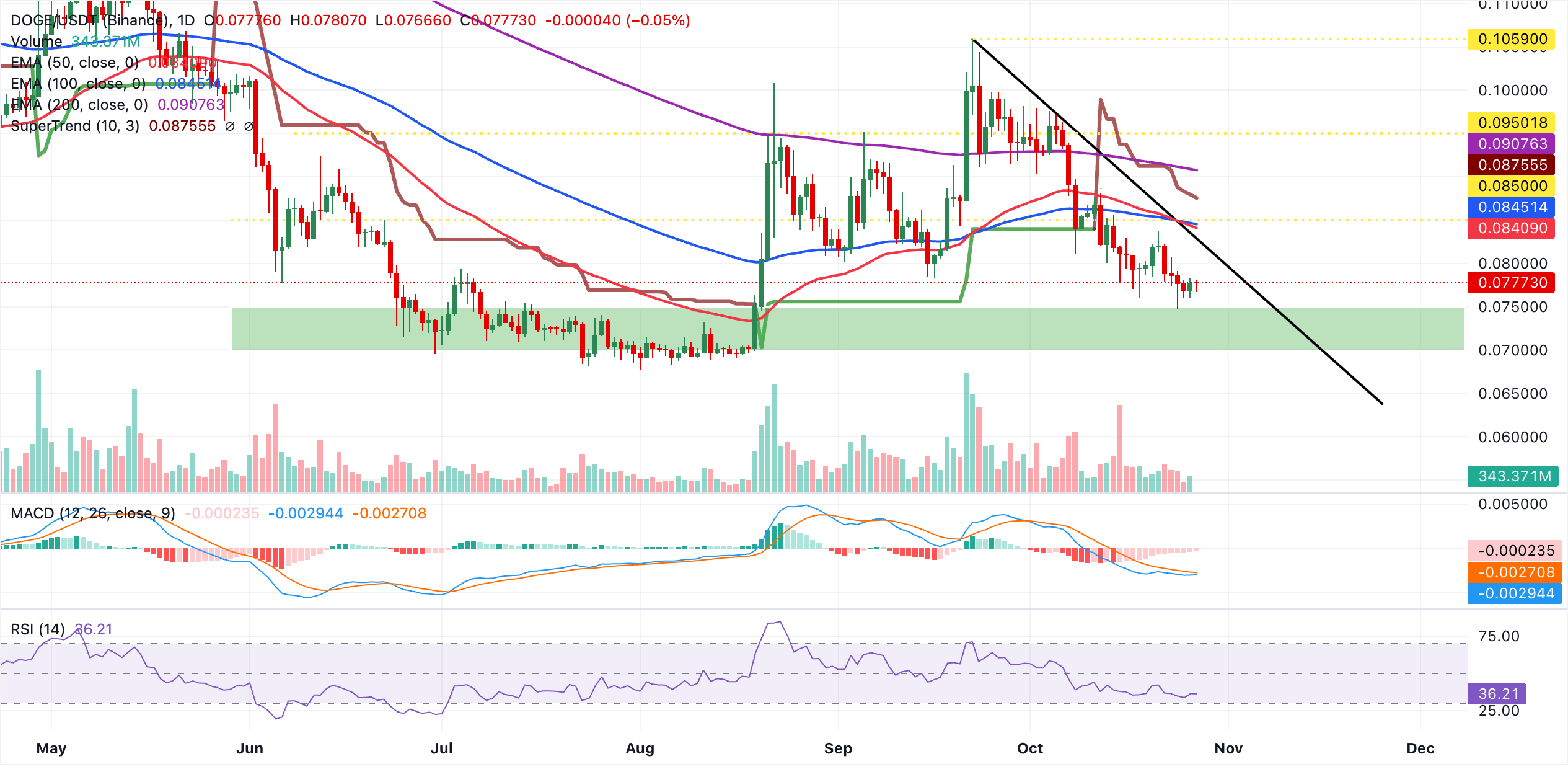
The falling trendline near $0.0825 provides the first resistance level. Beyond it, the short- and medium-term EMAs converge around $0.0840-$0.0845; a move above this cluster would be needed to relieve immediate selling pressure. The next hurdle is the SuperTrend near $0.0876, followed by the 200-day EMA at $0.0908, a major structural ceiling for a more substantial recovery.
The current daily-chart indicators do not identify a clear technical support level nearby. Intraday traders are therefore likely to assess price reactions at these overhead barriers for signs of whether the downward drift can stabilise or give way to further losses.
On the weekly chart, DOGE’s near-term bias remains bearish, but an RSI reading of 43 sits in neutral-to-weak territory. This supports a period of sideways movement and consolidation before another attempt at recovery.
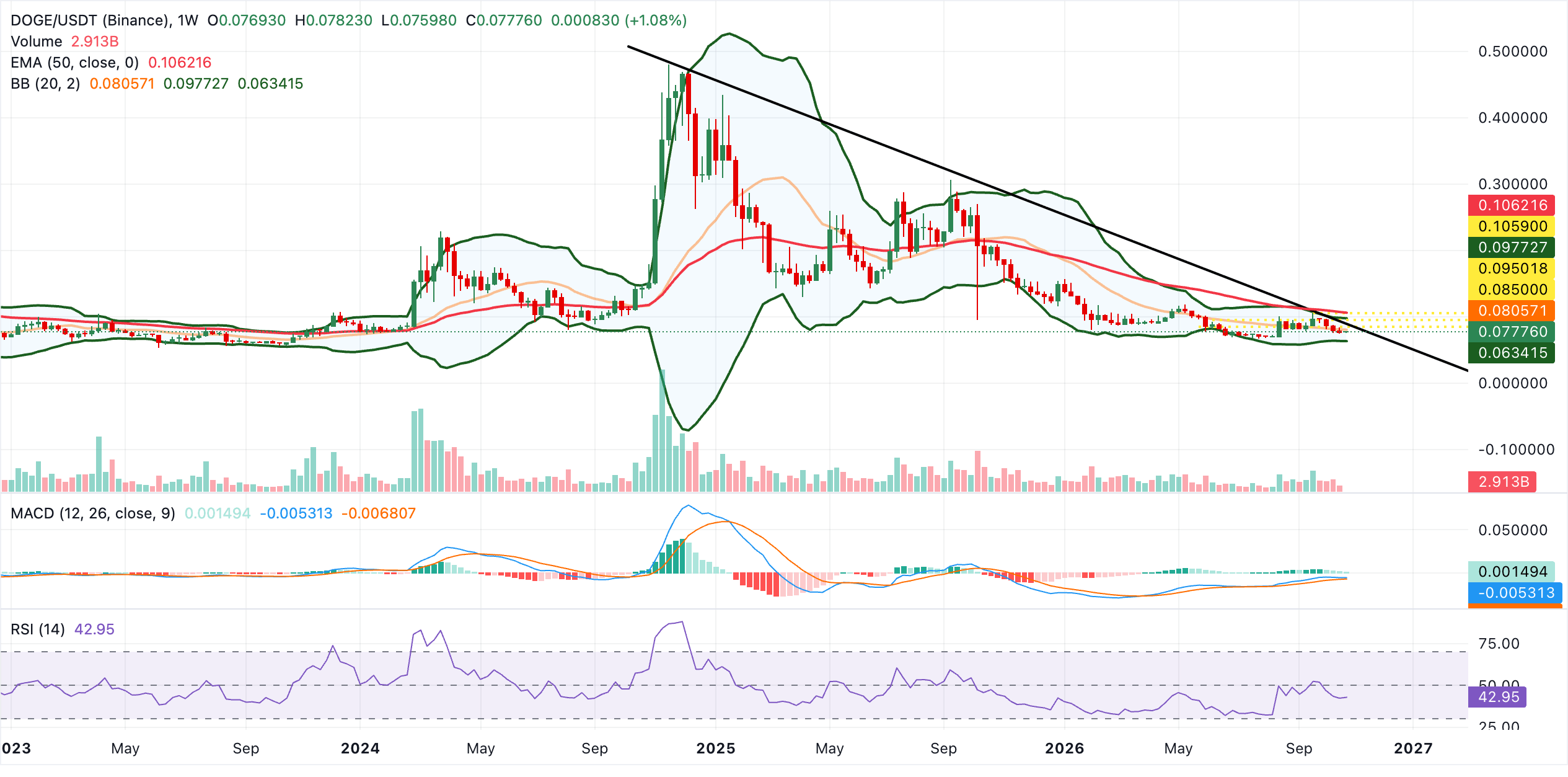
The Bollinger Bands’ central simple moving average at $0.0806 marks the first resistance, followed by the descending resistance trendline at $0.0888. Further hurdles lie at the upper Bollinger band near $0.0977 and the 50-EMA at $0.1062. Immediate downside support, meanwhile, sits at the lower Bollinger band around $0.0634. Trading below the $0.0806-$0.0888 zone is likely to restrict rallies, leaving the pair exposed to a retest of that lower volatility-band floor.
(The technical analysis of this story was written with the help of an AI tool. Know more.)
FAQs on Open Interest and funding rates
A rise in Open Interest is linked to greater liquidity and fresh capital entering the market. This is viewed as an improvement in market efficiency that supports the prevailing trend. Falling Open Interest, by contrast, is interpreted as a sign of market liquidation: investors are exiting and overall demand for the asset is weakening, encouraging bearish sentiment.
By raising the liquidation risk for traders, funding fees narrow the gap between an asset’s spot price and its futures contract prices. When funding rates remain high and positive, they signal bullish sentiment among market participants and expectations of a price increase. Persistently negative funding rates, on the other hand, indicate bearish sentiment: traders anticipate a decline in the cryptocurrency’s price, and a reversal towards a bearish trend is likely.
POPULAR ARTICLES
1Brazilian Real: Fiscal Doubts Accompany Post-Election Sell-Off – Commerzbank2Euro: Will key support at 1.1113 hold against US Dollar? – Scotiabank3Silver Price Forecast: Can XAG/USD Sustain Its Rebound From Year-to-Date Lows Ahead of the Fed Rate Decision?4British Pound slides further ahead of Fed decision and UK budget, extending 4-day decline5Dogecoin Price Forecast: Is a potential bottom in sight for DOGE bulls as retail interest holds steady?6Euro stays under pressure as Fed and ECB interest rate decisions draw near7Natural gas: Will persistent winter risk keep prices elevated? – Commerzbank8United Kingdom: How could Budget risks affect fiscal headroom and rates? - ING9Canadian Dollar: Is Consolidation Around 1.40 Holding? – Scotiabank
LIVE QUOTES

ALL ABOUT TECHNICAL
What Do Reversal Patterns Tell You, and How Can You Trade Them?
How Does a Continuation Pattern Work? Definition, Types and Strategies for Trading
What Is a Breaker Block in Trading, and How Can You Trade It?
Elliott Wave Theory: How Do Traders Apply Its Patterns and Rules?
What Does Smart Money Concept (SMC) Mean, and How Can You Trade It?
What Is an Order Block in Trading and How Can You Trade It?
Average True Range (ATR) Indicator: What Is the Formula, and How Do You Read and Use It?
What Is a Judas Swing? ICT Trading Strategy Explained With Examples
The Real Interest Rate: Are Your Savings Actually Earning Anything?
Get Started!
Sign up and access the Global Markets in less than 3 minutes

Connect With Us









Contacts
Phone: +61 2 8036 8388
Fax: +61 2 8036 8388
Email: support@tmgm.com



The information provided on this website is of a general nature only and does not constitute personal financial advice. Before acting on any information on this website, you should consider the suitability of the information in relation to your objectives, financial situation and needs. Investing in CFDs and FX Margin Contracts carries significant risks and is not suitable for all investors. You may lose more than your initial deposit. You do not own, or have, any interest in the underlying asset. We recommend that you seek independent advice and ensure you fully understand the risks involved before trading. It is important that you read and consider the disclosure document before you acquire any product listed on the website. The information and advertisements offered on this website are not intended for use by any person in any country or jurisdiction where such use would be contrary to local laws and regulations. The Products and Services offered on this website are not intended for residents of the United States, Malaysia and Thailand.
TMGM is authorized and regulated in various jurisdictions.
Trademax Australia Limited, trading as TMGM, is regulated by the Australian Securities and Investments Commission (ASIC), AFSL no. 436416 and is located at Level 28, One International Tower, 100 Barangaroo Avenue, 2000 Sydney, NSW Australia.
Email: support@tmgm.com.au
Trademax Global Limited, trading as TMGM, is authorized and regulated by the Vanuatu Financial Services Commission (VFSC), registration number 40356 and registered at 1276, Kumul Highway, Port Vila, Vanuatu, Republic of Vanuatu.
Email: support@tmgm.com
Trademax Global Markets (SE) Limited, trading as TMGM, is authorized and regulated by the Financial Services Authority (FSA) of Seychelles, with license number SD224. The company is registered at Office No 13, Providence Estate ABIS Centre, Mahe, Seychelles.
Email: support@tmgm.com
Trademax Global Markets (International) Pty Ltd, trading as TMGM, is authorized and regulated by the Financial Services Commission, Mauritius (FSC) with license no. GB22201012, and registered at 33, Edith Cavell Street C/o IQ EQ Fund Services (Mauritius) Ltd Port Louis, 11324 Mauritius.
Email: support@tmgm.com
Copyright © TMGM. All rights reserved