

Trading
Explore a wide range of markets with competitive pricing, deep liquidity, and advanced trading tools.
Learn More 
Platform
Trade seamlessly with TMGM's powerful platform, built for speed, precision, and a superior trading experience.
Learn More Trading Platform
Academy
Learn the fundamentals of trading with beginner-friendly resources, including guides, webinars, and market insights.
Learn More News & Analysis
Get real-time market updates and expert analysis to stay ahead of trading opportunities
Learn More News & Analysis
About
Learn what sets TMGM apart — our global presence, regulatory strength, and commitment to innovation in trading.
Learn More Why Choose TMGM
Sponsorship
BoE recap: What does a split rate hike signal as the Bank warns the energy shock is not over?
Further monetary tightening could be needed to counter energy pressures, the Bank of England (BoE) warned as it sharply revised its inflation forecasts upwards and raised its Bank Rate by 25 basis points to 4.00%. Eight policymakers supported the increase, while Catherine Mann favoured a larger 50-basis-point rise.
A peak of roughly 5% in Q2 2027 is now forecast by the “Old Lady”, replacing its previous projection of 3.2% in late 2026. CPI inflation is unlikely to return to the 2% target before Q3 2028. In the Bank’s adverse scenario, a worsening energy shock would push inflation to 6.2%.
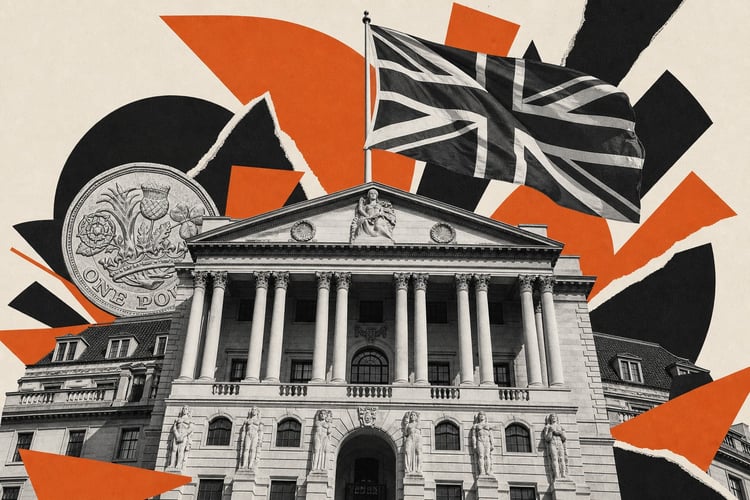
Inflationary pressures already in the pipeline were sufficient to justify the increase, according to Governor Andrew Bailey. While warning that the latest hike might not be the last and that the Middle East crisis might not be over, he stressed that the decision did not signal an inevitable sequence of rate increases. Evidence of second-round effects remains limited in the Bank’s assessment, although stronger-than-anticipated activity has strengthened the case for tighter policy.
An improved near-term growth outlook sits alongside a mixed broader economic picture. Having raised its near-term forecasts, the BoE now projects GDP growth of 1.6% in 2026, followed by a slowdown to 1.3% in 2027 and 1.2% in 2028. A gradual rise in unemployment is likely, yet pay growth is now forecast to exceed earlier estimates. The government’s budget is expected to lower inflation temporarily, with that effect likely to reverse later.
Despite the broadly hawkish tone, the Bank stopped short of committing to further tightening. A near-term increase has a case in its favour, according to MPC members Lombardelli and Pill, while Greene indicated that additional hikes would probably be necessary. Bailey, however, described the existing policy stance as generally restrictive enough. He also attributed part of the rise in market interest rate expectations to risk premia rather than the Bank’s projected policy path. By raising rates, the MPC has sought protection against a worse inflation outcome while intentionally leaving its next decision open.
POPULAR ARTICLES
1Why is Bitcoin falling below $76,000 as NASDAQ slides 5% in AI-led sell-off?2Demand strengthens for outperforming Japanese Yen on US tech rout and hawkish BoJ minutes3Germany: Do orders point to a recovery? – Commerzbank4United States 4-Week Bill Auction fell from previous 3.91% to 3.89%5BoE recap: What does a split rate hike signal as the Bank warns the energy shock is not over?6Inflation risks skewed to the upside, warns BoE’s Bailey7Inflation risks remain as energy and AI trends diverge, warns ECB’s Lagarde8Wall Street falls as AI trade unravels, with NASDAQ 100 leading losses9BoC’s Macklem plays down fiscal risks but leaves rate hike on the table


Get Started!
Sign up and access the Global Markets in less than 3 minutes

Connect With Us









Contacts
Phone: +61 2 8036 8388
Fax: +61 2 8036 8388
Email: support@tmgm.com



The information provided on this website is of a general nature only and does not constitute personal financial advice. Before acting on any information on this website, you should consider the suitability of the information in relation to your objectives, financial situation and needs. Investing in CFDs and FX Margin Contracts carries significant risks and is not suitable for all investors. You may lose more than your initial deposit. You do not own, or have, any interest in the underlying asset. We recommend that you seek independent advice and ensure you fully understand the risks involved before trading. It is important that you read and consider the disclosure document before you acquire any product listed on the website. The information and advertisements offered on this website are not intended for use by any person in any country or jurisdiction where such use would be contrary to local laws and regulations. The Products and Services offered on this website are not intended for residents of the United States, Malaysia and Thailand.
TMGM is authorized and regulated in various jurisdictions.
Trademax Australia Limited, trading as TMGM, is regulated by the Australian Securities and Investments Commission (ASIC), AFSL no. 436416 and is located at Level 28, One International Tower, 100 Barangaroo Avenue, 2000 Sydney, NSW Australia.
Email: support@tmgm.com.au
Trademax Global Limited, trading as TMGM, is authorized and regulated by the Vanuatu Financial Services Commission (VFSC), registration number 40356 and registered at 1276, Kumul Highway, Port Vila, Vanuatu, Republic of Vanuatu.
Email: support@tmgm.com
Trademax Global Markets (SE) Limited, trading as TMGM, is authorized and regulated by the Financial Services Authority (FSA) of Seychelles, with license number SD224. The company is registered at Office No 13, Providence Estate ABIS Centre, Mahe, Seychelles.
Email: support@tmgm.com
Trademax Global Markets (International) Pty Ltd, trading as TMGM, is authorized and regulated by the Financial Services Commission, Mauritius (FSC) with license no. GB22201012, and registered at 33, Edith Cavell Street C/o IQ EQ Fund Services (Mauritius) Ltd Port Louis, 11324 Mauritius.
Email: support@tmgm.com
Copyright © TMGM. All rights reserved