

Trading
Explore a wide range of markets with competitive pricing, deep liquidity, and advanced trading tools.
Learn More 
Platform
Trade seamlessly with TMGM's powerful platform, built for speed, precision, and a superior trading experience.
Learn More Trading Platform
Academy
Learn the fundamentals of trading with beginner-friendly resources, including guides, webinars, and market insights.
Learn More News & Analysis
Get real-time market updates and expert analysis to stay ahead of trading opportunities
Learn More News & Analysis
About
Learn what sets TMGM apart — our global presence, regulatory strength, and commitment to innovation in trading.
Learn More Why Choose TMGM
Sponsorship
Bitcoin Price Forecast: Why is BTC stalling near $80,000 as geopolitical tensions weaken risk appetite?
- Following three consecutive weeks of correction, Bitcoin trades near $80,500 on Monday.
- A return to net inflows ended two weeks of withdrawals from US-listed spot ETFs, which attracted $301 million last week.
- Risk appetite remains subdued as mounting Middle East geopolitical tensions drive oil prices upwards and heighten inflation worries.
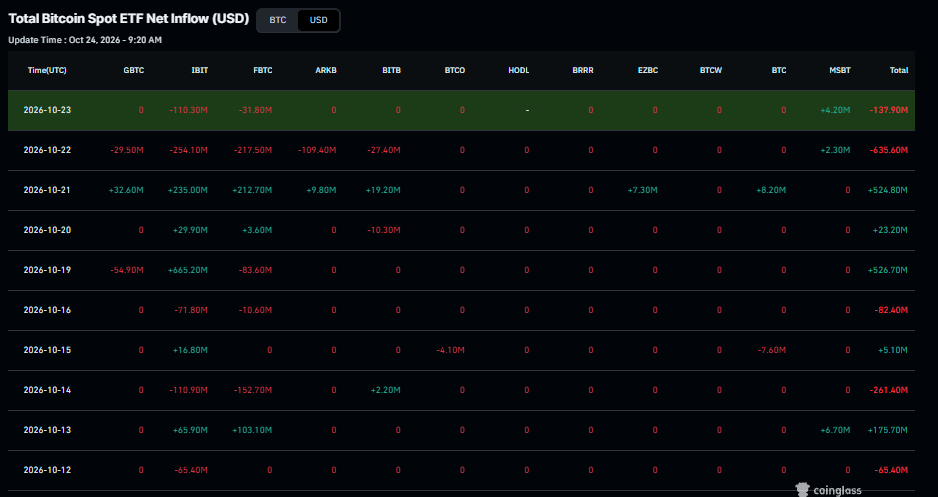
Bitcoin (BTC) remains under pressure after three successive weeks of correction, trading near $80,500 at the time of writing on Monday. Institutional appetite, however, showed signs of recovery despite the weaker price: spot Exchange Traded Funds (ETFs) attracted net inflows of $301.2 million last week, ending a two-week run of outflows.
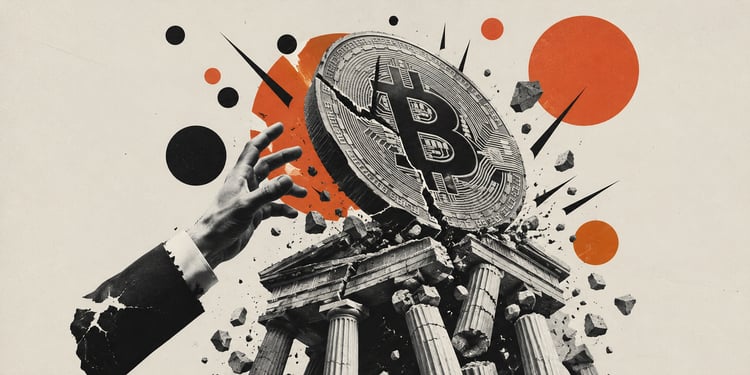
The Crypto King nevertheless faces continued pressure as costlier crude oil and intensifying Middle East geopolitical tensions heighten inflation worries and curb appetite for risk.
Is institutional demand beginning to recover?
The price retreat did not prevent tentative signs of renewed institutional interest last week. According to CoinGlass, Bitcoin spot ETFs attracted $301.2 million in net inflows, reversing two consecutive weeks of outflows. The improvement in demand, however, failed to halt BTC's decline: it lost over 2% last week, completing three successive weeks of correction since early October. A continuation and acceleration of these inflows this week could help soften the ongoing fall in price.
How are geopolitical tensions and higher oil prices pressuring BTC?
Supply worries linked to attacks in Saudi Arabia and tensions involving Iran sent crude oil prices to their highest since September 15. West Texas Intermediate (WTI) touched $103.28 per barrel on Friday.
In the latest development, Yemen's Iran-backed Houthis pledged on Sunday to continue attacks on Saudi Arabia's King Khalid Airport in Riyadh.
With US-Iran negotiations at a standstill, the geopolitical risk premium remains elevated, putting additional upward pressure on oil prices. Should energy costs stay high, inflation concerns could intensify, weakening risk appetite and limiting BTC's scope for gains.
Bitcoin technical outlook: Is BTC losing momentum?
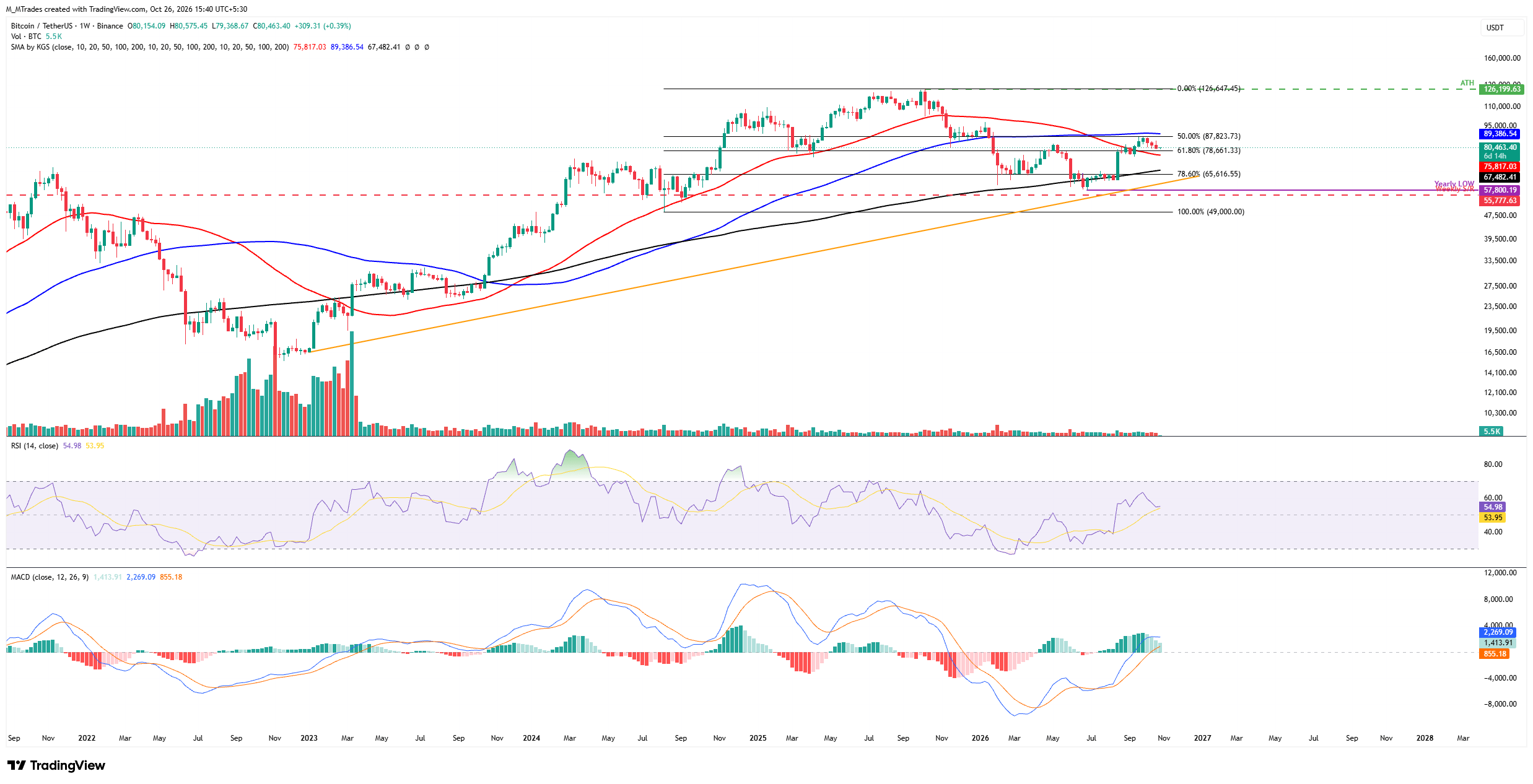
Monday sees the Crypto King trading near $80,400 following last week's 2.39% correction, its third consecutive weekly loss since early October.
A further correction could take BTC towards $78,661, the 61.8% Fibonacci retracement level drawn between the August 2024 low of $49,000 and the October 2025 record high of $126,199. This level broadly aligns with the 50-week Simple Moving Average (SMA) at $75,817.
Bullish momentum appears to be easing, with the weekly Relative Strength Index (RSI) near 54 and heading lower towards the neutral 50 mark. The Moving Average Convergence Divergence (MACD) histogram, while still positive, is also displaying shorter bars. Together, these signals suggest that the broader upward momentum remains in place but is weakening amid nearby resistance and the continuing pullback.
A recovery, by contrast, could carry BTC towards the 50% retracement level at $87,823, followed by the 100-week SMA at $89,386.
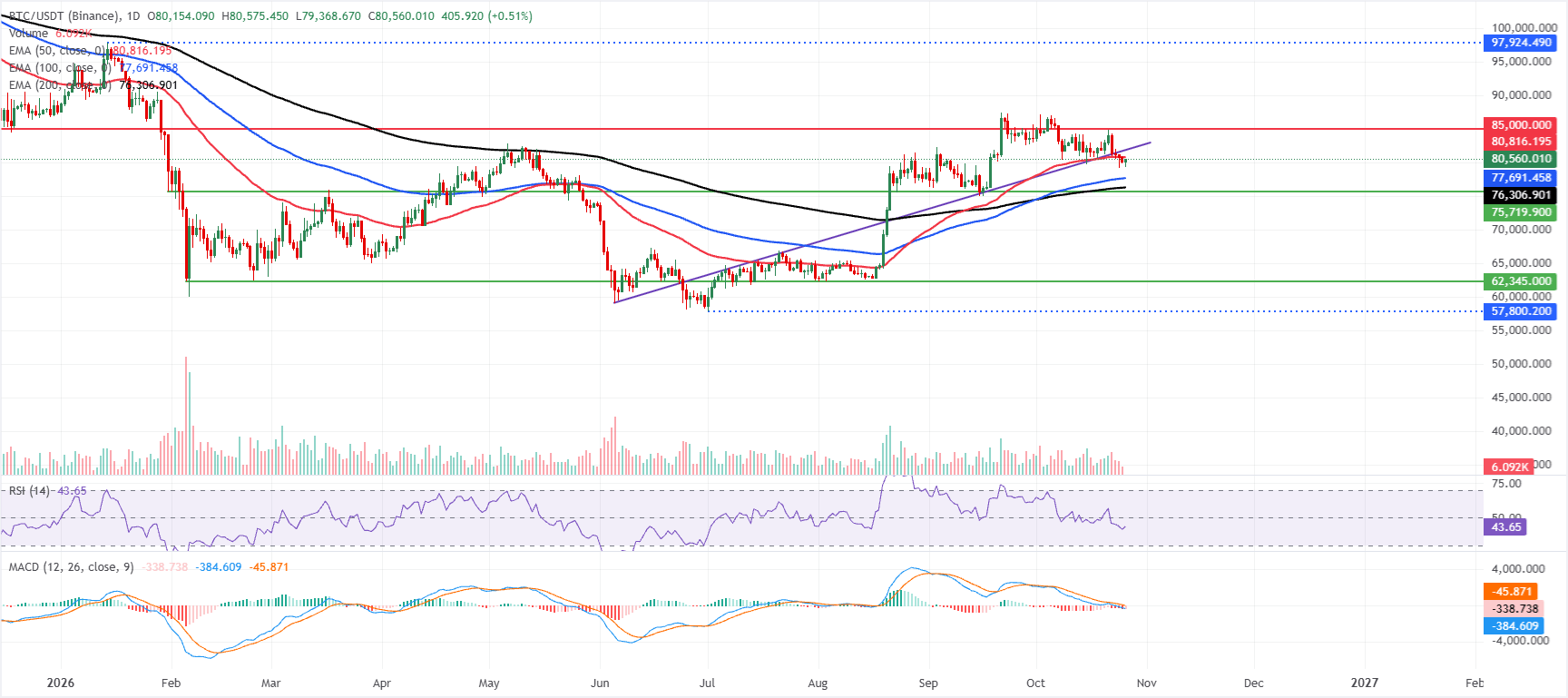
A neutral consolidation is evident on BTC's daily chart. The price remains above the 100-day and 200-day Exponential Moving Averages (EMAs), at $77,691 and $76,306 respectively, while the 50-day EMA at $80,816 continues to restrict gains. Trading between these trend indicators points to a broadly bullish backdrop, though near-term conviction is lacking. Meanwhile, a daily RSI reading of 43 signals waning momentum, and the MACD's position below zero suggests bullish momentum remains muted.
The first upside hurdle is the 50-day EMA at $80,816. Beyond it, the horizontal level near $85,000 presents a stronger barrier, where earlier selling pressure could return.
Initial downside support lies at the 100-day EMA of $77,691, followed by a deeper structural floor near the 200-day EMA at $76,306. A daily close beneath these supporting averages would likely shift the near-term bias towards a more bearish set-up.
(The technical analysis of this story was written with the help of an AI tool. Know more.)
FAQs on Bitcoin, altcoins and stablecoins
As the largest cryptocurrency by market capitalisation, Bitcoin is a virtual currency created to function as money. No single individual, group or entity can control this payment method, removing the need for third-party involvement in financial transactions.
The term altcoin covers cryptocurrencies other than Bitcoin. Some, however, also exclude Ethereum, on the grounds that these two cryptocurrencies are the starting points for forking. Under that interpretation, Litecoin is the first altcoin: it was forked from the Bitcoin protocol and is therefore an “improved” version of it.
Designed to maintain a stable price, stablecoins are cryptocurrencies whose value is backed by a reserve of the asset they represent. This is achieved by pegging each stablecoin's value to a commodity or financial instrument, such as the US Dollar (USD), while an algorithm or demand regulates its supply. Their primary purpose is to offer investors a route into and out of cryptocurrency trading and investment. They also enable investors to store value, as cryptocurrencies are generally subject to volatility.
Measured as Bitcoin's market capitalisation relative to the combined market capitalisation of all cryptocurrencies, Bitcoin dominance offers a clear indication of investor interest in Bitcoin. BTC dominance is typically high ahead of and during a bull run, when investors favour a relatively stable cryptocurrency with a large market capitalisation, such as Bitcoin. Falling BTC dominance generally indicates that investors are shifting capital and/or profits into altcoins in pursuit of better returns, often triggering a surge in altcoin rallies.
POPULAR ARTICLES
1Euro: Is trading against the US Dollar confined to a clear range? – UOB2Bitcoin Price Forecast: Why is BTC stalling near $80,000 as geopolitical tensions weaken risk appetite?3Reserve Bank of New Zealand: TD Securities now expects an October rate hike4Silver Price Forecast: Is XAG/USD Stalling Near $54.00 as Bears Retain Control?5Bank of Canada: Rabobank expects policy rate to remain unchanged6Australian Dollar: Will inflation data reinforce its yield advantage? – BBH7British Pound outpaces Japanese Yen as UK Budget and BoJ decision approach8Brazilian Real: Why is the election shock deepening losses against the US Dollar? - SocGen9USD/CAD Price Forecast: Oil Prices Weigh on the CAD as Dollar Strengthens Above 1.4000
LIVE QUOTES

ALL ABOUT TECHNICAL
What Is a Breaker Block in Trading, and How Can You Trade It?
Elliott Wave Theory: How Do Traders Apply Its Patterns and Rules?
What Does Smart Money Concept (SMC) Mean, and How Can You Trade It?
What Is an Order Block in Trading and How Can You Trade It?
Average True Range (ATR) Indicator: What Is the Formula, and How Do You Read and Use It?
What Is a Judas Swing? ICT Trading Strategy Explained With Examples
The Real Interest Rate: Are Your Savings Actually Earning Anything?
Butterfly Pattern Trading: How to Identify and Trade the Butterfly Harmonic Pattern
What Is a Rising Wedge Pattern and How Do You Trade It?
Get Started!
Sign up and access the Global Markets in less than 3 minutes

Connect With Us









Contacts
Phone: +61 2 8036 8388
Fax: +61 2 8036 8388
Email: support@tmgm.com



The information provided on this website is of a general nature only and does not constitute personal financial advice. Before acting on any information on this website, you should consider the suitability of the information in relation to your objectives, financial situation and needs. Investing in CFDs and FX Margin Contracts carries significant risks and is not suitable for all investors. You may lose more than your initial deposit. You do not own, or have, any interest in the underlying asset. We recommend that you seek independent advice and ensure you fully understand the risks involved before trading. It is important that you read and consider the disclosure document before you acquire any product listed on the website. The information and advertisements offered on this website are not intended for use by any person in any country or jurisdiction where such use would be contrary to local laws and regulations. The Products and Services offered on this website are not intended for residents of the United States, Malaysia and Thailand.
TMGM is authorized and regulated in various jurisdictions.
Trademax Australia Limited, trading as TMGM, is regulated by the Australian Securities and Investments Commission (ASIC), AFSL no. 436416 and is located at Level 28, One International Tower, 100 Barangaroo Avenue, 2000 Sydney, NSW Australia.
Email: support@tmgm.com.au
Trademax Global Limited, trading as TMGM, is authorized and regulated by the Vanuatu Financial Services Commission (VFSC), registration number 40356 and registered at 1276, Kumul Highway, Port Vila, Vanuatu, Republic of Vanuatu.
Email: support@tmgm.com
Trademax Global Markets (SE) Limited, trading as TMGM, is authorized and regulated by the Financial Services Authority (FSA) of Seychelles, with license number SD224. The company is registered at Office No 13, Providence Estate ABIS Centre, Mahe, Seychelles.
Email: support@tmgm.com
Trademax Global Markets (International) Pty Ltd, trading as TMGM, is authorized and regulated by the Financial Services Commission, Mauritius (FSC) with license no. GB22201012, and registered at 33, Edith Cavell Street C/o IQ EQ Fund Services (Mauritius) Ltd Port Louis, 11324 Mauritius.
Email: support@tmgm.com
Copyright © TMGM. All rights reserved