

Trading
Explore a wide range of markets with competitive pricing, deep liquidity, and advanced trading tools.
Learn More 
Platform
Trade seamlessly with TMGM's powerful platform, built for speed, precision, and a superior trading experience.
Learn More Trading Platform
Academy
Learn the fundamentals of trading with beginner-friendly resources, including guides, webinars, and market insights.
Learn More News & Analysis
Get real-time market updates and expert analysis to stay ahead of trading opportunities
Learn More News & Analysis
About
Learn what sets TMGM apart — our global presence, regulatory strength, and commitment to innovation in trading.
Learn More Why Choose TMGM
Sponsorship
AUD/NZD Price Forecast: Could the Aussie test previous highs around 1.2490 as support?
- After touching 13-year highs above 1.2600, AUD/USD retreats towards 1.2520.
- Broad-based losses hit the Kiwi after the RBNZ kept interest rates unchanged.
- Overbought conditions now prevail for the pair across most timeframes.
A sharp advance in the Aussie Dollar (AUD) against a weakening New Zealand Dollar (NZD) on Wednesday follows the Reserve Bank of New Zealand’s (RBNZ) surprise decision to pause at its monetary policy meeting. However, heavily overbought conditions have emerged in AUD/NZD after it touched multi-decade highs near 1.2600. During the Asian session, the pair has retreated towards the former resistance zone around 1.2490.

A broad sell-off in the Kiwi Dollar followed the RBNZ’s decision earlier on Wednesday to retain its Official Cash Rate (OCR) at 2.75%, rather than deliver the quarter-point increase markets had expected. Some of those losses were recovered soon afterwards, as Governor Anna Breman signalled the possibility of further monetary tightening in December.
The Aussie also drew support from Australia’s Consumer Price Index (CPI) release earlier in the day. September inflation quickened to 0.8%, compared with 0.4% in August, while the annual CPI reading increased to 4.3% from the previous month’s 4%.
The Reserve Bank of Australia (RBA) Trimmed Mean CPI, meanwhile, climbed to 1% from 0.8% on a quarterly basis, with the year-on-year reading holding steady at 3.6%. Together, the figures put the central bank under greater pressure to deliver its fifth rate increase this year at next week’s monetary policy meeting.
Technical Analysis: Could overbought conditions trigger a deeper correction?
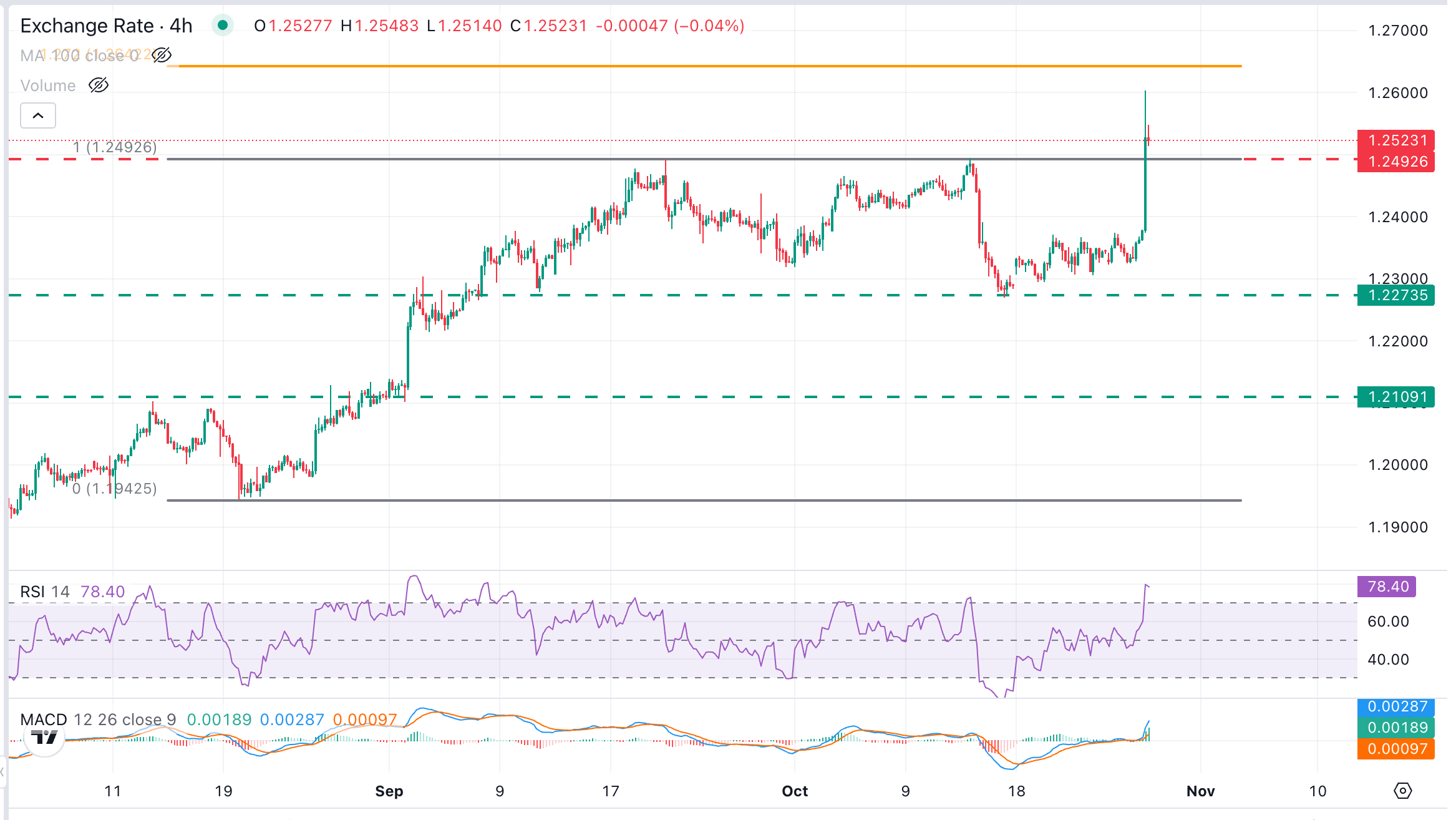
The breakout in AUD/NZD above its horizontal range of the past seven weeks has been sharp enough to lift the 4-hour Relative Strength Index (14) close to 80. Such deeply overbought readings often precede a correction.
Near-term momentum remains constructive, as indicated by the positive Moving Average Convergence Divergence (MACD) histogram. The bullish push has nevertheless weakened, leaving scope for a test of support near 1.2490, the former range ceiling, before the pair resumes its advance.
Should the correction deepen, attention would turn first to the lows of 21, 22 and 26 October around 1.2370, followed by the key support zone near 1.2275, marked by the lows of 10 September and 16 October.
Any renewed advance is likely to test buyers at the session high of 1.2609. Beyond that, a plausible target appears to be 1.2642, the 127.2% Fibonacci extension of the August-September rally.
(The technical analysis of this story was written with the help of an AI tool. Know more.)
How Is the New Zealand Dollar Performing Today?
The New Zealand Dollar (NZD) recorded its strongest performance against the Swiss Franc today. Its percentage moves against the major currencies listed are set out in the table below.
| USD | EUR | GBP | JPY | CAD | AUD | NZD | CHF | |
|---|---|---|---|---|---|---|---|---|
| USD | 0.04% | 0.17% | -0.03% | 0.05% | -0.08% | 1.19% | 0.20% | |
| EUR | -0.04% | 0.13% | -0.07% | 0.01% | -0.13% | 1.15% | 0.16% | |
| GBP | -0.17% | -0.13% | -0.21% | -0.12% | -0.27% | 1.02% | 0.03% | |
| JPY | 0.03% | 0.07% | 0.21% | 0.08% | -0.05% | 1.22% | 0.22% | |
| CAD | -0.05% | -0.01% | 0.12% | -0.08% | -0.14% | 1.13% | 0.15% | |
| AUD | 0.08% | 0.13% | 0.27% | 0.05% | 0.14% | 1.28% | 0.29% | |
| NZD | -1.19% | -1.15% | -1.02% | -1.22% | -1.13% | -1.28% | -0.97% | |
| CHF | -0.20% | -0.16% | -0.03% | -0.22% | -0.15% | -0.29% | 0.97% |
Percentage movements between major currencies are displayed in the heat map. Read the base currency from the left-hand column and the quote currency from the top row. For instance, selecting the New Zealand Dollar on the left and following that row across to the US Dollar gives the percentage change for NZD (base)/USD (quote) in the corresponding cell.
POPULAR ARTICLES
1USD/JPY Price Forecast: What Next as the V-Shaped Recovery Extends Towards 158.00?2AUD/NZD Price Forecast: Could the Aussie test previous highs around 1.2490 as support?3Gold: Tentative recovery brings risks in both directions – OCBC4Galaxy records $323M profit as Robinhood’s crypto revenue drops 55%5Turkey Trade Balance above forecasts (-5.23B) in September: Actual (-5.16B)6British Pound: Could a softer GBP revive inflows? - BNY7How did a strike on a Saudi refinery lift WTI above $100.50?8New Zealand Dollar: Kiwi gains capped by RBNZ pause – Commerzbank9Brent: Why is the risk premium holding amid continued uncertainty over Iran? – ING
LIVE QUOTES


ALL ABOUT FOREX
What Is a Stop Loss, How Does It Work and How Do You Set One?
Margin Call Meaning: What It Is, What Triggers It, and How to Avoid One
What Is an Islamic Account in Forex?
Best Indicators for Forex Trading and How to Use Them
The Top 10 Most Traded Currency Pairs in the World
What are the Major Forex Pairs? 7 Major Currency Pairs in the World
5 Best Forex Trading Apps In India In 2026
Top 15 Weakest Currencies in the World
Best Time to Trade Forex
Get Started!
Sign up and access the Global Markets in less than 3 minutes

Connect With Us









Contacts
Phone: +61 2 8036 8388
Fax: +61 2 8036 8388
Email: support@tmgm.com



The information provided on this website is of a general nature only and does not constitute personal financial advice. Before acting on any information on this website, you should consider the suitability of the information in relation to your objectives, financial situation and needs. Investing in CFDs and FX Margin Contracts carries significant risks and is not suitable for all investors. You may lose more than your initial deposit. You do not own, or have, any interest in the underlying asset. We recommend that you seek independent advice and ensure you fully understand the risks involved before trading. It is important that you read and consider the disclosure document before you acquire any product listed on the website. The information and advertisements offered on this website are not intended for use by any person in any country or jurisdiction where such use would be contrary to local laws and regulations. The Products and Services offered on this website are not intended for residents of the United States, Malaysia and Thailand.
TMGM is authorized and regulated in various jurisdictions.
Trademax Australia Limited, trading as TMGM, is regulated by the Australian Securities and Investments Commission (ASIC), AFSL no. 436416 and is located at Level 28, One International Tower, 100 Barangaroo Avenue, 2000 Sydney, NSW Australia.
Email: support@tmgm.com.au
Trademax Global Limited, trading as TMGM, is authorized and regulated by the Vanuatu Financial Services Commission (VFSC), registration number 40356 and registered at 1276, Kumul Highway, Port Vila, Vanuatu, Republic of Vanuatu.
Email: support@tmgm.com
Trademax Global Markets (SE) Limited, trading as TMGM, is authorized and regulated by the Financial Services Authority (FSA) of Seychelles, with license number SD224. The company is registered at Office No 13, Providence Estate ABIS Centre, Mahe, Seychelles.
Email: support@tmgm.com
Trademax Global Markets (International) Pty Ltd, trading as TMGM, is authorized and regulated by the Financial Services Commission, Mauritius (FSC) with license no. GB22201012, and registered at 33, Edith Cavell Street C/o IQ EQ Fund Services (Mauritius) Ltd Port Louis, 11324 Mauritius.
Email: support@tmgm.com
Copyright © TMGM. All rights reserved