
News & AnalysisCareer

A 0.3% decline takes USD/JPY towards 157.90 in Thursday’s European session, with the Japanese Yen (JPY) gaining against the US Dollar (USD). Weighing on the pair is the US Dollar’s underperformance, driven by concerns that United States (US) Republicans would find it difficult to maintain their policies following their midterm election setback against the Democrats.

Today’s percentage moves in the US Dollar (USD) relative to the major currencies listed are set out below. Its largest loss was against the New Zealand Dollar.
| USD | EUR | GBP | JPY | CAD | AUD | NZD | CHF | |
|---|---|---|---|---|---|---|---|---|
| USD | -0.29% | -0.16% | -0.32% | -0.12% | -0.17% | -0.41% | -0.33% | |
| EUR | 0.29% | 0.13% | -0.05% | 0.16% | 0.12% | -0.14% | -0.06% | |
| GBP | 0.16% | -0.13% | -0.17% | 0.03% | -0.01% | -0.25% | -0.19% | |
| JPY | 0.32% | 0.05% | 0.17% | 0.21% | 0.17% | -0.10% | -0.01% | |
| CAD | 0.12% | -0.16% | -0.03% | -0.21% | -0.04% | -0.30% | -0.22% | |
| AUD | 0.17% | -0.12% | 0.01% | -0.17% | 0.04% | -0.23% | -0.17% | |
| NZD | 0.41% | 0.14% | 0.25% | 0.10% | 0.30% | 0.23% | 0.10% | |
| CHF | 0.33% | 0.06% | 0.19% | 0.01% | 0.22% | 0.17% | -0.10% |
Percentage movements between the major currencies are displayed in the heat map. Select the base currency in the left-hand column and the quote currency in the top row. Selecting the US Dollar on the left and following its row across to the Japanese Yen, for instance, gives the percentage change for USD (base)/JPY (quote) in the corresponding cell.
At the time of writing, a 0.25% fall has brought the US Dollar Index (DXY) to around 101.24. The index, which tracks the Greenback against six major currencies, remains near the monthly low of 101.10 reached the day before.
A Democratic sweep would be likely to “lead to gridlock on the debt ceiling, a prolonged government shutdown next year”, according to analysts at ING. The bank also cautioned that “fears of tougher regulation could weigh on Artificial Intelligence (AI) stocks (we’ve recently seen how that can hit the greenback)”.
Attention on the economic calendar now turns to Friday’s release of October’s US Nonfarm Payrolls (NFP) figures. Investors expect the report to have a substantial influence on expectations for the Federal Reserve’s (Fed) monetary policy.
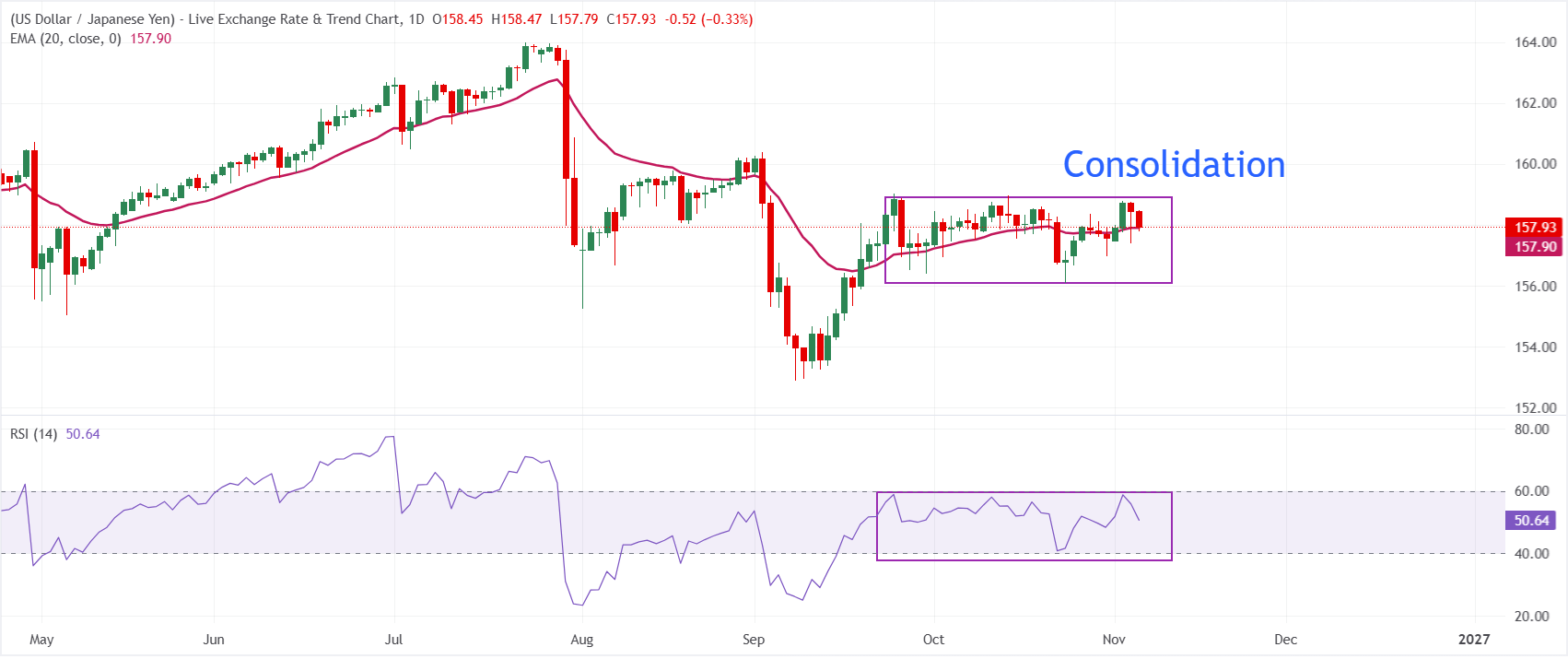
Trading at 157.93 on the daily chart, USD/JPY remains close to its 20-day exponential moving average (EMA) of 157.90. This leaves the short-term outlook broadly neutral.
Neither buyers nor sellers have a clear advantage at present: the Relative Strength Index (RSI), at 50.66, is close to its midpoint, suggesting limited directional conviction following the recent price swings.
The first downside support lies around 157.90 at the 20-day EMA. A breach would leave recent lows in view should selling pressure gather pace. With the supplied dataset showing no nearby technical resistance, traders may instead watch psychological round numbers and earlier swing highs above the current price for potential selling pressure on further advances.
(The technical analysis of this story was written with the help of an AI tool. Know more.)
Published by the US Bureau of Labor Statistics (BLS), Nonfarm Payrolls measures the number of jobs added across US non-agricultural businesses in the preceding month. Month-to-month payroll changes can fluctuate sharply, while substantial revisions to the figures can also generate volatility in the foreign exchange market. A strong reading is generally regarded as positive for the US Dollar (USD), and a weak result as negative. However, revisions to earlier months and the Unemployment Rate matter just as much as the headline number. The market response therefore reflects investors’ assessment of the BLS report in its entirety.
Find out more.Next publication: Fri 06 Nov 2026 13:30
Publication frequency: Every month
Consensus forecast: 65K
Previous reading: 29K
Data source: US Bureau of Labor Statistics
The monthly change in US employment is closely linked to the economy’s overall performance, making America’s jobs report what is regarded as the most important economic indicator for forex traders. Published on the first Friday after the reporting month, the figures are closely watched by policymakers. With full employment among its mandates, the Federal Reserve takes labour market developments into account when setting policy, which in turn affects currencies. Although several leading indicators inform forecasts, Nonfarm Payrolls often catch markets by surprise and prompt sizeable price swings. A reading above the consensus forecast tends to support the USD.







Phone: +61 2 8036 8388
Fax: +61 2 8036 8388
Email: support@tmgm.com



The information provided on this website is of a general nature only and does not constitute personal financial advice. Before acting on any information on this website, you should consider the suitability of the information in relation to your objectives, financial situation and needs. Investing in CFDs and FX Margin Contracts carries significant risks and is not suitable for all investors. You may lose more than your initial deposit. You do not own, or have, any interest in the underlying asset. We recommend that you seek independent advice and ensure you fully understand the risks involved before trading. It is important that you read and consider the disclosure document before you acquire any product listed on the website. The information and advertisements offered on this website are not intended for use by any person in any country or jurisdiction where such use would be contrary to local laws and regulations. The Products and Services offered on this website are not intended for residents of the United States, Malaysia and Thailand.
TMGM is authorized and regulated in various jurisdictions.
Trademax Australia Limited, trading as TMGM, is regulated by the Australian Securities and Investments Commission (ASIC), AFSL no. 436416 and is located at Level 28, One International Tower, 100 Barangaroo Avenue, 2000 Sydney, NSW Australia.
Email: support@tmgm.com.au
Trademax Global Limited, trading as TMGM, is authorized and regulated by the Vanuatu Financial Services Commission (VFSC), registration number 40356 and registered at 1276, Kumul Highway, Port Vila, Vanuatu, Republic of Vanuatu.
Email: support@tmgm.com
Trademax Global Markets (SE) Limited, trading as TMGM, is authorized and regulated by the Financial Services Authority (FSA) of Seychelles, with license number SD224. The company is registered at Office No 13, Providence Estate ABIS Centre, Mahe, Seychelles.
Email: support@tmgm.com
Trademax Global Markets (International) Pty Ltd, trading as TMGM, is authorized and regulated by the Financial Services Commission, Mauritius (FSC) with license no. GB22201012, and registered at 33, Edith Cavell Street C/o IQ EQ Fund Services (Mauritius) Ltd Port Louis, 11324 Mauritius.
Email: support@tmgm.com
Copyright © TMGM. All rights reserved


