
News & AnalysisCareer

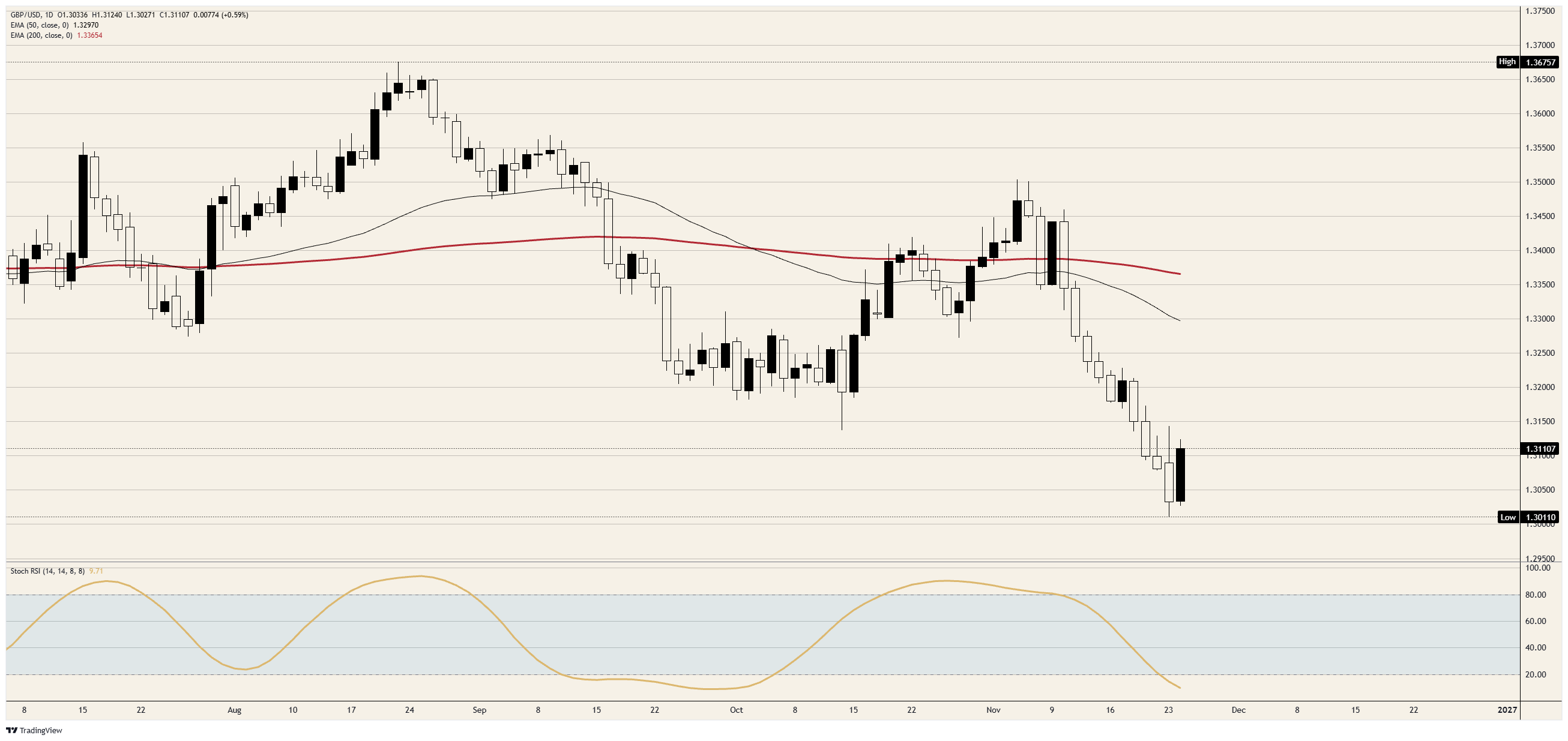
A decline of about 500 pips over three weeks has halted at the Pound's November 2025 low, with GBP/USD subsequently recovering above 1.3100. From a high near 1.3500 on 4 November, the pair slipped to just above 1.3000 on Monday before reversing course. It now trades just above 1.3100.

Monday's gains in the Dollar and US equities followed Nvidia (NVDA) bringing back its chief executive. The currency then surrendered its advance as artificial intelligence (AI) shares came under selling pressure. Sterling's recovery above 1.3100 also followed a warning from Treasury Secretary Bessent against excessive monetary tightening. Markets still assign a probability above 95% to a Fed rate rise on 9 December. Speaking on Monday, New York Fed President Williams said policy would have to adjust to return inflation to 2%.
November's preliminary UK surveys put services growth at a five-month low, although manufacturing output reached its highest level since August 2024. Retail sales increased by 0.7% in October. With the UK's Bank Rate at 4.00%, markets are pricing in at least two further Bank of England (BoE) increases. Sterling's direction, however, has been more closely tied to the Dollar than to any of these developments.
October's Personal Consumption Expenditures Price Index (PCE) is scheduled for Wednesday at 13:30 GMT, alongside revised third-quarter Gross Domestic Product (GDP) and weekly jobless claims. The US Thanksgiving holiday follows on Thursday. Given that the probability of a December Fed increase is priced above 95%, the releases mainly inform the question of whether a further rise will follow in January. Eight days after the Fed's decision, the BoE announces its next decision on 17 December. UBS expects the next BoE rate increase in February.
Only a few pips separate Monday's trough from the November 2025 low. On a chart beginning in September 2025, these mark the two lowest readings. While the 50-day Exponential Moving Average (EMA) has slipped below 1.3300, the 200-day EMA sits just below 1.3400. For the first time since early October, daily momentum is in oversold territory.
Dating from 886 AD, Pound Sterling (GBP) is the world's oldest currency and the official currency of the United Kingdom. Figures for 2022 rank it fourth in global foreign exchange (FX) trading, with a 12% share of all transactions and average daily turnover of $630 billion. Among its principal trading pairs, GBP/USD, known as ‘Cable’, represents 11% of FX trading. GBP/JPY, referred to by traders as the ‘Dragon’, accounts for 3%, while EUR/GBP accounts for 2%. Responsibility for issuing Pound Sterling rests with the Bank of England (BoE).
Monetary policy set by the Bank of England is the most important influence on Pound Sterling's value. Decisions hinge on progress towards the BoE's central objective of “price stability” – inflation holding steady at around 2%. Interest rate adjustments are its main means of pursuing that objective. To curb excessively high inflation, the BoE raises interest rates, increasing borrowing costs for households and businesses. GBP generally benefits because higher rates make the UK a more appealing destination for international investors' funds. By contrast, inflation that falls too low signals slowing economic growth. The BoE will then consider rate cuts to reduce borrowing costs, encouraging businesses to take out loans and invest in projects that generate growth.
By indicating the economy's health, published data can affect Pound Sterling's value. GDP, manufacturing and services PMIs, and employment figures are among the indicators that can determine GBP's direction. Sterling benefits from economic strength through increased foreign investment and the possibility that the BoE will raise interest rates, directly supporting GBP. Weak economic readings, on the other hand, are likely to weigh on Pound Sterling.
The trade balance is another important release for Pound Sterling, recording the gap between a country's export earnings and its spending on imports over a specified period. Strong overseas demand for a country's exports benefits its currency through the additional demand generated by foreign buyers purchasing those goods. A positive net trade balance therefore supports the currency, whereas a negative balance has the opposite effect.







Phone: +61 2 8036 8388
Fax: +61 2 8036 8388
Email: support@tmgm.com



The information provided on this website is of a general nature only and does not constitute personal financial advice. Before acting on any information on this website, you should consider the suitability of the information in relation to your objectives, financial situation and needs. Investing in CFDs and FX Margin Contracts carries significant risks and is not suitable for all investors. You may lose more than your initial deposit. You do not own, or have, any interest in the underlying asset. We recommend that you seek independent advice and ensure you fully understand the risks involved before trading. It is important that you read and consider the disclosure document before you acquire any product listed on the website. The information and advertisements offered on this website are not intended for use by any person in any country or jurisdiction where such use would be contrary to local laws and regulations. The Products and Services offered on this website are not intended for residents of the United States, Malaysia and Thailand.
TMGM is authorized and regulated in various jurisdictions.
Trademax Australia Limited, trading as TMGM, is regulated by the Australian Securities and Investments Commission (ASIC), AFSL no. 436416 and is located at Level 28, One International Tower, 100 Barangaroo Avenue, 2000 Sydney, NSW Australia.
Email: support@tmgm.com.au
Trademax Global Limited, trading as TMGM, is authorized and regulated by the Vanuatu Financial Services Commission (VFSC), registration number 40356 and registered at 1276, Kumul Highway, Port Vila, Vanuatu, Republic of Vanuatu.
Email: support@tmgm.com
Trademax Global Markets (SE) Limited, trading as TMGM, is authorized and regulated by the Financial Services Authority (FSA) of Seychelles, with license number SD224. The company is registered at Office No 13, Providence Estate ABIS Centre, Mahe, Seychelles.
Email: support@tmgm.com
Trademax Global Markets (International) Pty Ltd, trading as TMGM, is authorized and regulated by the Financial Services Commission, Mauritius (FSC) with license no. GB22201012, and registered at 33, Edith Cavell Street C/o IQ EQ Fund Services (Mauritius) Ltd Port Louis, 11324 Mauritius.
Email: support@tmgm.com
Copyright © TMGM. All rights reserved


