
News & AnalysisCareer

Annual consumer price inflation is forecast to accelerate sharply to 4.8% in October, its highest rate since the 4.9% recorded in October 2023. The Australian Bureau of Statistics (ABS) is due to release the Consumer Price Index (CPI) figures on Wednesday at 00:30 GMT.

Ahead of the release, the Australian Dollar (AUD) is under heavy selling pressure against the US Dollar (USD). With investors increasingly pricing in a steeper monetary tightening cycle from the US Federal Reserve (Fed), AUD/USD has shed nearly 6% in November. By contrast, the Reserve Bank of Australia (RBA) is considered to have finished raising rates and is expected to deliver at least one cut in 2027.
A CPI reading of 4.8%, as forecast, would increase pressure on the RBA to raise borrowing costs further, even as the economic effects of its five rate increases in 2026 begin to emerge. Wednesday’s release could therefore leave policymakers with a difficult balancing act, given the central bank’s primary objective of keeping inflation stable within a 2% to 3% range.
Recent macroeconomic releases have highlighted a rapid weakening in the labour market: October’s Unemployment Rate climbed to 4.9%, while net employment declined by nearly 80K over the past two months.
Further signs of weakness came from preliminary S&P Global Purchasing Managers' Index (PMI) figures published earlier this week. Both services and manufacturing activity contracted in November at their fastest rates in years, together signalling subdued Gross Domestic Product (GDP) growth in the final quarter of the year.
For Rabobank strategists, Australia provides a “salient case study” of the dangers of waiting too long to address inflation. The RBA’s policy rate, they point out, is “now 50bps above its peak during the Covid-19 inflation wave,” potentially lending weight to Fed Governor Lisa Cook’s warning that “failure to do enough to tackle inflation in the short term may necessitate a harsher response in the future.”
However, Rabobank’s experts also caution that unemployment is “now above the RBA’s estimate of the non-accelerating inflation rate of unemployment (NAIRU) and perilously close to triggering the Sahm Rule recession indicator,” highlighting growing unease that monetary policy may be moving beyond restrictive settings into excessive tightening.
In its latest monetary policy statement, the RBA projected that inflation risks would remain tilted to the upside over the coming months, while “tighter monetary policy is expected to keep GDP growth below potential”. Against that backdrop, a strong inflation figure would intensify concerns over stagflation, an environment of high consumer prices, slowing growth and rising unemployment, potentially adding to pressure on the Aussie.
A lower-than-forecast CPI reading could offer policymakers some relief and lend modest support to the Aussie, whereas elevated inflation would present the RBA with a considerable challenge. Any currency support is likely to be limited, however, since domestic factors alone do not explain the Australian Dollar’s sharp losses.
Expectations of Fed tightening have driven broad-based US Dollar gains in recent weeks. Unless US macroeconomic releases stop reinforcing the narrative of economic exceptionalism, that trend appears unlikely to turn.
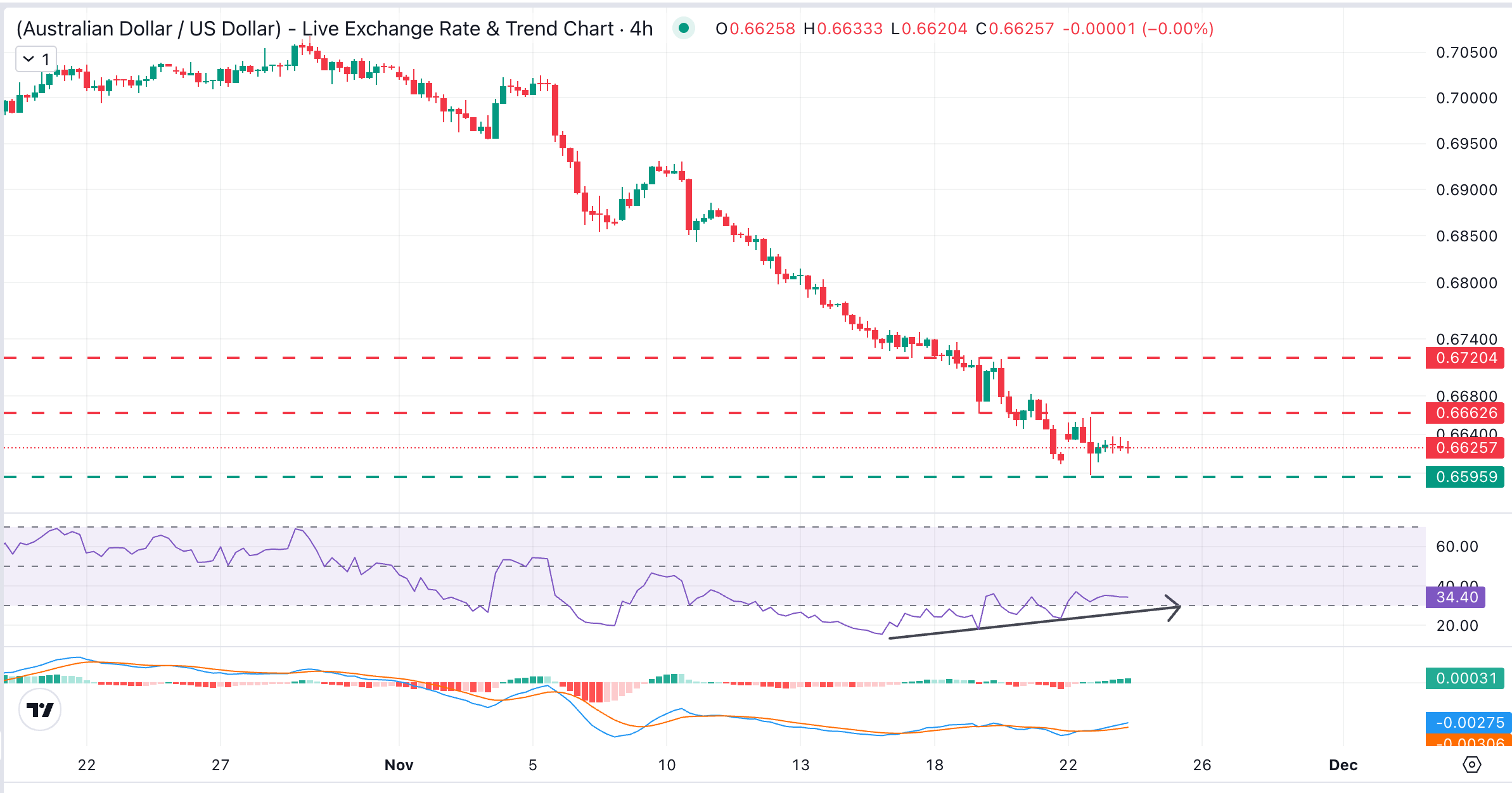
FXStreet Forex analyst Guillermo Alcalá describes the technical trend in AUD/USD as strongly bearish. Alcalá says: “The pair has lost nearly 6% in November and 8.5% from September’s highs and is not showing any sign of an immediate trend reversal, except for the bullish divergence in the 4-hour Relative Strength Index (RSI)”.
The momentum signals offer a mixed picture: the Moving Average Convergence Divergence (MACD) histogram has moved above zero, but the RSI remains just above oversold territory. In Alcalá’s assessment, bulls “need solid reasons to gain the necessary confidence to break resistances at Monday’s high near 0.6560 and the November 19 high at 0.6720 before raising expectations of any significant recovery.”
For now, the region below 0.6600 is containing bearish pressure. Should that support give way, Alcalá identifies the psychological 0.6500 mark, followed by the November 2025 lows around 0.6420, as the next downside objectives.
The increase in the cost of a representative basket of goods and services is measured by inflation. Headline figures are generally reported as percentage changes both month-on-month (MoM) and year-on-year (YoY). Food and fuel, whose prices can fluctuate with geopolitical developments and seasonal influences, are among the more volatile components excluded from core inflation. Economists concentrate on this core measure, which is also targeted by central banks under their mandate to maintain manageable inflation, typically around 2%.
Changes in the cost of a basket of goods and services over time are tracked by the Consumer Price Index (CPI), usually reported as percentage changes month-on-month (MoM) and year-on-year (YoY). Central banks target core CPI because it strips out volatile food and fuel components. A rise in core CPI above 2% generally leads to higher interest rates, while a fall below 2% usually has the reverse effect. As higher rates support a currency, stronger inflation typically strengthens it too; falling inflation tends to have the opposite effect.
A country’s currency tends to appreciate when inflation is high and weaken when it is low, a relationship that may initially seem counter-intuitive. Central banks normally respond to higher inflation by raising interest rates. Those higher rates draw in more international capital from investors seeking attractive returns on their money.
Historically, investors sought Gold during periods of high inflation for its ability to retain value. They still frequently buy it as a safe haven during severe market turmoil, but that inflation-driven pattern no longer holds most of the time. High inflation prompts central banks to raise interest rates to bring prices under control. For Gold, higher rates are a headwind: they raise the opportunity cost of holding the metal rather than an interest-bearing asset or a cash deposit. Conversely, lower inflation generally benefits Gold by bringing interest rates down and making the precious metal a more attractive investment alternative.
Published monthly by the Australian Bureau of Statistics, the Consumer Price Index (CPI) tracks price movements across a broad basket of goods and services purchased by households. Following a methodological change from quarterly to monthly readings, applicable to data from April 2024 onwards, it serves as the principal measure of headline inflation. The YoY figure compares prices in the reference month with those in the corresponding month a year earlier. A strong reading is regarded as bullish for the Australian Dollar (AUD); a weak one is viewed as bearish.
Find out more.Upcoming release: Wed 25 Nov 2026 00:30
Publication frequency: Monthly
Consensus forecast: 4.8%
Previous reading: 4.3%
Data source: Australian Bureau of Statistics







Phone: +61 2 8036 8388
Fax: +61 2 8036 8388
Email: support@tmgm.com



The information provided on this website is of a general nature only and does not constitute personal financial advice. Before acting on any information on this website, you should consider the suitability of the information in relation to your objectives, financial situation and needs. Investing in CFDs and FX Margin Contracts carries significant risks and is not suitable for all investors. You may lose more than your initial deposit. You do not own, or have, any interest in the underlying asset. We recommend that you seek independent advice and ensure you fully understand the risks involved before trading. It is important that you read and consider the disclosure document before you acquire any product listed on the website. The information and advertisements offered on this website are not intended for use by any person in any country or jurisdiction where such use would be contrary to local laws and regulations. The Products and Services offered on this website are not intended for residents of the United States, Malaysia and Thailand.
TMGM is authorized and regulated in various jurisdictions.
Trademax Australia Limited, trading as TMGM, is regulated by the Australian Securities and Investments Commission (ASIC), AFSL no. 436416 and is located at Level 28, One International Tower, 100 Barangaroo Avenue, 2000 Sydney, NSW Australia.
Email: support@tmgm.com.au
Trademax Global Limited, trading as TMGM, is authorized and regulated by the Vanuatu Financial Services Commission (VFSC), registration number 40356 and registered at 1276, Kumul Highway, Port Vila, Vanuatu, Republic of Vanuatu.
Email: support@tmgm.com
Trademax Global Markets (SE) Limited, trading as TMGM, is authorized and regulated by the Financial Services Authority (FSA) of Seychelles, with license number SD224. The company is registered at Office No 13, Providence Estate ABIS Centre, Mahe, Seychelles.
Email: support@tmgm.com
Trademax Global Markets (International) Pty Ltd, trading as TMGM, is authorized and regulated by the Financial Services Commission, Mauritius (FSC) with license no. GB22201012, and registered at 33, Edith Cavell Street C/o IQ EQ Fund Services (Mauritius) Ltd Port Louis, 11324 Mauritius.
Email: support@tmgm.com
Copyright © TMGM. All rights reserved


