
News & AnalysisCareer

Persistent inflation in the United States (US) provides the backdrop to Wednesday's gradual recovery in Ripple (XRP) and Stellar (XLM), ahead of next week's Federal Reserve (Fed) monetary policy decision. Both tokens are regaining momentum alongside gains in major digital assets. With XRP moving above $1.36 and XLM reaching $0.1854, the advances strengthen recently tested support levels.

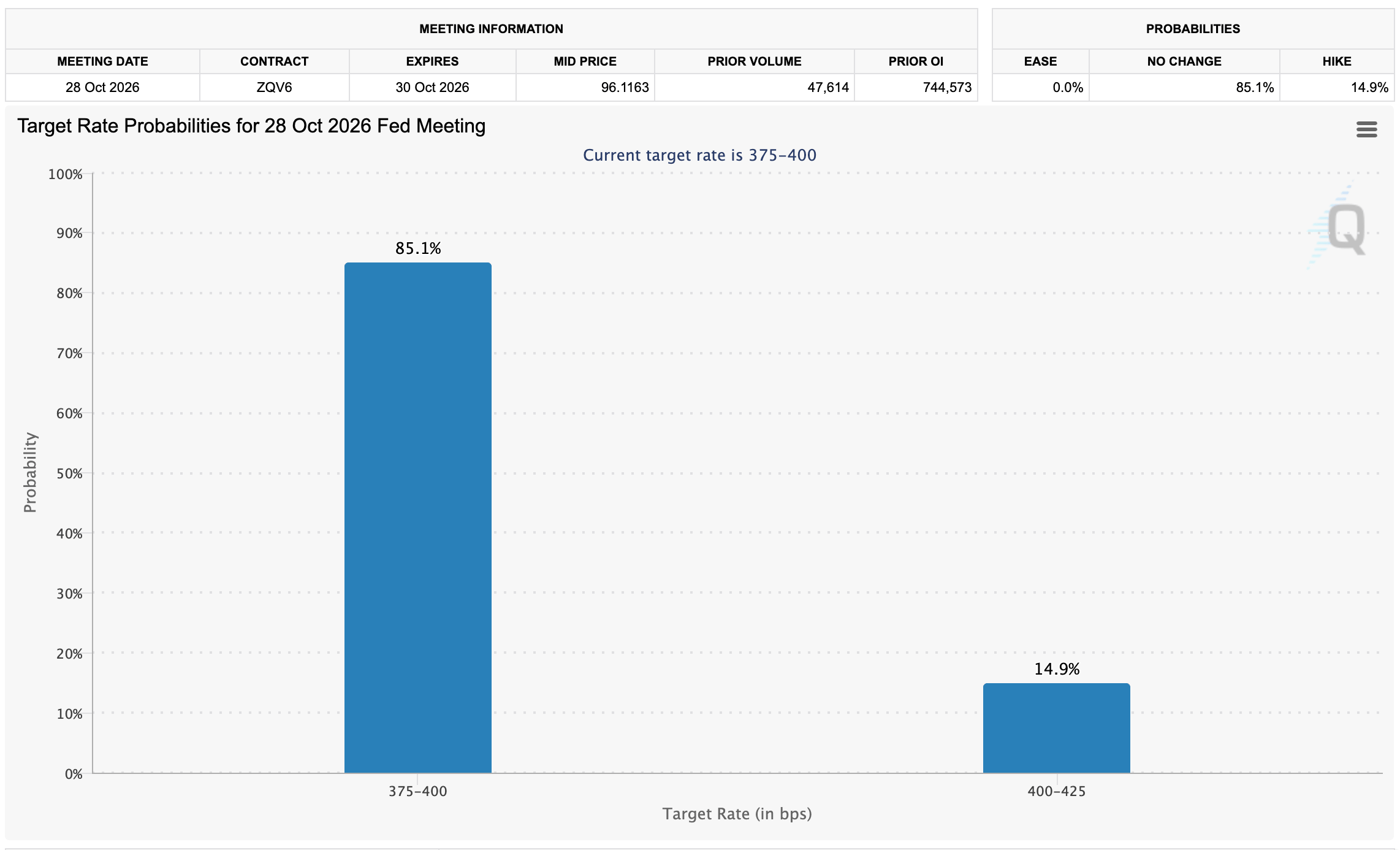
An 85% probability of interest rates remaining within the 3.75-4.00% range is priced in by the CME Group's FedWatch Tool, against a 15% chance of a 25-basis-point increase. Although XRP and XLM are showing signs of recovery, traders appear to be restricting their risk exposure as the Fed decision approaches.
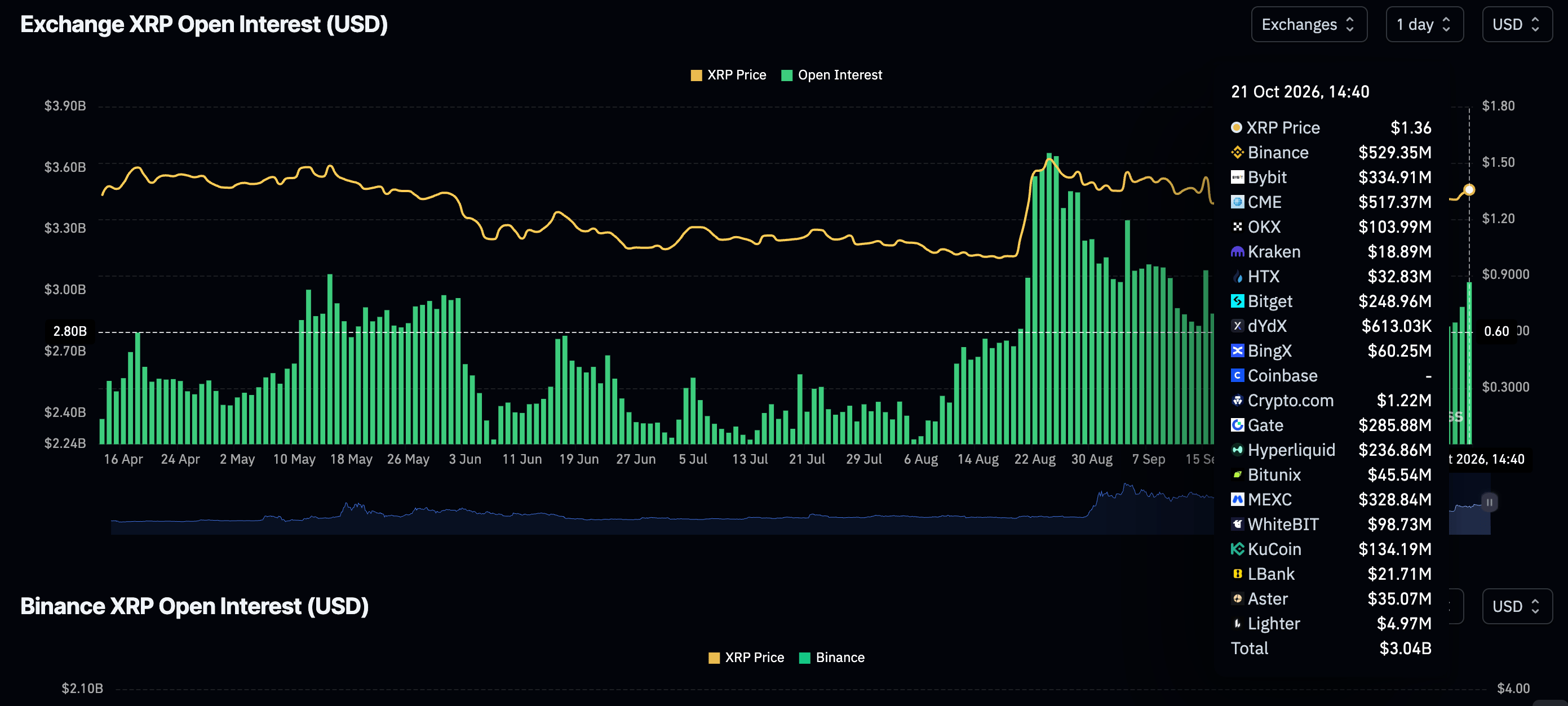
Perpetual futures open interest (OI) reached 2.23 billion XRP on Wednesday, edging up from 2.18 billion XRP a day earlier as derivatives trading gathered pace. According to CoinGlass data, OI stood at 2.12 billion XRP on Sunday, suggesting retail traders are attempting to establish an upward trend.
Confirmation of sustained interest remains elusive, however: the latest reading is still well short of September's 2.46 billion XRP peak and August's 2.77 billion XRP high.
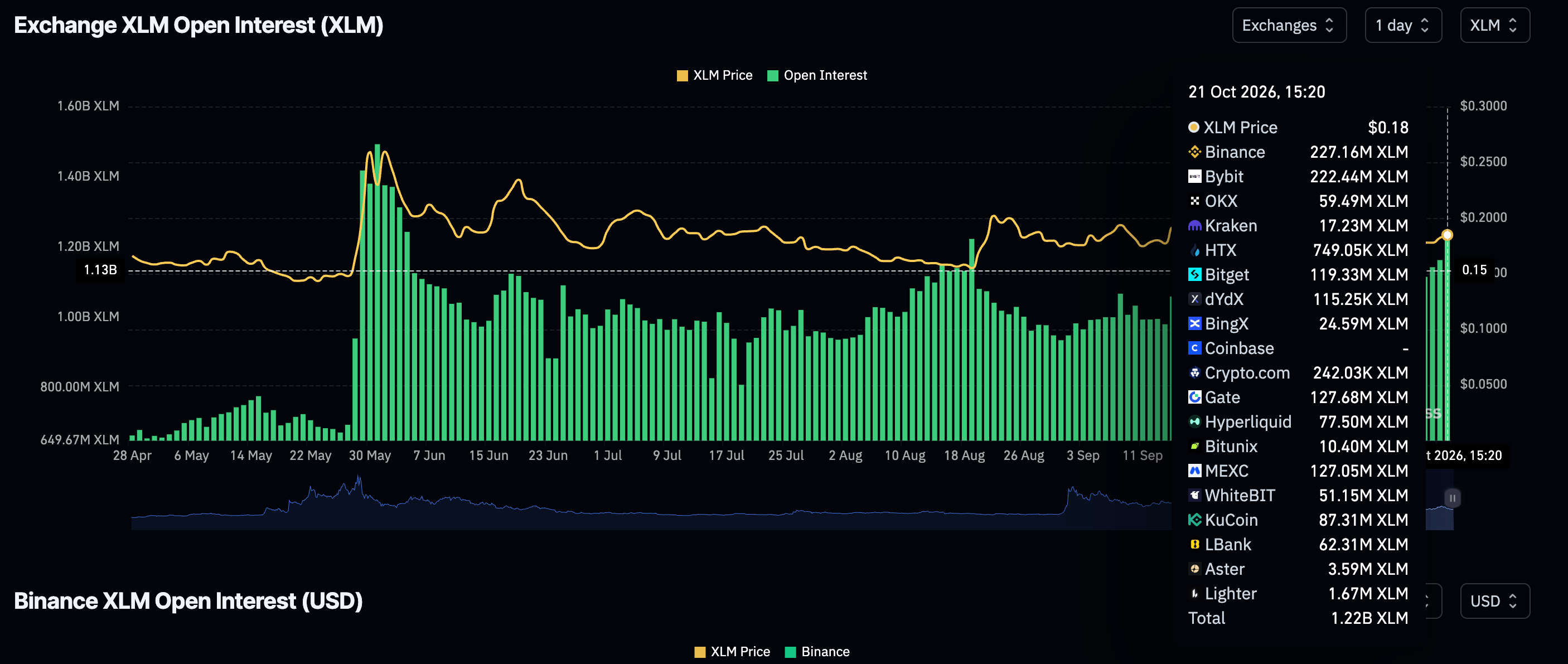
From 1.14 billion XLM the previous day, Stellar futures OI has increased to 1.22 billion XLM on Wednesday. Binance accounts for roughly 217 million XLM and Bybit for 222 million XLM, while total OI has recovered from Monday's 1.12 billion XLM. As leveraged positions expand alongside the continuing price rise, speculative interest in the token appears to be strengthening.
At $1.36, XRP remains beneath both the 50-day and 200-day Exponential Moving Averages (EMAs), each at $1.38. That positioning leaves the short-term outlook bearish, notwithstanding the recent rebound from lows.
Overhead constraints include the SuperTrend line at $1.47 and the broader descending resistance trendline projected towards $1.61. With the Relative Strength Index (RSI) near 46 in neutral territory and the Moving Average Convergence Divergence (MACD) still slightly negative, the indicators suggest fading upward momentum rather than a decisive bullish reversal.
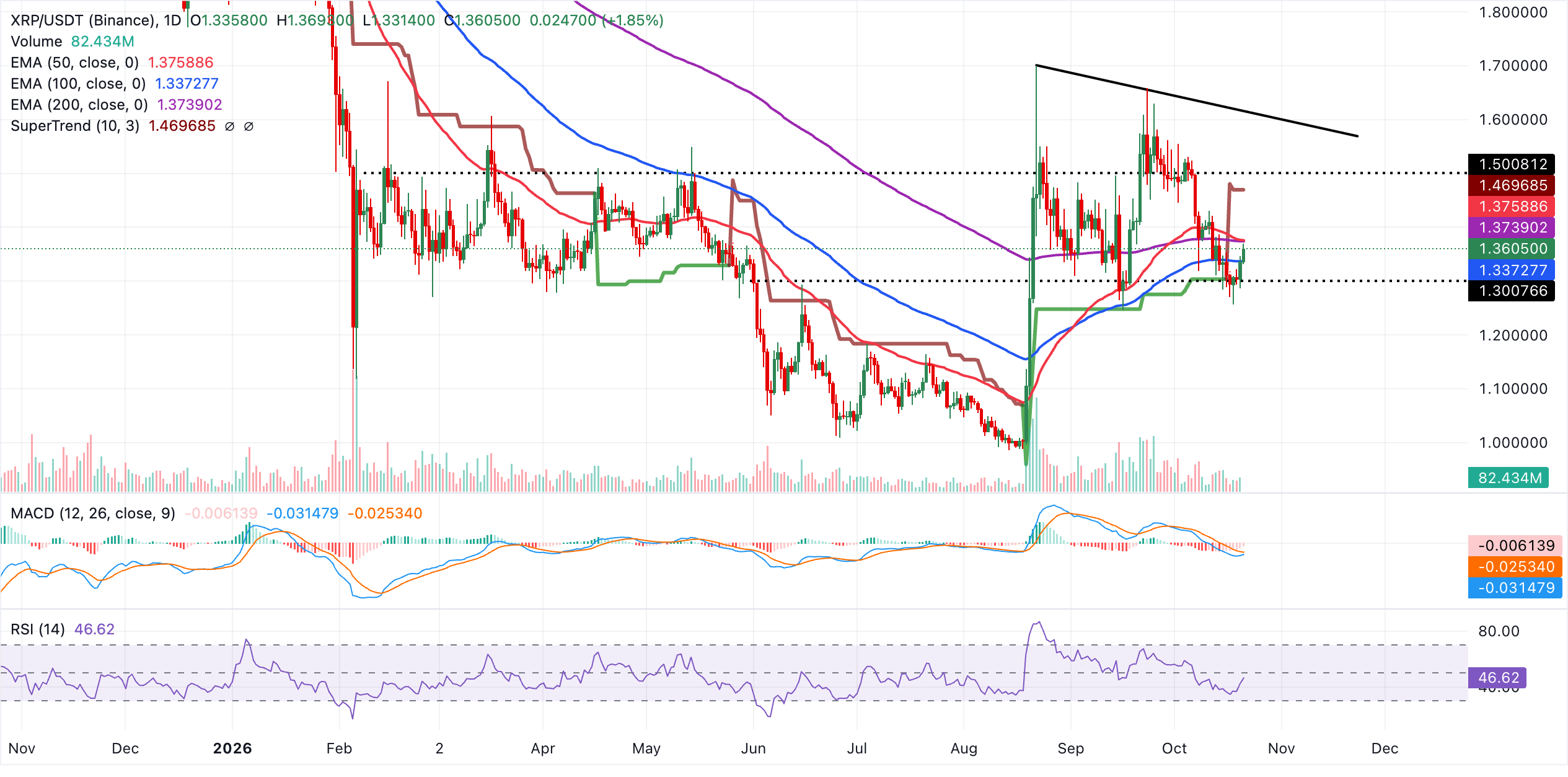
The convergence of the 200-day and 50-day EMAs near $1.38 forms the first resistance area. Only a daily close above this cluster would ease the prevailing downward pressure. Beyond it, further hurdles lie at the SuperTrend barrier near $1.47 and the descending trendline area towards $1.62. Initial support, meanwhile, is provided by the 100-day EMA at $1.34; a breach would likely pave the way for a more pronounced retreat towards earlier price lows.
With recently confirmed support near $0.1700 holding, XLM has advanced to $0.1854 as bullish momentum gathers. Nevertheless, the two-day rise has not displaced the bearish outlook: the token remains below the 50-day, 100-day and 200-day EMAs, grouped between roughly $0.1900 and $0.1946, as well as SuperTrend resistance at $0.2060. A slowly recovering but negative MACD, together with an RSI near 44, points to muted momentum rather than a forceful reversal.
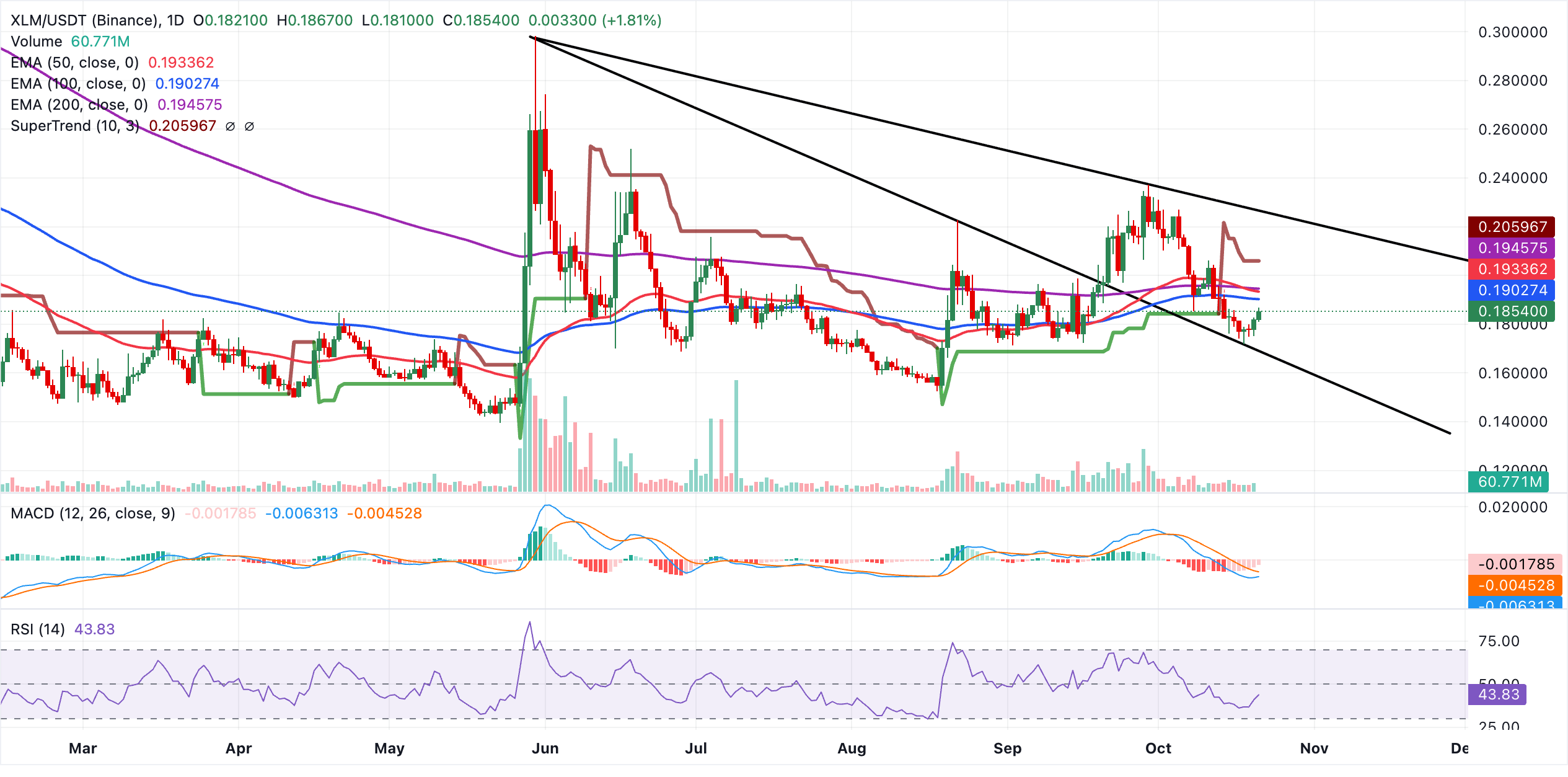
A tightly packed resistance zone begins with the 100-day EMA at $0.1903, followed by the 50-day EMA at $0.1934 and the 200-day EMA at $0.1946. Above this cluster sit the SuperTrend level at $0.2060 and descending trendline resistance higher up, around $0.2263. For downside risks, attention centres first on the current price pivot at $0.1854. Should a break below that level be sustained, the next significant support would be the former descending trendline breakout area near $0.1685.
(The technical analysis of this story was written with the help of an AI tool. Know more.)
Designed to function as money, Bitcoin is a virtual currency and the largest cryptocurrency by market capitalisation. No single person, group or entity can control this payment method, removing the need for third-party involvement in financial transactions.
Any cryptocurrency other than Bitcoin is classed as an altcoin. Some also exclude Ethereum, however, on the grounds that forks originate from these two cryptocurrencies. Under that interpretation, Litecoin is the first altcoin: it was forked from the Bitcoin protocol and is therefore an “improved” version of it.
Backed by a reserve of the asset they represent, stablecoins are cryptocurrencies intended to maintain a stable price. Each stablecoin achieves this by pegging its value to a commodity or financial instrument, such as the US dollar (USD), while an algorithm or demand regulates its supply. Their primary purpose is to give investors a route into and out of cryptocurrency trading and investment. Because cryptocurrencies are generally subject to volatility, stablecoins also offer investors a way to store value.
Measured as Bitcoin's market capitalisation divided by the combined market capitalisation of all cryptocurrencies, Bitcoin dominance indicates the level of investor interest in Bitcoin. BTC dominance is typically high before and during a bull run, when investors turn to relatively stable cryptocurrencies with large market capitalisations, such as Bitcoin. When BTC dominance declines, it usually signals that investors are transferring capital and/or profits into altcoins in pursuit of higher returns, often triggering a surge in altcoin rallies.







Phone: +61 2 8036 8388
Fax: +61 2 8036 8388
Email: support@tmgm.com



The information provided on this website is of a general nature only and does not constitute personal financial advice. Before acting on any information on this website, you should consider the suitability of the information in relation to your objectives, financial situation and needs. Investing in CFDs and FX Margin Contracts carries significant risks and is not suitable for all investors. You may lose more than your initial deposit. You do not own, or have, any interest in the underlying asset. We recommend that you seek independent advice and ensure you fully understand the risks involved before trading. It is important that you read and consider the disclosure document before you acquire any product listed on the website. The information and advertisements offered on this website are not intended for use by any person in any country or jurisdiction where such use would be contrary to local laws and regulations. The Products and Services offered on this website are not intended for residents of the United States, Malaysia and Thailand.
TMGM is authorized and regulated in various jurisdictions.
Trademax Australia Limited, trading as TMGM, is regulated by the Australian Securities and Investments Commission (ASIC), AFSL no. 436416 and is located at Level 28, One International Tower, 100 Barangaroo Avenue, 2000 Sydney, NSW Australia.
Email: support@tmgm.com.au
Trademax Global Limited, trading as TMGM, is authorized and regulated by the Vanuatu Financial Services Commission (VFSC), registration number 40356 and registered at 1276, Kumul Highway, Port Vila, Vanuatu, Republic of Vanuatu.
Email: support@tmgm.com
Trademax Global Markets (SE) Limited, trading as TMGM, is authorized and regulated by the Financial Services Authority (FSA) of Seychelles, with license number SD224. The company is registered at Office No 13, Providence Estate ABIS Centre, Mahe, Seychelles.
Email: support@tmgm.com
Trademax Global Markets (International) Pty Ltd, trading as TMGM, is authorized and regulated by the Financial Services Commission, Mauritius (FSC) with license no. GB22201012, and registered at 33, Edith Cavell Street C/o IQ EQ Fund Services (Mauritius) Ltd Port Louis, 11324 Mauritius.
Email: support@tmgm.com
Copyright © TMGM. All rights reserved

