
News & AnalysisCareer

A 0.15% decline takes USD/INR to around 94.83 in Tuesday’s opening trade, as the Indian Rupee (INR) records a third consecutive trading day of gains against the US Dollar (USD).
Continued selling pressure on oil is supporting the Indian currency, with hopes rising for a diplomatic resolution between the United States (US) and Iran.

At the time of writing, the MCX Crude Oil contract expiring on 19 November stands near Rs. 9,222, up 1.65%. Despite that rise, it remains almost 7.5% below its recent multi-month high of Rs. 9,972.
TD Securities attributes some of the retreat in oil’s risk premium to recent reports that US President Donald Trump is prepared to allow more time for diplomacy. Those headlines, "signaling attacks may not be imminent immediately before/after the midterms," have already resulted in "a portion of the geopolitical risk premium priced out of crude oil and petroleum products." As positioning and sentiment respond to the changing geopolitical backdrop, the strategists argue that "with flows elevated, and a large portion of recent upside attributed to a risk premium, these headlines will have an increasingly large impact on the market,"
Nevertheless, “headlines alone are unlikely to shed the whole risk premium,” TD Securities cautions. Persistent geopolitical threats still support prices, with the firm adding that “so long as there is no concrete conclusion to the war, and tanker and Houthi attacks remain prevalent, we do not anticipate a complete erosion of the risk premium via diplomacy headlines alone,”
For economies such as India, where meeting energy needs depends heavily on imported oil, cheaper crude is supportive of their currencies.
Brown Brothers Harriman (BBH) strategists flag that “the US midterm elections will be held on Tuesday,” and that “Democrats widely expected to win the House of Representatives.” The Senate contest is tighter: “Senate control is much closer, but the tide favors the Democratic Party,” they say. Although “Democrats need a net gain of four seats to secure a majority in the Senate”, BBH regards that goal as “within reach as Republicans are defending six of the seven toss-up seats.”
According to BBH, betting markets “favor a Democratic sweep,” with Polymarket and Kalshi “putting the odds around 70%.” The strategists believe this “points to a relatively muted initial market reaction if Democrats win both chambers,” but warn that “a Republican Senate hold would be the bigger surprise and could spark more market volatility.”
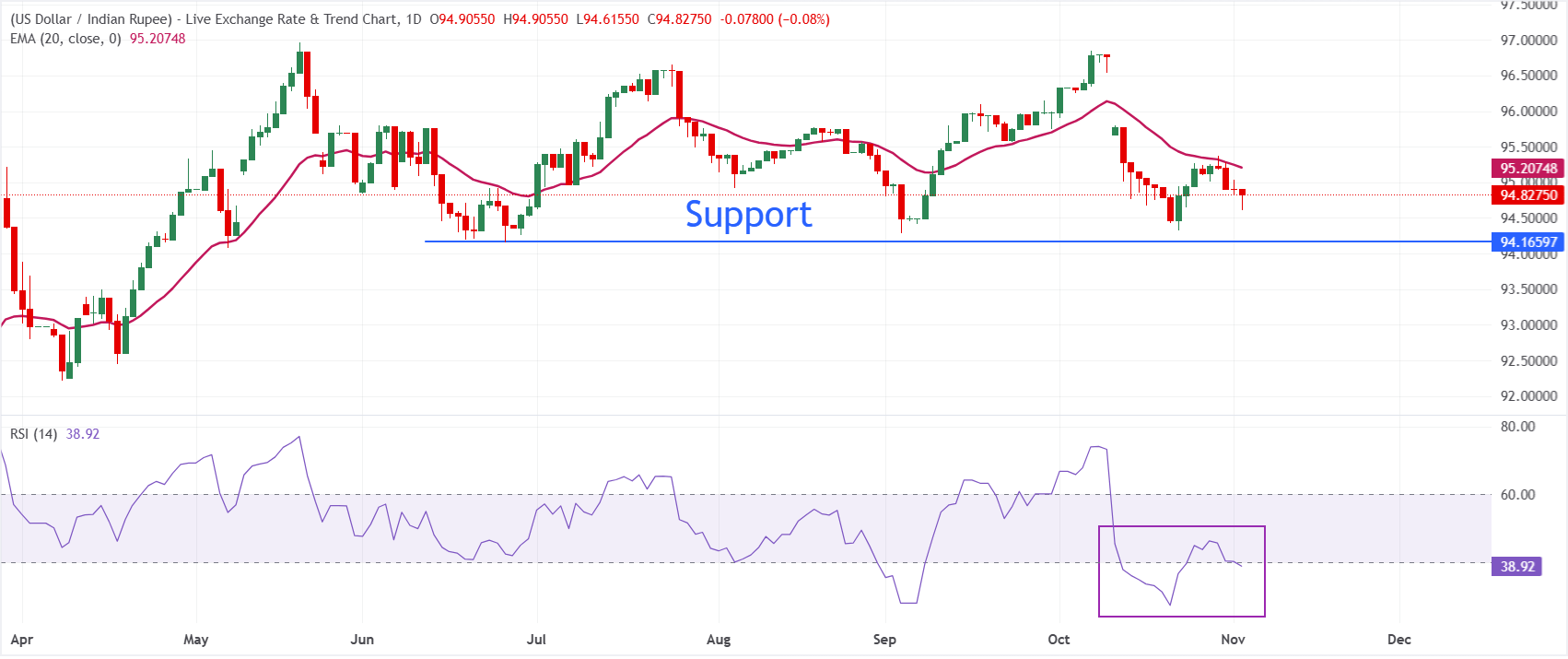
Trading at 94.83 on the daily chart, USD/INR retains a bearish short-term outlook below its 20-day Exponential Moving Average (EMA) of 95.21. That position relative to the short-term trend indicator suggests limited scope for rallies. Meanwhile, the Relative Strength Index (14), at 38.9, remains beneath the neutral 50 threshold, signalling continued downward pressure rather than an extreme oversold condition.
The 20-day EMA at 95.21 provides the first upside resistance; only a daily close above it would temper the prevailing bearish bias. The available dataset identifies no nearby technical support levels, leaving traders to consider recent lows and price action for potential interim floors. Momentum indicators also suggest that rebounds could remain constrained while USD/INR stays below the 95.21 area.
(The technical analysis of this story was written with the help of an AI tool. Know more.)
External developments have a particularly strong influence on the Indian Rupee (INR). Key drivers include Crude Oil prices, given India’s heavy reliance on imported Oil; the US Dollar’s value, since most trade is conducted in USD; and foreign investment levels. The Reserve Bank of India (RBI) also plays a major role, both through direct FX market intervention aimed at stabilising the exchange rate and through the interest rates it sets.
To facilitate trade, the Reserve Bank of India (RBI) seeks to keep the exchange rate stable through active intervention in currency markets. It also adjusts interest rates in an effort to keep inflation at its 4% target. An increase in rates typically supports the Rupee through the ‘carry trade’: investors borrow in lower-interest-rate countries and invest the proceeds in countries offering relatively higher rates, earning the difference.
Inflation, interest rates, GDP growth, the trade balance and foreign investment inflows all help determine the Rupee’s value. Faster economic growth can attract additional overseas investment and increase demand for the currency, while a narrowing trade deficit will ultimately strengthen it. Higher interest rates are also supportive, particularly in real terms, meaning interest rates after subtracting inflation. A greater appetite for risk can encourage inflows of Foreign Direct and Indirect Investment (FDI and FII), providing further support for the Rupee.
The Rupee generally suffers from higher inflation, especially when price rises outpace those in India’s peers, as this reflects a loss of currency value through oversupply. By making exports more expensive, inflation also results in more Rupees being sold to buy foreign imports, weakening the currency. However, rising inflation usually prompts the Reserve Bank of India (RBI) to increase interest rates. The resulting demand from international investors can support the Rupee. Lower inflation has the reverse effect.







Phone: +61 2 8036 8388
Fax: +61 2 8036 8388
Email: support@tmgm.com



The information provided on this website is of a general nature only and does not constitute personal financial advice. Before acting on any information on this website, you should consider the suitability of the information in relation to your objectives, financial situation and needs. Investing in CFDs and FX Margin Contracts carries significant risks and is not suitable for all investors. You may lose more than your initial deposit. You do not own, or have, any interest in the underlying asset. We recommend that you seek independent advice and ensure you fully understand the risks involved before trading. It is important that you read and consider the disclosure document before you acquire any product listed on the website. The information and advertisements offered on this website are not intended for use by any person in any country or jurisdiction where such use would be contrary to local laws and regulations. The Products and Services offered on this website are not intended for residents of the United States, Malaysia and Thailand.
TMGM is authorized and regulated in various jurisdictions.
Trademax Australia Limited, trading as TMGM, is regulated by the Australian Securities and Investments Commission (ASIC), AFSL no. 436416 and is located at Level 28, One International Tower, 100 Barangaroo Avenue, 2000 Sydney, NSW Australia.
Email: support@tmgm.com.au
Trademax Global Limited, trading as TMGM, is authorized and regulated by the Vanuatu Financial Services Commission (VFSC), registration number 40356 and registered at 1276, Kumul Highway, Port Vila, Vanuatu, Republic of Vanuatu.
Email: support@tmgm.com
Trademax Global Markets (SE) Limited, trading as TMGM, is authorized and regulated by the Financial Services Authority (FSA) of Seychelles, with license number SD224. The company is registered at Office No 13, Providence Estate ABIS Centre, Mahe, Seychelles.
Email: support@tmgm.com
Trademax Global Markets (International) Pty Ltd, trading as TMGM, is authorized and regulated by the Financial Services Commission, Mauritius (FSC) with license no. GB22201012, and registered at 33, Edith Cavell Street C/o IQ EQ Fund Services (Mauritius) Ltd Port Louis, 11324 Mauritius.
Email: support@tmgm.com
Copyright © TMGM. All rights reserved


