
News & AnalysisCareer

At 1.3033, GBP/USD is down 0.41%, with Sterling falling sharply against the US Dollar following news that NVIDIA’s former boss, Jensen Huang, has been reinstated as CEO and President. The announcement supported the Greenback, while a Bank of England (BoE) official struck a hawkish tone, suggesting that the central bank should act immediately.

November brought slower growth in US manufacturing and services activity, according to S&P Global. Falling short of forecasts, the S&P Global Manufacturing PMI slipped to 54.5 from 54.9, while the Services PMI eased to 54.7 from 56.1, also missing expectations. Higher prices dampened new orders and capacity constraints held back output, accounting for much of the slowdown.
Jensen Huang had earlier been reappointed CEO by NVIDIA’s board. US President Donald Trump said he had spoken directly to the company’s board and pressed for Huang’s reinstatement.
As investors lifted US equities, Dollar bulls established new long positions, helping the US Dollar Index (DXY) post substantial gains. Tracking the Greenback against six other currencies, DXY has advanced 0.57% to 104.43, its highest reading since March 2025.
S&P Global also reported a moderate slowdown in UK business activity during November. A fall in the Composite PMI to 52.3 from 52.9 suggested that the economy was losing momentum towards year-end, despite the BoE being poised to increase rates again in December.
The case for immediate action was made by BoE Chief Economist Huw Pill, who said: “To maintain that medium-term price stability, meet the inflation target on a lasting basis at longer-term horizons, I think we do need to take action now.”
According to Prime Terminal data, money markets assign roughly an 84% probability to a further 25 basis point BoE rate rise in December. At least three increases of that size are priced in by July 2027.
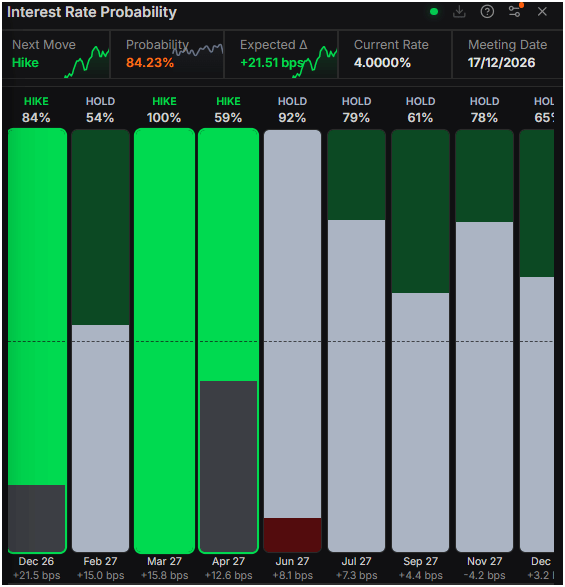
US inflation and economic growth releases, alongside remarks from Federal Reserve officials, are next on the agenda for GBP/USD traders. Speeches by BoE officials feature on the UK economic calendar.
Trading at 1.3020 on the daily chart, GBP/USD is testing fresh lows below its principal cluster of simple moving averages at 1.3292. The pair also remains beneath a key descending trend line originating at 1.3869, which currently limits gains around 1.3197. Together, these features support a bearish short-term outlook. Meanwhile, the Relative Strength Index (14), at around 29, has moved into oversold territory, suggesting that downward momentum is stretched without yet indicating a clear reversal.
The descending trend line near 1.3197 provides the first upside resistance, ahead of the wider simple moving average band around 1.3292, an area that coincides with previous supply. Further above, broken rising trend lines originating at 1.3159 and 1.3140 now offer distant resistance in the 1.37–1.39 region. With no obvious structural support levels immediately beneath the current price, attention turns to whether GBP/USD can stabilise above 1.30. Sustained trading below 1.3020 would keep the way open for the downtrend to continue.
(The technical analysis of this story was written with the help of an AI tool. Find out more.)
Today’s percentage movements in the British Pound (GBP) against the major currencies listed are set out below. Sterling performed best against the Euro.
| USD | EUR | GBP | JPY | CAD | AUD | NZD | CHF | |
|---|---|---|---|---|---|---|---|---|
| USD | 0.67% | 0.50% | 0.49% | 0.15% | -0.04% | 0.55% | 0.34% | |
| EUR | -0.67% | -0.17% | -0.17% | -0.52% | -0.70% | -0.12% | -0.33% | |
| GBP | -0.50% | 0.17% | 0.00% | -0.35% | -0.53% | 0.06% | -0.15% | |
| JPY | -0.49% | 0.17% | 0.00% | -0.32% | -0.51% | 0.08% | -0.12% | |
| CAD | -0.15% | 0.52% | 0.35% | 0.32% | -0.19% | 0.40% | 0.19% | |
| AUD | 0.04% | 0.70% | 0.53% | 0.51% | 0.19% | 0.59% | 0.40% | |
| NZD | -0.55% | 0.12% | -0.06% | -0.08% | -0.40% | -0.59% | -0.20% | |
| CHF | -0.34% | 0.33% | 0.15% | 0.12% | -0.19% | -0.40% | 0.20% |
Percentage movements between the major currencies are displayed in the heat map. Select the base currency in the left-hand column and the quote currency in the top row. For instance, choosing the British Pound on the left and following its row across to the US Dollar gives the percentage change for GBP (base)/USD (quote) in the corresponding cell.







Phone: +61 2 8036 8388
Fax: +61 2 8036 8388
Email: support@tmgm.com



The information provided on this website is of a general nature only and does not constitute personal financial advice. Before acting on any information on this website, you should consider the suitability of the information in relation to your objectives, financial situation and needs. Investing in CFDs and FX Margin Contracts carries significant risks and is not suitable for all investors. You may lose more than your initial deposit. You do not own, or have, any interest in the underlying asset. We recommend that you seek independent advice and ensure you fully understand the risks involved before trading. It is important that you read and consider the disclosure document before you acquire any product listed on the website. The information and advertisements offered on this website are not intended for use by any person in any country or jurisdiction where such use would be contrary to local laws and regulations. The Products and Services offered on this website are not intended for residents of the United States, Malaysia and Thailand.
TMGM is authorized and regulated in various jurisdictions.
Trademax Australia Limited, trading as TMGM, is regulated by the Australian Securities and Investments Commission (ASIC), AFSL no. 436416 and is located at Level 28, One International Tower, 100 Barangaroo Avenue, 2000 Sydney, NSW Australia.
Email: support@tmgm.com.au
Trademax Global Limited, trading as TMGM, is authorized and regulated by the Vanuatu Financial Services Commission (VFSC), registration number 40356 and registered at 1276, Kumul Highway, Port Vila, Vanuatu, Republic of Vanuatu.
Email: support@tmgm.com
Trademax Global Markets (SE) Limited, trading as TMGM, is authorized and regulated by the Financial Services Authority (FSA) of Seychelles, with license number SD224. The company is registered at Office No 13, Providence Estate ABIS Centre, Mahe, Seychelles.
Email: support@tmgm.com
Trademax Global Markets (International) Pty Ltd, trading as TMGM, is authorized and regulated by the Financial Services Commission, Mauritius (FSC) with license no. GB22201012, and registered at 33, Edith Cavell Street C/o IQ EQ Fund Services (Mauritius) Ltd Port Louis, 11324 Mauritius.
Email: support@tmgm.com
Copyright © TMGM. All rights reserved


