
News & AnalysisCareer

At 1.4340 at the time of writing, USD/CAD has rebounded from session lows near 1.4110 and is approaching last week’s 19-month high of 1.4357. As New York trading opens on Monday, the Canadian Dollar (CAD) is little changed against the US Dollar (USD), holding just above its 19-month lows while the Greenback recovers most of its Asian-session losses.
Mixed business activity readings from the Eurozone, alongside weak UK flash PMI data, have dampened the optimism evident at the start of European trading. The figures have also lent broad support to the US Dollar.
The US Dollar came under pressure at the start of the week as a modest appetite for risk emerged. US Treasury Secretary Scott Bessent’s warning to the US Federal Reserve (Fed) about the dangers of overtightening led investors to scale back expectations of a half-point rate rise following the December 8 and 9 Federal Open Market Committee (FOMC) meeting.
For HSBC analysts, today’s macroeconomic environment “has some similarities with 2022, when rising interest rates, geopolitical tensions and energy-market disruption supported the USD.” They qualify that comparison, however, stressing that “the backdrop now is less extreme.”
The bank’s assessment rests on its experts’ observation that “inflation is rising more gradually, interest rates are already at a higher level and labour-market pressures are less tight.” On balance, HSBC concludes that “the USD could remain strong, although a sharp rally may be less likely.”
For the Canadian Dollar, meanwhile, pressure persists from falling prices for oil, Canada’s main export, and last week’s subdued Canadian inflation figures. Brent oil is down 1.7% on the day so far, taking its decline from the highs reached in late October to more than 20%. That slide is a significant drag on any Loonie recovery.
Last week’s Canadian Consumer Price Index (CPI) release showed annual inflation holding steady in October, while Trimmed Mean CPI eased for the first month since May. These readings give the Bank of Canada (BoC) grounds to leave interest rates unchanged in December. With that in mind, markets are likely to scrutinise BoC Governor Tiff Macklem’s speech at the Economic Club of Canada.
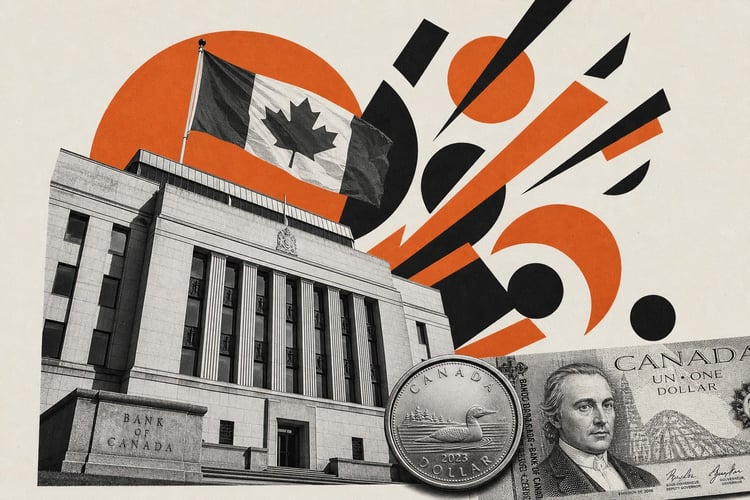
Based in Ottawa, the Bank of Canada (BoC) is responsible for setting Canada’s interest rates and conducting its monetary policy. Decisions are taken at eight scheduled meetings each year, with emergency meetings convened when necessary. Maintaining price stability is the BoC’s primary mandate, meaning inflation should stay within a 1-3% range. To achieve this, it chiefly relies on increases or reductions in interest rates. Higher rates relative to those elsewhere generally strengthen the Canadian Dollar (CAD), while lower rates tend to have the opposite effect. Quantitative easing and quantitative tightening are among its other policy tools.
When conditions become extreme, the Bank of Canada may turn to Quantitative Easing (QE). Under this policy, the BoC prints Canadian Dollars to purchase assets from financial institutions, typically government or corporate bonds. The Canadian Dollar usually weakens as a result. QE serves as a last resort when interest rate cuts alone are unlikely to deliver price stability. During the Great Financial Crisis of 2009-11, the Bank of Canada deployed the measure after banks lost confidence in one another’s capacity to repay debts, causing credit to freeze.
Once an economic recovery is under way and inflation begins to pick up, QE is followed by its reverse, quantitative tightening (QT). During QE, the Bank of Canada supplies financial institutions with liquidity by purchasing government and corporate bonds. Under QT, by contrast, it ceases further asset purchases and no longer reinvests the principal received when bonds in its existing portfolio mature. The policy is generally supportive, or bullish, for the Canadian Dollar.







Phone: +61 2 8036 8388
Fax: +61 2 8036 8388
Email: support@tmgm.com



The information provided on this website is of a general nature only and does not constitute personal financial advice. Before acting on any information on this website, you should consider the suitability of the information in relation to your objectives, financial situation and needs. Investing in CFDs and FX Margin Contracts carries significant risks and is not suitable for all investors. You may lose more than your initial deposit. You do not own, or have, any interest in the underlying asset. We recommend that you seek independent advice and ensure you fully understand the risks involved before trading. It is important that you read and consider the disclosure document before you acquire any product listed on the website. The information and advertisements offered on this website are not intended for use by any person in any country or jurisdiction where such use would be contrary to local laws and regulations. The Products and Services offered on this website are not intended for residents of the United States, Malaysia and Thailand.
TMGM is authorized and regulated in various jurisdictions.
Trademax Australia Limited, trading as TMGM, is regulated by the Australian Securities and Investments Commission (ASIC), AFSL no. 436416 and is located at Level 28, One International Tower, 100 Barangaroo Avenue, 2000 Sydney, NSW Australia.
Email: support@tmgm.com.au
Trademax Global Limited, trading as TMGM, is authorized and regulated by the Vanuatu Financial Services Commission (VFSC), registration number 40356 and registered at 1276, Kumul Highway, Port Vila, Vanuatu, Republic of Vanuatu.
Email: support@tmgm.com
Trademax Global Markets (SE) Limited, trading as TMGM, is authorized and regulated by the Financial Services Authority (FSA) of Seychelles, with license number SD224. The company is registered at Office No 13, Providence Estate ABIS Centre, Mahe, Seychelles.
Email: support@tmgm.com
Trademax Global Markets (International) Pty Ltd, trading as TMGM, is authorized and regulated by the Financial Services Commission, Mauritius (FSC) with license no. GB22201012, and registered at 33, Edith Cavell Street C/o IQ EQ Fund Services (Mauritius) Ltd Port Louis, 11324 Mauritius.
Email: support@tmgm.com
Copyright © TMGM. All rights reserved


