
News & AnalysisCareer

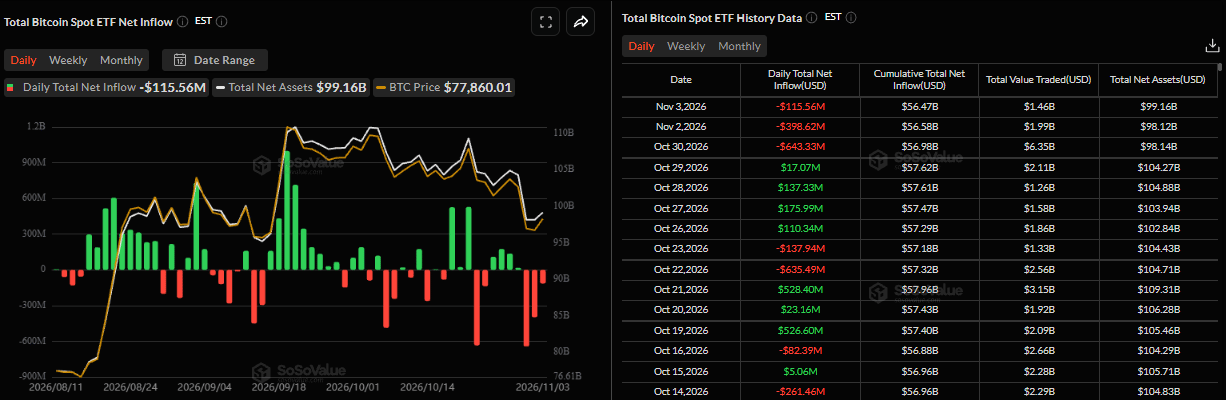
Tuesday's $115.56 million in modest net outflows from spot Bitcoin Exchange Traded Funds (ETFs) reflects institutional caution ahead of the US midterm election results. On Wednesday, Bitcoin (BTC) is trading between its key 100-day and 200-day Exponential Moving Averages (EMAs). This price behaviour points to consolidation, with a move beyond either boundary likely to establish BTC's next directional bias.

Despite maintaining a bullish view on the Crypto King, K33 Research analysts see scope for a volatility shock in either direction. They therefore favour strategies based on volatility over outright directional positions.
SoSoValue figures show that BTC spot ETFs registered modest outflows of $115.56 million on Tuesday, following Monday's $398.62 million withdrawal. Institutional demand has thus continued to soften this week. These successive daily withdrawals indicate that investors are exercising caution ahead of the US midterm election results, while retaining a mildly bearish stance on BTC. A continuation and acceleration of outflows over the rest of the week could lead to a deeper correction in Bitcoin.
In its Tuesday report, K33 Research highlighted the US midterm elections as a key driver of market volatility this week. Since then, Democrats have gained control of both the House of Representatives and the Senate. This creates the prospect of divided government and potential political deadlock for the rest of US President Donald Trump's term, which K33 Research regards as the most market-friendly outcome.
According to the report, a substantial shift in K33's proprietary regime indicator has been driven by diverging positioning in Bitcoin's Chicago Mercantile Exchange (CME) futures and perpetual (perp) futures. Comparisons with past regimes point to increased BTC volatility but no clear directional signal: earlier episodes have featured steep drawdowns as well as strong rallies.
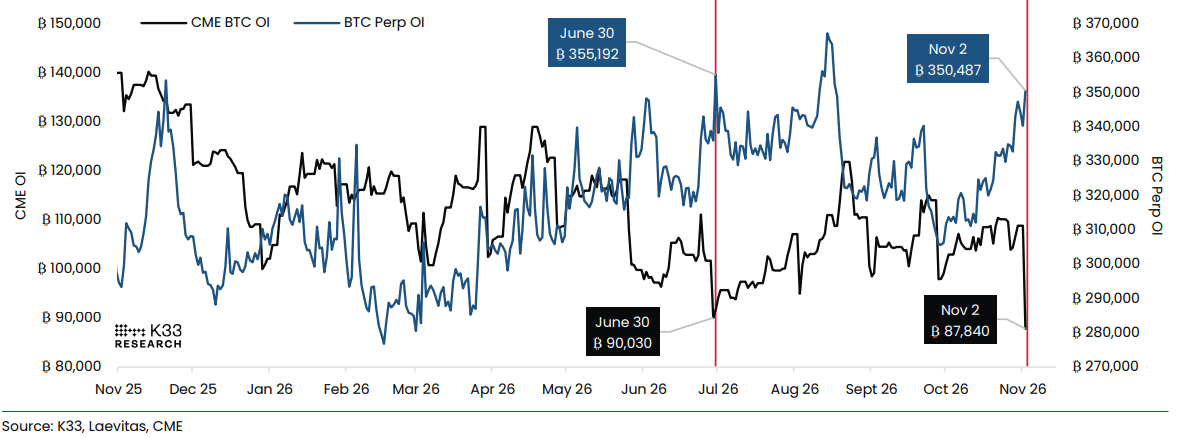
The analyst added: “While we remain bullish on BTC and believe the bottom is in, thin support and elevated leverage leave room for further downside and amplified liquidation-driven moves,”
With three-month implied volatility also close to historically low levels, K33 favours taking positions in volatility rather than choosing a direction. In particular, it favours long straddles, which could benefit from sizeable post-election moves in Bitcoin's price.
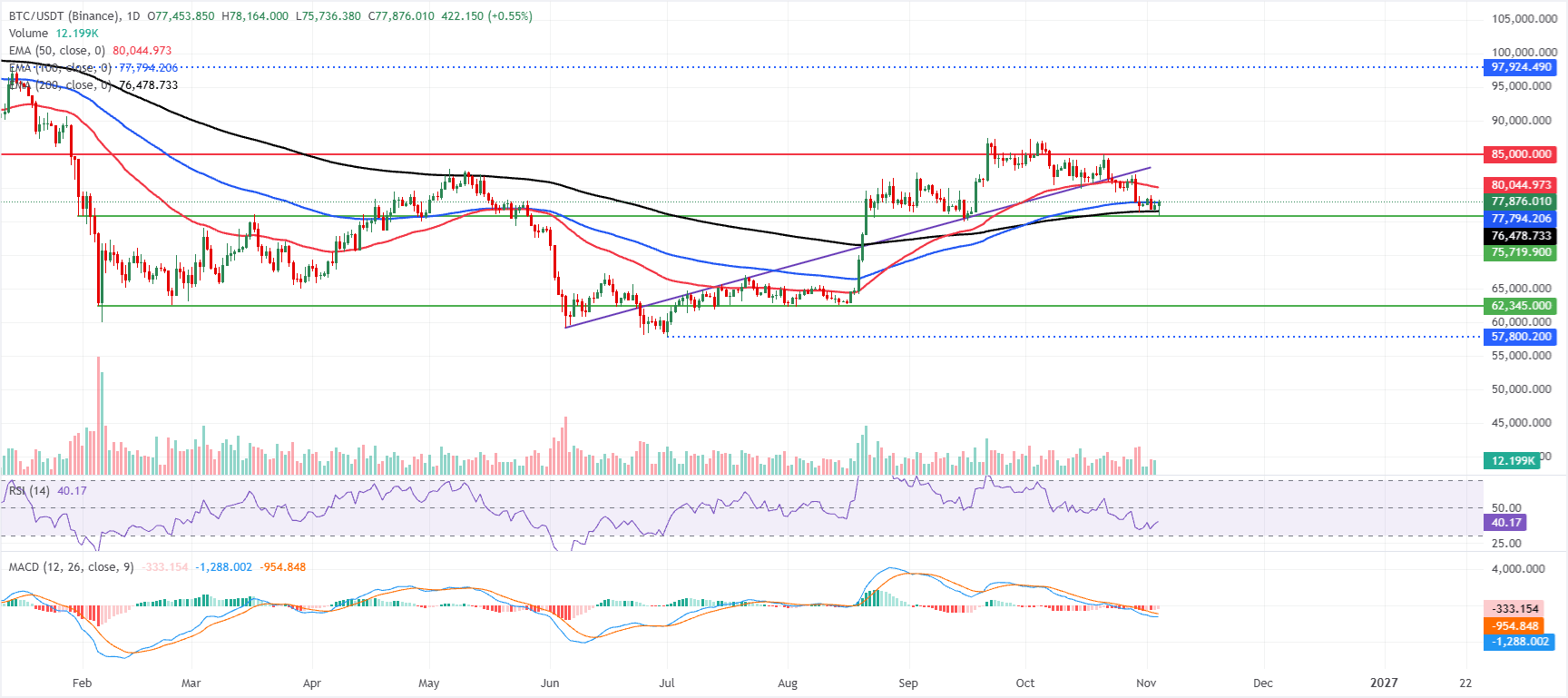
At the time of writing on Wednesday, Bitcoin stands at $77,876, with price consolidating between the 100-day and 200-day EMAs. The 50-day EMA at $80,044 continues to cap BTC's upside, reinforcing the prospect of further consolidation.
On the daily chart, a Relative Strength Index (RSI) reading close to 40 points to muted bullish momentum. The Moving Average Convergence Divergence (MACD) histogram is also still below zero. Together, these signals indicate weakness and support the view that trading remains range-bound beneath nearby resistance.
A daily close above the 100-day EMA at $77,794 would support a cautiously bullish outlook. That would put the 50-day EMA at $80,044 in focus as the next target, ahead of horizontal resistance at $85,000. Should prices climb further, previous supply is likely to return at that level.
Failure to secure a close above the 100-day EMA, however, could prolong the correction towards initial support at the 200-day EMA, near $76,479. Closing below that level on a daily basis would undermine BTC's technical structure and leave it exposed to a broader correction.
(The technical analysis of this story was written with the help of an AI tool. Know more.)
Designed to function as money, Bitcoin is a virtual currency and the world's largest cryptocurrency by market capitalisation. No single person, group or entity can control this payment method, removing the need for third parties to participate in financial transactions.
The term altcoin covers cryptocurrencies other than Bitcoin. However, some people also exclude Ethereum, on the grounds that forks originate from these two cryptocurrencies. Under that definition, Litecoin would be the first altcoin: it was forked from the Bitcoin protocol and is therefore an “improved” version of Bitcoin.
Backed by reserves of the assets they represent, stablecoins are cryptocurrencies intended to maintain a stable price. Each stablecoin is pegged to a commodity or financial instrument, such as the US dollar (USD), while an algorithm or demand regulates its supply. Their primary purpose is to offer investors a route into and out of cryptocurrency trading and investment. Stablecoins also provide a means of storing value, given that cryptocurrencies are generally volatile.
Expressed as a ratio, Bitcoin dominance compares Bitcoin's market capitalisation with the combined market capitalisation of all cryptocurrencies. It offers a clear indication of investor interest in Bitcoin. BTC dominance is typically high before and during a bull run, as investors turn to relatively stable cryptocurrencies with large market capitalisations, such as Bitcoin. When BTC dominance declines, it usually signals that investors are shifting capital and/or profits into altcoins in pursuit of greater returns. This typically sparks a surge in altcoin rallies.







Phone: +61 2 8036 8388
Fax: +61 2 8036 8388
Email: support@tmgm.com



The information provided on this website is of a general nature only and does not constitute personal financial advice. Before acting on any information on this website, you should consider the suitability of the information in relation to your objectives, financial situation and needs. Investing in CFDs and FX Margin Contracts carries significant risks and is not suitable for all investors. You may lose more than your initial deposit. You do not own, or have, any interest in the underlying asset. We recommend that you seek independent advice and ensure you fully understand the risks involved before trading. It is important that you read and consider the disclosure document before you acquire any product listed on the website. The information and advertisements offered on this website are not intended for use by any person in any country or jurisdiction where such use would be contrary to local laws and regulations. The Products and Services offered on this website are not intended for residents of the United States, Malaysia and Thailand.
TMGM is authorized and regulated in various jurisdictions.
Trademax Australia Limited, trading as TMGM, is regulated by the Australian Securities and Investments Commission (ASIC), AFSL no. 436416 and is located at Level 28, One International Tower, 100 Barangaroo Avenue, 2000 Sydney, NSW Australia.
Email: support@tmgm.com.au
Trademax Global Limited, trading as TMGM, is authorized and regulated by the Vanuatu Financial Services Commission (VFSC), registration number 40356 and registered at 1276, Kumul Highway, Port Vila, Vanuatu, Republic of Vanuatu.
Email: support@tmgm.com
Trademax Global Markets (SE) Limited, trading as TMGM, is authorized and regulated by the Financial Services Authority (FSA) of Seychelles, with license number SD224. The company is registered at Office No 13, Providence Estate ABIS Centre, Mahe, Seychelles.
Email: support@tmgm.com
Trademax Global Markets (International) Pty Ltd, trading as TMGM, is authorized and regulated by the Financial Services Commission, Mauritius (FSC) with license no. GB22201012, and registered at 33, Edith Cavell Street C/o IQ EQ Fund Services (Mauritius) Ltd Port Louis, 11324 Mauritius.
Email: support@tmgm.com
Copyright © TMGM. All rights reserved

