

Trading
Explore a wide range of markets with competitive pricing, deep liquidity, and advanced trading tools.
Learn More 
Platform
Trade seamlessly with TMGM's powerful platform, built for speed, precision, and a superior trading experience.
Learn More Trading Platform
Academy
Learn the fundamentals of trading with beginner-friendly resources, including guides, webinars, and market insights.
Learn More News & Analysis
Get real-time market updates and expert analysis to stay ahead of trading opportunities
Learn More News & Analysis
About
Learn what sets TMGM apart — our global presence, regulatory strength, and commitment to innovation in trading.
Learn More Why Choose TMGM
Sponsorship
Pound retreats from its high ahead of UK Budget and Fed decision
- 1.3350 gives way as GBP/USD retreats from its five-week high on 22 October.
- Ahead of the Fed decision, Dollar short-covering drives trading while the Pound holds steady against the Euro.
- Wednesday brings Chancellor Healey's Budget, followed by US PCE on Thursday.
GBP/USD finished just below 1.3350. Monday's decline took the pair to its lowest since the 20 October jobs figures, ending three sessions above that level. With the Pound unchanged against the Euro, the fall reflected traders covering Dollar shorts ahead of Wednesday's Federal Open Market Committee (FOMC) decision.

Following September's rate increase, the Fed is expected to leave rates unchanged. Traders reduced some bets against the Dollar ahead of the decision. An almost identical decline in EUR/USD and GBP/USD kept EUR/GBP steady, attributing the entire GBP/USD move to the Dollar.
A minimum-wage increase of about 3.9%, to around £13.20 for over-21s, is planned by Chancellor Healey, The Times reported. That would exceed the 3.7% growth in pay excluding bonuses by two-tenths. The pay figure is central to the argument for a Bank of England (BoE) rate increase on 5 November. In the following two five-minute bars, GBP/USD advanced.
Wednesday Budget and Fed Decision
Eight days before the BoE's 5 November decision, Chancellor Healey will deliver his first Budget on Wednesday. The Debt Management Office will release its gilt sales plan at the same time. Traders have almost fully priced in a quarter-point increase in the UK's Bank Rate from 3.75% at the BoE meeting.
Futures imply a near 90% probability that the Fed will keep rates at 3.75%-4.00% when it announces its decision on Wednesday at 18:00 GMT. The probability of a December increase is near 80%. Thursday at 12:30 GMT brings the initial estimate of US third-quarter Gross Domestic Product (GDP) and September's Personal Consumption Expenditures Price Index (PCE). Both releases will inform pricing for December.
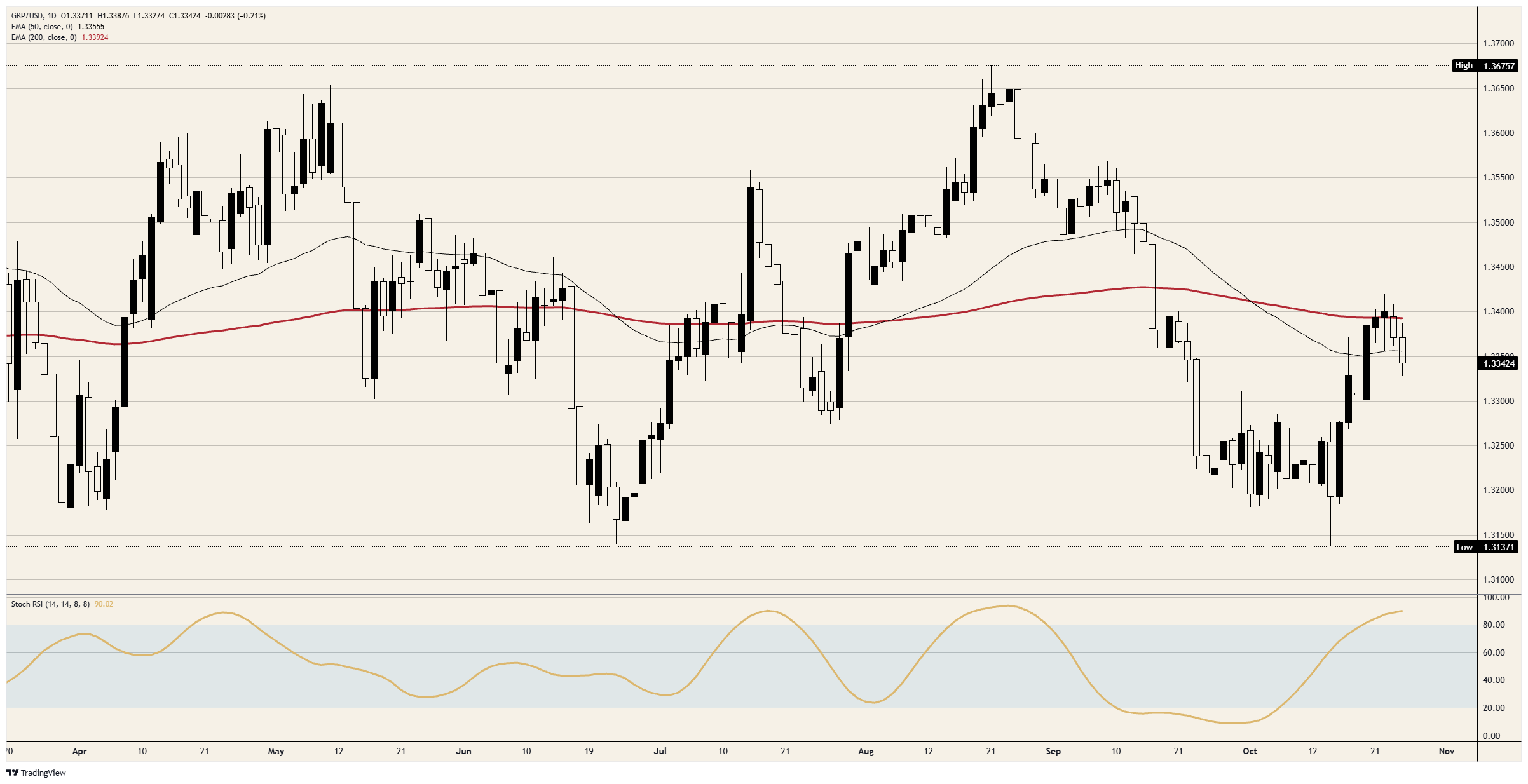
1.3400 High Meets 200-Day EMA
A test of the 200-day Exponential Moving Average (EMA) produced the 22 October high just above 1.3400, with the average sitting at roughly the same level. GBP/USD slipped beneath its 50-day EMA on Monday. The retreat from that peak amounts to about a third of the advance from the 14 October low near 1.3150, while daily momentum is easing from overbought conditions.
GBP/USD daily price chart
Pound Sterling: Key Questions
Dating back to 886 AD, the Pound Sterling (GBP) is the world's oldest currency and serves as the United Kingdom's official currency. According to 2022 figures, it ranks fourth in global foreign exchange (FX) trading, representing 12% of transactions with average daily turnover of $630 billion. Among its main pairs, GBP/USD, known as ‘Cable’, accounts for 11% of FX trading. GBP/JPY, called the ‘Dragon’ by traders, represents 3%, while EUR/GBP accounts for 2%. Issuance of the Pound Sterling is the responsibility of the Bank of England (BoE).
Monetary policy set by the Bank of England has the greatest influence on the Pound Sterling's value. Policy decisions depend on progress towards the BoE's central objective of “price stability” – inflation holding at around 2%. Adjusting interest rates is its main means of meeting that objective. To curb excessively high inflation, the BoE raises interest rates, increasing borrowing costs for households and businesses. GBP generally benefits because higher rates make the UK more appealing to international investors seeking a place for their funds. By contrast, excessively low inflation signals weaker economic growth. The BoE would then consider cutting rates to reduce borrowing costs, encouraging businesses to finance investment in projects that support growth.
By indicating the economy's health, published data can move the Pound Sterling. GDP, Manufacturing and Services PMIs, and employment figures are among the indicators that can shape GBP's direction. Sterling benefits from economic strength, which draws in additional overseas investment and may prompt the BoE to raise interest rates. Such an increase would directly strengthen GBP. Weak economic figures, conversely, are likely to weigh on the Pound Sterling.
The Trade Balance is another important release for the Pound Sterling. Over a specified period, it records the difference between a country's export earnings and its spending on imports. Strong overseas demand for a country's exports creates additional demand for its currency as foreign buyers seek to purchase those goods. A positive net Trade Balance therefore supports the currency, while a negative balance has the opposite effect.
POPULAR ARTICLES
1Half its gain erased: Yen retreats ahead of expected BoJ hold on Friday20.70 rally falters for Aussie Dollar ahead of Fed, RBA inflation tests3Third straight RBNZ hike priced in by New Zealand Dollar traders4Below 1.12: Euro faces Fed and ECB decisions a day apart5Pound retreats from its high ahead of UK Budget and Fed decision6Anthropic's filing boosts tech while Dow Jones Industrial Average trails7211.10 in bulls’ sights: GBP/JPY Price Forecast as bearish trend continues8Iran peace hopes buoy sentiment as Mexican Peso withstands Dollar strength9FOMC and Yields Shape Singapore Dollar (SGD) Trading Against US Dollar – OCBC
LIVE QUOTES


Get Started!
Sign up and access the Global Markets in less than 3 minutes

Connect With Us









Contacts
Phone: +61 2 8036 8388
Fax: +61 2 8036 8388
Email: support@tmgm.com



The information provided on this website is of a general nature only and does not constitute personal financial advice. Before acting on any information on this website, you should consider the suitability of the information in relation to your objectives, financial situation and needs. Investing in CFDs and FX Margin Contracts carries significant risks and is not suitable for all investors. You may lose more than your initial deposit. You do not own, or have, any interest in the underlying asset. We recommend that you seek independent advice and ensure you fully understand the risks involved before trading. It is important that you read and consider the disclosure document before you acquire any product listed on the website. The information and advertisements offered on this website are not intended for use by any person in any country or jurisdiction where such use would be contrary to local laws and regulations. The Products and Services offered on this website are not intended for residents of the United States, Malaysia and Thailand.
TMGM is authorized and regulated in various jurisdictions.
Trademax Australia Limited, trading as TMGM, is regulated by the Australian Securities and Investments Commission (ASIC), AFSL no. 436416 and is located at Level 28, One International Tower, 100 Barangaroo Avenue, 2000 Sydney, NSW Australia.
Email: support@tmgm.com.au
Trademax Global Limited, trading as TMGM, is authorized and regulated by the Vanuatu Financial Services Commission (VFSC), registration number 40356 and registered at 1276, Kumul Highway, Port Vila, Vanuatu, Republic of Vanuatu.
Email: support@tmgm.com
Trademax Global Markets (SE) Limited, trading as TMGM, is authorized and regulated by the Financial Services Authority (FSA) of Seychelles, with license number SD224. The company is registered at Office No 13, Providence Estate ABIS Centre, Mahe, Seychelles.
Email: support@tmgm.com
Trademax Global Markets (International) Pty Ltd, trading as TMGM, is authorized and regulated by the Financial Services Commission, Mauritius (FSC) with license no. GB22201012, and registered at 33, Edith Cavell Street C/o IQ EQ Fund Services (Mauritius) Ltd Port Louis, 11324 Mauritius.
Email: support@tmgm.com
Copyright © TMGM. All rights reserved