

Trading
Explore a wide range of markets with competitive pricing, deep liquidity, and advanced trading tools.
Learn More 
Platform
Trade seamlessly with TMGM's powerful platform, built for speed, precision, and a superior trading experience.
Learn More Trading Platform
Academy
Learn the fundamentals of trading with beginner-friendly resources, including guides, webinars, and market insights.
Learn More News & Analysis
Get real-time market updates and expert analysis to stay ahead of trading opportunities
Learn More News & Analysis
About
Learn what sets TMGM apart — our global presence, regulatory strength, and commitment to innovation in trading.
Learn More Why Choose TMGM
Sponsorship
Below 0.5600 again: Kiwi heads into New Zealand’s Saturday vote
- Below 0.5600, NZD/USD has reversed its advance above 0.5650 on Thursday.
- Under 50% odds now favour a December RBNZ rate rise, while the Dollar has recovered from its midterm low.
- Neither major party is heading for a majority as New Zealand prepares to vote on Saturday.
NZD/USD is back below 0.5600 at the session low. The retreat from above 0.5650 on Thursday has erased Wednesday's entire advance from the pair's lowest level since October 14. Ahead of New Zealand's vote on Saturday, the Kiwi has returned to where it traded before US midterm results sent the Dollar to a one-month low.

A December rate rise is now priced at under 50%, down from nearly 75% at the week's start following the third-quarter employment data. On October 28, the Reserve Bank of New Zealand (RBNZ) voted four to three to leave rates at 2.75%. It signalled that tighter policy was likely but gave no timetable. In the final Freshwater poll, Labour stood at 30.7% and Prime Minister Luxon's National at 26.4%. The Opportunity party held the balance with 5.1%.
Thursday's US data helped the Dollar recover part of Wednesday's slide to a one-month low, which followed the Democrats' capture of Congress. Against forecasts of 196K, jobless claims came in at 189K. Third-quarter productivity increased 3.6%, exceeding the 2.5% forecast. Markets assign a probability of nearly 70% to a Fed rate rise on December 9. Whether or not it happens, the Fed's 3.75%-4.00% rate remains above the RBNZ's 2.75%.
Key Data and Policy Dates
The immediate event is Saturday's election. On Monday at 01:30 GMT, China releases its October Consumer Price Index (CPI), following annual inflation of 0.9%. Chinese trade data follow on Tuesday at 03:00 GMT, after export growth of 36.3%. Due on Thursday, November 12, at 21:30 GMT, New Zealand's October manufacturing Purchasing Managers Index (PMI) follows a reading of 56.5. The next RBNZ rate decision accompanies December's Monetary Policy Statement.
October's Nonfarm Payrolls (NFP), due on Friday at 13:30 GMT, are expected at 65K, up from 29K. The forecast for October's CPI, scheduled for Tuesday, November 10, is 0.3%, compared with 0.6% previously. Both releases will inform the December 8-9 Fed meeting, which determines the higher interest rate in the currency pair.
Four-Fifths of the Advance Reversed
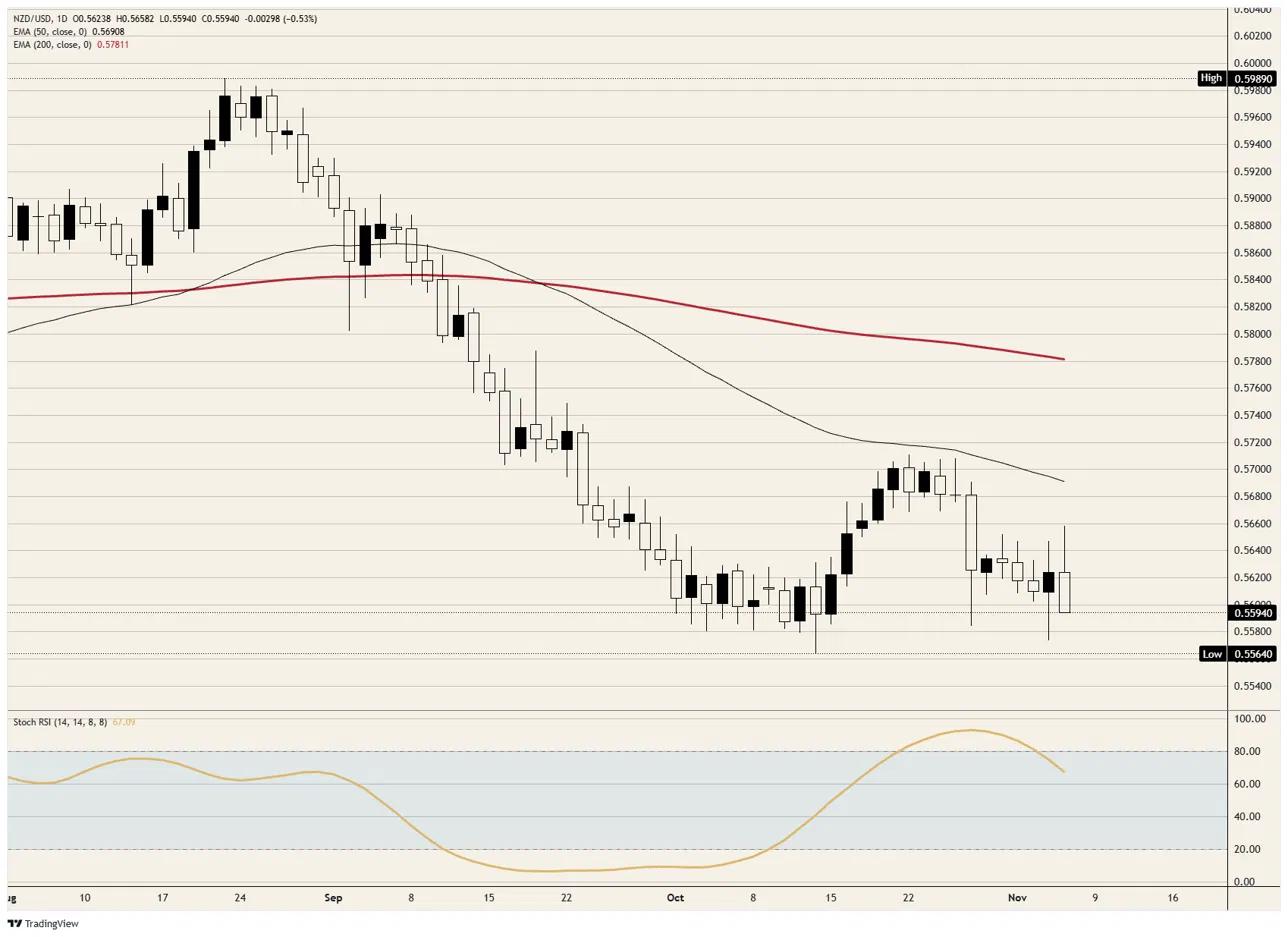
About four-fifths of the rally from near 0.5550 at the October 14 low to near 0.5700 at the October 22 high has now been erased. Since the RBNZ left rates unchanged, NZD/USD has traded below its 50-day Exponential Moving Average (EMA), which sits just under 0.5700. The 200-day EMA lies just below 0.5800. From overbought levels in late October, daily momentum has continued to decline.
Daily NZD/USD chart
New Zealand Dollar: Frequently Asked Questions
Economic conditions in New Zealand and the country's central bank policy broadly underpin the value of the New Zealand Dollar (NZD). Widely known as the Kiwi, it is a familiar currency among investors. Several distinctive influences also affect its movements. As New Zealand's largest trading partner, China has a significant bearing on the Kiwi through its economic performance. Weak Chinese economic news is likely to imply lower demand for New Zealand's exports, weighing on both the economy and the currency. Dairy prices are another driver, given the industry's position as New Zealand's main export sector. Higher prices lift export receipts, supporting the economy and, in turn, the NZD.
Keeping inflation close to the 2% midpoint of a 1% to 3% range over the medium term is the objective of the Reserve Bank of New Zealand (RBNZ). The bank sets interest rates at a level appropriate to that goal. If inflation is excessive, it raises rates to slow the economy. Higher rates also lift bond yields, making investment in New Zealand more attractive and supporting the NZD. Rate cuts, by contrast, generally weaken the currency. For NZD/USD, another important influence is the interest rate differential: the gap between current or expected New Zealand rates and those set by the US Federal Reserve.
By revealing the health of New Zealand's economy, macroeconomic releases can affect the valuation of the New Zealand Dollar (NZD). Robust growth, low unemployment and strong confidence indicate an economy that supports the currency. Rapid economic expansion draws foreign investment. If accompanied by elevated inflation, it may also prompt the Reserve Bank of New Zealand to raise interest rates. Weak figures, on the other hand, are likely to lead to NZD depreciation.
When investors see limited risks across markets and feel optimistic about growth, the New Zealand Dollar (NZD) generally gains. Such risk-on conditions tend to improve the outlook for commodities and so-called ‘commodity currencies’, including the Kiwi. Market disruption or economic uncertainty usually has the opposite effect: investors sell riskier assets in favour of more stable safe havens, and the NZD tends to weaken.
POPULAR ARTICLES
10.6950 gives way in AUD/USD as NASDAQ sell-off puts key 0.6900 support at risk2BoJ minutes lift Yen as Ueda and US NFP take focus on Friday3Below 0.5600 again: Kiwi heads into New Zealand’s Saturday vote4One-Month High Reversal: Euro Under Pressure Ahead of Friday's US NFP5Pound surrenders BoE rate-hike gains ahead of Friday's US payrolls6Banxico's surprise rate cut sends Mexican Peso sliding as easing bets grow77% ETH decline: Ethereum price forecast as AI sell-off pressures crypto8Data-centre backlash wipes out Dow Jones Industrial Average’s midterm rally9Chinese Yuan: Gains Capped by PBoC Resistance – Societe Generale


Get Started!
Sign up and access the Global Markets in less than 3 minutes

Connect With Us









Contacts
Phone: +61 2 8036 8388
Fax: +61 2 8036 8388
Email: support@tmgm.com



The information provided on this website is of a general nature only and does not constitute personal financial advice. Before acting on any information on this website, you should consider the suitability of the information in relation to your objectives, financial situation and needs. Investing in CFDs and FX Margin Contracts carries significant risks and is not suitable for all investors. You may lose more than your initial deposit. You do not own, or have, any interest in the underlying asset. We recommend that you seek independent advice and ensure you fully understand the risks involved before trading. It is important that you read and consider the disclosure document before you acquire any product listed on the website. The information and advertisements offered on this website are not intended for use by any person in any country or jurisdiction where such use would be contrary to local laws and regulations. The Products and Services offered on this website are not intended for residents of the United States, Malaysia and Thailand.
TMGM is authorized and regulated in various jurisdictions.
Trademax Australia Limited, trading as TMGM, is regulated by the Australian Securities and Investments Commission (ASIC), AFSL no. 436416 and is located at Level 28, One International Tower, 100 Barangaroo Avenue, 2000 Sydney, NSW Australia.
Email: support@tmgm.com.au
Trademax Global Limited, trading as TMGM, is authorized and regulated by the Vanuatu Financial Services Commission (VFSC), registration number 40356 and registered at 1276, Kumul Highway, Port Vila, Vanuatu, Republic of Vanuatu.
Email: support@tmgm.com
Trademax Global Markets (SE) Limited, trading as TMGM, is authorized and regulated by the Financial Services Authority (FSA) of Seychelles, with license number SD224. The company is registered at Office No 13, Providence Estate ABIS Centre, Mahe, Seychelles.
Email: support@tmgm.com
Trademax Global Markets (International) Pty Ltd, trading as TMGM, is authorized and regulated by the Financial Services Commission, Mauritius (FSC) with license no. GB22201012, and registered at 33, Edith Cavell Street C/o IQ EQ Fund Services (Mauritius) Ltd Port Louis, 11324 Mauritius.
Email: support@tmgm.com
Copyright © TMGM. All rights reserved