




The Australian Dollar rallies without an Australian reason
- AUD/USD holds above 0.7050 inside a 20-pip range, down 0.15%.
- All 37 economists in a Reuters poll expect a hold at 4.35% Tuesday.
- China's July CPI slowed to 0.5% YoY from 1%, missing 0.8%.
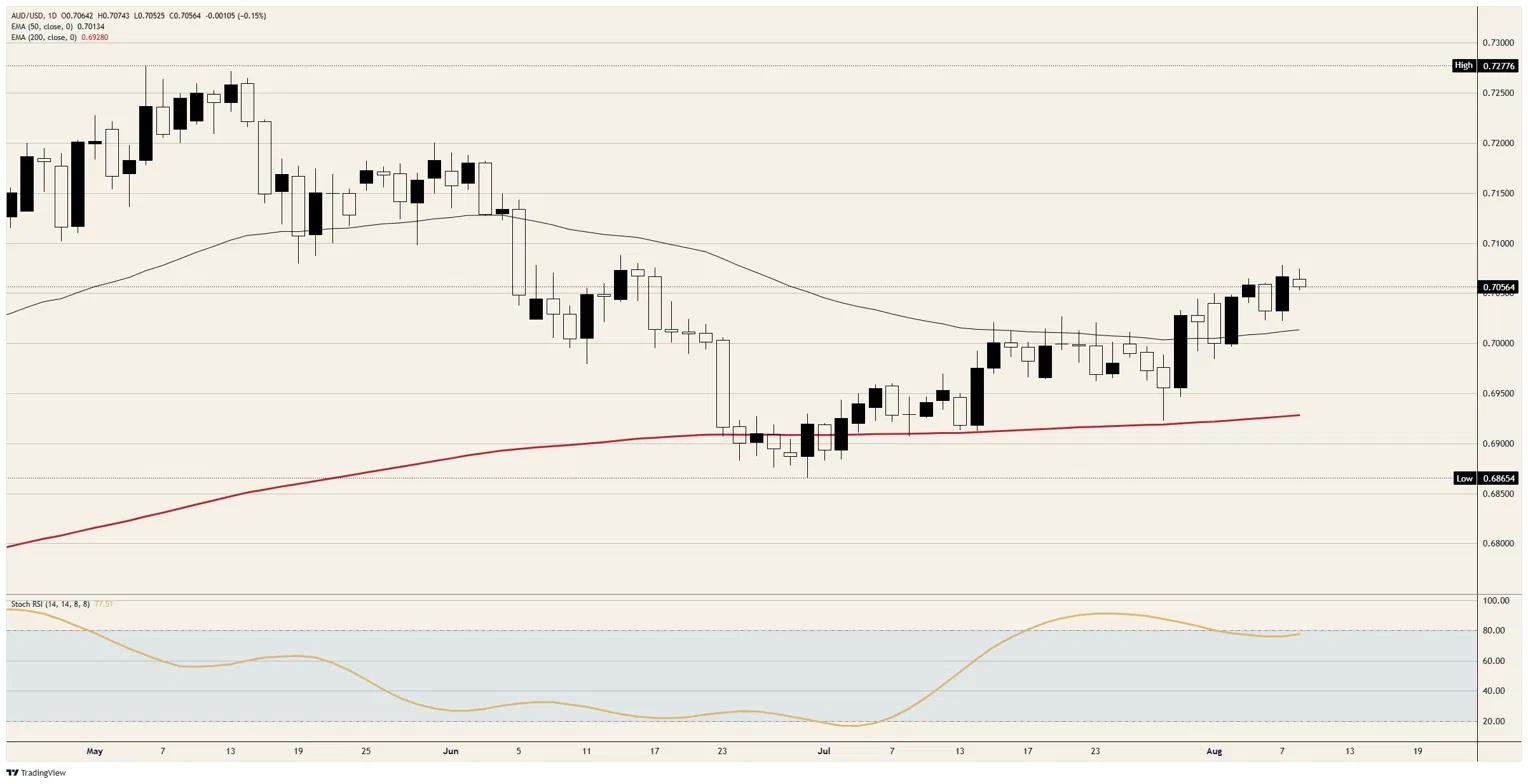
The Australian Dollar has traded a band of barely 20 pips through the session, holding above 0.7050 and easing 0.15% inside it. That is the tightest daily range the pair has produced in weeks, and it arrives at the end of a run of close to 200 pips from the late-June trough just above 0.6850. The 50-day Exponential Moving Average (EMA) just above 0.7000 was reclaimed on the way through and has flattened out underneath price.

What makes the position awkward is that every domestic input behind the move has deteriorated over the same stretch of tape. A rate decision arrives on Tuesday that nobody expects to move anything, the inflation reading that would have justified a move undershot, and the largest export market delivered a disinflation print on Sunday. The Aussie is up close to 3% off its low with none of its own drivers intact.
Tuesday's decision is not the event
The Reserve Bank of Australia (RBA) announces at 04:30 GMT on Tuesday against a 4.35% consensus and a 4.35% previous, and a Reuters poll of 37 economists produced not one forecast for anything else. Market-implied odds of an increase sit in low single digits, down from a live possibility three weeks ago, after the June-quarter trimmed mean printed 3.6% and undershot expectations. Unanimity that complete stops being a decision and becomes a formality with a microphone attached.
The news therefore sits in the quarterly Statement on Monetary Policy published alongside the decision and in the press conference an hour later at 05:30 GMT. What the forecast round has to answer is whether 4.35% is the peak of a cycle that added 75 basis points across February, March and May, and the four largest domestic lenders have already concluded that it is. A hold that ratifies the peak removes the last rate argument for owning the currency, which makes a confirmed top the bearish outcome rather than the neutral one.
The other two legs are gone
China's July inflation data landed at 01:30 GMT on Sunday and pointed the same direction as everything else on the Australian side of the ledger. Consumer prices fell 0.1% MoM against a 0.2% consensus, the annual rate slowed to 0.5% from 1% and missed 0.8%, and producer prices decelerated to 3.5% YoY from 4.1%. The largest customer is cooling in both the household and the factory series, and a currency that trades as the liquid proxy for Chinese demand has not given back a single figure on it.
Iron Ore has been no more helpful, holding beneath $100 a tonne through the summer on seaborne supply, compressed Chinese steel margins and elevated port stocks. Neither the terms-of-trade channel nor the rate channel is doing any lifting here, and a currency that has climbed 200 pips has to be climbing on something. That leaves the American side of the quote as the sole author of the move, which is a very specific kind of exposure to be carrying into Wednesday.
The week that matters is American
Pricing for the Fed has September 16 at 49.93% for a quarter-point increase against 50.07% for a hold, the flattest reading this cycle has produced, with October 28 at 76.50% for at least one move and the current range given no chance of surviving December 9. A Dollar index at its weakest level since early June is what carried the Aussie through 0.7050 in the first place. That is thin scaffolding to leave a two-cent rally standing on when the payrolls miss that built it has already been half priced back out.
The scaffolding gets tested at 12:30 GMT on Wednesday, where consensus has July consumer prices at 0.1% MoM from -0.4% and the core rate at 0.2% from 0%, taking the annual core to 2.5% from 2.6%. Producer prices follow on Thursday at 4.9% YoY from 5.5% and retail sales on Friday at 0.2% MoM, with two regional Fed presidents speaking either side of the Thursday release. Domestic events are thinner: consumer inflation expectations at 01:00 GMT on Thursday against a 4.7% previous, and the RBA Governor speaking at 23:30.
Levels
Resistance: The session ceiling short of 0.7100 is the first line, and 0.7100 itself is where the early-June breakdown began. A daily close through there reopens 0.7150 and the May peak just short of 0.7300 beyond it.
Support: The 0.7050 shelf that has contained the whole session comes first, then the 50-day EMA just above 0.7000. The 200-day EMA just under 0.6950 is the deeper floor and has risen every week of the summer.
Bias: Bearish. A 20-pip range at the top of a 200-pip run, with the daily Stochastic Relative Strength Index (Stoch RSI) near 78 and rolling over, is a rally that has run out of domestic reasons. Objectives 0.7000 then 0.6950, with invalidation on a daily close above 0.7100.
AUD/USD daily chart
Australian Dollar FAQs
One of the most significant factors for the Australian Dollar (AUD) is the level of interest rates set by the Reserve Bank of Australia (RBA). Because Australia is a resource-rich country another key driver is the price of its biggest export, Iron Ore. The health of the Chinese economy, its largest trading partner, is a factor, as well as inflation in Australia, its growth rate and Trade Balance. Market sentiment – whether investors are taking on more risky assets (risk-on) or seeking safe-havens (risk-off) – is also a factor, with risk-on positive for AUD.
The Reserve Bank of Australia (RBA) influences the Australian Dollar (AUD) by setting the level of interest rates that Australian banks can lend to each other. This influences the level of interest rates in the economy as a whole. The main goal of the RBA is to maintain a stable inflation rate of 2-3% by adjusting interest rates up or down. Relatively high interest rates compared to other major central banks support the AUD, and the opposite for relatively low. The RBA can also use quantitative easing and tightening to influence credit conditions, with the former AUD-negative and the latter AUD-positive.
China is Australia’s largest trading partner so the health of the Chinese economy is a major influence on the value of the Australian Dollar (AUD). When the Chinese economy is doing well it purchases more raw materials, goods and services from Australia, lifting demand for the AUD, and pushing up its value. The opposite is the case when the Chinese economy is not growing as fast as expected. Positive or negative surprises in Chinese growth data, therefore, often have a direct impact on the Australian Dollar and its pairs.
Iron Ore is Australia’s largest export, accounting for $118 billion a year according to data from 2021, with China as its primary destination. The price of Iron Ore, therefore, can be a driver of the Australian Dollar. Generally, if the price of Iron Ore rises, AUD also goes up, as aggregate demand for the currency increases. The opposite is the case if the price of Iron Ore falls. Higher Iron Ore prices also tend to result in a greater likelihood of a positive Trade Balance for Australia, which is also positive of the AUD.
The Trade Balance, which is the difference between what a country earns from its exports versus what it pays for its imports, is another factor that can influence the value of the Australian Dollar. If Australia produces highly sought after exports, then its currency will gain in value purely from the surplus demand created from foreign buyers seeking to purchase its exports versus what it spends to purchase imports. Therefore, a positive net Trade Balance strengthens the AUD, with the opposite effect if the Trade Balance is negative.













