

Savdo
Raqobatbardosh narxlar, chuqur likvidlik va ilg‘or savdo vositalari bilan keng turdagi bozorlarni kashf eting.
Batafsil ma’lumot 
Platforma
TMGM’ning tezlik, aniqlik va yuqori savdo tajribasi uchun yaratilgan kuchli platformasi bilan uzluksiz savdo qiling.
Batafsil ma’lumot Savdo platformasi
Savdo vositalari
Akademiya
Boshlovchilar uchun qulay resurslar, jumladan qo‘llanmalar, vebinarlar va bozor tahlillari orqali savdoning asoslarini o‘rganing.
Batafsil ma’lumot Yangiliklar va tahlil
Savdo imkoniyatlaridan oldinda bo‘lish uchun bozor yangilanishlari va ekspert tahlillarini real vaqt rejimida oling
Batafsil ma’lumot Yangiliklar va tahlil
Haqida
TMGMni boshqalardan ajratib turadigan jihatlarni bilib oling — bizning global mavjudligimiz, tartibga solishdagi mustahkamligimiz va savdoda innovatsiyalarga sodiqligimiz.
Batafsil ma’lumot Nega TMGMni tanlash kerak
The Yen rises on BoJ minutes, with Ueda and US NFP on the Friday docket
- USD/JPY is back under 158.00, where it was before Tuesday's jump toward 159.00.
- Minutes from the BoJ added to December hike bets, and US tech stocks fell.
- US payrolls and a speech by BoJ Governor Ueda are both scheduled for Friday.
The Yen is gaining on a Dollar that is up against the Pound, the Euro, the Kiwi and the Aussie on Thursday. Bank of Japan (BoJ) minutes that read as a case for a December hike did it, with help from a fall in US technology stocks. USD/JPY has dropped from Tuesday's high just under 159.00, its highest since mid-October, to just above 157.50.

The BoJ held at 1.25% on October 30 by eight votes to one, with BoJ board member Takata wanting 1.5%, and it meets next on December 17-18. Thursday's minutes landed on that split, and the gap to the Fed's 3.75%-4.00% is two and a half points or more. A December BoJ hike would trim it by a quarter-point, if the Fed stands still.
The Fed is priced near 70% for December 9, and Cleveland Fed President Hammack, who voted to hike on October 28, said on Thursday that policy has to become restrictive. A hike in Washington on December 9 and one in Tokyo on December 18 would leave the gap exactly where it is. US technology stocks fell on Thursday too, which is the other reason the Yen is up.
On the calendar
September labour cash earnings for Japan come at 23:30 GMT on Thursday, forecast up 3.8% from a year earlier, the same as August. BoJ Governor Ueda speaks at 16:00 GMT on Friday, and both feed the December 17-18 decision, the BoJ's last of the year.
Friday's 13:30 GMT release of October Nonfarm Payrolls (NFP) is forecast to show a 65K rise after 29K in September. New York Fed President Williams has a speech at 09:30 GMT the same day. October's Consumer Price Index (CPI) comes on Tuesday, November 10, at 13:30 GMT, with a 0.3% forecast after 0.6%, and feeds the Fed's December 8-9 meeting.
On the charts
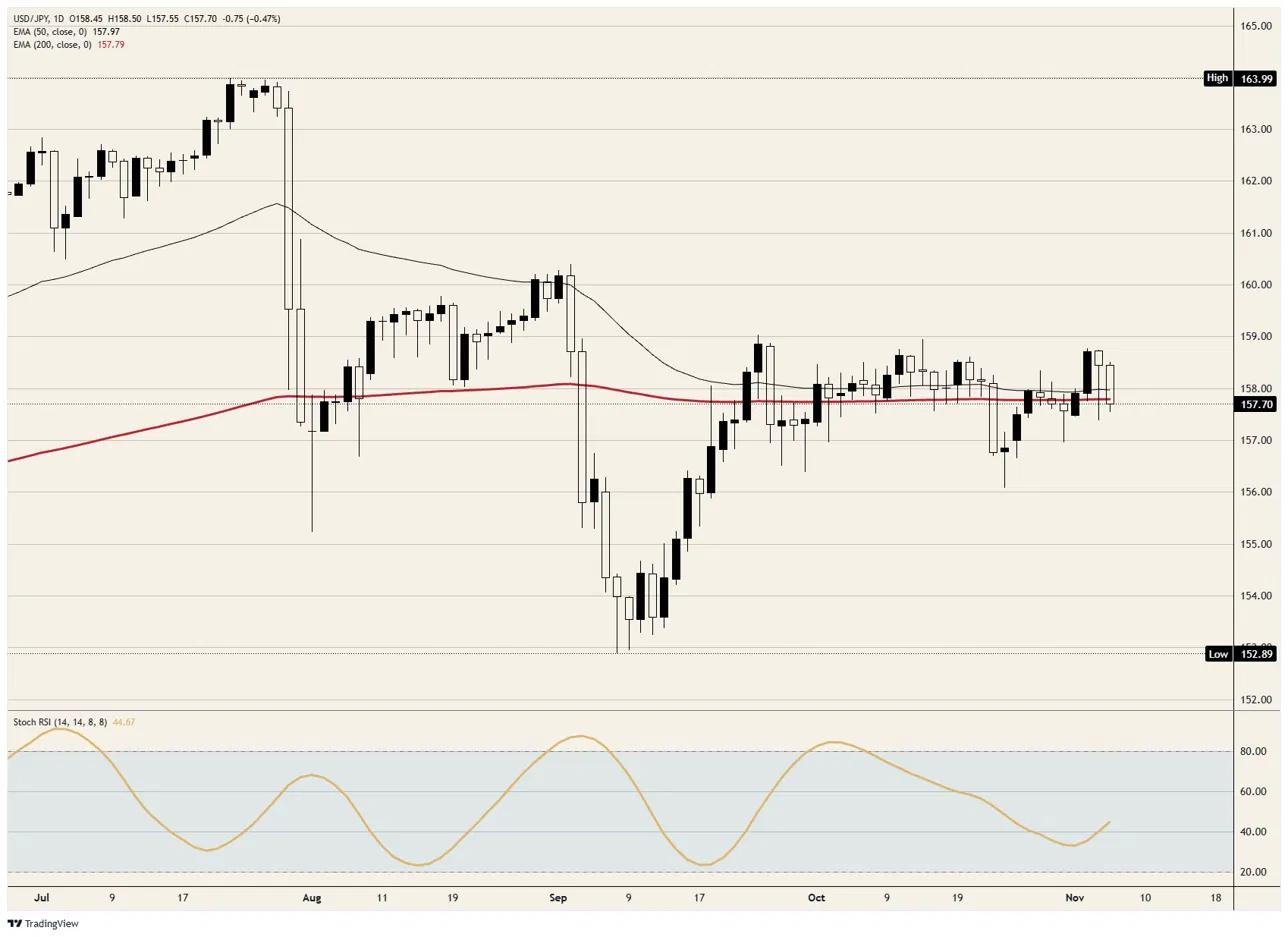
The pair is back inside the 156.00-159.00 range it has held since late September, and Tuesday's high was the latest turn lower from just under 159.00. The 50-day Exponential Moving Average (EMA) and the 200-day EMA are both within a quarter-Yen of 158.00, and USD/JPY is trading just below them.
USD/JPY daily chart
Japanese Yen FAQs
The Japanese Yen (JPY) is one of the world’s most traded currencies. Its value is broadly determined by the performance of the Japanese economy, but more specifically by the Bank of Japan’s policy, the differential between Japanese and US bond yields, or risk sentiment among traders, among other factors.
One of the Bank of Japan’s mandates is currency control, so its moves are key for the Yen. The BoJ has directly intervened in currency markets sometimes, generally to lower the value of the Yen, although it refrains from doing it often due to political concerns of its main trading partners. The BoJ ultra-loose monetary policy between 2013 and 2024 caused the Yen to depreciate against its main currency peers due to an increasing policy divergence between the Bank of Japan and other main central banks. More recently, the gradually unwinding of this ultra-loose policy has given some support to the Yen.
Over the last decade, the BoJ’s stance of sticking to ultra-loose monetary policy has led to a widening policy divergence with other central banks, particularly with the US Federal Reserve. This supported a widening of the differential between the 10-year US and Japanese bonds, which favored the US Dollar against the Japanese Yen. The BoJ decision in 2024 to gradually abandon the ultra-loose policy, coupled with interest-rate cuts in other major central banks, is narrowing this differential.
The Japanese Yen is often seen as a safe-haven investment. This means that in times of market stress, investors are more likely to put their money in the Japanese currency due to its supposed reliability and stability. Turbulent times are likely to strengthen the Yen’s value against other currencies seen as more risky to invest in.
Eng yaxshi maqolalar
1The Yen rises on BoJ minutes, with Ueda and US NFP on the Friday docket2New Zealand votes Saturday with the Kiwi back below 0.56003Friday's US NFP print bears down on a Euro turned back from a one-month high4The Pound loses its BoE hike bounce before Friday's US payrolls5Mexican Peso reels as Banxico's surprise rate cut fuels easing bets6Ethereum Price Forecast: ETH falls 7% as AI sell-off hits crypto7Dow Jones Industrial Average loses the midterm rally to the data-centre backlash8Chinese Yuan: PBoC resistance caps appreciation – Societe Generale9Gold rallies above $4,100 as NASDAQ 100 crashes, December hike bets fade


Boshlang!
Ro‘yxatdan o‘ting va 3 daqiqadan kamroq vaqt ichida Global bozorlariga kirish imkoniga ega bo‘ling

Biz bilan bog‘laning









Kontaktlar
Telefon: +61 2 8036 8388
Faks: +61 2 8036 8388
Email: support@tmgm.com



Ushbu veb-saytda taqdim etilgan ma’lumotlar faqat umumiy xususiyatga ega bo‘lib, shaxsiy moliyaviy maslahat hisoblanmaydi. Ushbu veb-saytdagi har qanday ma’lumot asosida harakat qilishdan oldin, ma’lumotning sizning maqsadlaringiz, moliyaviy ahvolingiz va ehtiyojlaringizga mosligini ko‘rib chiqishingiz kerak. CFD va FX Margin shartnomalariga sarmoya kiritish sezilarli xavflarni o‘z ichiga oladi va barcha investorlar uchun mos emas. Siz boshlang‘ich depozitingizdan ko‘proq yo‘qotishingiz mumkin. Siz asosiy aktivga egalik qilmaysiz va unda hech qanday manfaatga ega emassiz. Savdo qilishdan oldin mustaqil maslahat olishni va ishtirok etuvchi xavflarni to‘liq tushunishingizni tavsiya qilamiz. Veb-saytda keltirilgan har qanday mahsulotni xarid qilishdan oldin oshkor qilish hujjatini o‘qib chiqishingiz va ko‘rib chiqishingiz muhimdir. Ushbu veb-saytda taklif etilgan ma’lumotlar va reklama materiallari bunday foydalanish mahalliy qonunlar va qoidalarga zid bo‘ladigan har qanday mamlakat yoki yurisdiksiyadagi shaxslar tomonidan foydalanish uchun mo‘ljallanmagan. Ushbu veb-saytda taklif etilgan Mahsulotlar va Xizmatlar AQSh, Malayziya va Tailand rezidentlari uchun mo‘ljallanmagan.
TMGM turli yurisdiksiyalarda vakolatli va tartibga solinadi.
Trademax Australia Limited, TMGM nomi ostida faoliyat yuritadi, Avstraliya Qimmatli qog‘ozlar va investitsiyalar komissiyasi (ASIC) tomonidan tartibga solinadi, AFSL raqami 436416 va manzili: Level 28, One International Tower, 100 Barangaroo Avenue, 2000 Sydney, NSW Australia.
Email: support@tmgm.com.au
Trademax Global Limited, TMGM nomi ostida faoliyat yuritadi, Vanuatu Moliyaviy Xizmatlar Komissiyasi (VFSC) tomonidan vakolatli va tartibga solinadi, ro‘yxatga olish raqami 40356 va ro‘yxatdan o‘tgan manzili: 1276, Kumul Highway, Port Vila, Vanuatu, Vanuatu Respublikasi.
Email: support@tmgm.com
Trademax Global Markets (SE) Limited, TMGM nomi ostida faoliyat yuritadi, Seyshel orollari Moliyaviy Xizmatlar Boshqarmasi (FSA) tomonidan 224-sonli SD litsenziyasi bilan vakolatli va tartibga solinadi. Kompaniya Office No 13, Providence Estate ABIS Centre, Mahe, Seychelles manzilida ro‘yxatdan o‘tgan.
Email: support@tmgm.com
Trademax Global Markets (International) Pty Ltd, TMGM nomi ostida faoliyat yuritadi, Mauritius Moliyaviy Xizmatlar Komissiyasi (FSC) tomonidan GB22201012 litsenziya raqami bilan vakolatli va tartibga solinadi hamda 33, Edith Cavell Street C/o IQ EQ Fund Services (Mauritius) Ltd Port Louis, 11324 Mauritius manzilida ro‘yxatdan o‘tgan.
Email: support@tmgm.com
Mualliflik huquqi © TMGM. Barcha huquqlar himoyalangan