

Торговля
Изучите широкий спектр рынков с конкурентными ценами, высокой ликвидностью и передовыми торговыми инструментами.
Узнать больше 
Платформа
Торгуйте без сбоев на мощной платформе TMGM, созданной для скорости, точности и превосходного торгового опыта.
Узнать больше Торговая платформа
Торговые инструменты
Академия
Изучите основы торговли с помощью материалов для начинающих, включая руководства, вебинары и аналитические обзоры рынка.
Узнать больше Новости и аналитика
Получайте актуальные рыночные обновления и экспертную аналитику, чтобы быть на шаг впереди торговых возможностей
Узнать больше Новости и аналитика
О нас
Узнайте, что отличает TMGM — наше глобальное присутствие, надежное регулирование и приверженность инновациям в трейдинге.
Узнать больше Почему выбирают TMGM
Спонсорство
New Zealand votes Saturday with the Kiwi back below 0.5600
- NZD/USD has fallen back below 0.5600 after a run above 0.5650 on Thursday.
- December RBNZ hike odds are under 50%, and the Dollar is up off its midterm low.
- New Zealand votes on Saturday, with neither main party on course for a majority.
New Zealand votes on Saturday with the Kiwi back where it was before the Dollar fell to a one-month low on US midterm results. NZD/USD rose above 0.5650 on Thursday and has fallen to the session low just under 0.5600. That wipes out all of Wednesday's gains from a low that was the pair's lowest since October 14.

The Reserve Bank of New Zealand (RBNZ) held at 2.75% on October 28 by four votes to three and said tighter policy is likely, without a date. A December hike was priced near 75% at the start of the week and is under 50% after the third-quarter jobs figures. The final Freshwater poll had Labour at 30.7% and Prime Minister Luxon's National at 26.4%, with the Opportunity party on 5.1% holding the balance.
Wednesday's Dollar drop to a one-month low came after the Democrats took Congress, and Thursday's US figures gave some of it back. Jobless claims were 189K against a forecast of 196K, and third-quarter productivity rose 3.6% against a 2.5% forecast. Pricing for a Fed hike on December 9 is near 70%, and the Fed's 3.75%-4.00% stays above the RBNZ's 2.75% with or without it.
On the calendar
Saturday's election comes first. China's October Consumer Price Index (CPI) comes at 01:30 GMT on Monday, after 0.9% on the year, then its trade figures at 03:00 GMT on Tuesday, after exports grew 36.3%. New Zealand's October manufacturing Purchasing Managers Index (PMI) is due on Thursday, November 12, at 21:30 GMT, after 56.5, and the next RBNZ decision comes with December's Monetary Policy Statement.
Friday brings October's Nonfarm Payrolls (NFP) at 13:30 GMT, seen at 65K after 29K, and October's CPI is due on Tuesday, November 10, forecast at 0.3% after 0.6%. Both feed the Fed meeting of December 8-9, the bigger rate in the pair.
On the charts
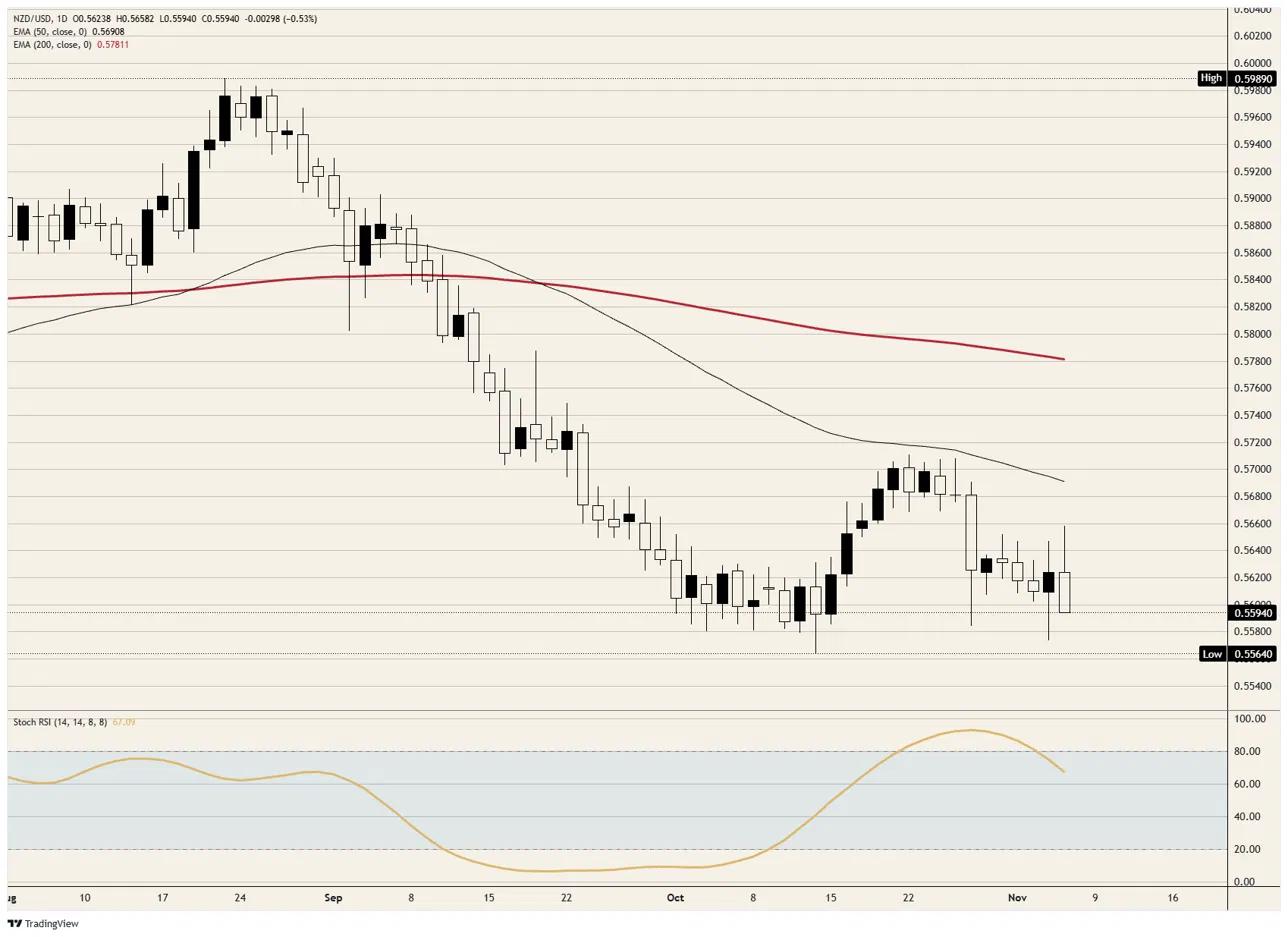
The pair has given back about four-fifths of its climb from the October 14 low near 0.5550 to the October 22 high near 0.5700. It has been under the 50-day Exponential Moving Average (EMA), just under 0.5700, since the RBNZ's hold, and the 200-day EMA is just under 0.5800. Daily momentum has been falling from overbought since late October.
NZD/USD daily chart
New Zealand Dollar FAQs
The New Zealand Dollar (NZD), also known as the Kiwi, is a well-known traded currency among investors. Its value is broadly determined by the health of the New Zealand economy and the country’s central bank policy. Still, there are some unique particularities that also can make NZD move. The performance of the Chinese economy tends to move the Kiwi because China is New Zealand’s biggest trading partner. Bad news for the Chinese economy likely means less New Zealand exports to the country, hitting the economy and thus its currency. Another factor moving NZD is dairy prices as the dairy industry is New Zealand’s main export. High dairy prices boost export income, contributing positively to the economy and thus to the NZD.
The Reserve Bank of New Zealand (RBNZ) aims to achieve and maintain an inflation rate between 1% and 3% over the medium term, with a focus to keep it near the 2% mid-point. To this end, the bank sets an appropriate level of interest rates. When inflation is too high, the RBNZ will increase interest rates to cool the economy, but the move will also make bond yields higher, increasing investors’ appeal to invest in the country and thus boosting NZD. On the contrary, lower interest rates tend to weaken NZD. The so-called rate differential, or how rates in New Zealand are or are expected to be compared to the ones set by the US Federal Reserve, can also play a key role in moving the NZD/USD pair.
Macroeconomic data releases in New Zealand are key to assess the state of the economy and can impact the New Zealand Dollar’s (NZD) valuation. A strong economy, based on high economic growth, low unemployment and high confidence is good for NZD. High economic growth attracts foreign investment and may encourage the Reserve Bank of New Zealand to increase interest rates, if this economic strength comes together with elevated inflation. Conversely, if economic data is weak, NZD is likely to depreciate.
The New Zealand Dollar (NZD) tends to strengthen during risk-on periods, or when investors perceive that broader market risks are low and are optimistic about growth. This tends to lead to a more favorable outlook for commodities and so-called ‘commodity currencies’ such as the Kiwi. Conversely, NZD tends to weaken at times of market turbulence or economic uncertainty as investors tend to sell higher-risk assets and flee to the more-stable safe havens.
Лучшие статьи
1The Yen rises on BoJ minutes, with Ueda and US NFP on the Friday docket2New Zealand votes Saturday with the Kiwi back below 0.56003Friday's US NFP print bears down on a Euro turned back from a one-month high4The Pound loses its BoE hike bounce before Friday's US payrolls5Mexican Peso reels as Banxico's surprise rate cut fuels easing bets6Ethereum Price Forecast: ETH falls 7% as AI sell-off hits crypto7Dow Jones Industrial Average loses the midterm rally to the data-centre backlash8Chinese Yuan: PBoC resistance caps appreciation – Societe Generale9Gold rallies above $4,100 as NASDAQ 100 crashes, December hike bets fade


Начать!
Зарегистрируйтесь и получите доступ к глобальным рынкам менее чем за 3 минуты

Свяжитесь с нами









Контакты
Телефон: +61 2 8036 8388
Факс: +61 2 8036 8388
Эл. почта: support@tmgm.com
Веб-сайт: https://www.tmgmsea.com



Информация, представленная на этом веб-сайте, носит исключительно общий характер и не является персональной финансовой консультацией. Прежде чем действовать на основании любой информации на этом веб-сайте, вам следует оценить ее уместность с учетом ваших целей, финансового положения и потребностей. Инвестирование в CFD и маржинальные контракты на FX сопряжено со значительными рисками и подходит не всем инвесторам. Вы можете потерять больше, чем ваш первоначальный депозит. Вы не владеете базовым активом и не имеете в нем какой-либо доли. Мы рекомендуем вам обратиться за независимой консультацией и убедиться, что вы полностью понимаете связанные с этим риски, прежде чем начинать торговлю. Важно прочитать и принять во внимание документ с раскрытием информации, прежде чем приобретать любой продукт, указанный на веб-сайте. Информация и рекламные материалы, предлагаемые на этом веб-сайте, не предназначены для использования любым лицом в любой стране или юрисдикции, где такое использование противоречило бы местным законам и нормативным актам. Продукты и услуги, предлагаемые на этом веб-сайте, не предназначены для резидентов США, Малайзии и Таиланда.
TMGM уполномочена и регулируется в различных юрисдикциях.
Trademax Australia Limited, работающая под брендом TMGM, регулируется Australian Securities and Investments Commission (ASIC), AFSL № 436416 и находится по адресу: Level 28, One International Tower, 100 Barangaroo Avenue, 2000 Sydney, NSW Australia.
Email: support@tmgm.com.au
Trademax Global Limited, работающая под брендом TMGM, уполномочена и регулируется Vanuatu Financial Services Commission (VFSC), регистрационный номер 40356, и зарегистрирована по адресу: 1276, Kumul Highway, Port Vila, Vanuatu, Republic of Vanuatu.
Email: support@tmgm.com
Trademax Global Markets (SE) Limited, работающая под брендом TMGM, уполномочена и регулируется Financial Services Authority (FSA) Сейшельских Островов, номер лицензии SD224. Компания зарегистрирована по адресу: Office No 13, Providence Estate ABIS Centre, Mahe, Seychelles.
Email: support@tmgm.com
Trademax Global Markets (International) Pty Ltd, работающая под брендом TMGM, уполномочена и регулируется Financial Services Commission, Mauritius (FSC), лицензия № GB22201012, и зарегистрирована по адресу: 33, Edith Cavell Street C/o IQ EQ Fund Services (Mauritius) Ltd Port Louis, 11324 Mauritius.
Email: support@tmgm.com
Авторское право © TMGM. Все права защищены