

Negociação
Explore uma ampla variedade de mercados com preços competitivos, alta liquidez e ferramentas de negociação avançadas.
Saiba Mais 
Plataforma
Negocie sem interrupções com a poderosa plataforma da TMGM, desenvolvida para velocidade, precisão e uma experiência de negociação superior.
Saiba Mais Plataforma de Negociação
Ferramentas de Negociação
Academia
Aprenda os fundamentos da negociação com recursos para iniciantes, incluindo guias, webinars e insights de mercado.
Saiba Mais TMGM Academy
Notícias & Análise
Receba atualizações de mercado em tempo real e análises de especialistas para se antecipar às oportunidades de negociação.
Saiba Mais Notícias & Análise
Sobre
Descubra o que diferencia a TMGM — nossa presença global, força regulatória e compromisso com a inovação em negociação.
Saiba Mais Por Que Escolher a TMGM
Mexican Peso rout deepens as USD/MXN blasts through 18.30
- USD/MXN surges above 18.30 as Peso selling accelerates.
- DXY clears 102 while elevated yields reinforce Dollar demand.
- Mexico manufacturing returns to growth, but underlying recovery remains fragile.
The Mexican Peso collapses, extending its depreciation by over 1.50% in the day as the Greenback strengthens sharply amid growing fears that the Middle East conflict will be prolonged, keeping energy prices under pressure. The USD/MXN trades at 18.35, after bouncing off daily lows of 18.06.
Geopolitical risk, high yields and Dollar strength overwhelm improving Mexican factory data

Sentiment remains negative, amid growing concerns of a potential escalation in the US-Iran conflict. This pushed energy prices higher and US Treasury yields as well, boosting the safe-haven appeal of the Greenback to the detriment of the Mexican currency.
Aside from this, Mexico’s economic docket revealed that manufacturing activity improved in September, according to S&P Global. The Manufacturing PMI expanded from 49.8 to 50.3.
Pollyanna De Lima, Economics Associate Director at S&P Global Market Intelligence, was more cautious, saying that “September's PMI data suggested that Mexico's manufacturing economy moved fractionally back into growth territory, but the underlying picture was still quite fragile.”
Meanwhile, the Bank of Mexico (Banxico) private economists’ poll revealed that the majority see the main reference rate at 6.50% through the end of 2027, and the USD/MXN exchange rate to end around 17.50 this year.
In the US, data showed that business activity in the manufacturing sector remains solid, despite cooling, with the ISM Manufacturing PMI hitting 54.5, below estimates of 55, a tenth below August’s 54.6. Earlier, Initial Jobless Claims for the week ending September 26, at 197K, were below forecasts of 200K and down from the previous week's 198K.
Given the backdrop, money markets trimmed their Fed-hawkish bets for October, but for December, the chances of another rate increase are 83%, according to Prime Terminal.
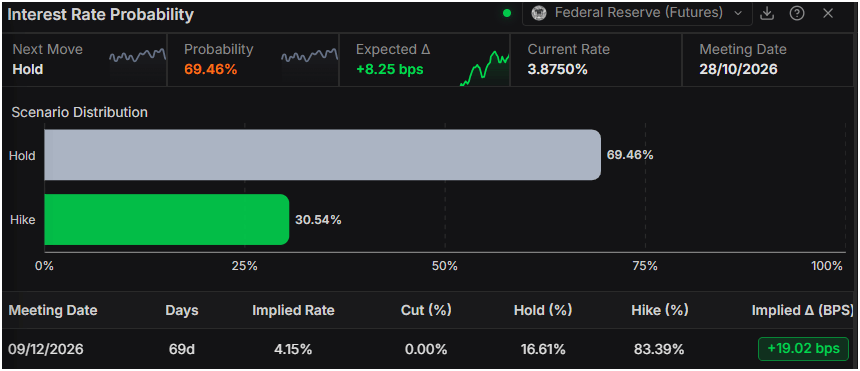
Also, high US Treasury yields keep the Greenback underpinned, as indicated by the US Dollar Index (DXY). The DXY, which measures the performance of the American Dollar against six peers, is at 102.16, up 0.69%. a headwind for the Mexican currency.
The US economic calendar ahead includes the September Nonfarm Payrolls report and additional Federal Reserve remarks.
USD/MXN Price Forecast: Technical Outlook
In the daily chart, USD/MXN trades at 18.3726. The pair holds well above the latest reading of the triple simple moving average (50, 100, 200) at 17.2219, keeping the near-term bias firmly bullish and suggesting an extension of the recent uptrend away from the mid-16.00s base. Momentum looks stretched, however, as the 14-period Relative Strength Index prints an overbought reading near 86.9, hinting that upside may be vulnerable to consolidation or a corrective pullback even as buyers remain in control.
On the downside, initial support is seen at the triple simple moving average cluster around 17.22, which reinforces the broader ascending structure. A deeper retreat would expose the horizontal support level at 16.8866, where previous demand emerged and a more significant downside correction could pause. With no clearly defined nearby resistance levels in the dataset, price action around current highs will guide whether USD/MXN extends the bullish phase or allows overbought conditions to unwind toward the 17.00–17.20 region.
(The technical analysis of this story was written with the help of an AI tool. Know more.)
Mexican Peso FAQs
The Mexican Peso (MXN) is the most traded currency among its Latin American peers. Its value is broadly determined by the performance of the Mexican economy, the country’s central bank’s policy, the amount of foreign investment in the country and even the levels of remittances sent by Mexicans who live abroad, particularly in the United States. Geopolitical trends can also move MXN: for example, the process of nearshoring – or the decision by some firms to relocate manufacturing capacity and supply chains closer to their home countries – is also seen as a catalyst for the Mexican currency as the country is considered a key manufacturing hub in the American continent. Another catalyst for MXN is Oil prices as Mexico is a key exporter of the commodity.
The main objective of Mexico’s central bank, also known as Banxico, is to maintain inflation at low and stable levels (at or close to its target of 3%, the midpoint in a tolerance band of between 2% and 4%). To this end, the bank sets an appropriate level of interest rates. When inflation is too high, Banxico will attempt to tame it by raising interest rates, making it more expensive for households and businesses to borrow money, thus cooling demand and the overall economy. Higher interest rates are generally positive for the Mexican Peso (MXN) as they lead to higher yields, making the country a more attractive place for investors. On the contrary, lower interest rates tend to weaken MXN.
Macroeconomic data releases are key to assess the state of the economy and can have an impact on the Mexican Peso (MXN) valuation. A strong Mexican economy, based on high economic growth, low unemployment and high confidence is good for MXN. Not only does it attract more foreign investment but it may encourage the Bank of Mexico (Banxico) to increase interest rates, particularly if this strength comes together with elevated inflation. However, if economic data is weak, MXN is likely to depreciate.
As an emerging-market currency, the Mexican Peso (MXN) tends to strive during risk-on periods, or when investors perceive that broader market risks are low and thus are eager to engage with investments that carry a higher risk. Conversely, MXN tends to weaken at times of market turbulence or economic uncertainty as investors tend to sell higher-risk assets and flee to the more-stable safe havens.
ARTIGOS POPULARES
1Fed’s Jefferson signals patience as next rate move stays data-driven2Banxico survey sees lower inflation, stronger growth and 6.50% hold3Mexican Peso rout deepens as USD/MXN blasts through 18.304Forex Today: US NFP takes centre stage5Near Protocol slides below $5.00 after Near Intents $4M exploit6Japanese Yen recovers as intervention risk offsets US Dollar strength7Australian Dollar weakens as robust US data, rising US yields overshadow RBA rate hike8Crude Oil turns a loss into a rally as Chinese refiners stop exporting fuel9British Pound buckles as DXY nears 102 on US jobs, factory strength
COTAÇÕES AO VIVO

Comece Agora!
Cadastre-se e acesse os Mercados Globais em menos de 3 minutos

Conecte-se Conosco









Contatos
Telefone: +61 2 8036 8388
Fax: +61 2 8036 8388
Email: support@tmgm.com



As informações fornecidas neste website são apenas de natureza geral e não constituem aconselhamento financeiro pessoal. Antes de agir com base em qualquer informação neste website, deve considerar a adequação da informação em relação aos seus objetivos, situação financeira e necessidades. Investir em CFDs e contratos de margem de FX envolve riscos significativos e não é adequado para todos os investidores. Poderá perder mais do que o seu depósito inicial. Não possui, nem detém, qualquer interesse no ativo subjacente. Recomendamos que procure aconselhamento independente e que se certifique de que compreende plenamente os riscos envolvidos antes de negociar. É importante que leia e considere o documento de divulgação antes de adquirir qualquer produto listado no website. As informações e os anúncios oferecidos neste website não se destinam a ser utilizados por qualquer pessoa em qualquer país ou jurisdição onde tal utilização seja contrária às leis e regulamentos locais. Os Produtos e Serviços oferecidos neste website não se destinam a residentes dos Estados Unidos, da Malásia e da Tailândia.
A TMGM é autorizada e regulada em várias jurisdições.
Trademax Australia Limited, operando como TMGM, é regulada pela Comissão Australiana de Valores Mobiliários e Investimentos (ASIC), AFSL nº 436416 e está localizada no Level 28, One International Tower, 100 Barangaroo Avenue, 2000 Sydney, NSW Austrália.
Email: support@tmgm.com.au
Trademax Global Limited, operando como TMGM, é autorizada e regulada pela Comissão de Serviços Financeiros de Vanuatu (VFSC), número de registro 40356 e registrada em 1276, Kumul Highway, Port Vila, Vanuatu, República de Vanuatu.
Email: support@tmgm.com
Trademax Global Markets (SE) Limited, operando como TMGM, é autorizada e regulada pela Autoridade de Serviços Financeiros (FSA) das Seychelles, sob o número de licença SD224. A empresa está registrada no Escritório nº 13, Providence Estate ABIS Centre, Mahe, Seychelles.
Email: support@tmgm.com
Trademax Global Markets (International) Pty Ltd, operando como TMGM, é autorizada e regulada pela Comissão de Serviços Financeiros de Maurício (FSC) com licença nº GB22201012, e registrada em 33, Edith Cavell Street C/o IQ EQ Fund Services (Mauritius) Ltd Port Louis, 11324 Maurício.
Email: support@tmgm.com
Copyright © TMGM. Todos os direitos reservados