

Negociação
Explore uma ampla variedade de mercados com preços competitivos, alta liquidez e ferramentas de negociação avançadas.
Saiba Mais 
Plataforma
Negocie sem interrupções com a poderosa plataforma da TMGM, desenvolvida para velocidade, precisão e uma experiência de negociação superior.
Saiba Mais Plataforma de Negociação
Ferramentas de Negociação
Academia
Aprenda os fundamentos da negociação com recursos para iniciantes, incluindo guias, webinars e insights de mercado.
Saiba Mais TMGM Academy
Notícias & Análise
Receba atualizações de mercado em tempo real e análises de especialistas para se antecipar às oportunidades de negociação.
Saiba Mais Notícias & Análise
Sobre
Descubra o que diferencia a TMGM — nossa presença global, força regulatória e compromisso com a inovação em negociação.
Saiba Mais Por Que Escolher a TMGM
British Pound underperforms this week as experts doubt BoE tightening prospects
- The British Pound underperforms against its major currency peers as experts question hawkish BoE repricing.
- Financial markets price in four 25bps interest rate hikes by the BoE over a one-year timeframe.
- The Fed is expected to deliver two more interest rate hikes this year.
The British Pound (GBP) trades with caution against its major currency peers on Friday. Against the US Dollar (USD), it is marginally up at around 1.3220 during the European session, but is close to its almost three-month low of 1.3200. The British currency has underperformed its peers this week, trading 1.27% down against the US Dollar.

Pound Sterling Price This week
The table below shows the percentage change of British Pound (GBP) against listed major currencies this week. British Pound was the weakest against the US Dollar.
| USD | EUR | GBP | JPY | CAD | AUD | NZD | CHF | |
|---|---|---|---|---|---|---|---|---|
| USD | 0.86% | 1.23% | 0.81% | 1.13% | 1.32% | 0.98% | 0.86% | |
| EUR | -0.86% | 0.39% | -0.07% | 0.27% | 0.46% | 0.12% | 0.01% | |
| GBP | -1.23% | -0.39% | -0.54% | -0.11% | 0.07% | -0.28% | -0.37% | |
| JPY | -0.81% | 0.07% | 0.54% | 0.38% | 0.52% | 0.20% | 0.10% | |
| CAD | -1.13% | -0.27% | 0.11% | -0.38% | 0.24% | -0.17% | -0.26% | |
| AUD | -1.32% | -0.46% | -0.07% | -0.52% | -0.24% | -0.34% | -0.51% | |
| NZD | -0.98% | -0.12% | 0.28% | -0.20% | 0.17% | 0.34% | -0.11% | |
| CHF | -0.86% | -0.01% | 0.37% | -0.10% | 0.26% | 0.51% | 0.11% |
The heat map shows percentage changes of major currencies against each other. The base currency is picked from the left column, while the quote currency is picked from the top row. For example, if you pick the British Pound from the left column and move along the horizontal line to the US Dollar, the percentage change displayed in the box will represent GBP (base)/USD (quote).
The reasoning behind GBP’s underperformance appears to be experts doubting hawkish Bank of England (BoE) interest rate expectations.
Strategists at Brown Brothers Harriman (BBH) highlight a growing disconnect between market pricing and their own expectations for the BoE policy path. They note that “the swaps curve continues to imply about 100bps of BoE rate hikes in the next twelve months to 4.75%,” but argue that “the BoE may not need to tighten as much as markets expect.”
BBH added that the UK economy “is already operating below capacity,” the current Bank Rate at “3.75% is near the top of the BoE’s estimated 2% to 4% neutral range,” and “fiscal policy will likely turn more restrictive” — all factors that, taken together, suggest less need for aggressive additional tightening than is currently embedded in market pricing.
Meanwhile, the US Dollar has outperformed this week amid fresh acceleration in hawkish Federal Reserve (Fed) bets due to warnings from officials that high inflation is a big concern. Also, stronger-than-projected United States (US) S&P Global Purchasing Managers’ Index (PMI) data for September has boosted hawkish Fed expectations too.
The CME FedWatch tool shows an almost 58% chance that the Fed will hike interest rates in both remaining policy meetings this year.
GBP/USD Technical Analysis
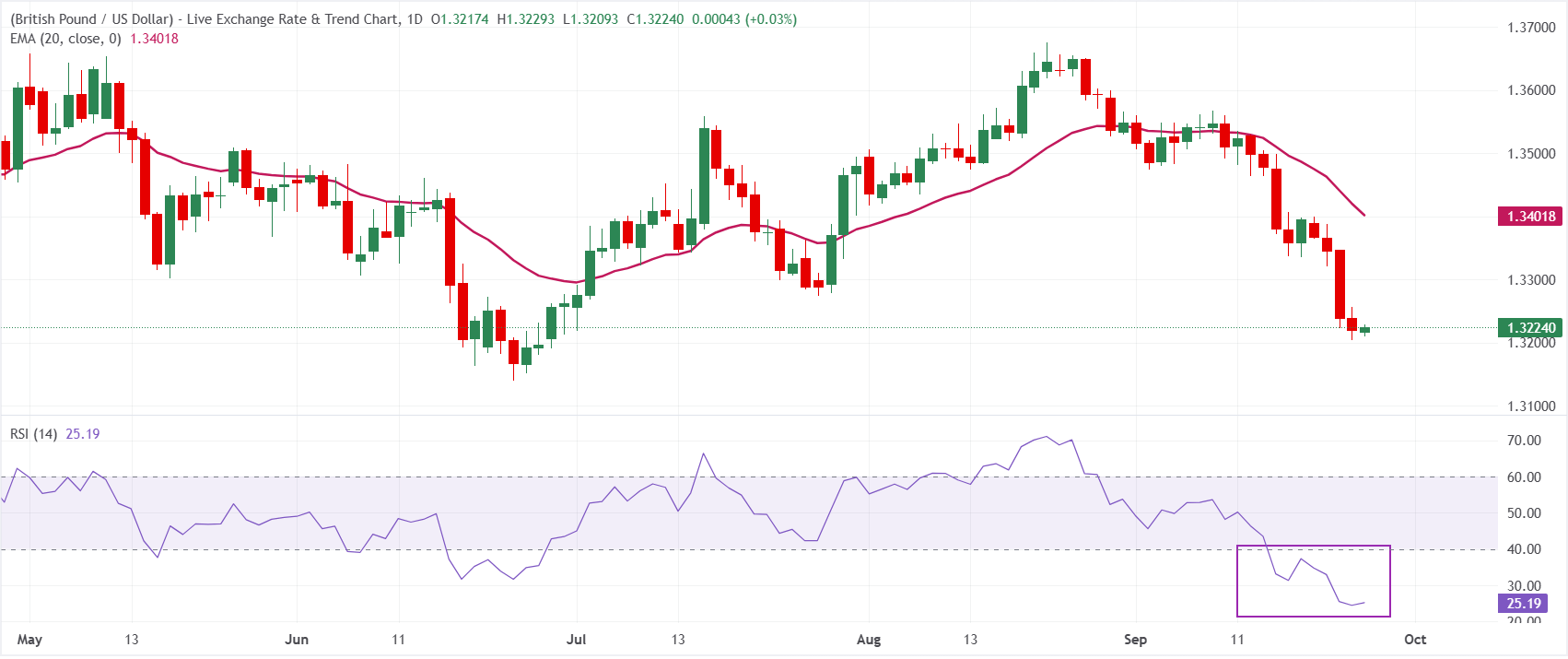
GBP/USD trades at 1.3224 at the time of writing, maintaining a bearish near-term bias as spot holds clearly beneath the 20-day Exponential Moving Average (EMA) at 1.3402. Price below this key trend indicator suggests sellers retain control, even as the Relative Strength Index (RSI) at 25 slips into oversold territory on the daily chart, hinting that downside momentum may be stretched but not yet reversed.
On the topside, initial resistance is the 20-day EMA at 1.3402, which is the first level buyers would need to reclaim to ease immediate bearish pressure and open the way for a more sustained recovery. With no nearby structural supports captured in the current dataset, any further declines from present levels would leave the pair trading in relatively uncharted territory on this timeframe, where oversold momentum conditions could slow but not necessarily stop the prevailing downtrend.
(The technical analysis of this story was written with the help of an AI tool. Know more.)
BoE FAQs
The Bank of England (BoE) decides monetary policy for the United Kingdom. Its primary goal is to achieve ‘price stability’, or a steady inflation rate of 2%. Its tool for achieving this is via the adjustment of base lending rates. The BoE sets the rate at which it lends to commercial banks and banks lend to each other, determining the level of interest rates in the economy overall. This also impacts the value of the Pound Sterling (GBP).
When inflation is above the Bank of England’s target it responds by raising interest rates, making it more expensive for people and businesses to access credit. This is positive for the Pound Sterling because higher interest rates make the UK a more attractive place for global investors to park their money. When inflation falls below target, it is a sign economic growth is slowing, and the BoE will consider lowering interest rates to cheapen credit in the hope businesses will borrow to invest in growth-generating projects – a negative for the Pound Sterling.
In extreme situations, the Bank of England can enact a policy called Quantitative Easing (QE). QE is the process by which the BoE substantially increases the flow of credit in a stuck financial system. QE is a last resort policy when lowering interest rates will not achieve the necessary result. The process of QE involves the BoE printing money to buy assets – usually government or AAA-rated corporate bonds – from banks and other financial institutions. QE usually results in a weaker Pound Sterling.
Quantitative tightening (QT) is the reverse of QE, enacted when the economy is strengthening and inflation starts rising. Whilst in QE the Bank of England (BoE) purchases government and corporate bonds from financial institutions to encourage them to lend; in QT, the BoE stops buying more bonds, and stops reinvesting the principal maturing on the bonds it already holds. It is usually positive for the Pound Sterling.
ARTIGOS POPULARES
1Bank of England: Policy convergence questions after Fed hike – Standard Chartered2British Pound underperforms this week as experts doubt BoE tightening prospects3Euro consolidates near three-month lows amid high Oil prices, Fed hiking bets4New Zealand Dollar inches higher as US Dollar declines on easing bond yields5Gold: Bearish bias holds below 4300 resistance - OCBC6Forex Today: US Dollar consolidates weekly gains ahead of mid-tier data7Dow Jones futures rise as treasury yields, oil prices ease8Equities: Rising yields weigh on stocks despite tech support - Deutsche Bank9Euro hovers near three-month highs against British Pound despite weak German data
COTAÇÕES AO VIVO


Comece Agora!
Cadastre-se e acesse os Mercados Globais em menos de 3 minutos

Conecte-se Conosco









Contatos
Telefone: +61 2 8036 8388
Fax: +61 2 8036 8388
Email: support@tmgm.com



As informações fornecidas neste website são apenas de natureza geral e não constituem aconselhamento financeiro pessoal. Antes de agir com base em qualquer informação neste website, deve considerar a adequação da informação em relação aos seus objetivos, situação financeira e necessidades. Investir em CFDs e contratos de margem de FX envolve riscos significativos e não é adequado para todos os investidores. Poderá perder mais do que o seu depósito inicial. Não possui, nem detém, qualquer interesse no ativo subjacente. Recomendamos que procure aconselhamento independente e que se certifique de que compreende plenamente os riscos envolvidos antes de negociar. É importante que leia e considere o documento de divulgação antes de adquirir qualquer produto listado no website. As informações e os anúncios oferecidos neste website não se destinam a ser utilizados por qualquer pessoa em qualquer país ou jurisdição onde tal utilização seja contrária às leis e regulamentos locais. Os Produtos e Serviços oferecidos neste website não se destinam a residentes dos Estados Unidos, da Malásia e da Tailândia.
A TMGM é autorizada e regulada em várias jurisdições.
Trademax Australia Limited, operando como TMGM, é regulada pela Comissão Australiana de Valores Mobiliários e Investimentos (ASIC), AFSL nº 436416 e está localizada no Level 28, One International Tower, 100 Barangaroo Avenue, 2000 Sydney, NSW Austrália.
Email: support@tmgm.com.au
Trademax Global Limited, operando como TMGM, é autorizada e regulada pela Comissão de Serviços Financeiros de Vanuatu (VFSC), número de registro 40356 e registrada em 1276, Kumul Highway, Port Vila, Vanuatu, República de Vanuatu.
Email: support@tmgm.com
Trademax Global Markets (SE) Limited, operando como TMGM, é autorizada e regulada pela Autoridade de Serviços Financeiros (FSA) das Seychelles, sob o número de licença SD224. A empresa está registrada no Escritório nº 13, Providence Estate ABIS Centre, Mahe, Seychelles.
Email: support@tmgm.com
Trademax Global Markets (International) Pty Ltd, operando como TMGM, é autorizada e regulada pela Comissão de Serviços Financeiros de Maurício (FSC) com licença nº GB22201012, e registrada em 33, Edith Cavell Street C/o IQ EQ Fund Services (Mauritius) Ltd Port Louis, 11324 Maurício.
Email: support@tmgm.com
Copyright © TMGM. Todos os direitos reservados