


Gold Price Forecast: XAU/USD corrects to near $4,620 in countdown to US PCE Inflation data
- Gold price retreats from its three-month high of $4,697 amid caution ahead of the US PCE Price Index data for July.
- Investors also await Fed Chair Warsh’s commentary at the Jackson Hole Symposium.
- Market experts believe Fed’s Warsh to face a difficult balancing act at the Symposium.
Gold price (XAU/USD) is down 0.75% to near $4,620 during the European trading session on Wednesday. The precious metal corrects as the rally pauses after posting a fresh three-month high at $4,697 the previous day, with investors turning cautious ahead of the United States (US) Personal Consumption Expenditure Price Index (PCE) data for July at 12:30 GMT and Federal Reserve (Fed) Chairman Kevin Warsh’s commentary at the Jackson Hole Symposium.

The US core PCE inflation, which is closely tracked by Federal Reserve (Fed) officials, is expected to have remained steady at 3.3% Year-on-Year (YoY), with monthly figures rising at a 0.2% pace, faster than the June reading of 0.1%.
Investors will pay close attention to the US PCE Inflation data to get fresh cues regarding the Federal Reserve’s (Fed) monetary policy outlook.
Signs of US inflationary pressures remaining steady might ease Fed’s interest rate hike expectations further, which receded significantly this month, following the release of the weak Nonfarm Payrolls (NFP) data for July.
Warsh’s Jackson Hole speech seen as key Fed credibility test amid long-bond jitters
Strategists at DBS flag Fed Chairman Kevin Warsh’s upcoming Jackson Hole keynote on Friday, August 28, as “the most important event this week,” but stress that the gathering is “viewed more as a credibility event rather than a rate-signalling one.” They note that “the past two days’ decline in the 30Y yield offers only a reprieve, not a resolution,” even as US Treasury Secretary Scott Bessent’s decision to expand long-bond buybacks “seeks to calm markets.” Against this backdrop, DBS argues that “Warsh faces a difficult balancing act: defending the Fed’s independence and price-stability mandate while providing greater clarity on the Fed’s reaction function without abandoning his preference for less forward guidance.”
Gold Technical Analysis
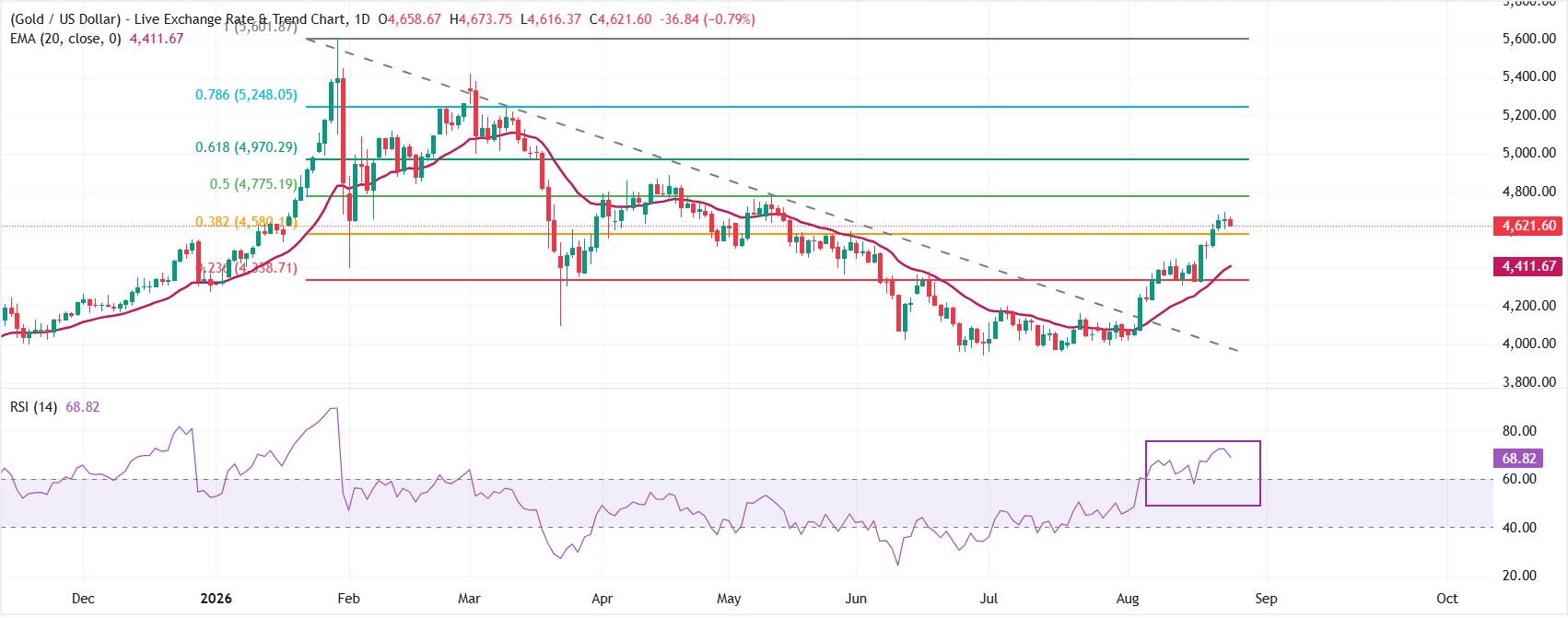
In the daily chart, XAU/USD trades at $4,621.08, maintaining a bullish near-term bias as spot holds well above the 20-period Exponential Moving Average (EMA) at $4,411.62 and the 23.6% Fibonacci retracement at $4,338.71. The metal is also trading just over the 38.2% retracement at $4,580.10, suggesting buyers remain in control after the latest surge, while the Relative Strength Index (RSI) at 68.77 flirts with overbought territory, hinting that upside momentum is strong but increasingly stretched.
On the topside, initial resistance is located at the 50.0% Fibonacci retracement at $4,775.19, followed by the 61.8% level at $4,970.29, with higher hurdles aligning at the 78.6% retracement at $5,248.05 and the cycle high reference at $5,601.87. On the downside, immediate support is seen at the 38.2% retracement at $4,580.10, ahead of the 20-period EMA at $4,411.62, while a deeper pullback would expose the 23.6% Fibonacci retracement at $4,338.71 as the next notable demand area.
(The technical analysis of this story was written with the help of an AI tool. Know more.)
Gold FAQs
Gold has played a key role in human’s history as it has been widely used as a store of value and medium of exchange. Currently, apart from its shine and usage for jewelry, the precious metal is widely seen as a safe-haven asset, meaning that it is considered a good investment during turbulent times. Gold is also widely seen as a hedge against inflation and against depreciating currencies as it doesn’t rely on any specific issuer or government.
Central banks are the biggest Gold holders. In their aim to support their currencies in turbulent times, central banks tend to diversify their reserves and buy Gold to improve the perceived strength of the economy and the currency. High Gold reserves can be a source of trust for a country’s solvency. Central banks added 1,136 tonnes of Gold worth around $70 billion to their reserves in 2022, according to data from the World Gold Council. This is the highest yearly purchase since records began. Central banks from emerging economies such as China, India and Turkey are quickly increasing their Gold reserves.
Gold has an inverse correlation with the US Dollar and US Treasuries, which are both major reserve and safe-haven assets. When the Dollar depreciates, Gold tends to rise, enabling investors and central banks to diversify their assets in turbulent times. Gold is also inversely correlated with risk assets. A rally in the stock market tends to weaken Gold price, while sell-offs in riskier markets tend to favor the precious metal.
The price can move due to a wide range of factors. Geopolitical instability or fears of a deep recession can quickly make Gold price escalate due to its safe-haven status. As a yield-less asset, Gold tends to rise with lower interest rates, while higher cost of money usually weighs down on the yellow metal. Still, most moves depend on how the US Dollar (USD) behaves as the asset is priced in dollars (XAU/USD). A strong Dollar tends to keep the price of Gold controlled, whereas a weaker Dollar is likely to push Gold prices up.
인기 기사
1유로화, 금리 인상 선반영 속 미국 인플레이션이 주도할 한 주 맞아2영국 파운드화, 인플레이션·임금 상승세 둔화에 압박받으며 PMI 발표 주간 진입3다우존스 산업평균지수, AI 관련주 급락 확산에 5거래일 연속 하락4중국 위안화: 미 달러 대비 일시 약세에 당국 통제 조치 나서 - 코메르츠방크5말레이시아 링깃: 반도체 수출 규제와 채권 수익률로 미 달러 대비 약세 압력 – OCBC6중국 위안화: 엄격한 관리 속 점진적 절상 – BNY7연준·호주중앙은행 정책 전망 엇갈리며 호주달러 하방 압력 지속8말레이시아 링깃: 성장세에도 환율은 안정적 박스권 유지 – 코메르츠방크9인도네시아 루피아: BI 조치로 미 달러 대비 낙폭 제한 - OCBC



소셜 미디어












이 웹사이트에 제공된 정보는 일반적인 성격의 정보일 뿐이며 개인 맞춤형 금융 자문을 구성하지 않습니다. 이 웹사이트의 정보를 바탕으로 행동하기 전에, 귀하의 목표, 재정 상황 및 필요에 비추어 해당 정보의 적합성을 고려해야 합니다. CFD 및 FX 마진 계약에 대한 투자는 상당한 위험을 수반하며 모든 투자자에게 적합하지 않을 수 있습니다. 귀하는 최초 예치금보다 더 큰 손실을 입을 수 있습니다. 귀하는 기초자산에 대한 소유권이나 어떠한 이해관계도 보유하지 않습니다. 거래를 시작하기 전에 독립적인 자문을 구하고 관련 위험을 충분히 이해하시기를 권장합니다. 웹사이트에 기재된 상품을 취득하기 전에 공시 문서를 읽고 검토하는 것이 중요합니다. 이 웹사이트에서 제공되는 정보 및 광고는 그러한 사용이 현지 법률 및 규정에 위배되는 국가 또는 관할권의 개인이 사용하도록 의도된 것이 아닙니다. 이 웹사이트에서 제공되는 상품 및 서비스는 미국, 말레이시아 및 태국 거주자를 대상으로 하지 않습니다.
TMGM은 다양한 관할권에서 승인 및 규제를 받고 있습니다.
TMGM으로 거래하는 Trademax Australia Limited는 호주 증권투자위원회(ASIC)의 규제를 받으며, AFSL 번호 436416이고 Level 28, One International Tower, 100 Barangaroo Avenue, 2000 Sydney, NSW Australia에 위치하고 있습니다.
이메일: support@tmgm.com.au
TMGM으로 거래하는 Trademax Global Limited는 바누아투 금융서비스위원회(VFSC)의 승인 및 규제를 받으며, 등록 번호 40356이고 1276, Kumul Highway, Port Vila, Vanuatu, Republic of Vanuatu에 등록되어 있습니다.
이메일: support@tmgm.com
Trademax Global Markets (SE) Limited(이하 TMGM)는 세이셸 금융청(FSA)의 인가 및 규제를 받으며, 허가 번호는 SD224입니다. 회사는 세이셸 마헤, 프로비던스 에스테이트 ABIS 센터, 사무실 번호 13에 등록되어 있습니다.
이메일: support@tmgm.com
TMGM으로 거래하는 Trademax Global Markets (International) Pty Ltd는 모리셔스 금융서비스위원회(FSC)의 승인 및 규제를 받으며 라이선스 번호 GB22201012이고, 33, Edith Cavell Street C/o IQ EQ Fund Services (Mauritius) Ltd Port Louis, 11324 Mauritius에 등록되어 있습니다.
이메일: support@tmgm.com
Copyright © TMGM. All rights reserved