

Сауда
Бәсекеге қабілетті бағалар, жоғары өтімділік және озық сауда құралдары арқылы нарықтардың кең ауқымын зерттеңіз.
Толығырақ 
Платформа
TMGM-нің жылдамдыққа, дәлдікке және жоғары деңгейлі сауда тәжірибесіне арналған қуатты платформасымен сауданы кедергісіз жүргізіңіз.
Толығырақ Сауда платформасы
Академия
Бастауыштарға арналған нұсқаулықтар, вебинарлар және нарық талдаулары сияқты ресурстар арқылы сауданың негіздерін үйреніңіз.
Толығырақ TMGM Академиясы
Жаңалықтар және талдау
Сауда мүмкіндіктерінен алда болу үшін нақты уақыттағы нарық жаңартулары мен сараптамалық талдауды алыңыз
Толығырақ Жаңалықтар және талдау
Туралы
TMGM-ді ерекшелендіретін жайттарды біліңіз — біздің жаһандық ауқымымыз, реттеушілік беріктігіміз және трейдингтегі инновацияларға деген адалдығымыз.
Толығырақ Неліктен TMGM-ді таңдау керек
Gold defies Fed hike bets, tops $4,100 as Oil rout hits the USD
- Gold gains nearly 1% above $4,100 as US Dollar weakness accelerates.
- WTI plunges nearly 6% while December Fed hike odds reach 84%.
- China's central bank adds 25.8 metric tons to Gold reserves ahead of US CPI.
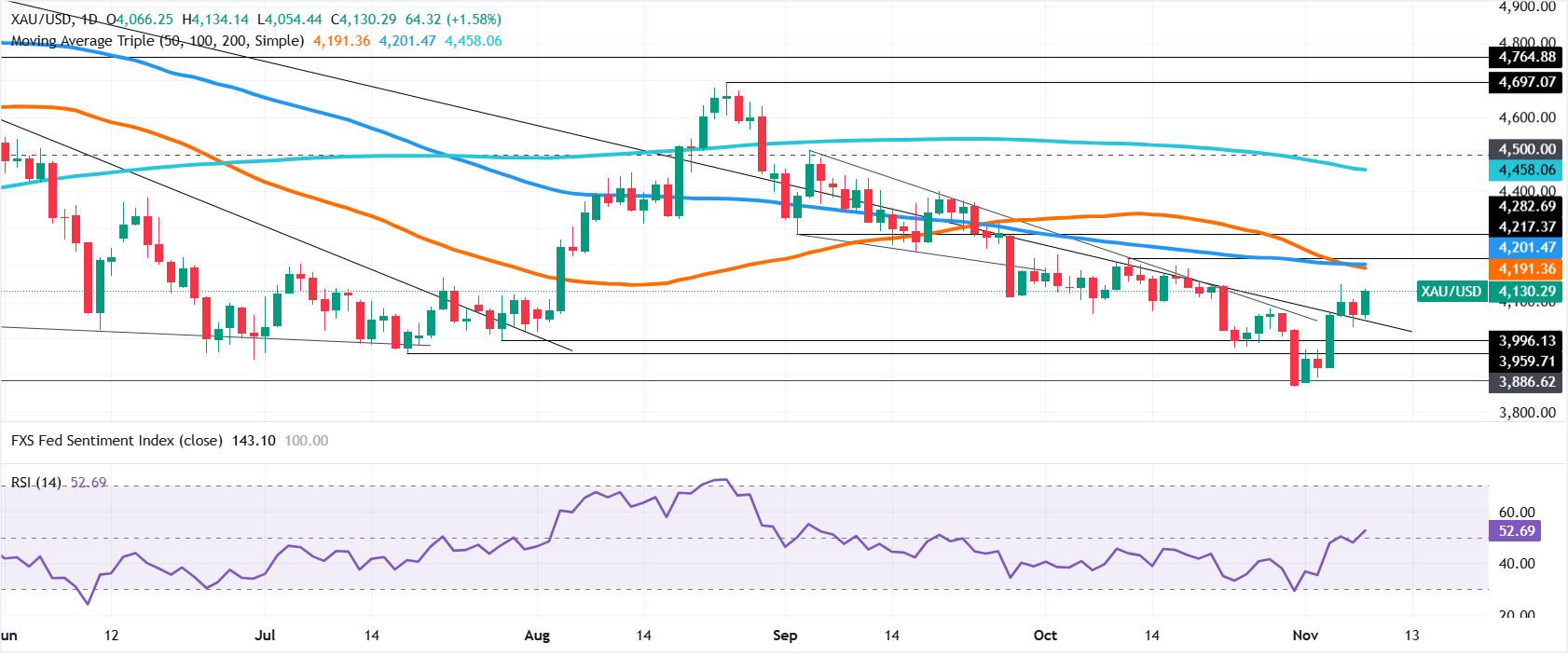
Gold (XAU/USD) price rises over 1.50% above $4,130 on Monday as the Greenback weakens, even though last Friday’s stellar US jobs data triggered a modest hawkish repricing, with markets increasing bets on a Federal Reserve (Fed) rate hike in December.
XAU/USD advances as Oil plummets, weighing on the USD despite rising Fed tightening speculation

US equities are recovering, reflecting a risk-on mood, in part because US President Donald Trump said it's “highly unlikely” he will order further strikes on Iran. Consequently, West Texas Intermediate (WTI), the US Oil benchmark, tumbled nearly 6% to $85.00, dragging the Greenback lower due to its positive correlation.
As of writing, reports emerged that US-Iran nuclear talks had been revived. Al-Arabiya, citing sources, reported that a Qatar-Pakistani proposal would allow Iran to enrich uranium to 3.67%, with Washington reportedly agreeing to the terms and Tehran accepting the proposal.
The US Dollar Index (DXY), which tracks the performance of the buck’s value against its peers, is down 0.46% to 101.81. On the other hand, the US 10-year Treasury yield rises two basis points to 4.889% as traders begin to price in further tightening after last Friday’s jobs report.
Nonfarm Payrolls crushed estimates, pushing the Unemployment Rate down from 4.2% to 4.1%. The CME FedWatch Tool shows that the odds of a December rate increase are 84%, up from last Friday’s 76%.
Due to its non-yielding nature, Gold usually fares badly amid high interest rate scenarios, but remains supported by central bank buying, as the People’s Bank of China (PBoC) added nearly 25.8 metric tons of the precious metal to its reserves in October, its largest monthly purchase in three years, according to the World Gold Council.
Federal Reserve (Fed) officials crossed the wires. Richmond Fed President Thomas Barkin commented that there’s no base case (in rates) for December, adding that the risk lies on the inflation side of the mandate.
Earlier, Chicago Fed President Austan Goolsbee was hawkish, saying that services inflation is beginning to “pick up,” that it has become a “big problem,” and that the Fed has to come to terms with failure on inflation.
Eyes shift to the release of the US Consumer Price Index (CPI) on Tuesday, which is expected to rise from 3.7% to 3.9% YoY in October. Core CPI is forecast to rise from 2.6% to 2.8% YoY.
XAU/USD technical outlook: Gold struggles at $4,100 and retreats
Gold price begins the week on a positive note, but it remains below last Thursday’s high of $4,146. Price action shows a modest jump, but momentum suggests that further consolidation lies ahead, with the Relative Strength Index (RSI) bracing for the 50-neutral level.
For a bullish continuation, XAU/USD must clear the confluence of the 100- and 50-day Simple Moving Averages (SMAs), at $4,191 and $4,201, respectively. Once hurdled, the next stop is the psychological $4,300.
On the downside, sellers must push Gold below $4,100, then $4,000. Once cleared, the next area of interest would be the November 4 daily low at $3,919, followed by the October 30 year-to-date low at $3,879.
Gold FAQs
Gold has played a key role in human’s history as it has been widely used as a store of value and medium of exchange. Currently, apart from its shine and usage for jewelry, the precious metal is widely seen as a safe-haven asset, meaning that it is considered a good investment during turbulent times. Gold is also widely seen as a hedge against inflation and against depreciating currencies as it doesn’t rely on any specific issuer or government.
Central banks are the biggest Gold holders. In their aim to support their currencies in turbulent times, central banks tend to diversify their reserves and buy Gold to improve the perceived strength of the economy and the currency. High Gold reserves can be a source of trust for a country’s solvency. Central banks added 1,136 tonnes of Gold worth around $70 billion to their reserves in 2022, according to data from the World Gold Council. This is the highest yearly purchase since records began. Central banks from emerging economies such as China, India and Turkey are quickly increasing their Gold reserves.
Gold has an inverse correlation with the US Dollar and US Treasuries, which are both major reserve and safe-haven assets. When the Dollar depreciates, Gold tends to rise, enabling investors and central banks to diversify their assets in turbulent times. Gold is also inversely correlated with risk assets. A rally in the stock market tends to weaken Gold price, while sell-offs in riskier markets tend to favor the precious metal.
The price can move due to a wide range of factors. Geopolitical instability or fears of a deep recession can quickly make Gold price escalate due to its safe-haven status. As a yield-less asset, Gold tends to rise with lower interest rates, while higher cost of money usually weighs down on the yellow metal. Still, most moves depend on how the US Dollar (USD) behaves as the asset is priced in dollars (XAU/USD). A strong Dollar tends to keep the price of Gold controlled, whereas a weaker Dollar is likely to push Gold prices up.
Үздік мақалалар
1 Gold defies Fed hike bets, tops $4,100 as Oil rout hits the USD2United States 3-Year Note Auction down to 4.627% from previous 4.932%3Forex Today: US inflation in the limelight4Argentina Industrial Output n.s.a (YoY) increased to -1.8% in September from previous -3.2%5Fed’s Barkin sees rates near neutral, offers no December signal6Canadian Dollar loses ground even as the US Dollar Index falls7Ethereum Price Forecast: ETH drops to $2,100 as community debates Vitalik Buterin's SoV pitch8BoE’s Bailey sees AI boosting UK growth, warns of bubble risks9Australian Dollar firms on broad USD decline as traders focus on US inflation

Бастау!
Тіркеліп, 3 минуттан аз уақытта жаһандық нарықтарға қол жеткізіңіз

Бізбен байланысыңыз









Байланыстар
Телефон: +61 2 8036 8388
Факс: +61 2 8036 8388
Эл. пошта: support@tmgm.com



Осы веб-сайтта берілген ақпарат тек жалпы сипатта ғана ұсынылады және жеке қаржылық кеңес болып табылмайды. Осы веб-сайттағы кез келген ақпаратқа сүйенбес бұрын, оның сіздің мақсаттарыңызға, қаржылық жағдайыңызға және қажеттіліктеріңізге сәйкестігін бағалауыңыз керек. CFD және FX Margin Contracts-қа инвестиция салу елеулі тәуекелдермен байланысты және барлық инвесторлар үшін қолайлы емес. Сіз бастапқы салымыңыздан артық қаражат жоғалтуыңыз мүмкін. Сіз базалық активке ешқандай меншік құқығына немесе үлеске ие болмайсыз. Сауда жасамас бұрын тәуелсіз кеңес алуды және тәуекелдерді толық түсінуді ұсынамыз. Веб-сайтта көрсетілген кез келген өнімді сатып алмас бұрын, ақпараттық құжатты оқып, оны мұқият қарастыру маңызды. Осы веб-сайтта ұсынылған ақпарат пен жарнамалар жергілікті заңдар мен ережелерге қайшы келетін кез келген елде немесе юрисдикцияда тұратын адамдардың пайдалануына арналмаған. Осы веб-сайтта ұсынылатын Өнімдер мен Қызметтер Америка Құрама Штаттары, Малайзия және Таиланд тұрғындарына арналмаған.
TMGM әртүрлі юрисдикцияларда уәкілетті және реттеледі.
Trademax Australia Limited, TMGM атауымен жұмыс істейді, Австралияның Бағалы қағаздар және инвестициялар жөніндегі комиссиясымен (ASIC) реттеледі, AFSL № 436416 және мына мекенжайда орналасқан: Level 28, One International Tower, 100 Barangaroo Avenue, 2000 Sydney, NSW Australia.
Электрондық пошта: support@tmgm.com.au
Trademax Global Limited, TMGM атауымен жұмыс істейді, Вануату Қаржылық қызметтер комиссиясымен (VFSC) уәкілетті және реттеледі, тіркеу нөмірі 40356, тіркелген мекенжайы: 1276, Kumul Highway, Port Vila, Vanuatu, Republic of Vanuatu.
Электрондық пошта: support@tmgm.com
Trademax Global Markets (SE) Limited, TMGM атауымен жұмыс істейді, Сейшел аралдарының Қаржылық қызметтер басқармасы (FSA) тарапынан уәкілетті және реттеледі, лицензия нөмірі SD224. Компания мына мекенжайда тіркелген: Office No 13, Providence Estate ABIS Centre, Mahe, Seychelles.
Электрондық пошта: support@tmgm.com
Trademax Global Markets (International) Pty Ltd, TMGM атауымен жұмыс істейді, Mauritius Қаржылық қызметтер комиссиясымен (FSC) № GB22201012 лицензиясы бойынша уәкілетті және реттеледі, тіркелген мекенжайы: 33, Edith Cavell Street C/o IQ EQ Fund Services (Mauritius) Ltd Port Louis, 11324 Mauritius.
Электрондық пошта: support@tmgm.com
Авторлық құқық © TMGM. Барлық құқықтар қорғалған