

Сауда
Бәсекеге қабілетті бағалар, жоғары өтімділік және озық сауда құралдары арқылы нарықтардың кең ауқымын зерттеңіз.
Толығырақ 
Платформа
TMGM-нің жылдамдыққа, дәлдікке және жоғары деңгейлі сауда тәжірибесіне арналған қуатты платформасымен сауданы кедергісіз жүргізіңіз.
Толығырақ Сауда платформасы
Академия
Бастауыштарға арналған нұсқаулықтар, вебинарлар және нарық талдаулары сияқты ресурстар арқылы сауданың негіздерін үйреніңіз.
Толығырақ TMGM Академиясы
Жаңалықтар және талдау
Сауда мүмкіндіктерінен алда болу үшін нақты уақыттағы нарық жаңартулары мен сараптамалық талдауды алыңыз
Толығырақ Жаңалықтар және талдау
Туралы
TMGM-ді ерекшелендіретін жайттарды біліңіз — біздің жаһандық ауқымымыз, реттеушілік беріктігіміз және трейдингтегі инновацияларға деген адалдығымыз.
Толығырақ Неліктен TMGM-ді таңдау керек
BNB Price Forecast: BNB rebounds above $700 as Binance records net inflows after hack
- BNB gains above $700, building on short-term support provided by the 200-day EMA.
- Binance hourly deposits exceed withdrawals as the exchange recovers from last week’s $6.3 billion hack.
- BNB's technical outlook remains broadly bearish despite the subtle rebound, with momentum indicators still lagging.
BNB (BNB) springs up above $700 on Tuesday, as bulls push to regain momentum following last week’s sell-off. The decline from highs above $760 on Thursday to lows of $680 was largely driven by investor reaction to the security breach on Binance, the largest crypto exchange.

The hack impacted approximately $6.3 billion, the largest in crypto industry history. Binance, in collaboration with blockchain stakeholders, froze roughly $3 billion of the assets believed to have been siphoned by TraderTraitor, a hacker group linked to North Korea.
Binance reports net hourly inflows
Changpeng Zhao, Binance co-founder, popularly known as CZ, stated on X on Tuesday that Binance is experiencing net hourly inflows, with deposits exceeding withdrawals. The report follows the exchange's resumption of withdrawals on Sunday after it contained the security breach.
The exchange reported about $3.64 billion in initial net outflow volume, based on $4.65 billion in withdrawals and $1.01 billion in deposits. This figure represents roughly 2.1% of Binance’s $171 billion total assets under management, according to the Proof of Reserves (PoR) snapshot on Wednesday.
The sustained net hourly inflow volume could suggest that Binance has weathered the storm from the hack and is beginning to rebuild user trust. Binance announced it will cover the hack losses in full, using its internal insurance fund and assets to protect customers.
Meanwhile, retail interest in BNB has taken a back seat over the last few days, as reflected in perpetual futures Open Interest (OI) standing at $1.74 million BNB on Tuesday, down from 1.95 million BNB last Friday. Reduced retail risk-on sentiment could weigh on the token, limiting its recovery potential while raising the odds of an extended sell-off.
Technical analysis: BNB ticks up above key support
BNB trades at $700, holding just above the 200-day Exponential Moving Average (EMA) near $692, which provides immediate trend support, but the token remains capped by the 100-day and 50-day EMAs at $708 and $729, respectively. This setup, along with the SuperTrend line at $766, a weak Relative Strength Index (RSI) around 39 and a negative Moving Average Convergence Divergence (MACD) histogram, suggests a broader bearish bias.
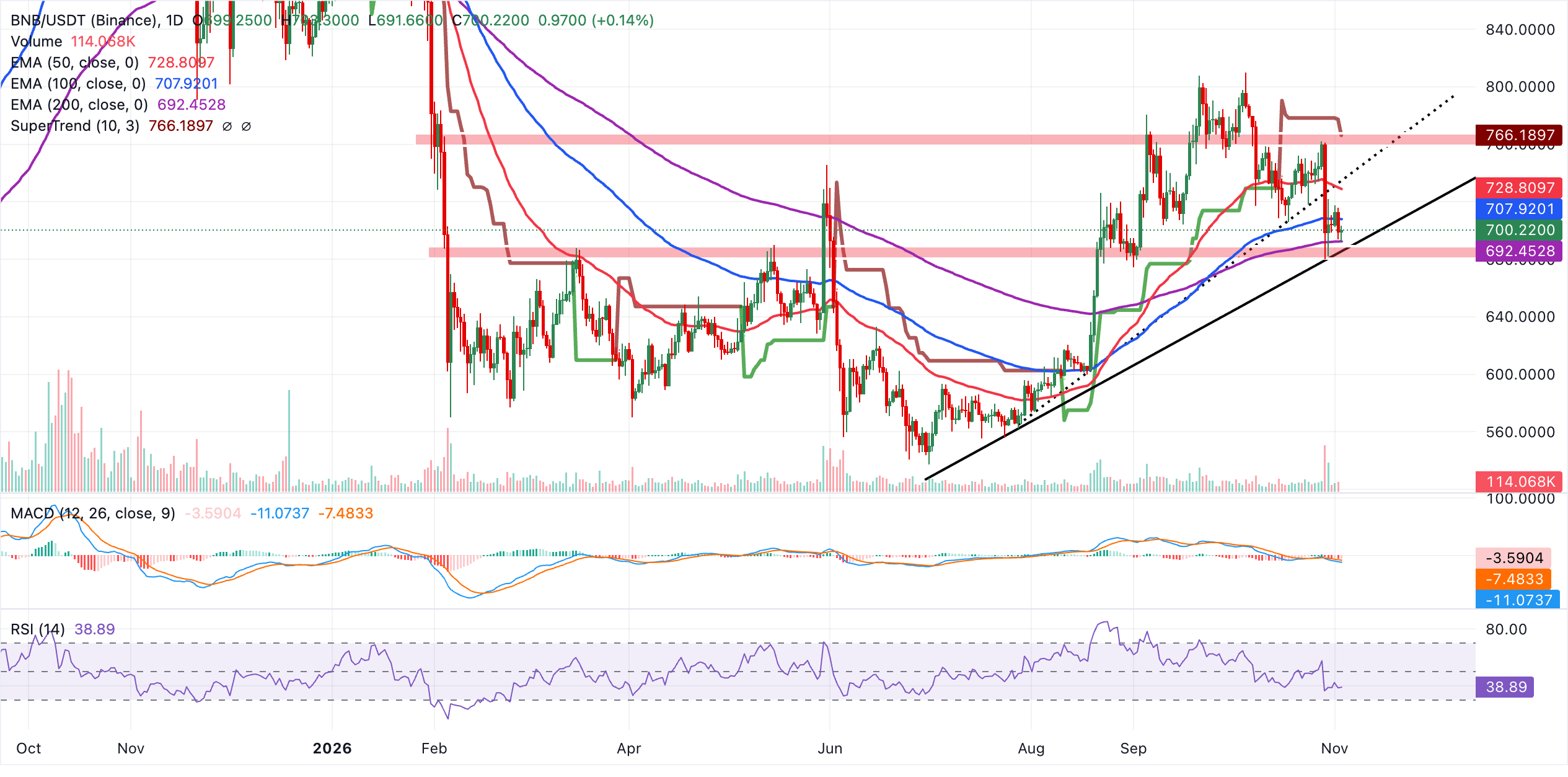
Initial resistance lies at the 100-day EMA around $708, followed by the 50-day EMA near $729. A more significant barrier is the broken rising trendline at $736, before the SuperTrend zone around $766 caps the advance. On the downside, the market finds near-term support at the reclaimed 200-day EMA near $692, with the earlier trendline-break area around $686 acting as a lower defensive level. Failure here would likely reopen room for a deeper pullback within the broader uptrend channel.
(The technical analysis of this story was written with the help of an AI tool. Know more.)
Open Interest, funding rate FAQs
Higher Open Interest is associated with higher liquidity and new capital inflow to the market. This is considered the equivalent of increase in efficiency and the ongoing trend continues. When Open Interest decreases, it is considered a sign of liquidation in the market, investors are leaving and the overall demand for an asset is on a decline, fueling a bearish sentiment among investors.
Funding fees bridge the difference between spot prices and prices of futures contracts of an asset by increasing liquidation risks faced by traders. A consistently high and positive funding rate implies there is a bullish sentiment among market participants and there is an expectation of a price hike. A consistently negative funding rate for an asset implies a bearish sentiment, indicating that traders expect the cryptocurrency’s price to fall and a bearish trend reversal is likely to occur.
Үздік мақалалар
1British Pound is flatlined as US jobs strength, election risks loom2Euro trades flat as US midterms and US-Iran developments keep traders cautious3BNB Price Forecast: BNB rebounds above $700 as Binance records net inflows after hack 4Silver: Price decline seen as excessive - Commerzbank5Brent: Pullback on US-Iran talks – ING6United States: Cost-of-living strains shape midterm risks – BNP Paribas7Gold: Price decline seen as excessive – Commerzbank8Australian Dollar recovers some ground after RBA’s dovish hike9Australian Dollar: Dovish RBA hike yet year-end 0.7100 target – ING

Бастау!
Тіркеліп, 3 минуттан аз уақытта жаһандық нарықтарға қол жеткізіңіз

Бізбен байланысыңыз









Байланыстар
Телефон: +61 2 8036 8388
Факс: +61 2 8036 8388
Эл. пошта: support@tmgm.com



Осы веб-сайтта берілген ақпарат тек жалпы сипатта ғана ұсынылады және жеке қаржылық кеңес болып табылмайды. Осы веб-сайттағы кез келген ақпаратқа сүйенбес бұрын, оның сіздің мақсаттарыңызға, қаржылық жағдайыңызға және қажеттіліктеріңізге сәйкестігін бағалауыңыз керек. CFD және FX Margin Contracts-қа инвестиция салу елеулі тәуекелдермен байланысты және барлық инвесторлар үшін қолайлы емес. Сіз бастапқы салымыңыздан артық қаражат жоғалтуыңыз мүмкін. Сіз базалық активке ешқандай меншік құқығына немесе үлеске ие болмайсыз. Сауда жасамас бұрын тәуелсіз кеңес алуды және тәуекелдерді толық түсінуді ұсынамыз. Веб-сайтта көрсетілген кез келген өнімді сатып алмас бұрын, ақпараттық құжатты оқып, оны мұқият қарастыру маңызды. Осы веб-сайтта ұсынылған ақпарат пен жарнамалар жергілікті заңдар мен ережелерге қайшы келетін кез келген елде немесе юрисдикцияда тұратын адамдардың пайдалануына арналмаған. Осы веб-сайтта ұсынылатын Өнімдер мен Қызметтер Америка Құрама Штаттары, Малайзия және Таиланд тұрғындарына арналмаған.
TMGM әртүрлі юрисдикцияларда уәкілетті және реттеледі.
Trademax Australia Limited, TMGM атауымен жұмыс істейді, Австралияның Бағалы қағаздар және инвестициялар жөніндегі комиссиясымен (ASIC) реттеледі, AFSL № 436416 және мына мекенжайда орналасқан: Level 28, One International Tower, 100 Barangaroo Avenue, 2000 Sydney, NSW Australia.
Электрондық пошта: support@tmgm.com.au
Trademax Global Limited, TMGM атауымен жұмыс істейді, Вануату Қаржылық қызметтер комиссиясымен (VFSC) уәкілетті және реттеледі, тіркеу нөмірі 40356, тіркелген мекенжайы: 1276, Kumul Highway, Port Vila, Vanuatu, Republic of Vanuatu.
Электрондық пошта: support@tmgm.com
Trademax Global Markets (SE) Limited, TMGM атауымен жұмыс істейді, Сейшел аралдарының Қаржылық қызметтер басқармасы (FSA) тарапынан уәкілетті және реттеледі, лицензия нөмірі SD224. Компания мына мекенжайда тіркелген: Office No 13, Providence Estate ABIS Centre, Mahe, Seychelles.
Электрондық пошта: support@tmgm.com
Trademax Global Markets (International) Pty Ltd, TMGM атауымен жұмыс істейді, Mauritius Қаржылық қызметтер комиссиясымен (FSC) № GB22201012 лицензиясы бойынша уәкілетті және реттеледі, тіркелген мекенжайы: 33, Edith Cavell Street C/o IQ EQ Fund Services (Mauritius) Ltd Port Louis, 11324 Mauritius.
Электрондық пошта: support@tmgm.com
Авторлық құқық © TMGM. Барлық құқықтар қорғалған