

Gold shrugs off Fed hike as falling yields reopen path to $4,400
- Gold clears the 100-day SMA as falling yields revive demand.
- Fed hike fails to derail bullion as October odds for another rate raise stay elevated.
- Oil pullback eases inflation pressure, helping XAU/USD target $4,400.
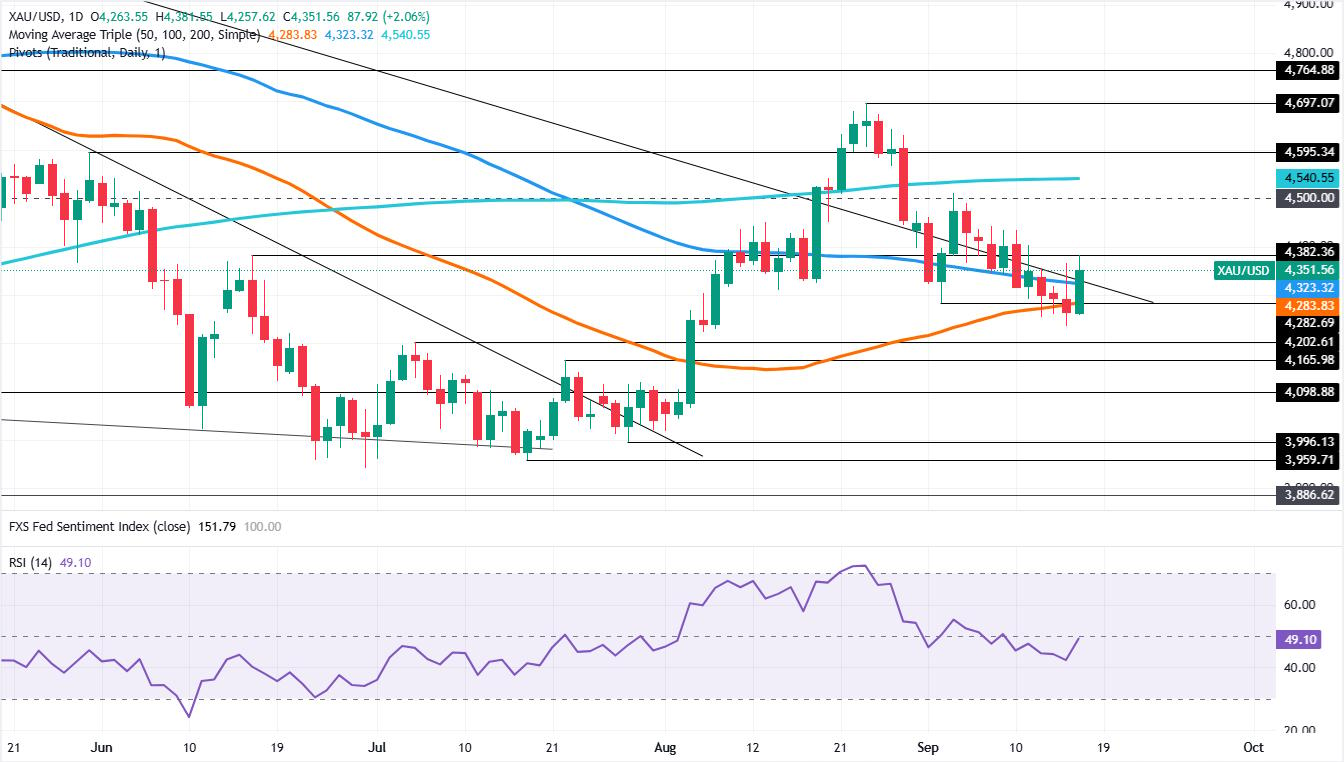
Gold (XAU/USD) rallies on Thursday, up by more than 2% as investors digest the latest rate hike by the Federal Reserve (Fed), while a fall in Oil prices pushed the US Dollar and US yields lower. The XAU/USD pair trades at $4,361, clearing a key technical resistance level at the 100-day Simple Moving Average (SMA) of $4,320, as buyers set their sights on $4,400.

XAU/USD clears key resistance as lower yields overpower Fed’s hawkish message
A potential de-escalation of the Middle East conflict underpins the non-yielding metal, benefiting from lower Oil prices. West Texas Intermediate (WTI), the US crude benchmark, is down by about 0.16%, undermining the Greenback given its positive correlation.
The US Dollar Index (DXY), which measures the buck’s performance against six currencies, is down 0.12% at 100.22. At the same time, US Treasury yields erased some of Wednesday’s hawkish Fed-tilt, down 7 basis points to 4.949%.
A day ago, the Federal Reserve raised rates as expected, 25 basis points to the 3.75%-4% range, the first in three years, opening the door for further tightening as the US central bank recognises that the economy remains growing strongly.
Fed Chair Kevin Warsh said that “the fact is that inflation is too high and has been for too long.” The Fed dot plot, in which officials express their expectations for the path of interest rates, shows the Fed funds rate hovering around 4.10% at the end of 2026, suggesting another rate increase is expected in the foreseeable future. This is in line with their inflation expectations, as the Personal Consumption Expenditures (PCE) price index is expected to remain at 3.7% this year and converge toward the Fed’s 2% goal through 2028.
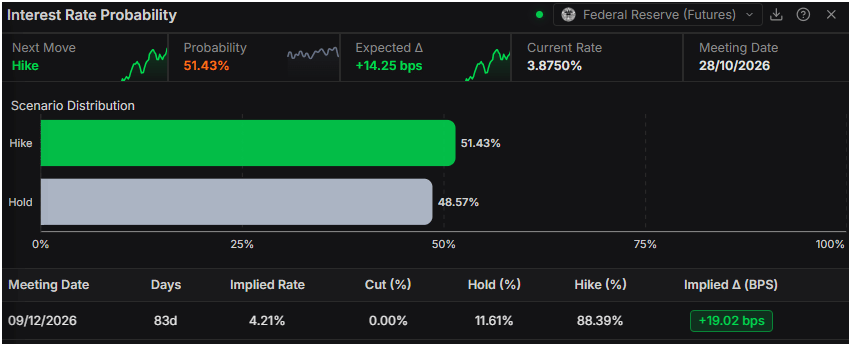
Money markets have priced in a 53% chance of another rate hike at the October meeting, according to Prime Terminal.
Regarding data, the US economic report showed that jobless claims for the week ending September 12 fell significantly from 206K to 196K, below the expected 208K.
On Friday, the US economic schedule will feature the Fed’s August Industrial Production report and a speech by Fed Governor Michelle Bowman.
XAU/USD technical analysis: Gold may challenge $4,400 on a close above $4,367
Price action in the short-term is poised for a recovery as a ‘bullish engulfing‘ candle pattern develops. If Gold closes above the September 16 high of $4,366, this could confirm a bullish recovery, but buyers must push prices above $4,500.
The Relative Strength Index (RSI) is trending higher but remains below its 50 neutral level, indicating neither buyers nor sellers are in control. However, if it clears 50 , further upside in Gold is expected.
XAU's first resistance is $4,400, followed by the psychological levels of $4,450 and $4,500. Once cleared, the next area of interest is the 200-day SMA at $4,540.
On the downside, Gold could register another leg lower if it drops below the 100-day SMA at $4,323, then the $4,300 mark. If achieved, the non-yielding metal will fall further, with the next support level the 50-day SMA at $4,283, followed by the July 6 high-turned support at $4,202.
Gold FAQs
Gold has played a key role in human’s history as it has been widely used as a store of value and medium of exchange. Currently, apart from its shine and usage for jewelry, the precious metal is widely seen as a safe-haven asset, meaning that it is considered a good investment during turbulent times. Gold is also widely seen as a hedge against inflation and against depreciating currencies as it doesn’t rely on any specific issuer or government.
Central banks are the biggest Gold holders. In their aim to support their currencies in turbulent times, central banks tend to diversify their reserves and buy Gold to improve the perceived strength of the economy and the currency. High Gold reserves can be a source of trust for a country’s solvency. Central banks added 1,136 tonnes of Gold worth around $70 billion to their reserves in 2022, according to data from the World Gold Council. This is the highest yearly purchase since records began. Central banks from emerging economies such as China, India and Turkey are quickly increasing their Gold reserves.
Gold has an inverse correlation with the US Dollar and US Treasuries, which are both major reserve and safe-haven assets. When the Dollar depreciates, Gold tends to rise, enabling investors and central banks to diversify their assets in turbulent times. Gold is also inversely correlated with risk assets. A rally in the stock market tends to weaken Gold price, while sell-offs in riskier markets tend to favor the precious metal.
The price can move due to a wide range of factors. Geopolitical instability or fears of a deep recession can quickly make Gold price escalate due to its safe-haven status. As a yield-less asset, Gold tends to rise with lower interest rates, while higher cost of money usually weighs down on the yellow metal. Still, most moves depend on how the US Dollar (USD) behaves as the asset is priced in dollars (XAU/USD). A strong Dollar tends to keep the price of Gold controlled, whereas a weaker Dollar is likely to push Gold prices up.














