

Trading
Explora una amplia gama de mercados con precios competitivos, liquidez profunda y herramientas de trading avanzadas.
Más información 
Plataforma
Opera sin interrupciones con la potente plataforma de TMGM, diseñada para ofrecer velocidad, precisión y una experiencia de trading superior.
Más información Plataforma de trading
Herramientas de trading
Academia
Aprende los fundamentos del trading con recursos ideales para principiantes, incluidas guías, seminarios web y análisis del mercado.
Más información Academia TMGM
Noticias y análisis
Obtén actualizaciones del mercado en tiempo real y análisis de expertos para adelantarte a las oportunidades de trading
Más información Noticias y análisis
Acerca de
Descubre qué distingue a TMGM: nuestra presencia global, solidez regulatoria y compromiso con la innovación en el trading.
Más información Por qué elegir TMGM
Loonie gives back part of its rally on soft Canadian inflation
- USD/CAD bounces off its lowest since September 23 as Canadian inflation misses.
- Core inflation eases to 2.2%, and gasoline is up 27.8% from a year earlier.
- Canadian retail sales are due Friday, the last release before the BoC meets.
Canadian inflation came in under forecast, and USD/CAD rose off its lowest level since September 23 on the release, though it's still on track for a third straight loss. The low just above 1.4050 came in the bars before the numbers, and the price went back above 1.4100 in the release bar. It has slipped back under 1.4100 since, with Friday's last trade just under 1.4150.

Headline inflation rose to 3.1% in September against a 3.2% forecast, with gasoline up 27.8% from a year earlier. The Bank of Canada (BoC) core measure eased to 2.2% from 2.4%, and core prices were flat on the month. Analysts read the flat core month as a reason to keep the BoC's 2.25%, unchanged all year, below the Fed's 3.75%-4.00% on October 28.
BoC surveys published after the release showed consumers' five-year inflation expectations up to 3.91% from 3.39%, and firms' expectations climbed after Canada-US trade talks failed. Scotiabank and Bank of Montreal then both called for a quarter-point hike on October 28, which would cut the gap to the Fed by the same amount. The BoC published two business surveys on the same day, and sentiment rose in the one taken mostly before the talks collapsed.
On the calendar
Canada's August retail sales are due at 12:30 GMT on Friday, forecast up 1.3% after a 0.7% fall, with sales excluding autos forecast up 1% after the same fall. It's the last Canadian release before the BoC's October 28 decision.
Fed officials are in their quiet period before the October 27-28 meeting, where futures put a hike near 15% and one by December near 89%. US weekly jobless claims are due at 12:30 GMT on Thursday, forecast at 200K after 199K. The S&P Global flash Purchasing Managers Index (PMI) surveys follow at 13:45 GMT on Friday, with services forecast at 57.9 after 58.8.
On the charts
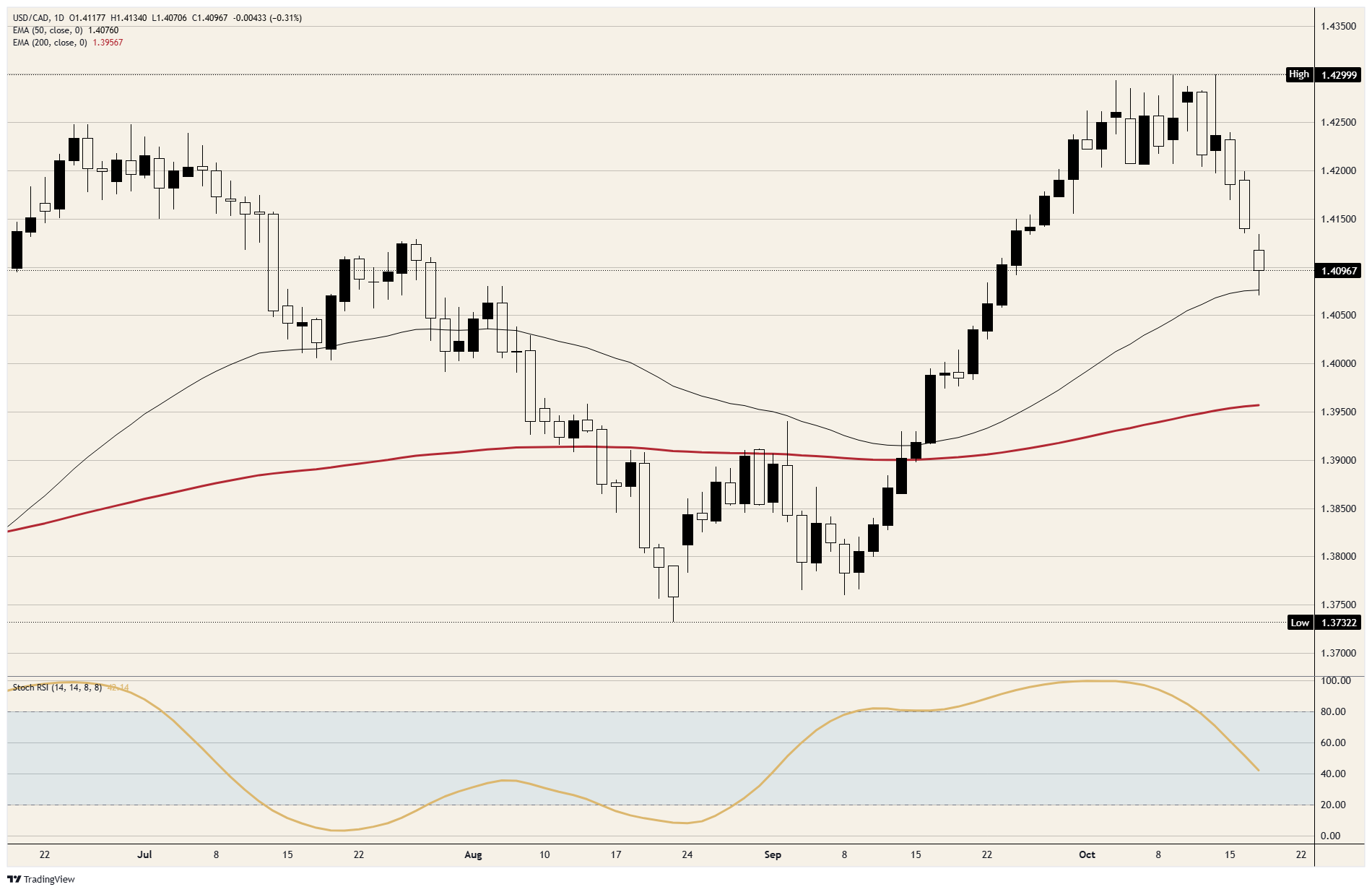
USD/CAD went just under its 50-day Exponential Moving Average (EMA) at the session low, its first trade below the average since mid-September. The slide from the two highs near 1.4300 on October 9 and October 14 has given back about two-fifths of the climb from the September 8 low near 1.3750.
USD/CAD daily chart
Canadian Dollar FAQs
The key factors driving the Canadian Dollar (CAD) are the level of interest rates set by the Bank of Canada (BoC), the price of Oil, Canada’s largest export, the health of its economy, inflation and the Trade Balance, which is the difference between the value of Canada’s exports versus its imports. Other factors include market sentiment – whether investors are taking on more risky assets (risk-on) or seeking safe-havens (risk-off) – with risk-on being CAD-positive. As its largest trading partner, the health of the US economy is also a key factor influencing the Canadian Dollar.
The Bank of Canada (BoC) has a significant influence on the Canadian Dollar by setting the level of interest rates that banks can lend to one another. This influences the level of interest rates for everyone. The main goal of the BoC is to maintain inflation at 1-3% by adjusting interest rates up or down. Relatively higher interest rates tend to be positive for the CAD. The Bank of Canada can also use quantitative easing and tightening to influence credit conditions, with the former CAD-negative and the latter CAD-positive.
The price of Oil is a key factor impacting the value of the Canadian Dollar. Petroleum is Canada’s biggest export, so Oil price tends to have an immediate impact on the CAD value. Generally, if Oil price rises CAD also goes up, as aggregate demand for the currency increases. The opposite is the case if the price of Oil falls. Higher Oil prices also tend to result in a greater likelihood of a positive Trade Balance, which is also supportive of the CAD.
While inflation had always traditionally been thought of as a negative factor for a currency since it lowers the value of money, the opposite has actually been the case in modern times with the relaxation of cross-border capital controls. Higher inflation tends to lead central banks to put up interest rates which attracts more capital inflows from global investors seeking a lucrative place to keep their money. This increases demand for the local currency, which in Canada’s case is the Canadian Dollar.
Macroeconomic data releases gauge the health of the economy and can have an impact on the Canadian Dollar. Indicators such as GDP, Manufacturing and Services PMIs, employment, and consumer sentiment surveys can all influence the direction of the CAD. A strong economy is good for the Canadian Dollar. Not only does it attract more foreign investment but it may encourage the Bank of Canada to put up interest rates, leading to a stronger currency. If economic data is weak, however, the CAD is likely to fall.
Artículos destacados
1Forex Today: UK jobs data in the limelight2New Zealand Dollar gains as traders await third-quarter inflation data3Crude Oil turns higher on unconfirmed reports of US strikes on Iran4British Pound: Weekly reversal targets range highs against US Dollar – Scotiabank5Silver advances above $57 despite Fed rate-hike bets, firmer US Dollar6Loonie gives back part of its rally on soft Canadian inflation7Canadian Dollar: Inflation risks and rate path – RBC8US Dollar: Recovery prospects with data-driven support – BBH9Crude Oil slips from a one-month high on Trump's Russia waiver
COTIZACIONES EN VIVO


TODO SOBRE FOREX
Margin Call Meaning: What It Is, What Triggers It and How to Avoid One
Top 15 Weakest Currencies in the World
Top 15 Strongest Currencies in the World
Is Forex Trading Halal?
Best Time to Trade Forex
Forex Trading vs Futures Trading
Forex Trading vs Stock Trading
Forex Trading vs Crypto Trading
Is Forex Trading Profitable In 2026?
¡Comience ahora!
Regístrese y acceda a los mercados globales en menos de 3 minutos

Conéctese con nosotros









Contactos
Teléfono: +61 2 8036 8388
Fax: +61 2 8036 8388
Correo electrónico: support@tmgm.com



La información proporcionada en este sitio web es únicamente de carácter general y no constituye asesoramiento financiero personal. Antes de actuar sobre cualquier información de este sitio web, debe considerar la idoneidad de la información en relación con sus objetivos, situación financiera y necesidades. Invertir en CFD y contratos de margen de FX conlleva riesgos significativos y no es adecuado para todos los inversores. Puede perder más que su depósito inicial. Usted no posee ni tiene ningún interés en el activo subyacente. Le recomendamos que busque asesoramiento independiente y se asegure de comprender plenamente los riesgos involucrados antes de operar. Es importante que lea y considere el documento de divulgación antes de adquirir cualquier producto listado en el sitio web. La información y los anuncios ofrecidos en este sitio web no están destinados al uso por parte de ninguna persona en ningún país o jurisdicción donde dicho uso sea contrario a las leyes y regulaciones locales. Los productos y servicios ofrecidos en este sitio web no están destinados a residentes de Estados Unidos, Malasia y Tailandia.
TMGM está autorizado y regulado en varias jurisdicciones.
Trademax Australia Limited, que opera como TMGM, está regulada por la Comisión Australiana de Valores e Inversiones (ASIC), AFSL n.º 436416, y está ubicada en Level 28, One International Tower, 100 Barangaroo Avenue, 2000 Sydney, NSW Australia.
Correo electrónico: support@tmgm.com.au
Trademax Global Limited, que opera como TMGM, está autorizada y regulada por la Comisión de Servicios Financieros de Vanuatu (VFSC), número de registro 40356, y está registrada en 1276, Kumul Highway, Port Vila, Vanuatu, República de Vanuatu.
Correo electrónico: support@tmgm.com
Trademax Global Markets (SE) Limited, que opera como TMGM, está autorizada y regulada por la Autoridad de Servicios Financieros (FSA) de Seychelles, con número de licencia SD224. La empresa está registrada en Office No 13, Providence Estate ABIS Centre, Mahe, Seychelles.
Correo electrónico: support@tmgm.com
Trademax Global Markets (International) Pty Ltd, que opera como TMGM, está autorizada y regulada por la Comisión de Servicios Financieros de Mauricio (FSC) con licencia n.º GB22201012, y está registrada en 33, Edith Cavell Street C/o IQ EQ Fund Services (Mauritius) Ltd Port Louis, 11324 Mauricio.
Correo electrónico: support@tmgm.com
Copyright © TMGM. Todos los derechos reservados