

Trading
Explora una amplia gama de mercados con precios competitivos, liquidez profunda y herramientas de trading avanzadas.
Más información 
Plataforma
Opera sin interrupciones con la potente plataforma de TMGM, diseñada para ofrecer velocidad, precisión y una experiencia de trading superior.
Más información Plataforma de trading
Herramientas de trading
Academia
Aprende los fundamentos del trading con recursos ideales para principiantes, incluidas guías, seminarios web y análisis del mercado.
Más información Academia TMGM
Noticias y análisis
Obtén actualizaciones del mercado en tiempo real y análisis de expertos para adelantarte a las oportunidades de trading
Más información Noticias y análisis
Acerca de
Descubre qué distingue a TMGM: nuestra presencia global, solidez regulatoria y compromiso con la innovación en el trading.
Más información Por qué elegir TMGM
Gold Price Forecast: XAU/USD extends gains nearing $4,200 as US Dollar struggles
- XAU/USD rallies for the second consecutive day and reaches session highs above $4,190.
- The US Dollar remains on the defensive amid dovish comments from Fed officials and lower US Treasury yields.
- Fed Chair Kevin Warsh praised the economic resilience at the IMF forum but failed to provide any monetary policy guidance.
Gold (XAU/USD) heads north for the second consecutive day on Friday, trading near $4,180, with bulls aiming for the $4,230 area, the top of October’s trading range. Precious metals have been boosted by lower US Treasury yields and dovish comments from Federal Reserve (Fed) officials this week, which have undermined speculative support for the Greenback.

US data released on Thursday showed that September's Producer Price Index (PPI) accelerated beyond expectations in September, following an overshoot consumer inflation report in the previous day. Also on Thursday, retail consumption showed a surprising resilience in the face of escalating prices.
The data, however, failed to lift the US Dollar as market expectations of a Fed interest rate hike in October remain low. A string of Fed officials suggested that the bank will stand pat at its next meeting, awaiting more insight into the economic impact of September’s interest rate hike.
The Federal Reserve Chairman, Kevin Warsh, spoke at the International Monetary Fund (IMF) forum in Bangkok earlier on Friday. Warsh praised the resilience of the US economy and reaffirmed the central bank’s commitment to fight inflation, but failed to provide any fresh hints about the bank’s near-term path.
Technical Analysis: Key resistance at the $4,230 area comes into focus
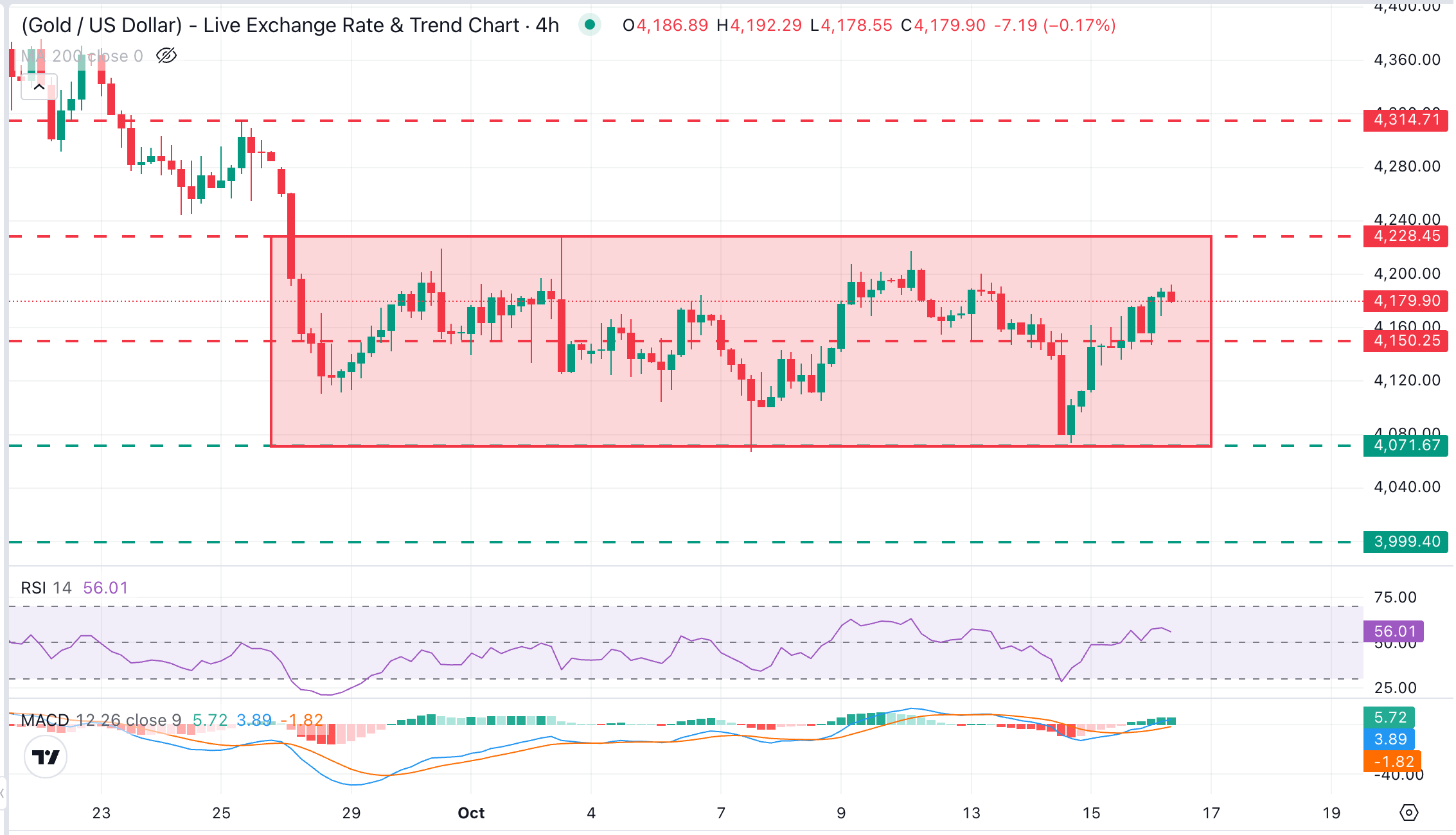
XAU/USD trades at $4,179, maintaining a bullish near-term bias with bulls aiming for the top of the last three weeks' horizontal range, in the $4,230 area. The 4-hour Relative Strength Index (14) is hovering in positive territory near 57, and the Moving Average Convergence Divergence (MACD) remains firmly above zero, hinting at moderate upside pressure.
Gold might find resistance at the $4,200 round area, ahead of the key $4,230 (October 2 high). A successful break of this level confirms a bullish reversal, aiming for the September 25 high at $4,315.
On the downside, initial support is at the intraday low near $4,150 ahead of the range bottom of $4,070. A bearish reaction below here negates the bullish view and increases pressure towards the late July, early August lows around the $4,000 psychological area.
(The technical analysis of this story was written with the help of an AI tool. Know more.)
Gold FAQs
Gold has played a key role in human’s history as it has been widely used as a store of value and medium of exchange. Currently, apart from its shine and usage for jewelry, the precious metal is widely seen as a safe-haven asset, meaning that it is considered a good investment during turbulent times. Gold is also widely seen as a hedge against inflation and against depreciating currencies as it doesn’t rely on any specific issuer or government.
Central banks are the biggest Gold holders. In their aim to support their currencies in turbulent times, central banks tend to diversify their reserves and buy Gold to improve the perceived strength of the economy and the currency. High Gold reserves can be a source of trust for a country’s solvency. Central banks added 1,136 tonnes of Gold worth around $70 billion to their reserves in 2022, according to data from the World Gold Council. This is the highest yearly purchase since records began. Central banks from emerging economies such as China, India and Turkey are quickly increasing their Gold reserves.
Gold has an inverse correlation with the US Dollar and US Treasuries, which are both major reserve and safe-haven assets. When the Dollar depreciates, Gold tends to rise, enabling investors and central banks to diversify their assets in turbulent times. Gold is also inversely correlated with risk assets. A rally in the stock market tends to weaken Gold price, while sell-offs in riskier markets tend to favor the precious metal.
The price can move due to a wide range of factors. Geopolitical instability or fears of a deep recession can quickly make Gold price escalate due to its safe-haven status. As a yield-less asset, Gold tends to rise with lower interest rates, while higher cost of money usually weighs down on the yellow metal. Still, most moves depend on how the US Dollar (USD) behaves as the asset is priced in dollars (XAU/USD). A strong Dollar tends to keep the price of Gold controlled, whereas a weaker Dollar is likely to push Gold prices up.
Artículos destacados
1Crypto Today: Bitcoin, Ethereum and XRP pare losses amid fading institutional support2Indian Rupee: Policy support and yield reversal – Societe Generale3New Zealand Dollar: Inflation and weak demand challenge RBNZ – Commerzbank4Gold Price Forecast: XAU/USD extends gains nearing $4,200 as US Dollar struggles 5Silver price today: Silver rises, according to FXStreet data6US Dollar: AI-driven vulnerabilities surface – OCBC7Euro recovers further against US Dollar amid AI sell-off narrative8British Pound: Resilient but BoE pricing stretched – MUFG9USD/CHF Price Forecast: Looks to defend 0.8230 confluence as USD selling remains unabated
COTIZACIONES EN VIVO

TODO SOBRE GOLD & PRECIOUS METALS
6 Best Indicators for Gold Trading
Short-Term Gold Trading: How It Works, Strategies, How to Start
Gold Trading Leverage: How It Works, Pros and Cons, Risk Management
Gold Trading Signals: How They Work, Why Use Them, Where to Find
How to Trade Gold (XAUUSD) in Forex
Gold (XAUUSD) Trading Hours: Best Time to Trade Gold
How to Trade Gold
Why Invest in Gold CFD? A Beginner’s Guide to Smart Investing
7 Ways to Invest in Gold
¡Comience ahora!
Regístrese y acceda a los mercados globales en menos de 3 minutos

Conéctese con nosotros









Contactos
Teléfono: +61 2 8036 8388
Fax: +61 2 8036 8388
Correo electrónico: support@tmgm.com



La información proporcionada en este sitio web es únicamente de carácter general y no constituye asesoramiento financiero personal. Antes de actuar sobre cualquier información de este sitio web, debe considerar la idoneidad de la información en relación con sus objetivos, situación financiera y necesidades. Invertir en CFD y contratos de margen de FX conlleva riesgos significativos y no es adecuado para todos los inversores. Puede perder más que su depósito inicial. Usted no posee ni tiene ningún interés en el activo subyacente. Le recomendamos que busque asesoramiento independiente y se asegure de comprender plenamente los riesgos involucrados antes de operar. Es importante que lea y considere el documento de divulgación antes de adquirir cualquier producto listado en el sitio web. La información y los anuncios ofrecidos en este sitio web no están destinados al uso por parte de ninguna persona en ningún país o jurisdicción donde dicho uso sea contrario a las leyes y regulaciones locales. Los productos y servicios ofrecidos en este sitio web no están destinados a residentes de Estados Unidos, Malasia y Tailandia.
TMGM está autorizado y regulado en varias jurisdicciones.
Trademax Australia Limited, que opera como TMGM, está regulada por la Comisión Australiana de Valores e Inversiones (ASIC), AFSL n.º 436416, y está ubicada en Level 28, One International Tower, 100 Barangaroo Avenue, 2000 Sydney, NSW Australia.
Correo electrónico: support@tmgm.com.au
Trademax Global Limited, que opera como TMGM, está autorizada y regulada por la Comisión de Servicios Financieros de Vanuatu (VFSC), número de registro 40356, y está registrada en 1276, Kumul Highway, Port Vila, Vanuatu, República de Vanuatu.
Correo electrónico: support@tmgm.com
Trademax Global Markets (SE) Limited, que opera como TMGM, está autorizada y regulada por la Autoridad de Servicios Financieros (FSA) de Seychelles, con número de licencia SD224. La empresa está registrada en Office No 13, Providence Estate ABIS Centre, Mahe, Seychelles.
Correo electrónico: support@tmgm.com
Trademax Global Markets (International) Pty Ltd, que opera como TMGM, está autorizada y regulada por la Comisión de Servicios Financieros de Mauricio (FSC) con licencia n.º GB22201012, y está registrada en 33, Edith Cavell Street C/o IQ EQ Fund Services (Mauritius) Ltd Port Louis, 11324 Mauricio.
Correo electrónico: support@tmgm.com
Copyright © TMGM. Todos los derechos reservados