

Trading
Explore a wide range of markets with competitive pricing, deep liquidity, and advanced trading tools.
Learn More 
Platform
Trade seamlessly with TMGM's powerful platform, built for speed, precision, and a superior trading experience.
Learn More Trading Platform
Academy
Learn the fundamentals of trading with beginner-friendly resources, including guides, webinars, and market insights.
Learn More News & Analysis
Get real-time market updates and expert analysis to stay ahead of trading opportunities
Learn More News & Analysis
About
Learn what sets TMGM apart — our global presence, regulatory strength, and commitment to innovation in trading.
Learn More Why Choose TMGM
Sponsorship
November BoE interest rate hike: UK CPI poised to accelerate, setting the stage
- 3.4% YoY is the forecast for September UK CPI. That would mark an acceleration from August’s 3.1% and the highest reading since December last year.
- As elevated energy costs feed into the wider economy, core inflation is also expected to pick up.
- For the BoE, the data could supply the decisive case for monetary tightening at its November meeting.
06:00 GMT on Wednesday is the expected release time for September’s Consumer Price Index (CPI). The United Kingdom (UK) Office for National Statistics (ONS) is due to publish the figures alongside the Producer Price Index (PPI) and Retail Sales report.

Investors are expected to scrutinise the consumer inflation data for clues to the Bank of England’s (BoE) next monetary policy decision. Governor Andrew Bailey and other BoE officials have signalled that interest rates need to rise to contain inflation, but have offered little clarity on when they will act. A UK inflation reading in line with market forecasts could reinforce expectations of a November rate increase, boosting speculative demand for the British Pound (GBP).
3.4% UK CPI Forecast Puts September Inflation in Focus
A 0.3% monthly rise in consumer prices is the consensus forecast for September, compared with August’s 0.5% increase. On a year-on-year basis, however, inflation is expected to climb from the previous month’s 3.1% to 3.4%.
Excluding volatile energy, food, alcohol and tobacco prices, core inflation is forecast to accelerate at a more measured pace. The projected rise in September’s Core CPI to 2.8%, from 2.6% in August, would provide further evidence that the energy shock caused by the Middle East conflict is filtering through the wider economy.
Since July, crude prices have gained nearly 50%, including an increase of more than 10% so far in October. At the time of writing, Brent Oil is trading above $108.00 a barrel, its highest level in five months. With regional powers becoming increasingly entangled in the conflict, a return to pre-war prices appears unlikely in the near term. This points to sustained inflationary pressure and a risk that central banks could fall behind the curve unless they respond swiftly.
The Bank of England remains among the few major central banks that have yet to tighten monetary policy in 2026. Calls for a rate increase have come from some BoE officials. At last week’s International Monetary Fund (IMF) summit in Bangkok, Governor Bailey voiced frustration over inflation remaining above target. His comments strengthened investors’ confidence that some tightening would come before year-end.
UK economic releases have recently reinforced that assessment. Tuesday’s ILO Unemployment Rate indicated that the labour market remained resilient, even as vacancies fell and claimant numbers rose more than expected. Last week’s monthly Gross Domestic Product (GDP) report also surprised positively: output unexpectedly expanded in August, supported by a strong industrial sector. Together, these developments create favourable conditions for a quarter-point rate increase at next month’s meeting.
GBP/USD: UK CPI Sets the Next Test for Sterling
Among major currencies, the British Pound ranks as one of this week’s strongest performers. Encouraging UK releases have bolstered confidence in the economic outlook. They have also reduced concerns over the cost of tax-relief measures pledged by Prime Minister Andy Burnham’s cabinet.
In their assessment of the recent economic releases, Commerzbank analysts say the data “gives the Bank of England room to raise rates without running the risk of putting additional pressure on an already weakening economy (...) Also takes some pressure off the Chancellor, who remains committed to reducing the budget deficit.”
In a note, Commerzbank says: “How this can be achieved while at the same time providing relief to households and businesses facing high energy costs should become clearer when the budget is presented at the end of the month,”
With those concerns having receded for now, robust UK figures and growing expectations that the BoE will finally raise rates in November continue to drive the Pound this week. The US Dollar, by contrast, remains weak as investors scale back wagers on consecutive Federal Reserve (Fed) rate increases. The Euro is also under pressure as protests in Paris turn violent, prompting the government to introduce curfews across several cities.
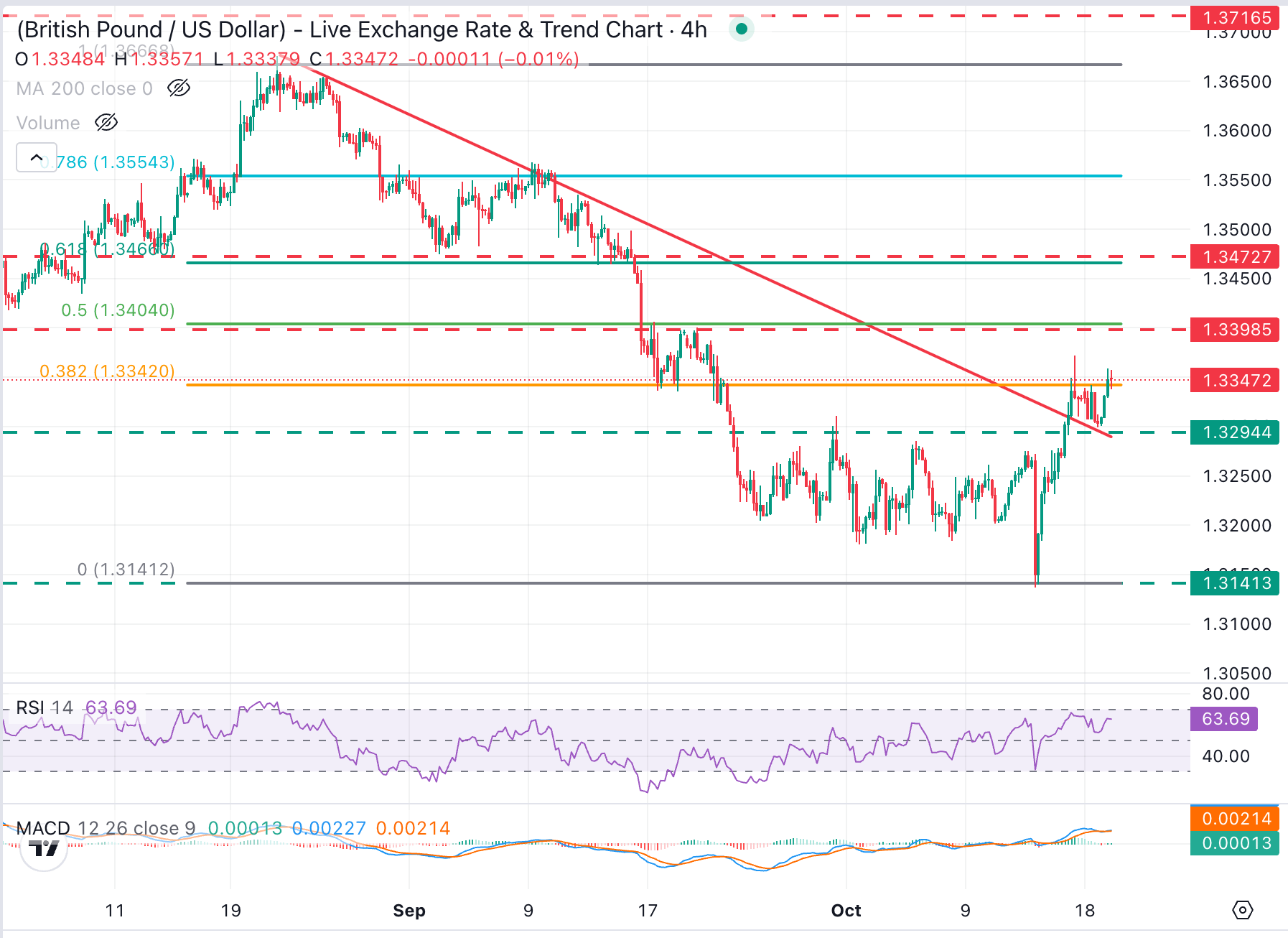
An immediate uptrend is evident on the GBP/USD 4-hour chart. The successful breach of the descending resistance line drawn from the late August highs, followed by Monday’s retest, confirms that bullish direction. Momentum readings offer support, with the Relative Strength Index (14) holding above 60. However, the Moving Average Convergence Divergence (MACD) is almost flat around zero, suggesting the advance remains fragile.
Resistance between Friday’s 1.3370 high and the 22 September high near 1.3400 is likely to test bullish conviction. A confirmed move above that band would shift attention to 1.3467, the 61.8% Fibonacci retracement of the August-October decline. The former support zone just above 1.3470, marked by the 2 and 4 September lows, would also come into focus.
For now, sellers are being held back around 1.3295, where the previously mentioned trendline meets the former range ceiling. A retreat below this confluence would leave the year-to-date lows near 1.3140 exposed.
Interest rates: key questions
Borrowers pay interest to financial institutions on their loans, while savers and depositors receive interest on their funds. These rates are influenced by the base lending rates that central banks set as economic conditions change. Price stability is normally part of a central bank’s mandate. In most cases, that means aiming for core inflation of around 2%. When inflation undershoots the target, a central bank may lower base lending rates to encourage borrowing and support economic activity. Inflation substantially above 2%, by contrast, usually prompts an increase in base lending rates to bring price growth down.
By making a country more attractive to international investors seeking a home for their funds, higher interest rates generally support its currency.
Holding Gold becomes more costly in opportunity-cost terms when interest rates rise, relative to owning an interest-bearing asset or keeping cash in a bank. Higher rates therefore tend to put pressure on Gold prices. High interest rates also usually strengthen the US Dollar (USD). As Gold is priced in Dollars, this typically pushes its price lower.
US banks lend to one another overnight at the Fed funds rate. Set by the Federal Reserve at its FOMC meetings, it is the benchmark rate frequently cited in headlines. The Fed specifies a range, such as 4.75%-5.00%, but the figure generally quoted is the upper bound, 5.00% in this example. The CME FedWatch tool tracks market expectations for the future Fed funds rate. Those expectations influence trading across many financial markets as participants anticipate upcoming Federal Reserve monetary policy decisions.
Economic Data Indicator
Core Consumer Price Index: Year-on-Year (YoY)
Published monthly by the Office for National Statistics, the United Kingdom (UK) Core Consumer Price Index (CPI) measures consumer price inflation to international standards. It tracks how prices rise or fall for the goods and services households purchase, excluding the volatile food, energy, alcohol and tobacco components. The YoY figure compares prices in the reference month with those a year earlier. As a key gauge of inflation and shifts in purchasing trends, Core CPI is closely watched. A high reading is generally considered bullish for the Pound Sterling (GBP); a low reading is generally considered bearish.
Read further.Upcoming release: Wed 21 Oct 2026 06:00
Release frequency: Every month
Consensus forecast: 2.8%
Prior reading: 2.6%
Data source: Office for National Statistics
2% is the approximate inflation rate the Bank of England is mandated to maintain. Measured by the headline Consumer Price Index (CPI), this target makes the monthly release important. Rising inflation implies earlier, faster interest rate increases or reduced bond purchases by the BOE, constraining the supply of pounds. Slower price growth, by contrast, signals looser monetary policy. A reading above expectations typically supports GBP.
POPULAR ARTICLES
1Below 0.5700: New Zealand Dollar eases on RBNZ rate hike odds as CPI inflation data come into focus2Record Ethereum staking contrasts with declining yield and fee revenue3Japan’s Widening Trade Deficit and BoJ Caution Weigh on Japanese Yen4November BoE interest rate hike: UK CPI poised to accelerate, setting the stage5Below 1.3400: British Pound slips ahead of UK CPI inflation release6Above 0.7000: Australian Dollar nears monthly high as hawkish RBA counters firmer USD7Above $98.50: WTI maintains gains amid Middle East supply risks86.7192: PBOC sets USD/CNY reference rate, compared with 6.7200 previously9Below 1.1250: Euro retreats under pressure from French protests and fiscal risks
LIVE QUOTES

Get Started!
Sign up and access the Global Markets in less than 3 minutes

Connect With Us









Contacts
Phone: +61 2 8036 8388
Fax: +61 2 8036 8388
Email: support@tmgm.com



The information provided on this website is of a general nature only and does not constitute personal financial advice. Before acting on any information on this website, you should consider the suitability of the information in relation to your objectives, financial situation and needs. Investing in CFDs and FX Margin Contracts carries significant risks and is not suitable for all investors. You may lose more than your initial deposit. You do not own, or have, any interest in the underlying asset. We recommend that you seek independent advice and ensure you fully understand the risks involved before trading. It is important that you read and consider the disclosure document before you acquire any product listed on the website. The information and advertisements offered on this website are not intended for use by any person in any country or jurisdiction where such use would be contrary to local laws and regulations. The Products and Services offered on this website are not intended for residents of the United States, Malaysia and Thailand.
TMGM is authorized and regulated in various jurisdictions.
Trademax Australia Limited, trading as TMGM, is regulated by the Australian Securities and Investments Commission (ASIC), AFSL no. 436416 and is located at Level 28, One International Tower, 100 Barangaroo Avenue, 2000 Sydney, NSW Australia.
Email: support@tmgm.com.au
Trademax Global Limited, trading as TMGM, is authorized and regulated by the Vanuatu Financial Services Commission (VFSC), registration number 40356 and registered at 1276, Kumul Highway, Port Vila, Vanuatu, Republic of Vanuatu.
Email: support@tmgm.com
Trademax Global Markets (SE) Limited, trading as TMGM, is authorized and regulated by the Financial Services Authority (FSA) of Seychelles, with license number SD224. The company is registered at Office No 13, Providence Estate ABIS Centre, Mahe, Seychelles.
Email: support@tmgm.com
Trademax Global Markets (International) Pty Ltd, trading as TMGM, is authorized and regulated by the Financial Services Commission, Mauritius (FSC) with license no. GB22201012, and registered at 33, Edith Cavell Street C/o IQ EQ Fund Services (Mauritius) Ltd Port Louis, 11324 Mauritius.
Email: support@tmgm.com
Copyright © TMGM. All rights reserved