

Trading
Explore a wide range of markets with competitive pricing, deep liquidity, and advanced trading tools.
Learn More 
Platform
Trade seamlessly with TMGM's powerful platform, built for speed, precision, and a superior trading experience.
Learn More Trading Platform
Academy
Learn the fundamentals of trading with beginner-friendly resources, including guides, webinars, and market insights.
Learn More News & Analysis
Get real-time market updates and expert analysis to stay ahead of trading opportunities
Learn More News & Analysis
About
Learn what sets TMGM apart — our global presence, regulatory strength, and commitment to innovation in trading.
Learn More Why Choose TMGM
Sponsorship
Silver Price Forecast: RSI turns oversold as downtrend intensifies
- October 2025 lows: Silver slumps as hawkish Fed expectations sustain sellers’ dominance.
- US Dollar strength intensifies the sell-off as the RSI enters oversold territory.
- Trading beneath its key moving averages, Silver retains a broadly bearish outlook.
Silver (XAG/USD) loses more than 4% on Wednesday. The decline takes the metal to levels not seen since October 2025. Precious metals remain under pressure from expectations of additional Federal Reserve (Fed) interest rate increases and the consequent strengthening of the US Dollar (USD). Gold (XAU/USD) has also dropped below $3,800, reaching its lowest point since September 2025.

At around $45 at the time of writing, XAG/USD stands more than 60% below the record of nearly $121 set in January. Meanwhile, the US Dollar Index (DXY) is trading near a 19-month high at around 103.85. The index measures the Greenback against a basket of six major currencies.
For buyers holding other currencies, Dollar appreciation raises the cost of Silver. Higher interest rates also reduce the appeal of holding the non-interest-bearing metal. According to the CME FedWatch Tool, markets have fully discounted a December rate increase and assign roughly a 70% probability to a further hike in January. How large the December increase will be remains uncertain.
A 50-basis-point increase in December had previously been raised as an option by Fed Governor Christopher Waller. In a CNBC appearance on Wednesday, Waller said a half-point rise would be appropriate if the Fed was unwilling to signal a quicker pace of increases over the coming months. Attention now turns to the minutes of the Fed’s October meeting, scheduled for release at 19:00 GMT.
$45 support in focus as technical signals remain bearish
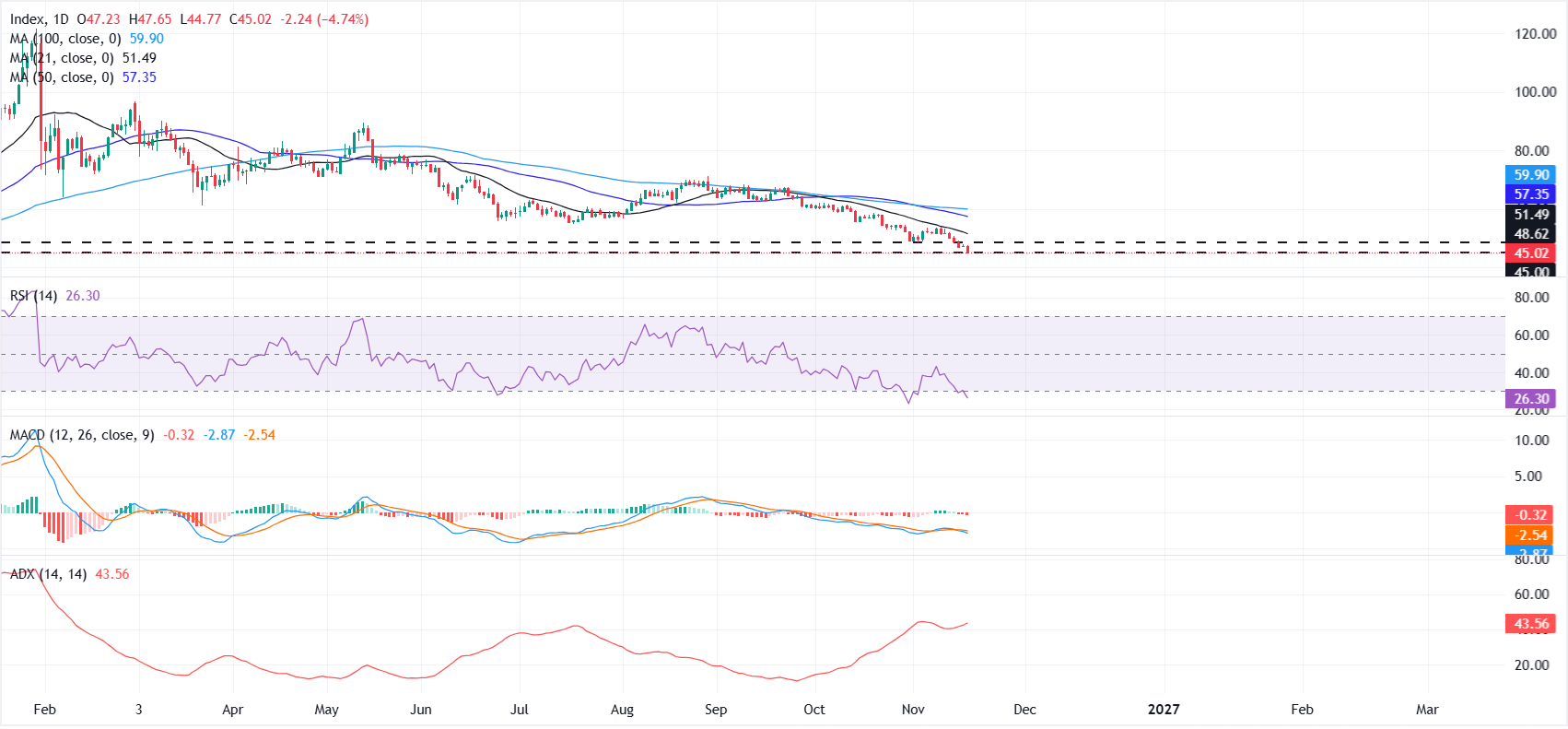
Lower highs and lower lows continue to define the daily XAG/USD chart, with prices beneath the key moving averages. The latest decline has taken the Relative Strength Index (RSI) into oversold territory. The Moving Average Convergence Divergence (MACD) is still negative, indicating that sellers retain control.
Any rebound faces its first resistance at the previous swing low of $48.62, ahead of the 21-day Simple Moving Average (SMA) at $51.49. Should the recovery gather momentum, the next resistance area is defined by the 50-day and 100-day SMAs, at $57.35 and $59.90 respectively.
Immediate downside support lies at the psychological $45 mark. A lasting break beneath that level could pave the way for further losses.
Silver: key questions answered
Widely traded by investors, Silver has long served both as a store of value and as a means of exchange. It attracts less interest than Gold, but traders may choose it for portfolio diversification, its intrinsic value or its potential to hedge against high inflation. Exposure can be obtained by purchasing physical Silver coins or bars, or through instruments such as Exchange Traded Funds that follow its price in international markets.
A broad set of influences can move Silver prices. Its safe-haven appeal can lift prices during geopolitical turmoil or fears of a severe recession, though the effect is generally weaker than for Gold. Lower interest rates also tend to support Silver because it generates no yield. Pricing in US Dollars (USD), expressed as XAG/USD, means the currency’s performance is another important driver. Dollar strength typically restrains Silver prices, while weakness is likely to lift them. Investment demand, recycling rates and mine supply can also influence pricing; Silver is far more abundant than Gold.
With electrical conductivity among the highest of any metal, exceeding both Copper and Gold, Silver has extensive industrial applications, notably in electronics and solar energy. A jump in demand can push prices higher, whereas weaker demand tends to weigh on them. Economic developments in the US, China and India can also generate price fluctuations. Large industrial sectors in the US and, especially, China use Silver across a range of processes. In India, consumer demand for Silver jewellery is also an important price driver.
Gold’s price direction is generally mirrored by Silver. A rise in Gold typically brings gains in Silver, reflecting their shared safe-haven characteristics. To assess their relative valuations, investors may use the Gold/Silver ratio: the number of ounces of Silver equivalent in value to one ounce of Gold. A high ratio may be interpreted by some investors as a sign that Silver is undervalued or Gold overvalued. Conversely, a low reading may indicate that Gold is undervalued compared with Silver.
POPULAR ARTICLES
16.6520 in View as Chinese Yuan Shows Gradual Upside Bias Against US Dollar – UOB2Silver Price Forecast: RSI turns oversold as downtrend intensifies34.5% inflation peak forecast for United Kingdom in Q1 2027 - Societe Generale4US Dollar: Fed tightening expectations fuel upside pressure – ING5Pandemic-era lows for New Zealand Dollar as Fed and RBNZ policy paths diverge6Near 160.00: lingering intervention risks underpin Japanese Yen7Five-week low for pound as UK CPI undershoots amid Fed rate hike expectations8British Pound: Downside risks reinforced by BoE path – BBH9Rising expectations of prolonged Fed tightening weigh on euro


Get Started!
Sign up and access the Global Markets in less than 3 minutes

Connect With Us









Contacts
Phone: +61 2 8036 8388
Fax: +61 2 8036 8388
Email: support@tmgm.com



The information provided on this website is of a general nature only and does not constitute personal financial advice. Before acting on any information on this website, you should consider the suitability of the information in relation to your objectives, financial situation and needs. Investing in CFDs and FX Margin Contracts carries significant risks and is not suitable for all investors. You may lose more than your initial deposit. You do not own, or have, any interest in the underlying asset. We recommend that you seek independent advice and ensure you fully understand the risks involved before trading. It is important that you read and consider the disclosure document before you acquire any product listed on the website. The information and advertisements offered on this website are not intended for use by any person in any country or jurisdiction where such use would be contrary to local laws and regulations. The Products and Services offered on this website are not intended for residents of the United States, Malaysia and Thailand.
TMGM is authorized and regulated in various jurisdictions.
Trademax Australia Limited, trading as TMGM, is regulated by the Australian Securities and Investments Commission (ASIC), AFSL no. 436416 and is located at Level 28, One International Tower, 100 Barangaroo Avenue, 2000 Sydney, NSW Australia.
Email: support@tmgm.com.au
Trademax Global Limited, trading as TMGM, is authorized and regulated by the Vanuatu Financial Services Commission (VFSC), registration number 40356 and registered at 1276, Kumul Highway, Port Vila, Vanuatu, Republic of Vanuatu.
Email: support@tmgm.com
Trademax Global Markets (SE) Limited, trading as TMGM, is authorized and regulated by the Financial Services Authority (FSA) of Seychelles, with license number SD224. The company is registered at Office No 13, Providence Estate ABIS Centre, Mahe, Seychelles.
Email: support@tmgm.com
Trademax Global Markets (International) Pty Ltd, trading as TMGM, is authorized and regulated by the Financial Services Commission, Mauritius (FSC) with license no. GB22201012, and registered at 33, Edith Cavell Street C/o IQ EQ Fund Services (Mauritius) Ltd Port Louis, 11324 Mauritius.
Email: support@tmgm.com
Copyright © TMGM. All rights reserved