

Trading
Explore a wide range of markets with competitive pricing, deep liquidity, and advanced trading tools.
Learn More 
Platform
Trade seamlessly with TMGM's powerful platform, built for speed, precision, and a superior trading experience.
Learn More Trading Platform
Academy
Learn the fundamentals of trading with beginner-friendly resources, including guides, webinars, and market insights.
Learn More News & Analysis
Get real-time market updates and expert analysis to stay ahead of trading opportunities
Learn More News & Analysis
About
Learn what sets TMGM apart — our global presence, regulatory strength, and commitment to innovation in trading.
Learn More Why Choose TMGM
Sponsorship
1.0950: EUR/USD Bulls Maintain Defence in Price Forecast
- 1.0996 in sight as EUR/USD advances and the US Dollar rally loses momentum.
- A December interest rate rise by the Fed is viewed as almost certain.
- Flash private-sector PMI releases from the Eurozone and US are firmly in focus.
The Euro (EUR) has gained 0.3% against the US Dollar (USD). Trading near 1.0996 in Monday’s European session, EUR/USD is benefiting from the US Dollar’s difficulty in sustaining its rally. The Dollar’s outlook nevertheless remains solid, with the Federal Reserve (Fed) expected to raise interest rates at successive meetings in the near term.

At the time of writing, a 0.2% decline has taken the US Dollar Index (DXY) to around 103.64. It remains within reach of last week’s 19-month peak of 104.00.
Further Fed tightening is firmly reflected at the front end of the curve, according to Rabobank strategists. They observe that “the OIS curve implies that investors are positioned for a full hike in December, followed by close to 70% of a 25bp hike priced in for the January meeting.” In their assessment, this positioning is “in line with Waller’s comments, after having moved from one of the most hawkish to one of the most dovish FOMC members and now back among the most hawkish.”
Expectations of a hawkish Fed lead market experts to anticipate additional Euro losses against the US Dollar.
1.08 EUR/USD target: Nordea sees hawkish Fed supporting Dollar
The case for a lower EUR/USD remains intact at Nordea, whose strategists say that “a more hawkish Fed will support the Dollar, strengthening our case for a lower EURUSD going forward.” Supporting that view, the bank observes that “statements from certain members over the week have also confirmed that market expectations of two to three rate hikes before summer are reasonable, in line with our Fed call.” Nordea therefore reiterates that “our baseline for the EUR/USD remains robust, and we continue to see further downside in the pair, to 1.08 during H1 2027.”
Also on investors’ radar are November’s flash Purchasing Managers’ Index (PMI) readings for the Eurozone and United States (US). The preliminary figures are due later in the day.
1.0996: EUR/USD Technical Outlook
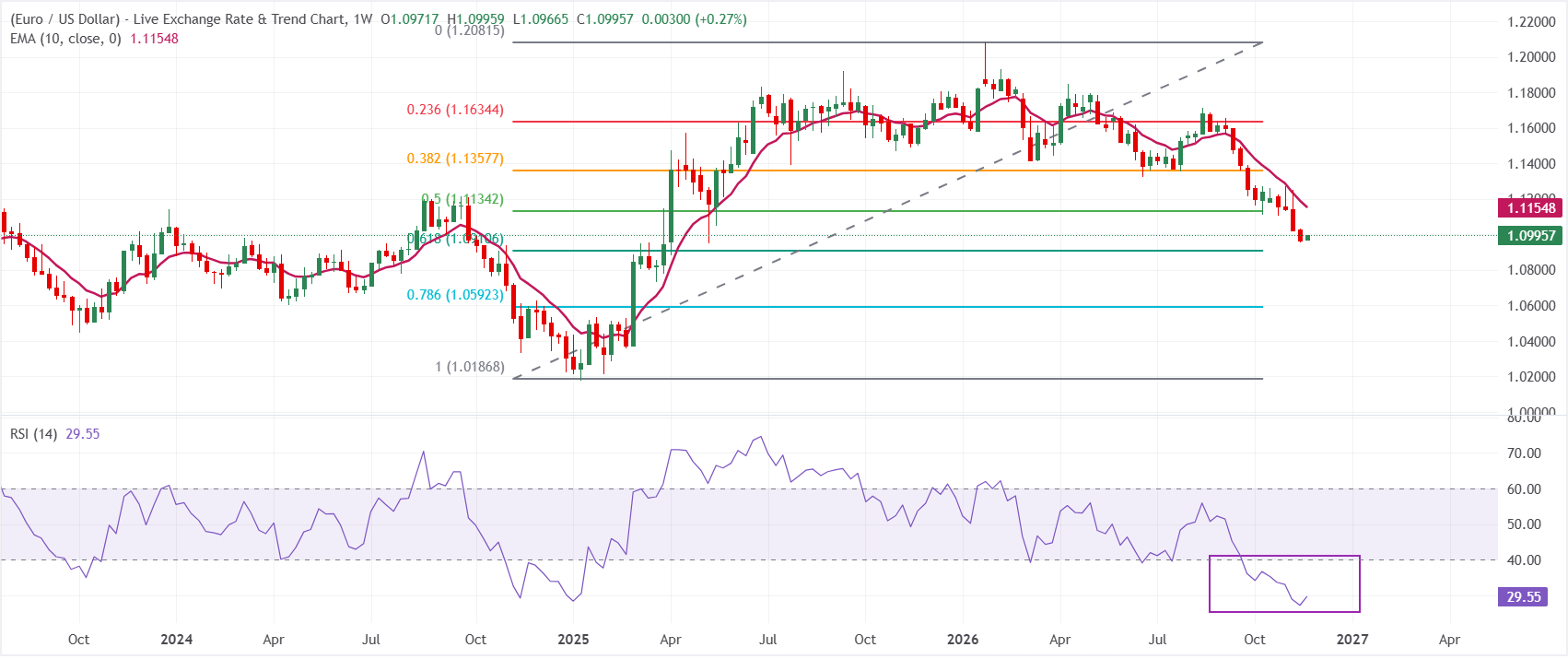
At 1.0996 on the weekly chart, EUR/USD remains below its 10-week exponential moving average (EMA) of 1.1155. This sustains the bearish bias and leaves the broader downtrend intact following the extended retreat from the 1.20 area. An oversold weekly Relative Strength Index (RSI) reading near 29.6 suggests downside momentum is stretched. However, the inability to recover the 50.00% Fibonacci retracement at 1.1134 indicates that rallies continue to attract selling pressure.
The first upside barrier is the 50.00% Fibonacci retracement at 1.1134. Together with the nearby 10-week EMA at 1.1155, it defines a key supply zone that would need to be cleared on a weekly closing basis to temper the immediate bearish bias. Beyond that zone, resistance stands at the 38.20% retracement of 1.1358 and the 23.60% level of 1.1634, followed by the cycle-high area around the 0.00% retracement at 1.2082. Initial downside support lies at the 61.80% Fibonacci retracement of 1.0911. If the decline continues, buyers may seek to limit further losses at the subsequent support levels of 1.0592 (78.60%) and 1.0187 (100.00%).
(The technical analysis of this story was written with the help of an AI tool. Know more.)
Fed questions and answers
The Federal Reserve (Fed) sets US monetary policy with a dual mandate: price stability and full employment. Interest rate adjustments are its main means of pursuing these objectives. If prices climb too rapidly and inflation exceeds the Fed’s 2% target, the central bank increases interest rates. Higher borrowing costs across the economy make the US more attractive to international investors, strengthening the US Dollar (USD). Conversely, inflation below 2% or an excessively high Unemployment Rate may prompt the Fed to cut interest rates. The aim is to stimulate borrowing, but the move weighs on the Dollar.
At eight policy meetings each year, the Federal Reserve’s Federal Open Market Committee (FOMC) reviews economic conditions and decides monetary policy. Twelve Fed officials participate: the seven Board of Governors members, the Federal Reserve Bank of New York president and four of the other eleven regional Reserve Bank presidents. Those four seats rotate, with each president serving a one-year term.
When conditions become extreme, the Federal Reserve may turn to Quantitative Easing (QE) to sharply expand credit flows through a stalled financial system. This unconventional policy is deployed during crises or periods of exceptionally low inflation. During the Great Financial Crisis in 2008, it was the Fed’s preferred response. Under QE, the Fed prints additional Dollars to purchase high-grade bonds from financial institutions. The US Dollar typically weakens as a result.
To reverse QE through Quantitative tightening (QT), the Federal Reserve halts bond purchases from financial institutions. It also stops reinvesting the principal received from maturing bond holdings in new bonds. This process generally supports the US Dollar’s value.
POPULAR ARTICLES
1Above 1.3100: British Pound ticks higher as traders trim Fed rate hike bets21.0950: EUR/USD Bulls Maintain Defence in Price Forecast31.0950 break key to Euro downside risk against US Dollar – UOB4Chainlink Price Forecast: Strong ETF outflows cast bull trap risk over LINK’s recovery5India’s HSBC PMI signals renewed expansion as Indian Rupee rally pauses6BI rate hike and MSCI talks bolster Indonesian Rupiah, pressure USD/IDR7New Zealand Dollar holds near multi-year low despite upbeat data and weaker USD8Above $70: Solana Price Forecast as ETF inflows cushion SOL sell-off9Above 174.50: EUR/JPY gains, but price forecast remains bearish below 100-day SMA


Get Started!
Sign up and access the Global Markets in less than 3 minutes

Connect With Us









Contacts
Phone: +61 2 8036 8388
Fax: +61 2 8036 8388
Email: support@tmgm.com



The information provided on this website is of a general nature only and does not constitute personal financial advice. Before acting on any information on this website, you should consider the suitability of the information in relation to your objectives, financial situation and needs. Investing in CFDs and FX Margin Contracts carries significant risks and is not suitable for all investors. You may lose more than your initial deposit. You do not own, or have, any interest in the underlying asset. We recommend that you seek independent advice and ensure you fully understand the risks involved before trading. It is important that you read and consider the disclosure document before you acquire any product listed on the website. The information and advertisements offered on this website are not intended for use by any person in any country or jurisdiction where such use would be contrary to local laws and regulations. The Products and Services offered on this website are not intended for residents of the United States, Malaysia and Thailand.
TMGM is authorized and regulated in various jurisdictions.
Trademax Australia Limited, trading as TMGM, is regulated by the Australian Securities and Investments Commission (ASIC), AFSL no. 436416 and is located at Level 28, One International Tower, 100 Barangaroo Avenue, 2000 Sydney, NSW Australia.
Email: support@tmgm.com.au
Trademax Global Limited, trading as TMGM, is authorized and regulated by the Vanuatu Financial Services Commission (VFSC), registration number 40356 and registered at 1276, Kumul Highway, Port Vila, Vanuatu, Republic of Vanuatu.
Email: support@tmgm.com
Trademax Global Markets (SE) Limited, trading as TMGM, is authorized and regulated by the Financial Services Authority (FSA) of Seychelles, with license number SD224. The company is registered at Office No 13, Providence Estate ABIS Centre, Mahe, Seychelles.
Email: support@tmgm.com
Trademax Global Markets (International) Pty Ltd, trading as TMGM, is authorized and regulated by the Financial Services Commission, Mauritius (FSC) with license no. GB22201012, and registered at 33, Edith Cavell Street C/o IQ EQ Fund Services (Mauritius) Ltd Port Louis, 11324 Mauritius.
Email: support@tmgm.com
Copyright © TMGM. All rights reserved