

Trading
Explore a wide range of markets with competitive pricing, deep liquidity, and advanced trading tools.
Learn More 
Platform
Trade seamlessly with TMGM's powerful platform, built for speed, precision, and a superior trading experience.
Learn More Trading Platform
Academy
Learn the fundamentals of trading with beginner-friendly resources, including guides, webinars, and market insights.
Learn More News & Analysis
Get real-time market updates and expert analysis to stay ahead of trading opportunities
Learn More News & Analysis
About
Learn what sets TMGM apart — our global presence, regulatory strength, and commitment to innovation in trading.
Learn More Why Choose TMGM
Sponsorship
4-day slide deepens for British Pound ahead of Fed decision, UK budget
- 0.14% lower at 1.3321, GBP/USD extends its losing run to four days.
- 91.7 marks the latest US Consumer Confidence reading, while Durable Goods increase 1.6%.
- Wednesday brings two key events: the Fed decision and the UK Autumn Budget.
GBP/USD trades at 1.3321. Sterling is down 0.14% against the US Dollar for a fourth consecutive daily decline, as the Greenback posts modest gains before Wednesday’s Federal Reserve monetary policy decision. On Tuesday, the pair remains confined to the 1.3307-1.3349 range.
1.3300 in focus: GBP/USD under pressure as firm US data backs Dollar before key policy decisions

Despite continuing hostilities in the Middle East, market sentiment remains upbeat. Reports indicated that debris was falling over Riyadh in Saudi Arabia, causing damage according to SPA. Iran’s supreme leader Mojtaba Khamenei also restated the country’s conditions for ending the war with the US. Before peace talks can begin, Tehran is demanding that the US naval blockade be lifted and sanctions removed.
Housing figures featured on the US data calendar. September’s New Home Sales posted a sharp -0.6% MoM reading, compared with 6.4% in August.
An unexpected improvement in Consumer Sentiment was reported by the Conference Board (CB). The October reading climbed to 91.7 from 84.2, reflecting greater household optimism about employment and business conditions. Within the survey, 12-month inflation expectations held at 5.8%, still far above the Fed’s target.
September’s Durable Goods Orders increased by 1.6%, compared with 0.1% previously. Business spending has remained strong as AI infrastructure expands. Earlier figures showed a modest slowdown in the labour market: the ADP Employment Change 4-week average eased to 16.8K from 18.5K.
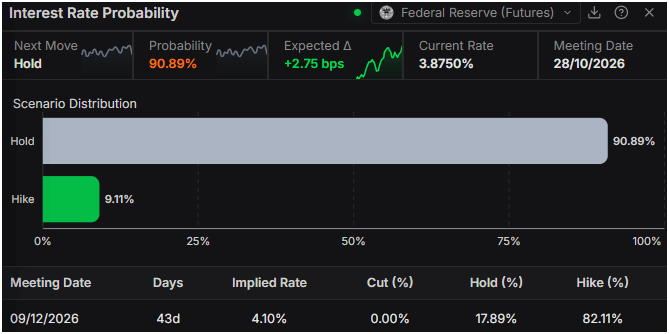
Money markets, meanwhile, point to unchanged Fed rates on Wednesday, with a 19% probability of an increase. According to Prime Terminal, the chances for December have continued to decline, reaching 82% from around 90% last week.
Sterling’s performance is mixed in the UK: it gains against the Euro, which faces pressure from France’s fiscal problems, but loses ground against the Greenback.
Attention centres on the forthcoming UK Autumn Budget. Chancellor Healey is expected to deliver a sustainable budget that avoids unsettling the bond market while meeting some of Andy Burnham’s government’s pledges. The Financial Times reports that John Healey is poised to announce a 4% increase for low-wage workers.
Wednesday’s Fed meeting is the next major focus for traders. On the UK economic calendar, the budget will be the key event.
1.3396 resistance: GBP/USD Price Forecast and technical outlook
At 1.3314 on the daily chart, GBP/USD retains a bearish short-term bias. It remains below the latest cluster of simple moving averages around 1.3396 and a descending resistance trend line near the same zone. The pair has moved away from former trend-line resistance, now support at 1.3257, but remains only slightly above it. This suggests sellers retain control of the wider structure. A 14-period Relative Strength Index reading around 48 points to momentum easing towards neutral, rather than supporting a forceful recovery.
The 1.3396 zone provides the first upside barrier, bringing together the 50-, 100- and 200-day simple moving averages. Beyond it, former rising trend-line supports now offer resistance near 1.3644 and 1.3823. Below the market, the breached trend-line level around 1.3257 is the first significant support. A daily close beneath it would likely pave the way for a deeper decline, extending the pair’s rejection from the substantial overhead resistance band.
(The technical analysis of this story was written with the help of an AI tool. Know more.)
Pound Sterling: key questions answered
Dating from 886 AD, the Pound Sterling (GBP) is the world’s oldest currency and serves as the United Kingdom’s official currency. According to 2022 figures, it ranks fourth globally in foreign exchange (FX) trading, representing 12% of transactions and an average daily turnover of $630 billion. Among its main pairs, GBP/USD, known as ‘Cable’, represents 11% of FX trading. GBP/JPY, called the ‘Dragon’ by traders, accounts for 3%, while EUR/GBP represents 2%. Issuance of the Pound Sterling is the responsibility of the Bank of England (BoE).
Bank of England monetary policy is the main driver of the Pound Sterling’s value. Policy decisions hinge on progress towards the BoE’s central objective of “price stability”, meaning steady inflation of around 2%. Adjusting interest rates is its principal means of achieving that goal. To curb excessive inflation, the BoE will seek to raise interest rates, increasing borrowing costs for households and companies. GBP generally benefits because higher rates make the UK a more appealing destination for international investors’ funds. By contrast, excessively low inflation signals a slowdown in economic growth. The BoE will then consider rate cuts to reduce borrowing costs, encouraging companies to borrow more and invest in projects that generate growth.
By revealing the economy’s condition, published data can affect the Pound Sterling’s value. GDP, Manufacturing and Services PMIs, and employment indicators can each shape GBP’s direction. Economic strength supports Sterling by attracting foreign investment. It may also prompt the BoE to raise interest rates, directly strengthening GBP. Weak economic figures, in contrast, are likely to weigh on the Pound Sterling.
The Trade Balance is another important release for the Pound Sterling. Over a specified period, it compares a country’s export earnings with its expenditure on imports. Strong overseas demand for a country’s exports creates additional demand for its currency as foreign buyers seek to purchase those goods. A positive net Trade Balance therefore supports the currency, while a negative balance has the opposite effect.
POPULAR ARTICLES
1Brazilian Real: Fiscal doubts accompany post-election sell-off – Commerzbank21.1113: Euro support against US Dollar takes centre stage – Scotiabank3Silver Price Forecast: XAG/USD rebounds from year-to-date lows as Fed rate decision nears44-day slide deepens for British Pound ahead of Fed decision, UK budget5Dogecoin Price Forecast: Steady retail interest puts potential bottom in focus for DOGE bulls6Euro under pressure as Fed and ECB interest rate decisions draw near7Natural gas: Persistent winter risk keeps prices elevated – Commerzbank8United Kingdom: Fiscal headroom and rates face Budget risks - ING91.40 level: Canadian Dollar consolidates – Scotiabank
LIVE QUOTES


Get Started!
Sign up and access the Global Markets in less than 3 minutes

Connect With Us









Contacts
Phone: +61 2 8036 8388
Fax: +61 2 8036 8388
Email: support@tmgm.com



The information provided on this website is of a general nature only and does not constitute personal financial advice. Before acting on any information on this website, you should consider the suitability of the information in relation to your objectives, financial situation and needs. Investing in CFDs and FX Margin Contracts carries significant risks and is not suitable for all investors. You may lose more than your initial deposit. You do not own, or have, any interest in the underlying asset. We recommend that you seek independent advice and ensure you fully understand the risks involved before trading. It is important that you read and consider the disclosure document before you acquire any product listed on the website. The information and advertisements offered on this website are not intended for use by any person in any country or jurisdiction where such use would be contrary to local laws and regulations. The Products and Services offered on this website are not intended for residents of the United States, Malaysia and Thailand.
TMGM is authorized and regulated in various jurisdictions.
Trademax Australia Limited, trading as TMGM, is regulated by the Australian Securities and Investments Commission (ASIC), AFSL no. 436416 and is located at Level 28, One International Tower, 100 Barangaroo Avenue, 2000 Sydney, NSW Australia.
Email: support@tmgm.com.au
Trademax Global Limited, trading as TMGM, is authorized and regulated by the Vanuatu Financial Services Commission (VFSC), registration number 40356 and registered at 1276, Kumul Highway, Port Vila, Vanuatu, Republic of Vanuatu.
Email: support@tmgm.com
Trademax Global Markets (SE) Limited, trading as TMGM, is authorized and regulated by the Financial Services Authority (FSA) of Seychelles, with license number SD224. The company is registered at Office No 13, Providence Estate ABIS Centre, Mahe, Seychelles.
Email: support@tmgm.com
Trademax Global Markets (International) Pty Ltd, trading as TMGM, is authorized and regulated by the Financial Services Commission, Mauritius (FSC) with license no. GB22201012, and registered at 33, Edith Cavell Street C/o IQ EQ Fund Services (Mauritius) Ltd Port Louis, 11324 Mauritius.
Email: support@tmgm.com
Copyright © TMGM. All rights reserved